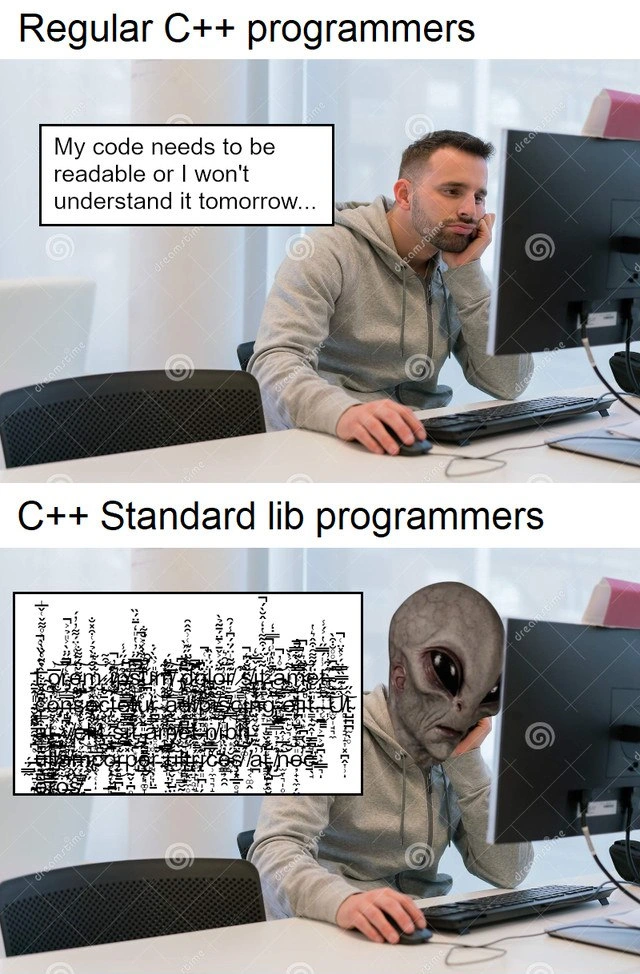
C++ Readability vs. Standard Library Hieroglyphics
Why is this Languages meme funny?
Level 1: Wizard Spells vs Plain Speech
Imagine you have two friends who like to invent secret codes. One friend writes a message in plain, simple language so that even if they read it tomorrow, they’ll know exactly what it means. “Meet me at the park at 5,” they write – nice and clear. Now, your other friend is a bit of a show-off and decides to write their message in an ultra-complicated secret code, with weird symbols, shapes, and words nobody recognizes. It looks like a magical spell or an alien language! When you peek at their note, it’s just a jumbled mess – even the friend who wrote it might have trouble reading it later. 📝🤔
In this scenario, the first friend is like an ordinary C++ programmer who writes code plainly so they and others can understand it later. The second friend is like a C++ wizard who writes incredibly fancy code that’s super powerful but almost impossible to read – it's as if they cast a spell over the page. The meme finds humor in this contrast: it’s as if the second friend’s head has become a giant galaxy brain (implying they’re ultra-smart or thinking in a cosmic way) and when they speak, only gibberish comes out because their ideas are too complex. It’s funny because usually we think smart people would explain things simply, but here the “genius” is making things sound more confusing than ever! In everyday terms, it’s like one person explaining something in a normal way versus another person using over-the-top nerdy techno-babble. We can all laugh because we’ve been on the confusing end of an explanation at some point, thinking, “Huh? Could you say that in plain English?” This meme just shows that idea with a coding twist – keep it simple, or you might end up not even understanding your own magical code spell tomorrow.
Level 2: Clarity vs Cleverness
Let’s break down the joke in simpler technical terms. In C++, a template is a feature that allows you to write code in a generic way. Think of a template as a cookie cutter for functions or classes: you write the logic once, and then the compiler can stamp out versions of that logic for different data types. For example, instead of writing separate functions to handle int, float, and double, you can write one template<typename T> T add(T a, T b) { return a + b; } and it will work for any numeric type T. This is super powerful, but it can also lead to very confusing code if overused or used in very complex ways. The C++ Standard Library is full of such templates because it provides generic containers (like std::vector) and algorithms that must work with any user-defined type. To achieve this flexibility and efficiency, the library code uses a lot of advanced template techniques that most beginners never see directly.
Now, what about readability? There’s a well-known idea in programming: code should be written clearly so that humans (not just computers) can understand it. When the meme’s top panel says, “My code needs to be readable or I won’t understand it tomorrow,” it’s highlighting that even the original author can get confused by their own complex code after some time passes. This is a relatable moment for junior developers: you write something “clever” one day, and the next week you look at it and go, “What on earth did I do here?” 😂. Clean code principles suggest we avoid unnecessary complexity – use descriptive variable names, simple logic, and break things into small functions – so that when you or someone else revisits the code later, it’s like reading plain English rather than solving a puzzle. A regular C++ programmer typically adheres to this; they might say, “I won’t get fancy, I’ll just do it in a straightforward way,” especially if doing otherwise makes the code harder to follow.
On the other hand, the bottom panel shows a wall of angle brackets and weird text. This represents the kind of output you might see from the compiler if you make a mistake with templates, or the kind of code the template wizards write internally. When you misuse a complex template, the C++ compiler tries to tell you what went wrong by showing the chain of templates that led to the error. For instance, if you try to sort a list of objects that don’t have a comparison defined, you might get an error that essentially says: “I tried to instantiate std::sort with your type, which tried to instantiate a comparison, which required a < operator that wasn’t there, etc., etc.” The error message will include pieces of code from the standard library like std::sort<YourType> followed by a lot of < > and colons and cryptic names. This is what we mean by unreadable template errors – they’re often huge and scary, especially to newcomers. The meme jokes that Standard Library programmers (the ones who write those complex templates) speak in this gibberish all the time. Of course, that’s an exaggeration – they don’t actually talk in angle brackets! – but it feels that way when you see the code they write or the errors that come out of it.
Let’s clarify some of the tags and terms in a down-to-earth way:
- Cpp (C++): A general-purpose programming language known for being fast and powerful, but also quite complex. It lets you manage memory manually and use things like templates for generic programming. This meme is specific to C++ culture.
- CompilerErrors: When you write C++ code that the compiler can’t understand or that violates the language rules, you get error messages. In C++, especially with templates, these errors can be very long and complicated. Developers often joke about how hard these are to read. The bottom panel’s speech bubble full of garbage text is a nod to those compiler errors from hell.
- CodeReadability: This is all about writing code that is easy to read and understand. The top panel programmer is concerned with code readability — they want to be able to read their code tomorrow as easily as today. This means avoiding too many tricks or overly terse, cryptic constructs.
- LanguageQuirks: Every programming language has its oddities. C++ has quite a few, especially around templates. For example, you have to sometimes tell the compiler that something is a type by using the
typenamekeyword in a template, or deal with things likestd::moveand perfect forwarding. These quirks make the language powerful but can trip up even seasoned devs. The meme’s humor leans on the quirk that template-heavy code is hard to decipher and that the language permits writing almost unreadable SpaghettiCode (a term meaning code that’s tangled and hard to follow, like a bowl of spaghetti). The tangled mass of<...>in the picture is like a plate of spaghetti made of angle brackets! - CleanCodePrinciples: These are guidelines popularized by folks like Robert C. Martin (Uncle Bob) which advocate for simplicity and clarity in code. For example, “clear is better than clever,” “you aren’t gonna need it” (don’t add code you don’t need), etc. The regular C++ dev is essentially quoting these principles: make it readable now so you (or the poor soul maintaining your code later) won’t suffer.
- template_metaprogramming: This is when you use C++ templates to do computations or logic at compile time. It’s a very advanced technique. It can let you, say, generate a lookup table at compile time or enforce rules about types. But template metaprogramming quickly becomes hard to read. The phrase “template chaos” or “arcane template magic” refers to this kind of code. The bottom panel wizard likely engages in template metaprogramming daily.
- standard_library_complexity: The C++ standard library authors are experts who often have to use complex techniques to make the library both fast and flexible. The result is that the implementation of the standard library (which most of us don’t see when we just use vector or string) is filled with convoluted code. It’s tested and works across many scenarios, but reading it feels like deciphering a complex machine. That’s why standard library programmers are depicted as having a “galaxy brain” — they handle complexity normal devs rarely touch.
- galaxy_brain_meme: This is an Internet meme format where a sequence of images shows brains getting bigger and more cosmic as the ideas depicted become more far-fetched or abstract. In this meme, the regular dev is normal-brained, and the standard library dev is the galaxy brain – meaning they’re on a higher plane of thought (or at least trying to be 😄). The bottom image literally put a galaxy/alien texture over the programmer’s head to signify this meme. It’s a visual way to say “this person’s brain works on a cosmic level… or maybe they’re just from another world!”
- readability_vs_abstraction: This tag captures the core tension here. Abstraction in programming means hiding details and making code more general. It’s usually good, up to a point, but too much abstraction (especially if done with complex templates in C++) can make code hard to read. So there’s a trade-off: highly abstract code might handle many cases elegantly and be reusable, but it could become so generic that understanding how it works is really tough. The meme highlights this tug-of-war: the regular dev leans towards readability (less abstraction, simpler code), whereas the wizard leans towards extreme abstraction (with complicated templates), sacrificing clarity.
In simpler terms, for a junior developer, this meme is saying: “C++ lets you write very straightforward code, or insanely complicated code. Most of us prefer it straightforward so we can maintain it. But there are these super C++ gurus who write code so complex that it’s like a secret language!” It’s funny because it exaggerates reality — most code isn’t that bad — but there’s enough truth in it that if you’ve seen a nasty template error or looked at something like std::tuple’s definition, you’re nodding along. The meme uses humor to convey a lesson too: be careful with being “too clever” in C++ (or any language). You might impress in the moment, but a day later even you might be scratching your head at what you wrought. After all, if your code looks like Martian hieroglyphics, maintaining it becomes a cosmic adventure! 🚀🛸
Level 3: Arcane Template Magic
For experienced developers, this meme hits on a familiar dichotomy in C++ programming culture: clean code vs. clever code, or readability versus ultra-high abstraction. The top panel’s “Regular C++ programmers” quote – "My code needs to be readable or I won't understand it tomorrow..." – embodies a very real software engineering principle. Even senior engineers live by the rule that code is read far more often than it is written. If you’ve ever returned to your own code months later and felt like you’re reading someone else’s work, you’ll empathize with that speech bubble. It’s essentially voicing the Clean Code principle of prioritizing maintainability: use clear variable names, straightforward logic, and moderate abstraction so that future you (or anyone else) can quickly grasp what's going on. This is how most of us write everyday C++: we might use templates for simple generics (like std::vector<int> for a list of ints), but we try to keep things understandable. We avoid overly convoluted template wizardry in business logic, because we know that debugging or extending such code can turn into a nightmare. A regular C++ dev might say, "I’ll just write 5 more lines of straightforward code rather than a one-liner template metaprogramming trick that takes a genius to decipher."
Enter the bottom panel: "C++ Standard lib programmers" with the galaxy-brain (almost alien) head spewing a wall of <> and cryptic tokens. This is poking fun at the C++ gurus who seem to revel in maximal abstraction and template metaprogramming. These are the folks who implement the likes of std::tuple, std::async, or boost libraries – the kind of code where template parameters have template parameters, and so on. They operate on a plane of thought where abstraction and type genericity trump immediate readability. The humor is that their code, while ingeniously designed, often looks indecipherable to others. In fact, reading portions of the C++ standard library implementation (say, <iterator> or <type_traits>) can feel like reading arcane scripture. You’ll find structs named __enable_if or __is_convertible_imp<T, U>::value nested inside multiple layers of templates. It’s powerful stuff – e.g., these tricks let the library decide at compile time the best way to copy memory or whether a type is eligible for some operation – but for the uninitiated, it is pure gibberish. The meme exaggerates this by showing the second programmer literally speaking gibberish. It resembles the frustrating compiler errors one gets when something goes wrong in template land: a cascade of angle-bracketed identifiers and notes about candidate templates, often jokingly referred to as "template vomit." Seasoned C++ devs laugh (or groan) at this because they’ve been there – one missed typename or a wrong type, and suddenly the compiler is basically telling you, “In some instantiation of foo<bar<baz<...>>>: no matching function for…” spanning dozens of lines. There’s even a classic joke: “I tried to use <\algorithm> and the compiler explained C++ to me in 30 pages of errors.”
This contrast – readable vs. inscrutable code – also reflects a cultural divide. “Standard lib programmers” (or those heavily into template meta-programming) are sometimes teased as wizards casting spells that normal devs can’t decode. The meme literally gives the wizard an expanded cranium (the galaxy brain meme format) to imply hyper-intelligence or at least hyper-abstract thinking. There’s a bit of irony here: those advanced C++ wizards are indeed extremely knowledgeable, but even they might struggle to debug their own template-heavy code if something goes wrong. It’s often said that template errors make even experts cry. In response, the C++ community has over time acknowledged these pain points. Modern C++ (since C++11, C++14, and especially C++20) introduced features like auto (to simplify declarations), constexpr (to perform computations in a clearer way at compile time), and concepts (which give more readable constraints on templates and clearer errors) – essentially tools to tame the madness. A senior developer reading the meme might nod, recalling the dark days before concepts, when figuring out why std::enable_if failed was like solving a cryptogram.
Why do these “Standard library wizards” tolerate such template chaos? Partly because their goals are different from regular application developers. They prioritize high abstraction and generic programming: writing one piece of code that works for all types, which in C++ means heavy template use. They also chase performance – C++ templates can generate code specialized per type, which the optimizer can inline and optimize aggressively. The payoff is zero runtime overhead generics, but the trade-off is compile-time complexity (and insanely long error messages if you misuse them). In a way, they accept unreadability in their implementation so that users of the library have easy-to-use, flexible components. It’s a bit like a mechanic building a complex engine so that the driver just has to turn the key and drive off smoothly — the driver never sees the complexity under the hood, until the engine breaks! Similarly, 98% of C++ developers use std::vector without caring how the sausage is made; it just works. But when something goes wrong or you venture into that header file, you discover layers of tricky code that only a wizard (or the original author) might fully grasp.
To illustrate the contrast, consider a simple example of adding two numbers. A regular C++ dev might write a straightforward function like this:
// Regular straightforward addition function:
int sum(int x, int y) {
return x + y;
}
This is clear and readable: it adds two integers. Now, a template wizard approach might try to make this function more abstract and powerful – for instance, allowing it to add any two numbers of potentially different numeric types (int, long, float, etc.), but only if those types support addition. They might write something wild like:
// Fancy template version that works with any arithmetic types,
// using template metaprogramming (enable_if and type traits) to restrict valid types:
#include <type_traits> // for std::is_arithmetic_v and std::enable_if_t
template<typename X, typename Y,
typename = std::enable_if_t<std::is_arithmetic_v<X> && std::is_arithmetic_v<Y>>>
auto sum(X x, Y y) {
return x + y;
}
Notice the explosion of angle brackets and std::enable_if_t<std::is_arithmetic_v<...>> in that second version. It’s doing compile-time type checking to ensure only arithmetic types (numbers) are allowed, using SFINAE under the hood. Impressively generic? Yes. Readability? Not so much. A regular dev would probably avoid writing something this fancy unless absolutely necessary, because it’s harder to read and way harder to debug if there’s an error. The meme exaggerates this gap: the top programmer writes code they can understand the next day, while the bottom one writes code so convoluted that it looks like an alien script. Seasoned devs laugh because they know at least one colleague (or language guru online) who writes code that triggers a “galaxy brain” reaction — the kind of code where you exclaim, “What sorcery is this?!?”
In real-world terms, the “Regular vs. Wizard” dichotomy also touches on code review culture. In a team setting, if someone submitted ultra-complex template-heavy code for a feature that could be done simply, a senior reviewer might respond with something like, “This solution is too clever; imagine maintaining this in six months. Can we refactor for clarity?” The top panel’s quote is essentially that voice of reason. On the flip side, there are domains (like high-frequency trading, graphics, or embedded systems) where C++ template magic is leveraged to squeeze out every ounce of performance. The wizards in those domains communicate in a dialect of C++ that can look intimidating. The meme humorously underscores that if you overheard them talking about their code, it might as well be an unintelligible string of angle brackets and typename gibberish. It’s a form of gatekeeping humor: “Welcome to C++ – here be dragons (and template wizards)!”
Ultimately, an experienced developer sees this meme as a lighthearted poke at a real balancing act in software design: how much abstraction is too much? The C++ language, more than many others, gives you enough rope to hang yourself with ridiculously abstract code. Everyone agrees readability is crucial – except when some argue that their ultra-generic “one true solution” is worth the brain-bending complexity. The meme just cranks that scenario to comedic extremes by equating the super-abstract C++ code to an alien language. It’s funny because it’s true on some level – anyone who’s battled a C++ template error or tried to trace through std::function’s internals will recognize the feeling of “I'm not smart enough to read my own code”. In summary, the senior perspective chuckles at the meme as a reflection of their collective experience: normal code is written for humans, but some C++ code seems written for the compiler (or by an alien wizard), leaving mere mortals scratching their heads.
Level 4: The Turing Tar Pit
At the most esoteric layer, C++ template metaprogramming is a notorious Turing-complete playground lurking within a mainstream language. This means you can, in theory, compute anything at compile time using templates – a power that comes at the cost of bewildering complexity. The meme’s bottom panel (the "galaxy-brain" C++ wizard) hints at exactly this: code so abstruse that it resembles an alien language of overlapping angle brackets (< and >) and inscrutable identifiers. This angle-bracket soup is no accident; it’s the inevitable output of the C++ compiler churning through deeply nested templates. In academic terms, we might call this a Turing tar pit – a system where “everything is possible, but nothing of interest is easy.” C++ templates allow astonishing feats of compile-time computation (from calculating Fibonacci numbers to building domain-specific languages within C++), but understanding those feats can feel like deciphering a PhD thesis written in hieroglyphs.
The C++ Standard Library itself is a showcase of sophisticated template usage. Generic containers (std::vector, std::map, etc.) and algorithms (std::sort, std::accumulate, and friends) are implemented as templates to maximize performance and flexibility. Under the hood, these rely on advanced techniques like template specialization and SFINAE (Substitution Failure Is Not An Error) to choose the right implementations or to intelligently enable/disable certain functions based on types. SFINAE, for instance, is a template trick that acts like an if statement at the type level – it can exclude certain template instantiations from consideration if some condition on the types isn’t met. It’s incredibly powerful, but when it triggers, the compiler often spews a cascade of template instantiation errors. Those lengthy errors enumerate every template and type involved, producing the kind of unreadable template errors being parodied in the meme. Each layer of angle brackets in that gibberish corresponds to another level of templates-inside-templates, like a Matryoshka doll of code. Seasoned C++ library authors leverage these abstruse techniques to achieve zero-overhead abstraction – meaning you pay no runtime cost for the flexibility – but the cognitive overhead is off the charts.
Historically, this “template complexity explosion” led to C++ being dubbed a multi-paradigm language gone wild. By the early 2000s, template metaprogramming had essentially become a form of functional programming within C++. There were conference talks and books (e.g. Modern C++ Design by Andrei Alexandrescu) exploring how to implement design patterns and computations in the type system. A famous example: someone implemented a compile-time interpreter for Brainf*ck (an esoteric language) using just templates – a stunt proving that C++ templates are as powerful (and as arduous to use) as a theoretical computing machine. This heavy machinery explains why the second developer in the meme has a galaxy-sized brain (figuratively) – they’re harnessing complex abstractions that border on the terrifying. In practical terms, the compiler acts like an interpreter or theorem prover when handling this code, and the output (errors or even just symbol names in compiled binaries) looks like line noise. For instance, a simple mistake using std::sort on an incompatible type might yield an error with a hundred lines of std::__something<traits<...<T> > > nonsense because the compiler is listing every template instantiation step. It’s a perfect demonstration of a key language quirk of C++: the power of abstraction turned up to eleven, often outrunning human readability.
So the bottom line at this deep level: C++ template wizards manipulate the language almost like metalogic, bending the compiler to do computations and generate highly optimized code at compile time. The cost is that the code they write – and the error messages it can produce – approach the complexity of abstract algebraic expressions or something from another planet. It’s awe-inspiring and horrifying in equal measure. The meme humorously exaggerates this by literally giving the “Standard lib programmer” an alien-like galaxy brain head and a speech bubble of pure compile-time chaos. Seasoned engineers chuckle (or shudder) because they recognize a truth: beyond the neat interfaces of std::vector and std::optional lies an arcane template magic that most of us mortals would struggle to comprehend without serious study. In short, the meme operates on the contrast between the pragmatic need for code readability and the almost academic, otherworldly intricacy hidden in the depths of C++’s abstraction mechanisms.
Description
A two-panel meme contrasting different types of C++ programmers. The top panel is labeled 'Regular C++ programmers' and shows a man with a concerned expression sitting at a computer. A speech bubble from him reads, 'My code needs to be readable or I won't understand it tomorrow...'. The bottom panel, labeled 'C++ Standard lib programmers', shows the same man in the same posture, but his head has been replaced with a grey alien's head. The computer screen in front of him, which was normal before, now displays a block of chaotic, unreadable text resembling Zalgo text or ancient symbols. This meme humorously exaggerates the perceived complexity and inscrutability of C++ Standard Library (STL) code. It plays on the idea that while most developers prioritize writing clear, maintainable code, those who work on the standard library delve into such deep, complex template metaprogramming that their code becomes 'alien' and unreadable to the average programmer

Comments
15Comment deleted
Some C++ programmers write readable code to solve problems. STL programmers write unreadable code just to see if the compiler's SFINAE implementation starts crying
Why bother writing docs when the compiler will gladly emit a 500-line template instantiation traceback that doubles as your architecture diagram?
The STL maintainer who wrote std::enable_if_t<std::is_invocable_v<...>> just got promoted for reducing compile times by 3% while simultaneously making debugging impossible for the next decade of engineers
The C++ Standard Library: where `std::enable_if_t<std::is_same_v<decltype(std::declval<T>()), U>>` is considered 'self-documenting code' and your future self will need a Rosetta Stone to decipher what you meant by that perfectly cromulent SFINAE expression you wrote at 2 AM
Std::lib developers don’t write comments; they let two-phase lookup and SFINAE annotate the code as a 900-line compiler error
STL: where 'readable tomorrow' requires resurrecting the metaprogramming monk who wrote it
Zero-cost abstractions: the CPU pays nothing; your reviewers, compilers, and 3 a.m. on-call pay the invoice
__std_crp_ttl_ra2 Comment deleted
Kind of where nightmares come into existence Comment deleted
Когда lorem ipsum folor sit amet Comment deleted
До сих пор не понимаю зачем у них локальные даже имена переменных с начинаются с __ Comment deleted
Стдлиба должна пережить дефайн Comment deleted
Да, действительно, чет я тупенький и не додумался, спасибо. Забыл про возможность #define true false и подобного, и чтобы это не ломало стдлиб Comment deleted
Please use English as a main language in this chat -- add a translation Comment deleted
No doubt c/cpp will allow you to that :). Theoretically, you can completely write your own preprocessor language dialect with unique constructions & other things, and that's the reason a lot of people like it (incl. me). However, I think we were discussing cases when you don't want absolutely accidentally break things up, not when you're really wishing to shot yourself in the leg Comment deleted