Quantum Computing in a Nutshell
Why is this QuantumComputing meme funny?
Level 1: Pirate Paradox for Everyone
Imagine you ask a friend a yes-or-no question, and your friend cheerfully replies, “Yes! … Well, actually no.” You’d probably give them a funny look, right? Are they saying yes or no? It sounds like they answered both. This meme is joking that quantum computers are like that silly friend – they give answers that are both “yes” and “no” at the same time.
In normal life, things are usually one way or the other. Think of a light bulb: it’s either ON (light) or OFF (dark). There’s no in-between at a given moment. But a quantum computer’s bits (the pieces of information it uses) are like a magical light bulb that is somehow on and off at once until you check it. That’s obviously not something we see in daily life, which is why it seems funny and confusing.
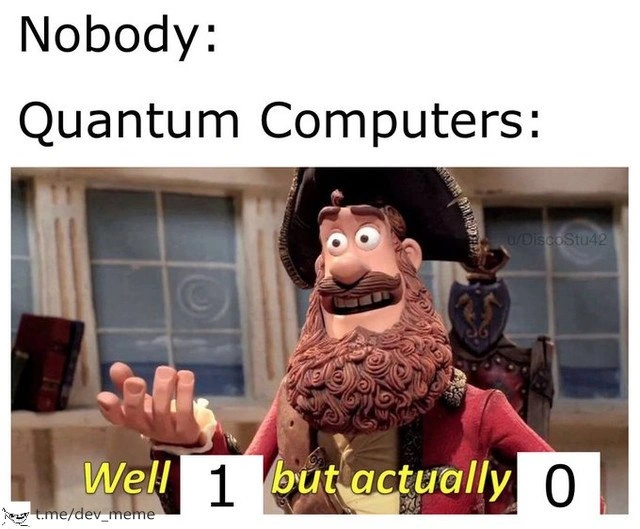
The meme uses a picture of a goofy pirate who initially looks like he’s agreeing (raising his hands happily saying “Well 1”, which means “sure, it’s 1!”) but then immediately contradicts himself (“but actually 0,” meaning “nope, it’s 0!”). It’s a paradox – a situation that doesn’t normally make sense – and that’s the joke. Quantum computers are filled with these little paradoxes that make our heads spin, much like this pirate is making us chuckle by changing his answer mid-sentence.
So, in super simple terms: the meme is funny because it’s as if the quantum computer can’t make up its mind whether a bit is 1 or 0. It’s both things at once (just like our indecisive pirate friend). And only when you “ask” the quantum computer firmly (by checking the bit) do you get a clear answer – but by then the joke’s already made: it was claiming to be 1 and 0 all along. It’s like a pretend game where a coin is spinning in the air and you ask, “Is it heads or tails?” and the coin yells back, “Heads! ... but also tails!”
Even if you don’t understand the science, it’s a funny image. We have nobody talking, and suddenly Quantum Computers speak up with a nonsense answer. It’s unexpected and goofy. It basically says: “No one asked, but here’s this crazy thing about quantum computers: a bit that’s 1 and 0 at the same time!” And that surprise twist – that a computer bit could seemingly say “well yes, but actually no” – is what makes us laugh. It’s a little reminder that the universe has some weird tricks up its sleeve, and even a pirate finds that pretty absurd and hilarious.
Level 2: Qubits for Newbies
Alright, let’s dial it back and explain the joke in plain developer terms. First, some quick definitions from QuantumComputingConcepts and basic CS:
- Bit (Classical Bit): This is the fundamental unit of information in traditional computing. It can have a value of either 0 or 1. Think of a light switch that’s either OFF (0) or ON (1). All the data in your computer – numbers, text, images – is ultimately encoded in bits, a vast sea of zeros and ones. No ambiguity: at any moment, a classical bit is definitely one of those two states.
- Qubit (Quantum Bit): This is the basic unit of quantum information. A qubit is like a very tricky light switch that can be in a special combination of OFF and ON at the same time until you check it. We call that a superposition. It’s a bit like if you had a coin spinning in the air – while it’s spinning, you might say it’s not heads or tails, it’s kind of both in limbo. Only when it lands (when you “measure” it) do you get a definite heads (1) or tails (0). A qubit in superposition is that coin mid-spin: conceptually both outcomes coexist. This is weird, we know! But it’s how quantum physics works at small scales.
- Superposition: This is the word we use to describe that state of being in two (or more) states at once. For qubits, superposition means the qubit isn’t just 0 or 1, but some mix of both. If you’ve heard of the famous Schrödinger’s cat thought experiment, it’s the same idea – the cat in the box is both alive and dead (two states) until someone opens the box to check. Replace the cat with a bit, and “alive/dead” with “1/0”, and you’ve got a qubit’s deal.
- Measurement (Collapsing the state): When you look at a qubit – i.e., measure it – the superposition “collapses” and the qubit will randomly snap to either 0 or 1. Before measurement, it was in a fuzzy both-0-and-1 state; after measurement, it’s definitively one or the other. Importantly, once measured, that qubit loses its superposition (just like once the coin lands, it’s clearly heads or tails, no in-between).
Now, what does the meme say? The text in the meme goes:
Nobody:
Quantum Computers: Well 1 but actually 0
“Nobody:” is a popular meme way of indicating that literally nobody is saying or asking anything about a topic. It’s like starting a conversation with silence for comedic effect. In memes, it’s used to set up a punchline where a person or thing just blurts out something unexpected. Here, it implies no one was talking about how bits work, but Quantum Computers come in with a weird fact anyway.
“Quantum Computers: Well 1 but actually 0” – This is the punchline. It’s written over the image of a grinning claymation pirate from a known meme template (the “well yes, but actually no” pirate meme). In the original template, the pirate’s line is “Well yes, but actually no,” which you’d use if someone almost got something right but not quite. The meme creator replaced it with “Well 1 but actually 0” to fit the quantum joke.
So why is that funny or meaningful? Because a quantum computer’s qubit can be saying “I’m a 1!” and “I’m a 0!” at the same time. If you ask a classical computer to pick one, it can’t do that – it has to choose. But a quantum computer doesn’t play by those normal rules; it can have a bit that’s essentially undecided until you peek. The pirate’s altered line “Well 1 but actually 0” perfectly captures this oddity: it starts to assert one binary value (“1”) then swings right around to the opposite (“0”). It’s basically a humorous way to voice a qubit’s qubit_state_confusion.
Think of it this way: A normal bit is like a clear answer on a true/false question – it’s either definitely True (1) or definitely False (0). A qubit, however, is like someone answering “Both?” to a yes/no question – which doesn’t make sense in everyday life, but in quantum land that’s a valid state! The meme is funny because it imagines a quantum computer talking in that contradictory way, which to us sounds adorably confusing. It’s highlighting the binary_vs_qubit difference using a comedic pirate line. The pirate image adds to the silliness – he looks so cheerful yet clueless, which is exactly how a classical developer might feel when first encountering superposition: smiling through the confusion, “I think I get it... well, maybe not?”.
For a junior developer or someone new to these concepts, the meme is basically saying: “Quantum computers are weird because their bits can be 1 and 0 at once.” It uses the pirate meme to give a familiar comedic structure to this bizarre fact. And even if you didn’t know the pirate meme origin, the phrase “Well 1 but actually 0” itself is clearly a contradiction, which is the whole point. We usually don’t expect a computer to give us a self-contradicting answer! So it’s immediate, simple humor on the surface, backed by a really cool science idea underneath.
Just to cement the understanding, here’s a quick comparison that might help:
| Classical Computer Bit | Quantum Computer Qubit |
|---|---|
| State: Definitely 0 or 1. | State: Can be 0, 1, or a mix of both (superposition). |
| Example value: 0 (100% chance) | Example state: 50% chance 0, 50% chance 1 (until measured). |
| Behavior: Doesn’t change unless we flip it. | Behavior: Stays in mixed state until observation forces a definite value. |
| Analogy: A coin that’s either heads or tails facing up. | Analogy: A spinning coin – not heads or tails until you catch it. |
In the context of the meme, “Well 1 but actually 0” is like saying the qubit was leaning towards 1 but, surprise, ends up 0 when you check. That’s literally how measurement can feel if you expected a straight answer from a qubit without accounting for quantum probabilities. It’s the kind of answer that would make a classical computer (or a classical programmer!) do a double-take. And that double-take is exactly the laugh the meme is going for.
Also, notice the alternating yellow and white text coloring on “Well 1 but actually 0” in the image – that’s a stylistic choice meme-makers use to emphasize the words and match the original pirate meme formatting. It doesn’t change the meaning; it just makes the phrase pop out, almost like a comedic timing effect (you can almost hear the pirate’s voice emphasizing “1” then “0”). And the small watermark “u/DiscoStu42” and the cat icon with “t.me/dev_meme” are just credit to the meme’s creator and the channel – they’re not part of the joke, but they’re part of the image details so you know who to thank for this nerdy humor.
In summary at this level: the meme is teaching us (through humor) about a key difference between normal computing and quantum computing. Classical bits are straightforward – one or zero – while qubits can be strangely both at once until you look. The pirate saying “Well 1 but actually 0” is just a funny way to say “It’s both 1 and 0, matey!”. If you’re new to qubits, remember this phrase – it pretty much sums up why people say quantum mechanics is mind-bending!
Level 3: Superposition Shenanigans
For an experienced developer or a computer science veteran, the meme lands as a witty reference to the bizarre behavior of quantum computers compared to classical ones. The format “Nobody: \n Quantum Computers:” sets the stage: absolutely no one asked, yet quantum computers just volunteer this absurd truth about qubits. This is a common meme format – the “nobody meme format” – used to highlight behaviors or facts that come out of nowhere. In this case, it dramatizes how quantum computing concepts often feel disconnected from everyday computing conversation: nobody in a typical dev meeting is talking about bit superposition, and then along comes quantum theory saying something completely bonkers like “Well 1 but actually 0.” It’s the qubit_state_confusion in a nutshell.
The pirate image is from the well-known “well yes, but actually no” pirate meme template (an iconic scene from a stop-motion animated film by Aardman Animations). That original meme is used whenever someone makes a statement that starts agreeable (“well, yes...”) but then flips (“...but actually, no”). In our remix, the pirate proudly declares a similarly contradictory line about a bit value. QuantumComputingConcepts often force us into these “yes and no” situations. A seasoned dev knows that in classical computing, saying a single bit is both 1 and 0 would be nonsensical – it breaks the law of non-contradiction that binary logic is built on. That’s why this TechHumor hits home: it’s portraying the qubit’s behavior using a meme format literally made for contradicting oneself.
Let’s break down the technical joke:
- In a normal program, a variable (think of a bit flag) might be
true(1) orfalse(0). There’s no in-between – this is binary_vs_qubit in contrast. You might setisAuthenticated = trueorisAuthenticated = false, never a mysterious both-true-and-false state. If you ever encountered a regular bit that acted like “it’s true but also false”, you’d assume the code is terribly broken or you’ve hit a bizarre bug in the CPU. - Enter quantum computing: a qubit can indeed exist in a superposition where, if you were to ask it, “Are you 1?”, it’s kind of yes, and “Are you 0?”, it’s kind of yes as well, until you actually perform a measurement (at which point it randomly collapses to either 0 or 1 definitively, according to its probabilities).
So when the meme shows Quantum Computers: “Well 1 but actually 0”, it’s riffing on exactly this phenomenon. It’s as if the quantum computer cheerfully gives an answer that satisfies both outcomes. This captures the qubit_state_confusion that many developers feel when first learning about qubits. It’s the ultimate DeveloperHumor for those who’ve maybe read an article or two on quantum logic and thought, “How can something be 0 and 1 at the same time?!”
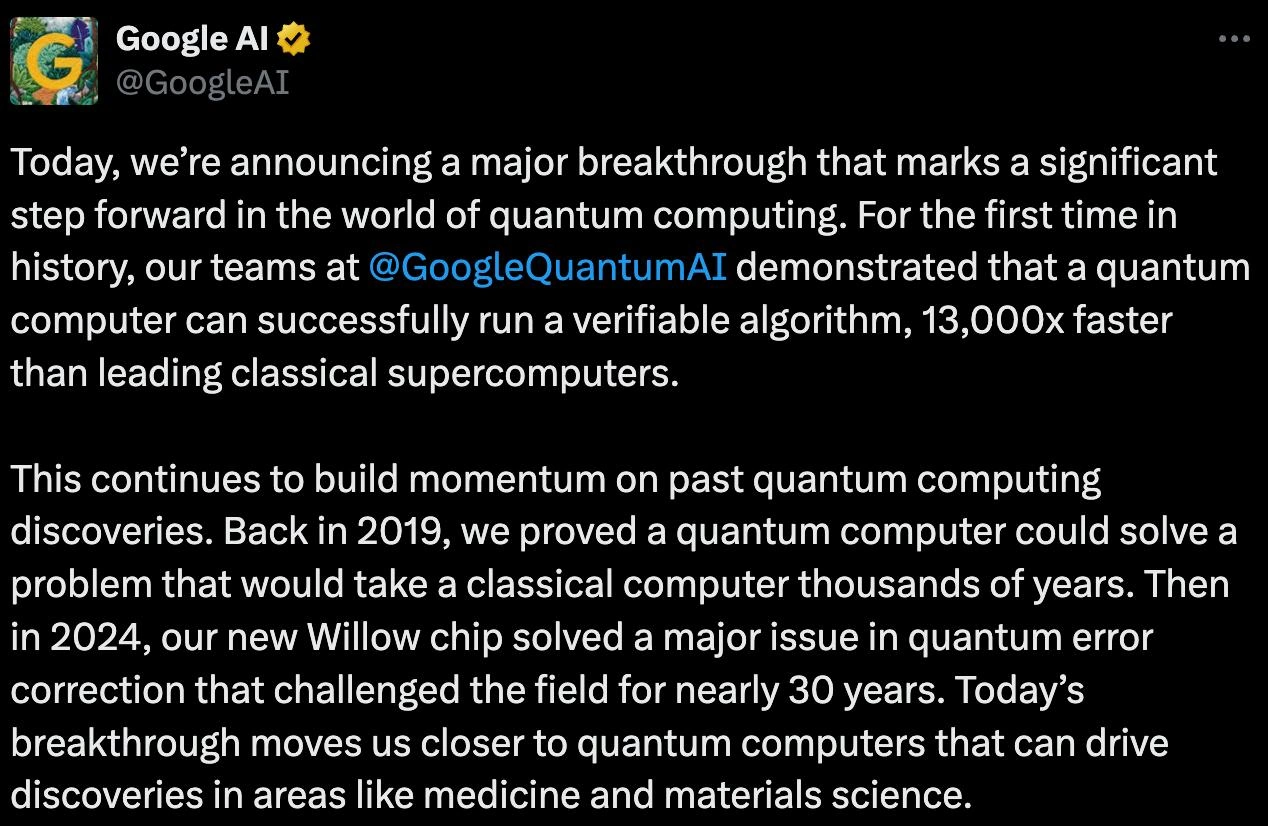
From a senior dev perspective, there’s also a bit of an eye-roll at how hyped quantum computing can be portrayed. We’ve all seen clickbait headlines like “Quantum Computer Does in 200 Seconds What Classical Supercomputers Do in 10,000 Years” (after Google’s quantum supremacy experiment). It’s impressive, but the nuances are often lost, and people imagine qubits as these magical bits that are “both on and off, solving everything instantly.” The meme plays on that simplified notion – it’s almost mocking how we explain qubits in soundbites. An experienced engineer might chuckle because they remember trying to wrap their head around qubits the first time: “Wait, so it’s not really 0 or 1… it’s kind of both until I look? Well yes (superposition), but actually no (once measured)?” – Exactly the pirate’s words! That contradiction is the core of what makes quantum algorithms tricky: you have to set up computations where this “both at once” state is useful, then cleverly interfere those states and extract a meaningful answer at the end. If you naively just ask a qubit “Hey, are you 0 or 1 now?”, you break the superposition and get a random 0 or 1 with certain probability. So quantum computers force us to think very differently.
This meme resonates with seasoned tech folks because it succinctly captures that differently. In CS_Fundamentals, the binary system is foundational; everything from low-level machine code to high-level algorithms assumes crisp bits. Yet here come quantum computers saying, “Bits? Ahoy, they be both 0 and 1 till ye measure ’em.” It’s equal parts fascinating and absurd. The pirate’s goofy grin and raised hands as he delivers this paradox perfectly mirrors how a quantum physicist might joyfully drop this knowledge on an unsuspecting programmer: mind blown. It even slyly hints at how conversations between quantum physicists and classical engineers can feel – one side excitedly describing qubits, the other side going, “Wait… well yes, that sounds like 1, but actually no, what do you mean it’s 0 as well?”
So, for a dev in the know, this meme is a gem. It compresses a whole quantum_superposition_meme into a single pirate catchphrase. It reminds us of the beautiful strangeness of quantum mechanics – how nature doesn’t always follow binary rules – and it does so using a format we all recognize from internet humor. In short, it’s a clever blend of science and silliness: making light of the fact that quantum bits just don’t behave, matey! Arr.
Level 4: Schrödinger’s Bit
At the deepest theoretical level, this meme is poking fun at quantum superposition – a cornerstone of QuantumComputing that defies our classical intuition. In a classical computer (the ones we use every day), a bit is strictly binary: it’s either 0 or 1 at any given time. But a qubit (quantum bit) exists in a complex vector space (a Hilbert space), allowing it to be in a combination of states simultaneously. Formally, a qubit’s state can be written as a linear combination (superposition) of the basis states |0⟩ and |1⟩:
$$ |\psi\rangle = \alpha,|0\rangle + \beta,|1\rangle, \qquad \text{with } |\alpha|^2 + |\beta|^2 = 1~, $$
where $\alpha$ and $\beta$ are complex probability amplitudes. This equation encapsulates why the pirate in the meme cheerfully says “Well 1 but actually 0”: a qubit can literally be in a state that is part 1 and part 0 at the same time. It’s like Schrödinger’s famous thought experiment with a cat that’s both alive and dead until observed – here we have Schrödinger’s bit, both 1 and 0 until measured.
The humor lands because of a fundamental truth in quantum mechanics: upon measurement of a qubit, its nebulous superposition “collapses” to a definite value (either 0 or 1, in this case) with probabilities $|\alpha|^2$ and $|\beta|^2$. Before you measure, the qubit isn’t secretly one or the other; it genuinely behaves as if it were both. This is deeply counterintuitive for those grounded in classical CS_Fundamentals, and it’s precisely the classical/quantum bit dilemma the meme text highlights. The pirate’s phrase “Well 1 but actually 0” is a playful nod to how a qubit’s state lives in a superposition of 1 and 0 – effectively “well, kinda 1 and kinda 0” – until you check, at which point it’s definitively one or the other.
From a computing theory perspective, this quantum ability to explore multiple possibilities at once is what gives quantum algorithms their power (e.g., Shor’s algorithm for factoring uses a superposition of many states to find factors exponentially faster than classical brute force). But it’s also what makes them so bewildering. In a way, quantum computers operate in a fuzzy realm of probability amplitudes where logic can feel pirate-level paradoxical. The meme brilliantly simplifies this mind-bending concept: the pirate cheerily agrees it’s “1”, only to immediately contradict himself with “but actually 0”. That’s a tongue-in-cheek summary of quantum indeterminacy – the system saying “aye, it’s 1!” and “nay, it’s 0!” at the same time. To a seasoned engineer with some quantum theory background, the meme elicits a chuckle because it captures, in one goofy phrase, the spooky essence of qubits that even Einstein famously poked at (the whole “spooky action at a distance” skepticism). Here there’s no entanglement depicted, but the superposition shenanigans alone are enough to confuse and amuse. It’s a fun reminder that under the hood of quantum hardware, our neat binary world gets delightfully weird.
Description
A meme explaining a core concept of quantum computing. The top text reads 'Nobody: Quantum Computers:'. Below is an image of the Pirate Captain from the movie 'The Pirates! Band of Misfits', using the 'Well yes, but actually no' meme format. The subtitled text has been altered to read 'Well 1 but actually 0'. This is a humorous oversimplification of the quantum mechanical principle of superposition, where a quantum bit (qubit) can exist in a state of being both 1 and 0 simultaneously, unlike classical bits which can only be one or the other. The joke is that this counterintuitive concept is presented in a very casual, hand-wavy manner, which is relatable to anyone who has tried to explain or understand quantum computing
Comments
8Comment deleted
Classical bits are like a light switch: either on or off. Qubits are like that one flickering fluorescent light in the office basement that's somehow both on and off and also about to start a fire
Our feature-flag system has gone full quantum: every user is in a superposition of code paths until the VP logs in - then the wavefunction collapses straight into a Sev-1
After 20 years in the industry, I've learned that quantum computers are just like our production deployments - they work perfectly until someone actually observes them, then immediately collapse into the one state you didn't want
Quantum computers: the only machines where 'it works on my machine' is literally true and false simultaneously until you run it in production, at which point the wavefunction collapses and you get a segfault in both universes
Quantum POCs: “It’s 1 and 0” - then after 10k shots the measurement collapses to 0, QEC burns the budget, and the slide deck still claims quadratic speedup
Quantum boolean: a feature flag with decoherence - looks like 1 in the deck, collapses to 0 the moment anyone measures it
Qubits: hardware that perfectly models prod deploys - superposition of 'scales exponentially' until measured, then O(n) regret
So Comment deleted