Incrementing variables and quantum states
Why is this Languages meme funny?
Level 1: Double No Means Yes
Think of it this way: The first part of the meme is like someone using a double negative in a sentence. Imagine your friend asks, “Did you eat the cookie?” and you reply, “I didn’t not eat it.” That’s a confusing way to say “Yes, I did eat it,” right? It’s silly and can make people laugh because you’re just complicating something simple. That’s exactly what x-=-1 is doing – a funny, roundabout way to say “add one.” Two negatives (minus a negative) turned into a plus, like how two “no” words turned your answer into a “yes.”
Now the second part: think about flipping a coin. Normally, it’s either heads or tails when it lands. But imagine a magical coin that could be both heads and tails at the same time until you peek at it. Sounds impossible, but that’s the weird idea the meme is joking about. It’s saying a quantum bit (qubit) could be "1" (like heads, meaning yes) and "0" (like tails, meaning no) simultaneously. The meme shows a pirate character looking puzzled, saying “Well 1 but actually 0.” It’s like asking someone “Is the light on or off?” and they cheekily answer “Well, it’s on… but also off!” That mix-up of yes and no is unexpected, and that surprise is what makes it funny. It’s poking fun at how strange the world of quantum science is compared to our normal everyday logic.
In simple terms, this meme made people laugh by taking a basic math idea (two negatives make a positive) and a crazy science idea (something being two things at once) and turning them into little jokes. It’s like a nerdy inside joke: even if you don’t get all of it yet, the absurdity of saying two opposite things at the same time is pretty goofy!
Level 2: Double Negative & Superposed Bits
Let’s break it down in simpler terms. The first meme panel is about incrementing a variable, which is a fancy way of saying “adding one to a number.” If you have x = 5 and you do x = x + 1, then x becomes 6. This is extremely common in programming whenever you need to count things or move to the next step. Many languages have shortcuts for this. For example, x += 1 is a compound assignment that also makes x one bigger (it means add 1 to x). In C-like languages (such as C, C++, Java, JavaScript), there’s even an x++ operator that literally means “increment x by one.” Now, what about x-=-1? It looks weird, right? This is using the -= operator in a tricky way: normally x -= 1 would mean subtract 1 from x. But here we subtract -1. Subtracting a negative is the same as adding a positive. It’s just math: think minus minus one becomes plus one. So x-=-1 increases x by one as well! The meme shows Spider-Man characters all pointing at each other with x = x+1 (implying they’re all essentially doing the same thing), and then a goofy-looking Spider-Man with x-=-1 as if he’s saying “I’m doing it too, just in a weird way!” This is classic SyntaxHumor – joking about the odd ways you can write code. The double negative in code is like a double negative in English: “I didn’t not eat the cookie” really means “I ate the cookie.” It’s technically correct, just an awkward way to say it. In coding, you can increment by writing x-=-1, but most people would simply write x = x+1 or use the more straightforward x += 1. Part of the joke is also the image format: the Spiderman pointing meme is commonly used among developers to show multiple things that are really the same. Here it emphasizes that despite different appearances (x+1 vs a double-negative), the result is identical. It’s a light-hearted poke at how CS fundamentals like math and assignment always hold true, even if you write them in a convoluted way.
Now, the second panel is about quantum computing. A normal computer uses bits which are either 0 or 1 at any time – off or on, false or true. But a quantum computer uses something called qubits. A qubit follows the weird rules of quantum physics. That means a qubit can be in a state that isn’t just 0 or 1, but a mix of both. This is called superposition. It’s as if you had a coin that you spun on a table – while it’s spinning, you can’t say it’s clearly heads or tails, maybe it’s kind of both until it lands. In quantum terms, only when you measure (or observe) the qubit does it “decide” to become just 0 or just 1. The meme sets this up with the format “Nobody:” (meaning nobody said anything or asked, it’s just silence) and then “Quantum Computers:” followed by an image. This format is a joke template implying that quantum computers have a wacky response even when no one is expecting it. The image used is the “Well yes, but actually no” meme – a frame from a kids’ animated show where a pirate character initially agrees (“Well yes…”) then contradicts himself (“but actually no”). In the meme’s text, they changed it to say “Well 1 but actually 0”. So it’s like the quantum computer is claiming to be 1 (yes, true) and 0 (no, false) simultaneously. This is a humorous way to describe a qubit’s superposition: it’s a bit that, until observed, behaves as if it’s both 1 and 0 at once. For someone learning computer science fundamentals, this sounds impossible – and that shock or confusion is exactly what makes it funny. It’s playing on the surprise factor: in the normal world, something can’t be two opposite things at the same time. But quantum physics says, until you check, it kind of can! Developers tag this kind of joke as CSFundamentals and QuantumComputing humor because it references a core concept (bits vs qubits) in a jokey way.
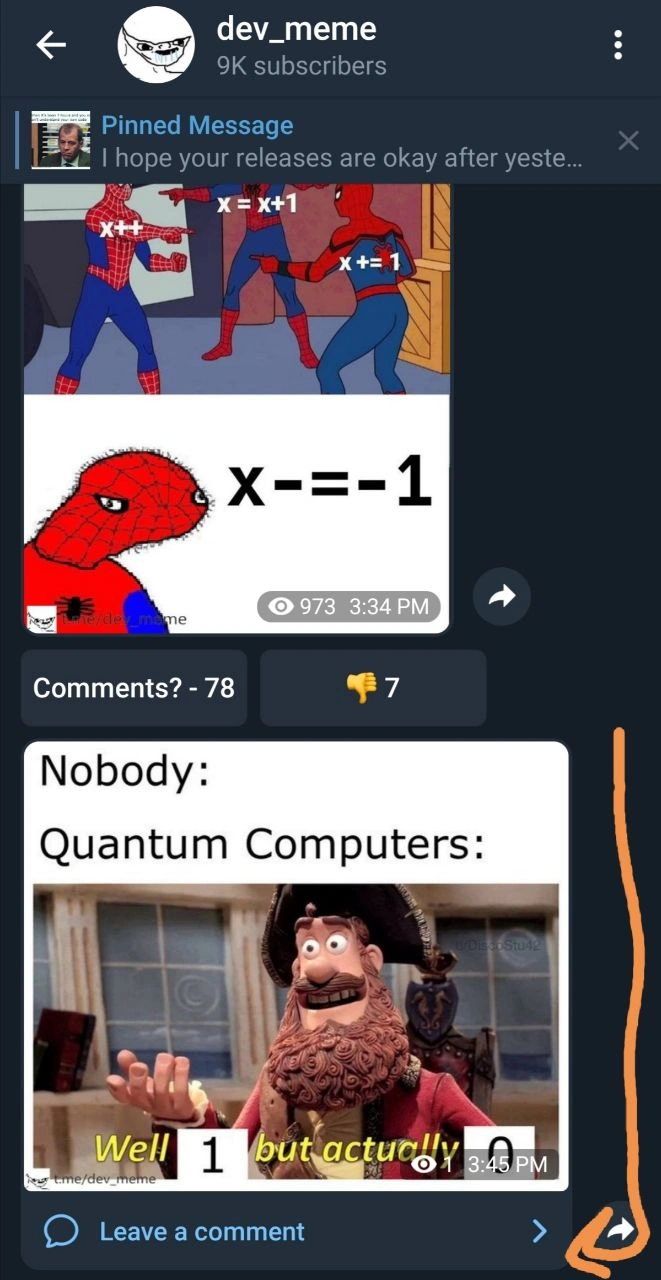
Also, notice the environment of the meme: it’s screenshotted from a Telegram channel called dev_meme (with 9K subscribers). You can see the Telegram UI: dark background, a “Comments? – 78” button, a thumbs-down icon with a count (🖓 7), and a “Leave a comment” bar. This context tells us it’s being shared in a group chat of developers who enjoy tech memes. That thumbs-down count might indicate a few people jokingly didn’t approve – perhaps they found the joke too cringe or they pressed the wrong superposition of buttons 😜. In developer communities, sharing memes like these is common. They combine inside jokes about code (like the compound assignment trick) and bleeding-edge tech references (quantum bits) in a quick visual format. If you’re a junior dev or a student, don’t worry if the quantum part seems confusing – even professionals scratch their heads at it! The key point is that the meme highlights the difference between classical logic (where things are straightforward: 2 + 2 = 4, a bit is 0 or 1) and quantum logic (where things get fuzzy: a state can be a blend). It’s a crash course in how reality can be counter-intuitive, delivered with a punchline. You learn that two negatives make a positive in code, and that quantum bits can be a wild mix – all through the universal language of memes and humor.
Level 3: Increment Insanity & Quantum Quandary
For seasoned developers, this meme hits two different nerves. The top panel uses the classic Spider-Man pointing meme – three Spider-Men accusing each other because they are essentially the same. Each Spidey is labeled x = x + 1, implying that no matter who you point at, it’s the same operation: incrementing a variable by one. Enter the derpy-faced Spider-Man in the bottom sub-panel with x-=-1. It’s the goofy imposter among them. Any experienced coder immediately recognizes that bizarre expression as just another way to increment x. It’s a compound assignment gimmick: using the -= operator with a negative value. Seasoned devs have seen this kind of stunt in code golf or during humorous code reviews – it’s the sort of thing a clever junior might try to impress others or a colleague might do as a joke. In a language like Python (which famously has no x++ syntax), one might jokingly write x -= -1 to mimic an increment. A C or Java developer knows x += 1 or x++ are the usual choices, so seeing x-=-1 is both hilarious and cringe-inducing. It’s as if the code is doing a confusing double-take: subtract-negative-one. The Spider-Man meme format amplifies this humor by visually pointing out that all these forms – normal increment, prefix/postfix ++, or bizarre double negatives – ultimately do the same thing. The syntax humor is relatable: every dev has encountered multiple ways to write the same logic, and we laugh because some ways (like x-=-1) are unnecessarily convoluted. The Telegram channel UI even shows a few 👍 and 👎 reactions – one can imagine a senior dev playfully giving a thumbs-down, muttering “just because you can do that, doesn’t mean you should.” 😅 In real development, clarity wins over clever tricks, but in a DeveloperHumor channel, these clever tricks are comedy gold.
Now, the bottom meme shifts to a QuantumComputing joke, and an experienced techie appreciates how it’s set up with a familiar format: “Nobody: [crickets]” followed by “Quantum Computers: [punchline]”. This “nobody asks, but X does something crazy” formula is a popular way to highlight unexpected or over-the-top behavior. And what could be more unexpectedly crazy in computing than bits that are 1 and 0 at the same time? The punchline is given with the “Well yes, but actually no” pirate meme – a template used to express contradiction or confusion. In the edited version, our pirate enthusiastically says “Well 1” in lime-green text, then in the same breath, “but actually 0.” For the experienced crowd, this immediately screams quantum superposition and the inherent uncertainty of quantum states. They chuckle because it’s both an oversimplification and a spot-on representation of how weird quantum bits feel compared to normal bits. Many of us have a basic CS mindset where a bit is binary and deterministic. Quantum computers turn that on its head – a qubit occupies a blurry state of multiple possibilities until you check it. It’s the ultimate CS_Fundamentals curveball: even the Pirate Captain from a kids’ show is befuddled, giving an answer that is simultaneously affirmative and negative. The senior dev humor here also comes from a bit of self-awareness: quantum computing is a hot topic, but let’s be honest, even a lot of seasoned programmers find it head-spinning. By memeing it, we’re winking at each other – “Quantum logic, am I right? Both 0 and 1… well, yes and no!” It’s a communal coping laugh at a concept that defies our binary-trained brains. In sum, this Telegram post delivers a one-two punch of DeveloperMemes: first, poking fun at silly syntax tricks that old-timers love to nitpick, and second, marveling at futuristic computing where the rules of classic logic seem to break down. Both layers are funny in different ways, and together they showcase the breadth of CodingHumor – from low-level code quirks to high-level quantum strangeness, all in one scroll.
Level 4: Double Negative, Dual State
At the deepest level, this stacked meme juxtaposes a trivial arithmetic trick with the mind-bending nature of quantum computing. First, consider how a compiler or interpreter parses x-=-1. This funky-looking expression is actually two operators glued together: the -= compound assignment and a negative literal -1. The parser interprets x-=-1 as x -= -1, which expands to x = x - (-1). In plain math, subtracting a negative is addition, so it's just another way to write x = x + 1. There's no magic here – it's a consequence of how programming language grammars tokenize symbols. The lexer sees -= as one token and -1 as a number, and the AST (abstract syntax tree) that gets generated is identical to a normal increment. So under the hood, those three Spider-Men all reduce to the same operation. This illustrates a broader computer science truth: different syntax can represent the exact same underlying operation once compiled. It’s a tongue-in-cheek nod to compiler design – you could say the code’s meaning is in a superposition of subtraction and addition until the parser resolves it!
Speaking of superposition, the second meme dives into actual quantum theory. A qubit (quantum bit) isn’t constrained to classical 0 or 1. In quantum computing theory, a qubit’s state is a linear combination α|0⟩ + β|1⟩ – essentially a vector in a two-dimensional complex Hilbert space. Before measurement, the qubit exists in a superposition of the basis states |0⟩ and |1⟩. It’s like Schrödinger’s famous cat thought experiment, but for bits: until you look (measure), the qubit can be thought of as “both 0 and 1.” The meme’s pirate text “Well 1 but actually 0” humorously alludes to this principle. In formal terms, upon measurement the qubit will probabilistically collapse to 1 or 0 (yes or no), but prior to observation its quantum state is indeterminate from a classical viewpoint. This bizarre property comes straight from the fundamentals of quantum mechanics, described by the mathematics of complex probability amplitudes. The humor here is rooted in the sheer absurdity (to our everyday intuition) that something can be two opposite things at once. It’s a playful take on the CAP theorem of reality: in the quantum realm, consistency (definitely 0 or 1) is sacrificed for a form of availability (potentially 0 and 1)! Of course, the real physics is more nuanced – a superposition isn’t literally “0 and 1” but a unique quantum state until measured. But memeing it as 1 and 0 simultaneously is a cheeky simplification that nods to the complex beauty of quantum computing fundamentals.
Description
This image contains two separate tech memes. The top meme uses the 'Spider-Man pointing at Spider-Man' format. Three Spider-Men are pointing at each other, labeled with different ways to increment a variable in code: 'x++', 'x=x+1', and 'x+=1'. A fourth, distorted Spider-Man is shown below them pointing at 'x-=-1', which is a less common, and often confusing, way to increment a variable. The second meme, at the bottom, is captioned 'Nobody: Quantum Computers:'. It uses the 'Well yes, but actually no' format with the pirate captain from 'The Pirates! Band of Misfits'. The text below him reads 'Well 1 but actually 0', humorously illustrating the quantum computing concept of superposition, where a qubit can be in multiple states at once
Comments
14Comment deleted
The `x-=-1` syntax is the interview question equivalent of a CAPTCHA; it's designed to prove you're a human developer who has seen some weird production code, not a bot that only knows the textbook examples
x -=- 1 is the Schrödinger increment - until the code-review collapses the wavefunction, it’s simultaneously a clever micro-opt and tomorrow’s 3 a.m. incident
The real quantum entanglement is when your code works in development but exists in a superposition of both working and failing in production until someone observes the logs
Ah yes, quantum computers - where your variable can be both incremented and decremented until you observe it, at which point your entire codebase collapses into a segfault. Meanwhile, us classical developers are still arguing whether x++ is morally superior to ++x, blissfully unaware that quantum engineers are over here running O(√n) algorithms while we're stuck optimizing our O(n log n) sorts. But hey, at least our bugs are deterministic - quantum debugging is just Heisenberg's Uncertainty Principle with extra steps and a $10M price tag
x-=-1 is the classical engineer’s superposition - it's +1 until code review observes it, then it collapses into “please use x += 1.”
Qubits: the hardware equivalent of stakeholder specs - both true and false until measured in prod
x-=-1 is the qubit of increments: the optimizer folds it to +1, but code review collapses it to x += 1 and a new lint rule
Ah yes, I can send messages without joining the chat Comment deleted
What is this app? Deffo not stock tg Comment deleted
tg beta.. Comment deleted
https://install.appcenter.ms/users/drklo-2kb-ghpo/apps/telegram-beta-2/distribution_groups/all-users-of-telegram-beta-2 Comment deleted
Азаза Comment deleted
Welcome Comment deleted
Чо Comment deleted