The Many Faces of Variable Incrementing
Why is this Languages meme funny?
Level 1: Double Negative Confusion
Imagine you’re with a group of friends counting stuff – say, you’re stacking blocks one by one. One friend says, “I’ll add one more block.” Another friend says, “I will increase the stack by one.” A third friend just puts a block on top without saying anything fancy. All of these actions do the same thing: one more block on the stack. Now, picture a goofy friend who instead says, “I’m going to take away negative one block!” That sounds pretty confusing, right? You all stop and stare, trying to figure out what they even mean. After a moment, you realize taking away a negative block is the same as adding one block – and indeed they add a block to the pile – but everyone is scratching their heads at the weird way it was said. The meme is funny for the same reason: there are normal, simple ways to say “add one,” and then there’s a ridiculously roundabout way. It makes us laugh because the silly way (“subtracting minus one”) achieves the same result but in a needlessly confusing manner. It’s like someone using a double negative in a sentence – you eventually get the meaning, but it sure makes you think twice!
Level 2: All Roads Lead to +1
Let’s break down what’s happening in simpler terms. In programming, adding one to a number is a very common task – imagine a counter going up. Different programming languages offer different syntax options (mostly for convenience) to do this increment. The meme shows three common ways:
x = x + 1– This is the straightforward way. Take the current value of x, add 1, and store the result back into x. Every newbie learns this first, and it works in pretty much any language.x++– This is the post_increment operator, popular in C-style languages. It’s like a shorthand for “add 1 to x.” Ifxwas 5, afterx++it becomes 6. You’ll often see this in loops (for example,for(int i = 0; i < 10; i++) { ... }usesi++to go up by one each time). It’s called post-increment because if you use it inside a larger expression, it yields the original value then increments, but if it’s just alone on a line, you can think of it as “increase x by one.”x += 1– This is a compound_assignment operator. It means “add 1 to x and assign the result to x, in one step.” It’s essentially the same asx = x + 1, just a bit shorter to write. Many languages have these compound operators (like+=,-=,*=, etc.) as a form of syntax sugar – a nicer, succinct way to write common operations.
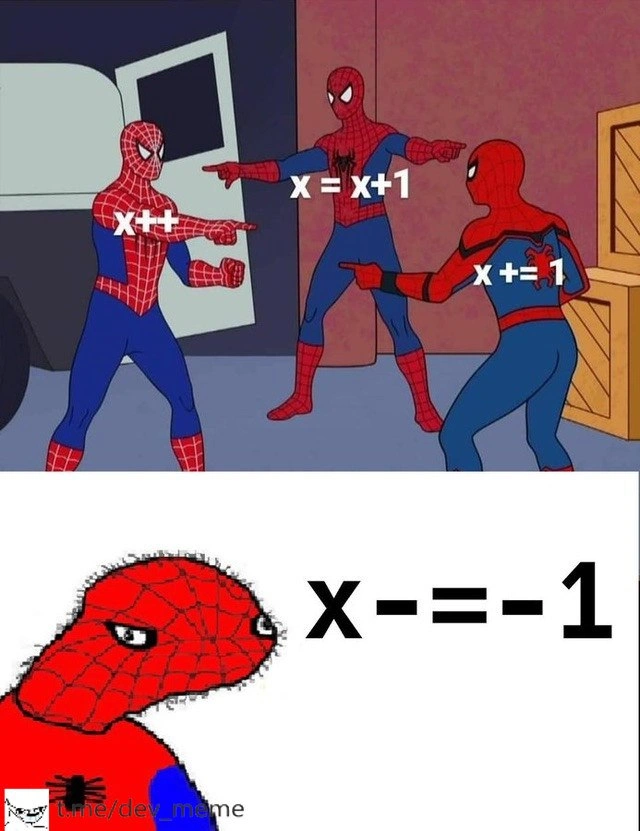
In the top part of the meme, all these three do the same job: increase the value of x by one. That’s why the Spider-Man characters are pointing at each other – it’s the classic Spider-Man meme used to show “hey, we’re all the same!”. Developers sometimes playfully argue about which form is better style, but functionally, if you see x++, x = x + 1, or x += 1 in code, you know x will end up one larger regardless. In languages like JavaScript, C#, or C++, you can use any of them. (In Python, interestingly, you cannot use x++ – Python doesn’t have the ++ operator, so you’d stick with x = x + 1 or x += 1. Each language has its little LanguageQuirks!)
Now look at the bottom panel: x -= -1. This one might make a beginner’s head spin. Let’s decode it step by step. The operator -= is another compound assignment, similar to += but for subtraction. x -= 1 would normally mean “subtract 1 from x”. However, here we have x -= -1. The -1 is a negative one. Subtracting a negative is the same as adding a positive. So x -= -1 mathematically means “x = x - (-1)”, which simplifies to x = x + 1. Yes, it actually increments x by one as well! It’s just doing it in a roundabout way. This is why the meme’s caption jokes about “until someone tries subtracting minus one” – it’s showing a wacky, needlessly confusing way to add one. Technically, the code works: if x was 5, after x -= -1 it’ll be 6, just like all the others. But it’s not a method you’d see in normal code because it’s hard to read. It uses a double negative, which tends to confuse humans (two negatives make a positive, but at first glance you might scratch your head).
To summarize these in code form, imagine x starts at 5:
int x = 5;
x++;
// x is now 6
x = 5;
x = x + 1;
// x is now 6
x = 5;
x += 1;
// x is now 6
x = 5;
x -= -1;
// x is now 6 (subtracting -1 adds 1)
All four snippets end up with x being one larger than it started. The first three are common and considered clear. The last one x -= -1 does the same math but is like a weird trick – you probably won’t find it in any tutorials! The meme contrasts these normal ways with the odd one to poke fun at how developers sometimes overcomplicate things. A new programmer might learn the hard way that just because code works doesn’t mean it’s the best way to write it. Readability and clarity are super important. Seeing x -= -1 might make you pause and think “wait, what is that doing?” whereas x += 1 or x = x + 1 are immediately understood. This is a gentle lesson hidden in humor: prefer the clear and simple approach when coding, and be cautious of clever one-liners that make others do mental gymnastics.
Level 3: Syntactic Sugar Showdown
The top panel of this developer meme features the iconic Spider-Man pointing at Spider-Man scene – except here all three Spider-clones are accusing each other of doing the exact same thing. Each Spider-Man is labeled with a different way to increment a value: x++, x = x + 1, and x += 1. In programming languages like C, C++, Java, and many others, all three of those expressions are essentially synonyms – they all add one to the variable x. This setup humorously highlights a classic syntax_sugar debate: multiple ways to achieve the same result. Seasoned developers recognize this as a parody of those endless style discussions where everyone has their favorite syntax for the increment_operator. Here, the three Spider-Men are effectively identical in function (hence the finger-pointing standoff), representing how x++, x = x+1, and x += 1 are just superficially different flavors of accomplishing “one more”.
From a senior developer’s perspective, the humor cuts deeper: we’ve all seen colleagues passionately argue over these trivial differences in code reviews or on Stack Overflow. Which is more readable? Which is the “proper” way? People act as if these three are totally different species, much like Spider-Man clones accusing each other of being the imposter. Yet under the hood, their operator_semantics are nearly identical. In fact, compilers often generate the same machine instructions for all these forms. The meme plays on this shared understanding: the Spider-Man clone trio is pointing fingers despite there being no real culprit – they’re all the same (++ adds one, += 1 adds one, and x = x+1… well, adds one). It’s a tongue-in-cheek nod to the LanguageQuirks and tiny debates that devs fixate on while writing code.
But the real punchline comes in the bottom panel. Suddenly, we see a derpy, low-quality Spider-Man clone (drawn all lopsided) next to the bold text x -= -1. This is the wildcard – the one developer who tries something absurd to add one: subtracting negative one. If the top panel was a spiderman_pointing_meme of normal syntax choices, the bottom panel is the malformed mutant of coding style. Using x -= -1 is like saying “I’ll subtract a negative number to increment”. It’s technically valid in many languages (since mathematically, minus -1 is the same as +1), but it’s so confusing that it would make any experienced dev do a double-take. This is a classic case of being too clever for your own good. The meme mocks how developers sometimes find convoluted ways to do simple things, or how a misguided coder might think “subtracting minus one” is an ingenious trick. In reality, it’s a readability nightmare. No sane codebase would accept x -= -1 in a code review without a good chuckle (and a swift edit to remove the double negative). As a senior engineer, you immediately recognize this as a double_negative_bug waiting to happen – not because it computes the wrong value (it still adds one), but because it’s begging for a misunderstanding or error by the next person who reads it.
Reviewer: “So it works, but nobody should ever write it like this.” – (Every code reviewer seeing
x -= -1in a codebase)
The genius of the joke lies in contrast. The top half shows devs pedantically debating three equivalent forms (literal syntax humor in action) – it’s a silly squabble over nothing, depicted by identical Spider-Men. Then the bottom half sucker-punches us with an example of true bad practice: a baffling compound assignment that technically increments but through a double negative twist. In other words, while everyone’s busy bikeshedding about x++ vs x += 1, someone out there is writing code that’s the real problem for readability. The meme’s message resonates with experienced developers: don’t lose sight of clarity while arguing over cosmetic differences. It’s a light-hearted reminder that all the ways to add one are fine… until you do it in the most confusing way possible.
Description
A two-panel meme that humorously categorizes different ways to increment a variable in programming. The top panel features the 'Spider-Man pointing at Spider-Man' meme, where three identical Spider-Men point at each other. They are labeled with the most common and standard ways to increment a variable: 'x++', 'x = x+1', and 'x += 1'. The bottom panel shows a poorly drawn, distorted version of Spider-Man, representing an outcast or a flawed version. This character is labeled with the syntactically correct but confusing and obscure expression 'x -= -1'. The humor comes from the contrast between the universally accepted, clean methods and the bizarre, unreadable alternative that achieves the same result, highlighting the kind of code that senior developers sometimes find in legacy systems

Comments
7Comment deleted
Using 'x-=-1' in a code review is a power move to assert dominance and ensure no one else ever volunteers to touch your code again
We spent three sprints bikeshedding x++ versus x += 1; then a staff engineer merged x -= -1 and the only thing we actually incremented was the cognitive load
After 20 years in the industry, you'd think muscle memory would prevent '==' instead of '=' typos, but here we are at 3 AM, wondering why our state machine is comparing instead of assigning, while the junior who uses only strict equality operators sleeps peacefully
The x -= -1 operator is the programming equivalent of saying 'I'm not not going to the meeting' - technically correct, mathematically sound, but guaranteed to make your code reviewer question your life choices and add a comment like 'TODO: refactor this abomination during next sprint.' It's the kind of code that passes all tests but fails the 'would you want to debug this at 3 AM?' test spectacularly
Pick your linter war: x++ vs x += 1 vs x = x + 1; in prod they all compile to the same race condition - x -= -1 just gets you invited to the postmortem
x -= -1: the senior dev special that increments without the pleb postfix, perfect for haunting the next maintainer's dreams
x-=-1 is how a +1 becomes a Sev‑2 postmortem about operator precedence and our missing code‑golf policy