Skip to content
DevMeme
691 of 7435
How Python cuddles you while C++ hurls insults at compile-time
Languages Post #783, on Nov 6, 2019 in TG

How Python cuddles you while C++ hurls insults at compile-time

Why is this Languages meme funny?

Level 1: Gentle Teacher vs Harsh Teacher

Imagine you’re learning something new with two different instructors. With the first instructor, every time you make a mistake, they give you a warm hug and say, “It’s okay, you tried. Here’s what went wrong, let’s fix it together.” That’s how Python makes you feel when your code has an error – it’s comforting and helpful. Now picture a second instructor who, at the first sign of a mistake, screams in your face, “What on earth did you do?! Are you kidding me?!” and calls you a silly name like “donkey” for messing up. That’s how C++ can make you feel when there’s an error – it’s intense and a bit scary.

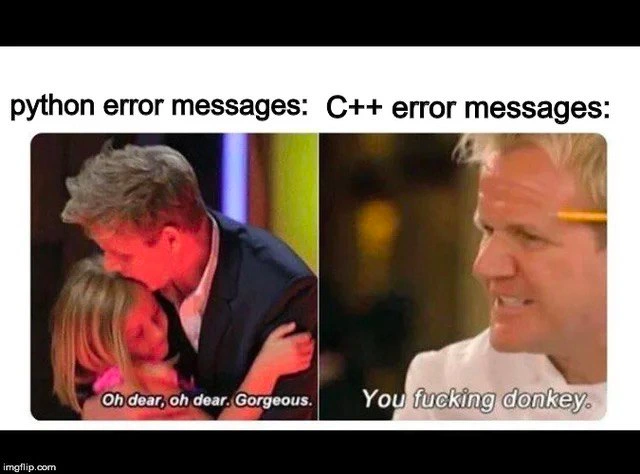
In simple terms, the meme is funny because it’s comparing these two experiences. The left side (Python) is the nice teacher gently guiding a child who messed up, and the right side (C++) is the angry coach yelling at someone who made a mistake. We laugh because it’s a big exaggeration, but it feels true when you’re a programmer: Python’s messages are calm and easy to understand, while C++’s messages can be so complicated that it feels like you’re being yelled at. It’s like the difference between a friend who kindly helps you correct a homework error versus a strict teacher who gives you a page full of red marks and a scolding. The emotional core here is comfort vs. intimidation, and seeing that contrast side by side in a silly way (especially using Gordon Ramsay’s famously split personalities on TV) makes it very clear and very funny.

Level 2: Kid Gloves vs Gauntlet

Let’s break down the elements of this meme in simpler terms. We have a side-by-side comparison of how two programming languages – Python and C++ – present error messages, especially when something goes wrong in your code. The left side (Python) shows a very gentle scene: a famously tough chef is seen comforting a child contestant, saying “Oh dear, oh dear. Gorgeous.” The meme labels this as “python error messages.” This is illustrating that Python’s error messages are friendly and supportive. When you run a Python program and hit an error (like dividing by zero or using a variable that wasn’t defined), Python will stop and print out a message that tells you what happened in plain language. It also gives you a stack trace, which is basically a list of the functions that were running when the error happened, so you can see where things went wrong. Importantly, these messages are usually pretty readable. For example, if you try to access something that doesn’t exist, Python might say AttributeError: 'Car' object has no attribute 'fly' – which is a clear way of saying “you tried to make a car fly, but cars don’t have a fly function.” It’s almost polite; it’s like the language is patting you on the back and saying “Oops, that part doesn’t work, but here’s exactly why.” This can feel encouraging, especially if you’re new to coding. Python is often recommended as a first language partly because of this gentle learning curve: even the errors try to teach you.

Now, the right side (C++) has the same chef, but in a very different mood – he’s yelling aggressively at an adult, calling them a donkey (in a very blunt way: “You f**king donkey!”). This is labeled “C++ error messages.” It’s a humorous way to say that when you make a mistake in C++, the compiler (the program that turns your C++ code into an executable machine code) doesn’t sugarcoat anything. In fact, C++ error messages are infamous for being long, complicated, and often hard to understand if you’re not experienced. Why is that? Well, C++ is a language that catches errors before you even run the program (we call these compile-time errors). That’s great for preventing bugs, but it means the feedback you get is coming from this very strict compiler that expects code to be exactly right. If it’s not, it spits out what looks like a paragraph of technical jargon. For a beginner, seeing something like:

error: no matching function for call to ‘addNumbers(std::string&, int&)’

and then a bunch of lines referencing candidate functions and types can be overwhelming. It’s as if the compiler is yelling at you with a list of everything you did wrong, all at once. There’s even a running joke among programmers about C++ template error nightmares – templates are a C++ feature for generic programming, and if you make a mistake using them, the error message can be massive, basically the compiler’s inner monologue spilled out onto your screen. Developers sometimes literally feel debugging frustration because deciphering these messages is like solving a puzzle. You have to pick through and find the actual issue (maybe a wrong type or a missing #include), hidden in all that text.

The images used in the meme come from two of Gordon Ramsay’s TV shows, which is a perfect analogy:

  • In MasterChef Junior, Ramsay is kind and encouraging to young chefs – this represents Python, which coddles beginners with helpful error messages.
  • In Hell’s Kitchen, Ramsay is brutally honest and loud with professional chefs – this represents C++, which expects you to know what you’re doing and practically shouts at you when you mess up.

So, when you see “python error messages: (hug and kind words)” versus “C++ error messages: (angry shouting)”, it’s comparing the developer experience. Python’s errors often tell you in a straightforward way what went wrong in your code (and in a tone that feels almost like a gentle teacher). C++’s errors often feel like the computer is frustrated with you – they’re full of compilers jargon and can come off as harsh or even insulting in their bluntness. Of course, the compiler isn’t really angry (it has no emotions), but as a human reading the message, you might feel scolded because it’s so hard to read. This is a classic bit of coding humor: giving programming tools a personality based on how they “treat” the programmer. And here, Python is the kind friend who helps you debug, while C++ is the strict coach who might make you cry while fixing your code.

For a junior developer or someone just learning, the takeaway is also educational: error messages are not all the same. Some languages like Python hold your hand a bit, showing exactly where the problem is in a nice format. Other languages like C++ assume you’re more of an adult – they give you all the raw details and expect you to figure it out. Neither approach is inherently wrong; they each come from the language’s goals and design. Python prioritizes ease of use and quick feedback at runtime, whereas C++ prioritizes catching every possible issue at compile-time, even if the feedback is harder to digest. That’s why a Python error might be easier to fix in the moment (you run the program and read a friendly message), while a C++ compile error might require careful reading and sometimes a lot of Googling to understand. The meme just dramatizes this difference in a way that anyone who has seen both will instantly get – and likely laugh, because it’s true enough to sting a little.

Level 3: Compile-Time Roast Session

For anyone who’s wrestled with both languages, the meme lands as hilariously accurate. It personifies the experience of debugging in Python versus C++. On the left, labeled "python error messages," we have Gordon Ramsay (the famously harsh chef) in a rare gentle moment – hugging a distraught child on MasterChef Junior and saying, “Oh dear, oh dear. Gorgeous.” This image perfectly captures how a Python error message often feels: empathetic, clear, and almost apologetic. When you make a mistake in Python – maybe you called a function that doesn’t exist or tried to add incompatible types – the interpreter doesn’t berate you. Instead, it gives you a concise message and a traceback that pinpoints where things went wrong. It might not literally say “Oh dear, gorgeous, you tried your best,” but relatively speaking, a Python stack trace is straightforward. For example, if you refer to a variable that hasn’t been defined, Python will kindly inform you: NameError: name 'myVar' is not defined. It’s practically the language’s way of saying, “Oops, looks like myVar isn’t set – no worries, just check that.” This stack_trace_friendliness means even newcomers can often read the error and have a clue how to fix it. Python’s philosophy and community put a strong emphasis on readability and simplicity (remember, “Errors should never pass silently” is part of the Zen of Python). That ethos extends to its error messages, which strive to tell you what happened in plain terms.

Now look at the right side: "C++ error messages." Here Ramsay is in full Hell’s Kitchen mode, leaning in and shouting “You f**king donkey!” at an adult contestant. Seasoned C++ developers chuckle (and perhaps cringe) at this because C++ compiler errors often feel like a personal attack. The compiler isn’t literally angry, of course, but the wall of text it spits out when you mess up can feel utterly overwhelming and rude. It’s the difference between a gentle nudge and a drill sergeant’s scream. If you’ve ever introduced a tiny mistake in a C++ template-heavy codebase, you know the dread: one wrong std::map usage or a slight type mismatch, and suddenly your terminal is flooded with a hundred-line error trace. It’ll begin at the point of failure (maybe no matching function for call to ...), but then it continues: referencing candidate function signatures, listing template parameters, pointing to lines in header files you didn’t even open, and basically dumping the compiler’s stream of consciousness about why it’s not happy. It’s like the compiler is saying, “I couldn’t compile your code because of X… which came from Y… which was called in Z… what were you thinking?!”

This humor is a nod to countless real-world experiences where developers felt debugging frustration with C++. A senior engineer might joke that the first time they saw a C++ linker error or a template error, they thought the compiler was straight-up insulting them. For example, a linker error might output something like:

undefined reference to `SomeClass::SomeMemberFunction()`

But with name mangling it could look scarier, and to a junior dev it’s basically “You did something wrong in a way you don’t understand, figure it out, or else.” Meanwhile, Python’s equivalent scenario (calling a function that doesn’t exist) would just be a single clean line in the traceback. The LanguageComparison here plays on stereotypes: Python is the easy-to-love, beginner-friendly language that “cuddles” you – it won’t compile to machine code until runtime, and when it hits a snag, it explains it as clearly as it can. C++ is the high-performance, no-nonsense language that “hurls insults” at compile time – it demands you get everything correct upfront, and if you don’t, its feedback is brutally candid.

In daily developer life, this contrast leads to very different debugging sessions. Python developers often iterate quickly: run the code, see a readable error, fix it, run again. A Python error might even suggest what went wrong (some tools can add hints like “Did you mean…?” if you have a typo). On the other hand, C++ developers sometimes spend significant time troubleshooting a single compile error: parsing through the avalanche of compiler output to find the root cause. It’s almost a rite of passage to learn tricks like reading C++ errors from the bottom up (because often the last line is the real error, and preceding lines are context), or using an IDE/compiler that colors and collapses template instantiations. Seasoned C++ devs have a dark humor about it – they’ll say things like “I love C++’s power, but man, the compiler can be a real bully when I mess up.” And indeed, many a bug-hunting session at 2 AM has felt like getting yelled at by a furious chef for screwing up the “recipe” of code.

The meme resonates because it exaggerates a truth: C++ error messages can be ridiculously hard to decipher, even insulting to one’s intelligence at first glance, whereas Python errors tend to be digestible. It taps into the ongoing LanguageWars trope in coding humor – where each language is given a personality. Here Python is the kind mentor or friend, and C++ is the genius but irritable expert who has no patience for your mistakes. The comedic genius of using Chef Gordon Ramsay’s two personas (gentle with kids vs. harsh with adults) is instantly relatable to developers: we’ve all yearned for a bit of kindness from our tools when we’re stuck, and sometimes, we’ve felt like the compiler is just shouting at us even though we’re trying our best. In short, this panel is funny to developers because it’s so true: when your Python script fails, it feels like a helpful debug buddy guiding you, but when your C++ code fails to compile, it often feels like an angry boss scoffing at your incompetence.

Level 4: Template Instantiation Hell

At the most granular level of compilation, this meme highlights a deep technical contrast between how a dynamic interpreter and a static compiler handle errors. In C++, error messages often stem from the compiler’s perspective: the C++ compiler must analyze code upfront, performing type checking, template instantiation, and name resolution before the program can run. When something goes wrong in this compile-time process – say, a template can’t be resolved or a type doesn’t match – the compiler dumps a detailed diagnostics trail. This trail includes every layer of template instantiation or function overload resolution that it walked through, leading to notoriously long and complex error spew. Each “In instantiation of…” line in a C++ error is the compiler peeling back another layer of the code’s abstraction. It’s as if the compiler is reciting a stack trace of templates and types – but unlike a runtime stack trace, which is a linear sequence of calls, the compile-time version can branch and recurse through templates, producing a combinatorial explosion of detail.

Consider C++ templates: they are Turing-complete, meaning the compiler is effectively executing a metaprogram when it substitutes template parameters. If something doesn’t fit – for example, you try to call a template with a type that doesn’t support a required operation – the error may appear deep inside a nested chain of instantiations. The compiler then reports an error like:

template<typename T>
T add(T a, T b) { return a + b; }

struct X {};

int main() {
    X x1, x2;
    add(x1, x2); // error: no '+' operator for X
}

Compiling this C++ code might yield an error such as:

error: invalid operands to binary expression ('X' and 'X')
note: in instantiation of function template 'add<X>' requested here

For a simple case, that’s not so bad – but imagine a complex template from the STL or Boost libraries. The error could span dozens of lines, mentioning internal template types like std::enable_if<T, U>::type or a mangled name _ZNSt6vectorIiE7push_backEOSi that looks like gibberish. Name mangling is the compiler’s way of encoding typed function names for the linker, but to a developer it reads like an alien language. The C++ compiler’s error diagnostics often feel like a torrent of internal implementation details, because under the hood it’s exposing the raw mechanics of template expansion, overload resolution, and type deduction.

Python, by contrast, doesn’t even compile in the same way – it’s interpreted (or bytecode-compiled at runtime), meaning it determines types dynamically and only raises an error when it actually encounters a problematic operation during execution. Python’s errors are handled by throwing exceptions at runtime. The interpreter constructs a stack trace that shows the sequence of function calls leading to the error, but this trace is typically much simpler and shorter than a C++ template traceback. Why? Because there was no need to unroll a ton of metaprogramming context; Python doesn’t instantiate types or unroll templates ahead of time. If you try to add a string to an integer in Python, it doesn’t generate a cryptic combinatorial log; it simply halts at that line and says something like TypeError: can only concatenate str (not "int") to str. This straightforward message is possible because Python’s error reporting happens at the moment of failure with full knowledge of what operation failed and why, in terms that align with the source code you wrote.

In essence, the meme’s humor reflects a fundamental design difference: static vs dynamic language error reporting. C++ catches errors early (at compile time) by performing rigorous checks using formal language rules – but the flip side is that the messages you get are as formal and rigid as the compiler’s thought process. Python postpones many checks until the code runs, and when something goes wrong, it can afford to be more human-friendly in its error output, almost like it’s consoling you with a gentle explanation. This is a direct consequence of language philosophy: C++ gives you power and performance but expects you to understand its dense feedback; Python gives you ease of use and tries to cushion the blow when things go awry. The “template error nightmares” that seasoned C++ programmers joke about aren’t just because compilers are mean – it’s because they’re exposing the full complexity of type logic and the compile-time algorithms required to ensure your program is correct. It’s a bit of tough love baked into the language’s very foundation.

Description

Meme split into two panels under the heading text: "python error messages:" (above the left panel) and "C++ error messages:" (above the right panel). Left panel shows a blurred-face celebrity chef gently hugging a small child; the subtitle reads "Oh dear, oh dear. Gorgeous." Right panel shows the same chef, now shouting at an adult contestant, with the subtitle "You fucking donkey." The visual contrast illustrates how Python’s stack traces feel supportive and readable, whereas C++’s template-instantiation spew can feel personally abusive to seasoned engineers wrestling with linker errors and undecipherable diagnostics

Comments

6
Anonymous ★ Top Pick After twenty years of shipping C++, I’ve learned the compiler’s bedside manner is proportional to the depth of the template instantiation - zero levels is a warning, eight levels is a full Gordon Ramsay meltdown
  1. Anonymous ★ Top Pick

    After twenty years of shipping C++, I’ve learned the compiler’s bedside manner is proportional to the depth of the template instantiation - zero levels is a warning, eight levels is a full Gordon Ramsay meltdown

  2. Anonymous

    Python: 'NameError: name 'x' is not defined. Did you mean 'X'?' vs C++: 'error: no matching function for call to std::vector<std::unique_ptr<MyClass<typename T::value_type::nested_type>>>...'

  3. Anonymous

    The real difference isn't just the error messages - it's that Python tells you exactly which line broke and why, while C++ gives you a 300-line template instantiation stack trace because you forgot a const qualifier three inheritance levels deep. At least with Python, you can fix the bug before your coffee gets cold; with C++, you're still scrolling through compiler output wondering if std::vector<std::shared_ptr<T>> is actually compatible with std::vector<std::shared_ptr<const T>> and questioning your life choices

  4. Anonymous

    Python offers a stack trace; C++ delivers a 4KB instantiation backtrace where SFINAE, ADL, and Concepts each nominate the linker as the real culprit

  5. Anonymous

    Python tells you where you tripped; C++ gives you 400 lines of template-instantiation therapy, then quietly admits on the last line that the symbol wasn’t defined

  6. Anonymous

    Python errors: 'Consider this traceback, friend.' C++: 'Behold 47 lines proving your includes summoned undefined behavior from the abyss.'

Use J and K for navigation