Hacker Focus: The Allure of a Vulnerability Scan
Why is this Security meme funny?
Level 1: Laptop Beats Party
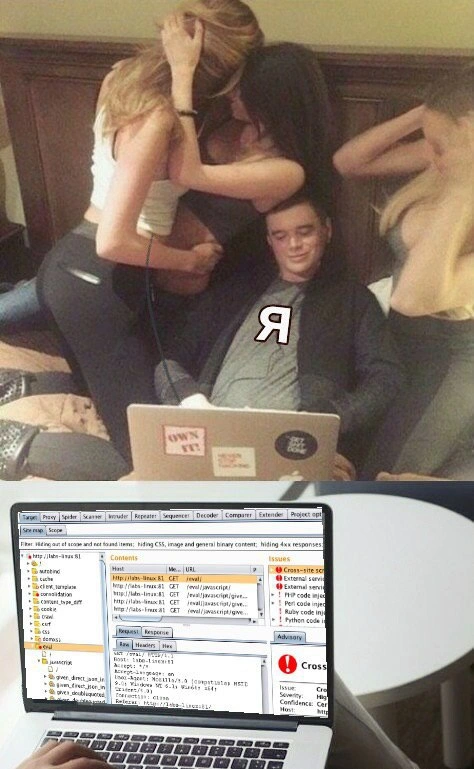
Imagine you’re at a birthday party with friends, and there’s cake, music, and games. But instead of playing with the other kids or eating cake, one kid sits in the corner totally glued to his handheld video game or a cool new toy. The others are trying to get his attention – “Come dance! Come play!” – but he just smiles at his device and doesn’t look up. This meme is just like that, but with a grown-up at an adult party. The man in the picture is surrounded by people giving him lots of attention (hugs and smiles and all), which normally would be super fun. But he’s so fascinated by what’s on his laptop that he ignores them completely.
Why is this funny? Because usually you’d think being at a fun party and having people interested in you is the best thing ever. But for this guy (who represents a big computer nerd), the computer stuff is more exciting than the party stuff! What’s on his screen is basically a bunch of internet data – kind of like secret messages from a website – and he’s found something interesting in those messages (like a hidden problem or a little treasure in a game). To him, that’s more interesting than the real-life party around him. It’s a silly exaggeration that shows how some people really love their hobbies or work (in this case, computer security) so much that they forget everything else. Even though it’s outrageous – who would ignore friends for a bunch of scrolling text on a screen? – we laugh because we know at least one person (maybe even ourselves) who’s a bit like that with something they love. In simple terms: the laptop’s “party” beat the actual party for this guy, and that contrast is what makes it humorous and cute.
Level 2: Burp Suite Bliss
Now, for a more straightforward explanation – especially if you’re newer to web development or security. This meme is showing a guy at a party who is completely absorbed in his computer. What’s on his screen? It’s a program called Burp Suite, which is a popular tool for penetration testing. Penetration testing (or “pen-testing”) is like ethical hacking: companies or security researchers test websites and apps to find security holes before the bad guys do. Burp Suite has a feature called the Proxy that lets you intercept HTTP requests and responses. Think of it like a security guard secretly listening in on a conversation between your web browser and a website – you get to see everything sent and received, and even modify it if you want. In the screenshot (the bottom panel of the meme), you can see a list of web addresses (paths like /static/js and an /api/… endpoint) that the tool has captured as the user browses a site. Each of those is something the website is loading (like JavaScript files or API calls). The middle shows the HTTP method (mostly GET requests, which just means the browser is getting or fetching data). On the right, there’s a highlighted alert: “Cross-site scripting” with a big red exclamation mark – that’s Burp Suite warning that one of those requests/responses might have a vulnerability.
Let’s break down Cross-site scripting, often abbreviated as XSS. It’s one of the most common web security issues (often listed in the OWASP Top 10 security risks for websites). XSS happens when a web application doesn’t handle user input carefully, and someone manages to inject malicious script code into a page. For example, imagine a website has a comment box. You’re supposed to type text, but what if someone types in <script>badStuff()</script>? If the site isn’t protecting itself, it might actually include that in the page so that every visitor’s browser runs that script – yikes! That script could then do things like steal cookies (tiny pieces of login info) or show fake login forms, etc. In our meme, the Burp Suite proxy likely caught something like that – maybe the guy was testing an input field with some script, and the site spit it back out. The red warning is basically the tool saying: “Heads up! This site might be vulnerable to XSS!” It’s a security testing victory moment.
So why is he ignoring the party for this? Well, this is where the humor kicks in as developer humor. The meme caption says, “When Burp Suite Traffic Outshines the Attention You’re Getting at the Party.” It’s poking fun at how some developers or security geeks find more joy in debugging_troubleshooting technical stuff than in socializing. The guy in the picture (with the Cyrillic "Я" on his chest meaning "Me/I") represents the meme’s author or the typical viewer. He has three people around him at this party giving him affection and attention, but he’s completely oblivious because he’s busy looking at HTTP logs! The laptop even has cool stickers (one of them looks like it says “OWN” which in hacker lingo can mean to own/pwn a system, i.e., hack it successfully). Everything about his body language says, “I’d rather do tech stuff than party.”
For a junior developer or someone not in security, here’s why that’s funny: Usually, you’d think being the focus of attention at a party (especially with attractive people flirting with you) would be the ultimate good time. But this meme flips it—saying that for some of us nerdy folks, the “ultimate good time” is actually catching a vulnerability on our computer. It’s relatable_dev_experience for those who have ever gotten too into a coding project or a tech task. Maybe you’ve experienced this in a smaller way: have you ever been so into fixing a tricky bug or finishing a feature that you ignored texts from friends or forgot to eat? That’s the idea, just exaggerated to party-level. Here the tech task is running Burp Suite and intercepting traffic, which is a very Security engineer thing to do. The phrase “Those script kiddies” (used in the post message) is a slangy way the community jokes about inexperienced hackers. A script kiddie is basically a newbie attacker who doesn’t really understand the deeper stuff but knows how to run automated scripts or tools to look for easy vulnerabilities. When our guy sees an XSS alert, he might be thinking it’s the handiwork of some script kiddie scanning the site – and instead of being upset, he’s actually amused or interested. It’s kind of like a police officer at a party suddenly hearing police radio chatter about a petty thief nearby – their professional instincts kick in and that excites them more than the party fun.
In simpler terms, this panel is highlighting the contrast in priorities_over_party: the average person at a party cares about dancing, talking, maybe flirting. But the security nerd cares about what’s happening on his screen. The burp_suite_proxy and http_intercept_session tags point to exactly what he’s doing: using Burp’s proxy to catch all the web session info. And owasp_top10_focus and cross_site_scripting_alert highlight that specific vulnerability he’s zeroed in on (XSS, which is indeed a big focus in web security circles).
To someone early in their dev career, the key takeaways are: BurpSuite is a tool that can show you everything going on behind the scenes of a web page – super useful for finding bugs or holes. PenetrationTesting is basically trying to hack yourself (or your client) before bad guys do. And sometimes, people get really, really into this stuff – so much that it becomes more exciting than typical fun activities. The meme is a lighthearted way of saying “I find debugging and hacking so fun that I’d pick it over a party any day.” You don’t need to know the deeper technical details to get the joke – just recognizing that the guy is more into his computer than the people around him is enough. If you’ve ever been called out for checking your GitHub or server logs on a Friday night, you’ll likely chuckle at this scenario. It’s both ridiculous and endearingly relatable for a certain kind of developer.
Level 3: Payloads Over Parties
Zooming out to a senior developer or security analyst’s perspective, the meme’s comedy comes from a painfully relatable scenario: choosing a stream of network payloads over the pleasures of a party. The man labeled "Я" (meaning "I" in Russian) represents us, the techies, completely absorbed in his laptop. He’s surrounded by people vying for his attention – three friendly party-goers with arms around him – yet he couldn’t care less. His eyes are glued to lines of HTTP requests and a glaring security alert. Why is this funny? Because it satirizes the stereotypical security_engineer_mindset: the notion that catching an exploit or weird bug in real-time is way more exciting than whatever social stuff is happening around you. The priorities_over_party have been comically flipped. Instead of enjoying the party, he’s enjoying a live feed of web traffic.
We’ve all known (or been) that developer who, at a team party or a Friday night hangout, suddenly tunes out the world because they received an alert on their phone or spotted something interesting in the server logs. Maybe the production site is showing strange traffic, or they just can’t resist checking an app’s response to the new scan they kicked off. Here it’s the classic infosec twist: he’s running a penetration testing tool, Burp Suite, and it’s flagging a possible vulnerability. In the world of Security and Debugging_Troubleshooting, that’s as thrilling as breaking news on TV – you can’t look away! The meme exaggerates this devotion to the craft. The guy’s slight smirk suggests he’s actually pleased – perhaps he just found an XSS exploit that some wannabe hacker left dangling out there. He is the predator here, not tempted by the immediate environment because he’s zeroed in on catching a WebSecurity vulnerability.
There’s an implicit industry in-joke: BurpSuite showing a “Cross-site scripting” alert with a red exclamation is instantly recognizable to web pentesters. It’s an OWASP Top 10 classic and often the very first exploit you find on a poorly secured site. The meme caption “Those script kiddies” hints at exactly that. Script kiddies is slang for novice hackers who use ready-made exploits or tools with little understanding. The man might be thinking, “Ha, amateurs are trying a basic XSS here – how cute.” He’s so engrossed in analyzing (or maybe even exploiting) this finding that no amount of flirtation will break his concentration. It’s played for laughs, but many experienced devs and security folks will nod knowingly. There’s truth underneath: real vulnerabilities in the wild trump real-life distractions, at least in those obsessive moments of discovery.
This humor also touches on the broader developer culture. In DeveloperHumor circles, there are countless jokes of devs ignoring spouses, dates, or social events because they’re stuck in “just one more deploy” or “figuring out why it’s always DNS” or chasing a bug. Here it’s a security-flavored twist – he’s literally at a party with the kind of attention many people dream of, yet he prefers combing through HTTP logs. It’s an extreme caricature of the relatable_dev_experience where solving a tech problem gives more dopamine than the party’s music or the attention from others. The laptop even has its own personality: covered in stickers (one looks like “OWN” – likely short for “pwned” or owning a system in hacker slang). Everything in frame screams that this guy’s true love is hacking and debugging, not partying.
Why do senior engineers chuckle at this? Because it reflects on the passion-bordering-on-obsession that comes with the field. They remember the late nights where hunting down a bug or monitoring a live exploit was the priority, even if it meant being a social outcast for the evening. They also recognize the irony: in tech, we often celebrate catching a security bug or achieving high uptime more than our own birthdays. The meme playfully jabs at that tendency. It’s essentially saying, “Look, we’re the kind of people who would literally have BurpSuite open at a party – and be proud of it.” The tags like burp_suite_proxy and http_intercept_session highlight exactly the activity stealing his attention. And the party scene around him emphasizes just how out-of-place that is to anyone outside our bubble. In a way, it’s poking fun at ourselves (the developer and hacker community) for sometimes having upside-down priorities. We can laugh because we see a bit of ourselves in that couch-bound hacker. As the crowd dances and mingles, he’s happily scrolling through directory trees and HTTP 200 OKs. It’s absurd – and yet, for those of us who have been there, it’s totally plausible.
"Those script kiddies..." he might mutter with a smirk, fingers poised to inject a counter-payload, utterly immune to the party’s charms. He’s in his element, doing SecurityTesting in a social setting, and the joke’s on him (or us): packet captures are his idea of a good time. This senior-perspective breakdown shows how the meme cleverly contrasts social allure with the allure of catching a vulnerability, a contrast many veteran devs find hilariously relatable.
Level 4: Intercept Intoxication
At the highest technical level, this meme is all about live HTTP interception and the magnetic pull of finding a vulnerability in real-time. The laptop screen shows Burp Suite in action – specifically its Proxy interface. Burp Suite is performing as a classic man-in-the-middle (MITM) proxy, intercepting web traffic between a browser and a server. Under the hood, it’s handling raw HTTP requests and responses, even decrypting TLS on the fly by using a locally trusted certificate. This means our meme’s hero has configured his browser to trust Burp’s custom CA, allowing him to peek into what would normally be encrypted SSL/TLS traffic. Each entry in that left-hand tree (like /static/js or /api/...) represents a captured endpoint, and the center column with GET methods and the right-side showing a big red alert tells us he’s found something juicy in those packets.
What’s so enthralling on screen? A red “Cross-site scripting” warning – one of the infamous vulnerabilities from the OWASP Top 10. This implies Burp Suite’s scanner or passive analyzer has detected a potential XSS issue in the intercepted traffic. Technically speaking, Cross-Site Scripting is an injection flaw: the application might be reflecting user input (like a search query or form field) back into the page without proper encoding. The browser is then executing that injected <script> tag as if it were legitimate page content. This breaks the normal same-origin policy rules by letting an attacker smuggle script code into a trusted context. In more academic terms, XSS is a failure of context-specific output encoding – the web app isn’t distinguishing between data and code, allowing malicious scripts to slip through. It’s a beautifully pesky example of why separating syntax and user input is hard in computing (akin to classic injection attacks like SQLi, but for the client-side). Burp’s alert indicates it likely observed something like an HTML snippet in a response that matches a known XSS pattern.
To a security engineer, catching a live XSS exploit in traffic is exhilarating. It’s like an zoologist spotting a rare creature in the wild. The HTTP intercept session scroll shows every request and response in detail – from the Host: example.com and User-Agent: Mozilla/5.0 headers down to the page content. The tool might have even injected a benign <script>alert('XSS')</script> payload as a probe, and then caught it echoed back by the server, confirming the vulnerability. Consider a raw example of what he might be seeing in Burp’s decoder:
GET /search?term=%3Cscript%3Ealert('XSS')%3C/script%3E HTTP/1.1
Host: vulnerable.site
User-Agent: BurpScanner/2.1
Cookie: session=abcd1234
And the corresponding response that triggers the alert might contain the malicious script echoed, e.g.:
HTTP/1.1 200 OK
Content-Type: text/html; charset=UTF-8
... Search results for: <script>alert('XSS')</script> ...
Seeing that <script>alert('XSS')</script> appear inside the page response is the smoking gun that the site is vulnerable. Burp Suite flags it with a red exclamation because it means an attacker could potentially run arbitrary JavaScript in other users’ browsers – a serious breach of trust and security.
The humor here is rooted in the deep focus and thrill of this technical process. Debugging_Troubleshooting at the packet level can be more engrossing than any real-world stimulus. For a seasoned pentester, a burp_suite_proxy view full of endpoints and parameters is like a mystery novel you can’t put down. Each intercepted request is a clue, each response a reveal. The theoretical allure comes from understanding how complex and layered modern web apps are – dozens of requests (scripts, APIs, assets) all interacting – and knowing that a tiny anomaly in one of them (like an unexpected <script> in a response) might be your ticket to owning the entire system. In such a moment, the brain’s puzzle-solving circuits fire on all cylinders, dumping dopamine. It’s the security_engineer_mindset in overdrive: the rest of the world fades away because the intricacies of protocols and vulnerabilities are far more interesting. Mathematics and logic underpin these exploits – from input sanitization functions to the browser’s DOM parsing and execution. Fundamentally, the meme exaggerates how a true geek achieves a form of flow or even intoxication from intercepting network traffic. The priorities_over_party become retraced to first principles: why engage in small talk or dancing when you can dissect live data streams for hidden secrets?
Description
This two-panel meme contrasts a social scene with the focused world of cybersecurity. The top panel uses a popular meme format showing a young man sitting on a bed with a laptop, completely ignoring several women who are surrounding him. A large Cyrillic letter 'Я' (meaning 'I' or 'Me') is superimposed on his chest. In the bottom panel, a close-up reveals what's on the laptop: the user interface of Burp Suite, a well-known web vulnerability scanner. The Burp Suite window shows a list of security issues found on a target system, with 'Cross-site scripting' highlighted. The meme humorously portrays the intense focus and dedication of a security professional or enthusiast, suggesting that the thrill of finding vulnerabilities like XSS is more compelling than any party. The original post's caption, 'Those script kiddies,' adds a layer of irony, as Burp Suite is a sophisticated tool used by professionals, playfully reclaiming a term often used pejoratively
Comments
7Comment deleted
Socializing gives you O(n) potential conversations. Finding a critical vulnerability gives you O(1) root access. The choice is clear
Some people chase club lights; I chase reflected XSS before it goes into production
When you're the only one who knows the production database password and everyone suddenly wants to be your friend during the outage
Ah yes, the classic remote work stack: production-ready code on localhost, CrossBrowserTesting open to ensure pixel-perfect rendering across devices, and a carefully curated camera angle that definitely doesn't show the three other people fighting for couch space behind you. Because nothing says 'professional software architect' quite like debugging CSS specificity issues while someone's elbow is in your peripheral vision. At least the laptop stickers add +10 to credibility during standups
Everyone else is scaling social throughput; I’m in Repeater shaving headers until the CDN stops normalizing and the reflected XSS reproduces - event‑driven introversion with a P1 SLA
Hot fixes incoming - and they're not patching the event loop
Senior priorities: if Repeater reproduces the payload and scope pays, that’s the only invite I’m accepting - everything else is just background traffic