Skip to content
DevMeme
690 of 7435
The Three Magic Words for Any Developer
Compilers Post #782, on Nov 5, 2019 in TG

The Three Magic Words for Any Developer

Why is this Compilers meme funny?

Level 1: Perfect Score Feeling

Imagine you’re doing a homework assignment, and you worked really hard on it. When you turn it in, the teacher looks at it and says, “Perfect – no mistakes at all!” How would you feel? Probably super happy and proud, right? That’s exactly the feeling this meme is talking about. In everyday life, people say “I love you” to make someone feel great and cherished. But for someone who writes computer programs, hearing their computer say “compiled without errors” is a bit like the teacher giving that perfect score. It means you did everything right in your code homework. No errors, no corrections needed. It’s such a good feeling that the meme jokingly says a programmer might like those three words even more than a romantic “I love you.” It’s a funny way to show how much developers care about their code being correct. In simple terms: fixing all your mistakes and getting a big thumbs-up from your computer can feel as wonderful as love.

Level 2: Build Succeeded

Let’s break down the joke for those newer to coding. First, what does “compiled without errors” mean? When you write code in a compiled language (like C, C++ or Java), you can’t run it straight away. You have to feed it to a compiler, a special program that translates your human-readable code into machine code (the 0s and 1s the computer can execute). The compiler is very strict – it checks your code against all the language rules. A compiler error (often just called a compile error) happens when your code violates those rules. For example, you might have a typo, use a variable that wasn’t defined, or, very commonly, forget a ; semicolon at the end of a statement in languages that require it. Any of those mistakes, and the compiler will refuse to complete the translation. It will spit out an error message telling you what’s wrong (or sometimes a confusing approximation of what’s wrong). You’ll see things like “Syntax error at line 12” or “Unexpected token”. It’s basically the computer saying “I don’t understand this, please fix it.”

If you have even one error, the compiler typically won’t produce the final program. So you fix the mistake, try again, maybe fix another, and keep going. The moment you have 0 errors, the compiler can finish its job and give you the program to run. Many development environments will then display a happy message like “Build succeeded” or “Compiled successfully.” That’s what the meme’s bottom panel is celebrating. It’s like the machine is giving you a thumbs-up 👍 after being very picky. Here’s a tiny illustration:

// A small C code snippet with an error:
#include <stdio.h>
int main() {
    printf("Hello, world!")  // Oops, missing a semicolon at the end of this line
    return 0;
}

If we try to compile this, we’ll get a compiler error because of the missing semicolon:

$ gcc hello.c -o hello
hello.c: In function ‘main’:
hello.c:4:5: error: expected ‘;’ before ‘return’
     return 0;
     ^~~~~~

The compiler stops in its tracks here – it won’t create an executable file because our code wasn’t 100% correct. Now, if we fix that error by adding the semicolon, like so:

    printf("Hello, world!");  // Fixed: added the semicolon

… and compile again, we’ll see no error messages. The compiler will quietly produce a program (in this case, a file we can run). Some compilers or IDEs will explicitly say something like “Compiled without errors” or “0 errors, 0 warnings.” Others might not say anything at all when it works – they’ll just give you back the shell prompt or enable the “Run” button, which itself is the signal that everything is okay. Developers often joke that no news is good news from the compiler. The silence or a success message means “Congrats, your code was understood perfectly.”

Now, why compare that to “I love you”? The top part of the meme sets up a very common phrase considered the most wonderful thing to hear from someone. It then humorously claims that, for senior engineers, hearing “compiled without errors” is even better. Of course, this is an exaggeration to make us laugh – it’s a form of DeveloperHumor/CodingHumor that plays on our priorities. When you’re new to coding, the first time you get a program to compile and run successfully feels incredible. It’s a mix of relief and pride. You go from seeing perhaps a dozen red error messages to finally “build succeeded” – that can honestly make your day. It’s so satisfying because you likely struggled to get there. In that moment, you might actually feel happier about fixing your code than about some social compliment, which is exactly what the meme highlights. It’s using the three_words_meme format (three words better than “I love you”) to poke fun at how emotionally invested developers can get in their work. After all, relatable humor in tech often comes from these little truths: we celebrate bug fixes and successful builds in ways that outsiders might find comically disproportionate.

So, for a junior developer or someone learning to code, understand that “compiled without errors” is basically the compiler saying “Everything is correct!” Think of the compiler as a very strict teacher or editor for your code. Getting that approval means you did everything right (at least in terms of syntax/structure). It doesn’t mean your program’s logic is perfect, but it means you’ve cleared a huge hurdle. This is a universally happy moment in programming. Whether you’re printing “Hello World” or building a complex app, seeing it compile cleanly is the first big victory. That’s why this meme is relatable: even if you haven’t experienced it many times yet, you soon will – and you’ll likely remember the rush of seeing no errors for the first time. It’s a uniquely geeky joy, and we love to laugh at ourselves for how excited we get about it.

Level 3: Binaries & Butterflies

To an experienced developer, those words “compiled without errors” can give more butterflies than a dozen Valentine’s cards. This meme plays on a core RelatableDevExperience: the almost absurd joy of a clean build. Why is it so funny (and true)? Because anyone who’s wrestled with stubborn compiler errors at 3 AM knows that moment of pure relief when the code finally builds. After hours of battling cryptic error messages – missing semicolons, mismatched braces, forgotten includes, type mismatches – seeing the compiler calmly report zero errors sends a wave of euphoria. It’s the clean_build_ecstasy that unites programmers across languages and generations. In the world of DeveloperHumor, we joke that a successful compile is our version of a love confession from the machine.

Think of all the times a senior engineer has grumbled through a broken build. Maybe a colleague pushed code that broke the CI pipeline, and you’ve been staring at a red “❌ Build Failed” for an hour. You fix one thing, then another – perhaps a missing library reference, then an undefined variable – inching closer to that green tick. When at last you see “Build succeeded” or “0 errors, 0 warnings”, it’s like the sun breaking through clouds. Seasoned devs often facetiously say “It compiles on the first try – I must be dreaming (or I forgot to compile the right project)!” That’s how rare a flawless compile can feel. We carry a bit of battle scar cynicism: after endless CompilerErrors, a quiet compiler feels suspiciously good. But it’s real, and it’s glorious.

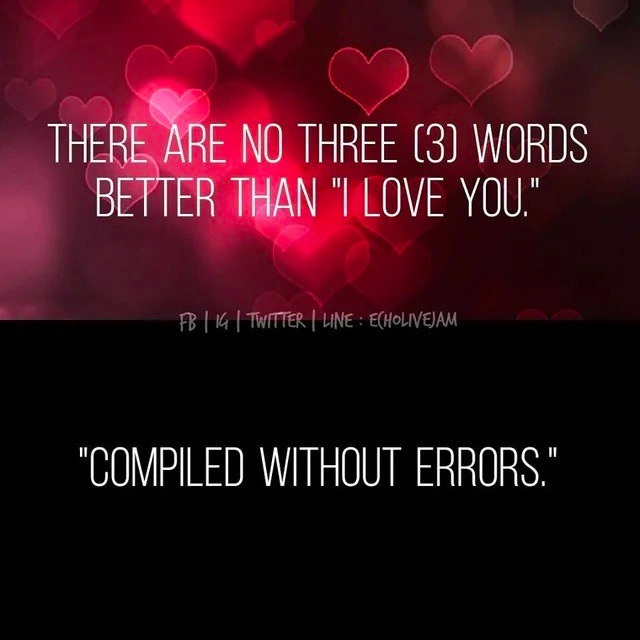
The juxtaposition in the meme sets up a fake-out: a romantic backdrop with “There are no three words better than ‘I love you.’” – something anyone would expect – versus the punchline “compiled without errors.” This romantic_vs_compilation contrast is hilarious because it’s so true for developers. Our loved ones might not get it, but the RelatableHumor here is that a machine’s approval can sometimes light up our day more than human affection (tongue-in-cheek, of course!). It highlights the passion developers have for their craft. Shipping code that works is an emotional experience! The meme’s claim that senior engineers prefer those magic build words over a love confession is an exaggeration with a grain of truth: after all the heartbreak from failing builds, success is addictively sweet.

For senior engineers in particular, this resonates because they’ve been through the wars of software development. They’ve had on-call disasters trace back to one missing semicolon or a one-line syntax error that took systems down. They’ve experienced the grind of large codebases where a single error in one module can cascade into dozens of compile errors due to dependencies. Over time, you develop a real appreciation for even the absence of errors. Hearing nothing but silence from your compiler (or perhaps a gentle “build successful” message) is like a warm blanket of reassurance. It’s the senior love language: stability, predictability, and things working as intended. While a junior might still be learning why that matters, a senior has lived it – hence the meme winking at senior devs specifically.

This meme format of “better than ‘I love you’” is a classic in CodingHumor circles. You’ll find variations for all sorts of nerdy joys. For example, some developers swoon over the phrase “all tests passing”, others over “no merge conflicts”, or the ever-romantic “it works on production.” These three-word phrases are the love letters of our industry. TechHumor often elevates these mundanely glorious moments to mythical status. By declaring “compiled without errors” as the ultimate trio of words, the meme is basically saying: if you want to make a programmer smile, you don’t need roses or poetry – just give them a bug-free build. It’s a humorous exaggeration, of course – we do value human love (promise!). But in the daily rollercoaster of coding, a successful compile is a pure bliss moment. For a senior engineer who’s been around broken builds and crazy deadlines, those words are like music. They mean: You can finally run the program! No more staring at a wall of red error text. Time to hit execute and see some results. That confidence boost is sometimes all you need to feel on top of the world. In short, the meme pokes fun at how our priorities can skew when we’re deep in the code mines: the heart wants what the heart wants, and sometimes it really just wants a clean compile.

Level 4: Syntax Serenade

At the heart of this meme lies a deep truth about compilers and code: formal correctness can feel profoundly satisfying. When your program finally reports “compiled without errors”, it means the source code has successfully navigated the compiler’s rigorous checks. A compiler isn’t swayed by emotion – it’s a strict grammar enforcer. Every semicolon, every brace, and every type declaration must be in its rightful place. The phrase is essentially a certificate of syntactic and semantic correctness. In contrast, “I love you” is a natural language expression, rich in emotion but inherently ambiguous to a machine. A computer has no idea what love means in English, but it absolutely understands a syntactically perfect piece of code. From a language theory perspective, hearing “compiled without errors” is like a sweet song to a programmer’s ears because it signifies their code conforms to an exacting formal specification (something far less subjective than human love!).

Under the hood, compiling code involves several stages, each an opportunity for errors to be caught:

  • Lexical Analysis: The source code text is broken into tokens (identifiers, keywords, symbols). If you accidentally put a weird character or forget a quote, the lexer will throw a fit.
  • Parsing: The tokens are arranged into a structured representation, often an Abstract Syntax Tree (AST), according to the language’s grammar rules. A missing semicolon or misordered parenthesis here is like hitting a sour note in the music of code – the parser will complain that your code doesn’t “sound” grammatically correct.
  • Semantic Analysis: The compiler then checks deeper logic – are all variable types matching up? Are you trying to call a function that doesn’t exist? This is where type checking and name resolution happen. If you declared a variable as an int but try to use it like a string, you’ll get an error. It’s akin to making logical sense of a sentence; if something doesn’t semantically line up, the compiler protests.
  • Code Generation & Optimization: Only after passing syntax and semantic checks can the compiler translate code into machine code or bytecode and optimize it. If anything was amiss earlier, it wouldn’t even reach this stage.

When the compiler finishes all these stages without errors, it’s essentially saying your code adhered 100% to the formal rules of the language. That success state triggers a unique joy in developers. In theoretical computer science, we sometimes compare program correctness to a proof. Thanks to concepts like the Curry-Howard correspondence (which maps programs to proofs), a clean compile can feel like you’ve proven a theorem true. It’s a moment where the math, logic, and syntax of your program all align. No wonder it’s so euphoric – you’ve convinced the ultimate picky reader (the compiler) that your “essay” (code) is flawless. For a seasoned engineer, that concise compiler message is a proof of sanity in the sea of complexity that is software development. It’s a bit like a Q.E.D. at the end of a long proof, but in compiler terms, it outputs a binary. Compiled without errors? That’s the sound of computational harmony.

Yet, any wise coder knows this is just one victory. The program might still crash at runtime or produce the wrong output (logical bugs don’t trigger compile errors!). But in that fleeting moment, when no compile errors remain, there’s a genuine sense of accomplishment. It’s a semantic serenity – the assurance that, at least from the language’s standpoint, your instructions make sense. Humans say “I love you” to convey deep acceptance; compilers say “no errors” to convey absolute syntactic acceptance. In the realm of Compilers, that’s as affectionate as it gets. The meme humorously elevates this dry, technical confirmation to the height of romantic devotion. It tickles us because, on a fundamentally rational level, a clean compile is unambiguous and earned – something a room full of developers might just prefer hearing over any sweet nothing.

Description

This is a two-panel comparison meme. The top panel has a romantic, dark red background with glowing, out-of-focus hearts. The white text reads, 'THERE ARE NO THREE (3) WORDS BETTER THAN "I LOVE YOU."'. Below this, there is a social media handle watermark: 'FB | IG | TWITTER | LINE : E(HOLIVE)AM'. The bottom panel provides the punchline, with a plain black background and bold white text stating, '"COMPILED WITHOUT ERRORS."'. The meme humorously asserts that for a software developer, the feeling of successfully compiling a program without any errors is a moment of pure joy and relief that surpasses even the most profound expressions of love. It speaks to the often arduous process of writing and debugging code, where a clean compile marks a significant victory and a moment of peace before the next phase of testing and potential runtime bugs begins
Comments

7
Anonymous ★ Top Pick Sure, 'I love you' is nice, but it doesn't guarantee that the relationship will run without exceptions. 'Compiled without errors' is a promise, albeit a very temporary one
  1. Anonymous ★ Top Pick

    Sure, 'I love you' is nice, but it doesn't guarantee that the relationship will run without exceptions. 'Compiled without errors' is a promise, albeit a very temporary one

  2. Anonymous

    After 20 years of watching CI pipelines, I’ve learned the fastest way to spike team morale is still a green build - HR can keep the trust-fall exercises

  3. Anonymous

    After 20 years in this industry, "compiled without errors" just means the real bugs are now runtime problems that'll surface in production at 3 AM on a holiday weekend

  4. Anonymous

    After 20 years in the industry, you realize 'compiled without errors' is just the beginning of a toxic relationship - it's what the code does at runtime that really matters. But that first clean compile? Still hits different every time

  5. Anonymous

    “Compiled without errors” is the honeymoon; the linker and prod traffic are the in-laws

  6. Anonymous

    Compiled without errors - music to a senior dev’s ears, right until the linker whispers: undefined reference

  7. Anonymous

    Forget 'I love you' - in a monorepo with 47 languages, 'compiled without errors' is the unicorn that actually deploys

Use J and K for navigation