ProtonMail tweet denounces Russian blocking, defends encryption and free speech rights
Why is this DataPrivacy meme funny?
Level 1: Bully vs Secret Notes
Imagine you and your friend have a special secret code that you use to send messages to each other. You write a letter in this code so only your friend, who knows the trick to read it, can understand it. Now, think of a big bully at school who hates that you two have secrets. He can’t read your coded letters (it just looks like gibberish to him, full of random symbols), and that makes him mad. Since he can’t crack your secret, the bully decides to stop the notes from being passed at all – he tries to snatch them or tell the teacher to ban your notes. In our story, ProtonMail is like the friend who gave you that secret code system for your letters. When the bully (in this case, a powerful authority) tries to block people from sending these coded messages, ProtonMail stands up and says, “Hey, it’s not okay to silence people just because you can’t spy on them. Everyone should be allowed to talk quietly and safely with their friends!” It’s basically about keeping your private messages truly private, even when a bully tries to eavesdrop or shut it all down – and saying that’s just not fair.
Level 2: No Snooping Allowed
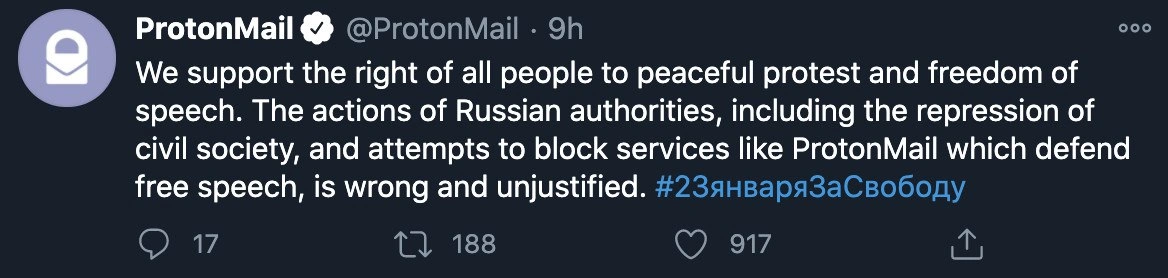
At its core, this meme is about an email service standing up to a government and saying, “Hands off our users’ data!” ProtonMail is an online email provider, but unlike typical email (say, the Gmail account you might have), it uses end-to-end encryption by default. That means if you send a message using ProtonMail, it gets scrambled into secret code on your device, travels across the internet as a jumbled cipher, and only gets unscrambled on the recipient’s device. No one in the middle – not even ProtonMail’s own servers – can read it. This design addresses major privacy concerns: traditionally, email servers could be forced to hand over your messages, but with ProtonMail’s system, handing over data is futile if it’s all locked up with someone’s password and key. In the screenshot, which looks like a dark-mode Twitter interface, ProtonMail’s official account (blue check and all) is making that point loud and clear. They tweet support for people’s right to protest and condemn the Russian government’s attempt to block ProtonMail’s service. That hashtag #23январяЗаСвободу is in Russian – it means “January 23 for Freedom,” referencing a specific day of planned peaceful protests in Russia. So, picture what happened: protest organizers or activists were likely using ProtonMail to communicate safely (because any old plain email might be monitored). The Russian authorities didn’t like that at all – since they couldn’t peek at the ProtonMail messages (thanks to the strong encryption), they tried to shut off access to ProtonMail entirely. This is what we call service blocking or censorship: preventing people from reaching a site/app at all, usually by ordering internet providers to blacklist it. It’s like the government put a giant “Internet Firewall” up that says “ProtonMail – Forbidden.” ProtonMail’s tweet is pushing back, saying it’s wrong and unjustified to silence peaceful communication. For a junior developer or anyone new to Security, this highlights why encryption matters. Terms like Data Privacy become very concrete here – it’s not abstract at all. ProtonMail built a system where your inbox is locked with your own key, so you control who reads your mail. That empowers users (like activists, journalists, or just privacy-conscious folks) to exercise free speech and communicate without fear of someone reading over their shoulder. And when a government tries the digital equivalent of yanking the phone cord out of the wall, it turns into a public battle. The meme’s image – effectively just a screenshot of ProtonMail’s tweet – might not be a typical funny haha meme, but in developer circles it’s impactful. It’s showing a tech company using social media (that’s the whole Twitter screenshot we see) to call out a powerful entity for violating fundamental rights. Imagine being a new developer on the ProtonMail team: you’d feel pretty fired up seeing your company boldly defend communication freedom in front of the world. ProtonMail basically says, “We engineered our platform to protect people’s voices. Trying to block or hack us won’t change that – it only highlights why our security is needed.” It’s a lesson in how technical design (like encryption) and social issues (like censorship) intersect in the real world.
Level 3: Encryption Strikes Back
This tweet screenshot is a tech company taking a bold public stand, and experienced developers immediately recognize the pattern: strong encryption built into a platform becomes a thorn in the side of surveillance-happy authorities. ProtonMail, based in privacy-friendly Switzerland, has architected their service so that even they cannot read user emails (they’re stored encrypted with user-controlled keys). That’s a deliberate design choice to uphold privacy and security, effectively saying “no backdoors, not even for us.” The humor (tinged with real-world tension) comes from the situation: Russian authorities are so vexed by protesters using an encrypted email service to organize that their response is basically “if we can’t snoop it, we’ll nuke it off the internet.” It’s an absurd but common retaliation – when governments face tools they can’t penetrate, they resort to blunt force like IP bans and domain blocking. We’ve seen this play out before: remember when Russia tried to block Telegram? They ended up accidentally knocking out millions of unrelated IP addresses, like a clumsy DoS on their own internet. Here, ProtonMail’s tweet is calling out that same heavy-handed approach. The tweet is a political statement in a developer’s world: a security-focused service openly condemning Russian censorship and defending users’ free speech rights. Seasoned devs nod knowingly at the #23январяЗаСвободу hashtag (which translates to “23 January for Freedom”) – it timestamps this in the context of real protests where information control was at stake. ProtonMail essentially says, “Our Communication platform is meant to empower civil society, and blocking it is unjustified.” This is the Cypherpunk ethos coming alive on Twitter: technology (in this case, encrypted email) used as a shield for human rights. The DataPrivacy and PrivacyConcerns tags aren’t just buzzwords here; they’re the crux of an ongoing battle. We recall the Crypto Wars of the 90s and the more recent clashes like Apple vs. FBI – time and again, tech companies have had to choose between user privacy or yielding to authority. ProtonMail is firmly choosing privacy. For veterans in security, there’s a bit of an inside grin: the tweet’s subtext is “Good luck, you can’t break our crypto, and blocking us just proves our point.” It’s both a stand and a subtle techie taunt. The meme resonates because it highlights a truth many developers appreciate: a well-designed secure system can make life difficult for would-be snoops. And if a government finds your code unsolvable, their only recourse is often an almost cartoonish yank of the network cable. It’s a modern David vs. Goliath: tiny encrypted bytes striking back against giant institutions – and sometimes, math wins with a retweet ratio to prove it.
Level 4: Math vs the Censors
At the heart of this meme is a clash between cryptography and censorship, where pure mathematics is thwarting state control. End-to-End Encryption (E2EE) relies on robust mathematical principles – prime factorization, discrete logarithms, and one-way functions – to secure communication. ProtonMail’s email uses asymmetric encryption (each user has a public key to encrypt and a private key to decrypt), often based on large prime numbers that create an uncrackable code under current computing limits. The computational hardness of breaking 4096-bit RSA or similarly strong keys means no government cryptanalyst can just brute-force read those emails; it’s like trying every combination on an astronomically complex lock. According to Kerckhoffs’s principle, even if Russian authorities know which algorithms ProtonMail uses (open info), it doesn’t matter – only the secret keys matter, and those remain with the users. This mathematical strength is by design: it ensures data privacy as a fundamental guarantee. So when a government attempts to snoop, they hit a wall of encrypted gibberish – ciphertext that looks like random noise without the key. Frustrated by this impregnable cipher, the only option left for an authoritarian regime is service blocking at the network level. It’s a showdown of bytes vs. bureaucracy: strong encryption transforms communication into information theoretic secrets, forcing censors to play whack-a-mole with IPs and domains since they cannot solve the underlying math. In essence, ProtonMail’s stance in that tweet is backed by the cold reality of cryptographic science: you can’t intimidate an equation or imprison a prime number. The laws of mathematics provide a neutral ground where even powerful authorities must yield, making the repression of civil society much harder in the digital sphere. This meme highlights that deep technical truth – as long as the crypto is solid, censorship is fighting a losing battle against math.
Description
Dark-mode Twitter screenshot shows ProtonMail’s verified account (@ProtonMail) posting nine hours ago. The tweet text reads: “We support the right of all people to peaceful protest and freedom of speech. The actions of Russian authorities, including the repression of civil society, and attempts to block services like ProtonMail which defend free speech, is wrong and unjustified. #23январяЗаСвободу”. Interaction icons below display 17 replies, 188 retweets, and 917 likes. Visually, the ProtonMail purple lock-logo avatar sits at left, with typical Twitter UI elements (ellipsis menu, share icon) on dark background. Technically, the image highlights the tension between end-to-end-encrypted email services and state-level censorship, underscoring privacy, security, and communication freedoms relevant to developers building resilient, censorship-resistant platforms
Comments
7Comment deleted
Authorities: “We blocked ProtonMail’s IP.” Packets: “Cute. We’re already domain-fronted, onion-routed, and ECH-wrapped - same evasive maneuvers our microservices pull whenever compliance asks for a single log file.”
When your encrypted email service gets blocked by a government, you know you've successfully implemented the 'security through obscurity' pattern backwards - security so good, they want to obscure you from their citizens
When your encrypted email service becomes so good at protecting privacy that authoritarian regimes try to block it - that's not a bug, that's a feature validation in production. ProtonMail: where your threat model includes nation-states, and your uptime SLA has a 'geopolitical interference' clause
Marketing tweets ‘we support free speech’; networking hears ‘ship TLS 1.3 ECH, rotate anycast IPs hourly, and pray domain fronting isn’t dead’
When an E2EE mail service meets state‑level DPI, the architecture review becomes an unscheduled resilience test - DNS poisoning, SNI filters, BGP blackholes - and your pager learns geopolitics the hard way
Russian firewall vs ProtonMail: Where zero-knowledge proofs clash with iron-fisted DPI - the ultimate asymmetric cipher war
Hypocrites lmao Comment deleted