Skip to content
DevMeme
2399 of 7435
When a stray space turns "double" into an undefined variable
Compilers Post #2667, on Jan 23, 2021 in TG

When a stray space turns "double" into an undefined variable

Why is this Compilers meme funny?

Level 1: Little Space, Big Confusion

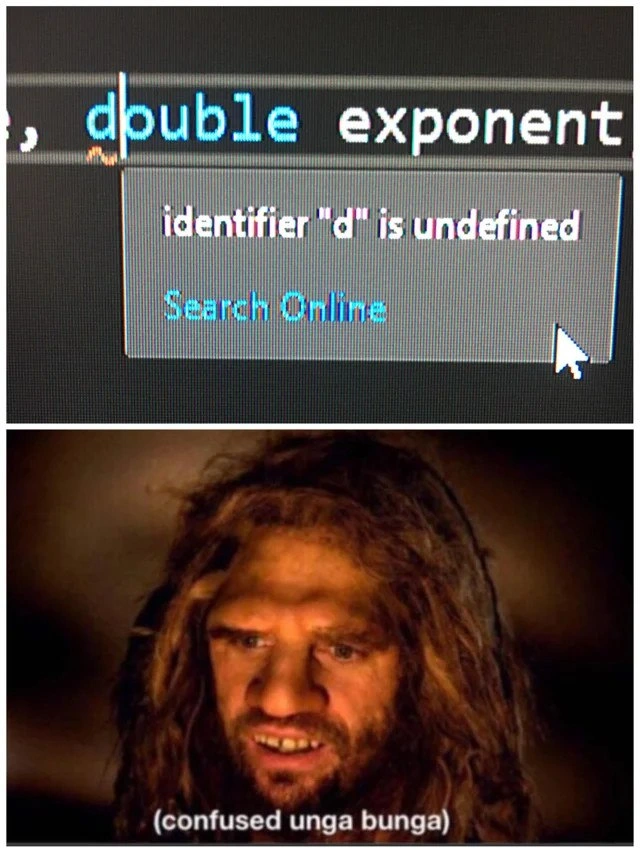
Imagine you’re reading a sentence and suddenly a word is split in half by an extra space, like “ice cream” accidentally written as “i cecream.” The sentence would sound like nonsense, right? You’d be confused, scratching your head like, “What is this ‘i’ doing here?” That’s exactly what happened in this meme, but with computer code. The programmer meant to write a normal word that the computer understands (the word “double,” which is a type of number). But they accidentally put a tiny space in the middle of the word, so the computer got totally lost and said, “Hey, I found this letter d that I don’t understand.”

In the picture, the top part shows the computer program complaining about that lonely d – it put a red underline under it and is basically saying “I have no idea what d means.” The bottom part shows a caveman with a very confused look on his face, with the caption “(confused unga bunga).” That caveman represents the programmer at that moment: completely baffled, as if he’s a prehistoric human staring at something he can’t comprehend. It’s funny because it’s such a small mistake – just an extra space – but it caused a big confusion. Both the computer and the coder are momentarily stumped. The joke is that even a tiny typo can make a smart developer feel as perplexed as a caveman trying to understand modern technology. In simple terms: one little out-of-place space in the code made everything go wrong, and the result is equally frustrating and comical. It’s a reminder to all of us that even the tiniest errors can create giant “Huh?!” moments.

Level 2: The Stray Space Error

Let’s break down what’s happening in simpler technical terms. The image shows a coding error in a C/C++ style language inside an IDE (Integrated Development Environment, like Microsoft Visual Studio). In the top panel, the code is supposed to have a parameter of type double named exponent (probably in a function signature or definition). For example, you’d normally write something like:

int power(double exponent) {
    // ...
}

Here, double is a keyword – a special word that the language reserves for its own use, in this case indicating a double-precision floating point number type. But in the screenshot, there’s a tiny mistake: the letters of double got split. It looks like d ouble exponent instead of double exponent. That stray space after the d effectively turned one word into two. Now the compiler reads it as if you wrote:

int power(d ouble exponent) {
    // ...
    // ^^^ This is not making sense to the compiler
}

The compiler or IDE is highlighting d with a red underline, meaning it sees d as a separate identifier (basically a name for something, like a variable or type). The error message “identifier 'd' is undefined” means that d is being used as a name, but the compiler has no idea what d refers to – because the programmer never defined any variable, function, or type by that name. In other words, the compiler thinks you might be referring to something called d that should have been declared earlier, but no such declaration exists. This is a classic compiler error in languages like C++: if you use a name that hasn’t been defined, the compiler will complain that the identifier is undefined.

Why didn’t the compiler recognize double? Because by inserting a space, the word double got broken. The compiler doesn’t see double as one token here; it sees d and ouble as two separate tokens (words). double only has meaning if those letters appear together with no interruption. When split apart, d just looks like a lone character identifier, and ouble looks like another token (likely also considered an identifier, ouble, which probably also doesn’t mean anything). Essentially, the compiler is very literal about the code. To us humans, it’s obvious that d ouble was a typing mistake. But the compiler can’t infer that – it follows strict rules: whitespace (spaces, line breaks) is mostly just a separator between tokens. So double must be written exactly as double. If you accidentally type dou ble or d ouble, the compiler treats it as two separate things and loses the original meaning completely.

The IDE’s behavior here is also telling. Modern coding environments underline errors as you write code (that red squiggly line under the d). When you hover over it or sometimes automatically, a tooltip pops up with the error message from the compiler (or a realtime code analyzer) – in this case, identifier "d" is undefined. There’s even a suggestion link “Search Online,” which is something Visual Studio offers to quickly look up the error. This indicates that the environment recognizes this as a compile-time error and is ready to help you find more info. It’s a bit funny, because an experienced eye might immediately catch the typo, but if you’re newer or the mistake is hard to spot, the first impulse is often to google the error message. That “Search Online” is practically a built-in Stack Overflow search button! It shows how common it is for developers to hit puzzling errors and seek answers on the internet.

So, to sum up in plain terms: the top panel shows a bug caused by a simple typo – a space in the wrong place – leading to a syntax error/compile error. The term “identifier is undefined” means the compiler encountered a name (d) that it doesn’t recognize because it wasn’t declared. The developer who wrote the code is likely confused why the compiler is complaining about d when they intended to write double. This kind of mistake falls under everyday debugging and troubleshooting for developers: you run the code or compile it, you get an error, and then you have to figure out what went wrong. Often it’s a simple fix (remove that space), but finding it can take a moment. The meme captures that “Aha!” (or “D’oh!”) moment when you realize a tiny slip caused the issue. The bottom panel’s caveman image labeled “(confused unga bunga)” is a humorous way to show the developer’s face when facing this confusing error message before realizing the cause. It’s saying: Even a modern programmer can feel like a confused caveman when a single space breaks their code. It’s a lighthearted reminder that small mistakes in coding can lead to big confusion, and it happens to everyone, from beginners to pros.

Level 3: Double Trouble

Experienced developers will chuckle (and maybe cringe) at this scenario because it perfectly encapsulates classic debugging frustration caused by a tiny mistake. The meme’s top panel is a screenshot of an IDE (Visual Studio, judging by the dark theme and styling) with a red squiggly underline under a lone d in what was meant to be the type declaration double exponent. Thanks to an accidental space, the keyword double got split into d and ouble. This triggers a compiler error: “identifier 'd' is undefined.” In other words, the compiler thinks you’re referring to some variable or type named d that it has never heard of. The humor here is that as developers, we’ve all been in this exact situation: the code is almost correct, but some trivial typo sends the compiler on a wild goose chase and it responds with an error message that leaves us feeling confused. It’s a double whammy of trouble – our intended double turned into an undefined symbol and now nothing makes sense.

Why is this so funny (or painful) to those in the know? Because it’s so trivial yet so disruptive. A single whitespace character is basically invisible to our eyes – especially if you’re tired or the font doesn’t make it obvious – but it’s enough to break the code. The compiler is a strict language parser; it doesn’t do guesswork. So instead of understanding what we meant, it faithfully reports what it sees: “there’s some identifier d here I can’t resolve.” Meanwhile, the hapless programmer is staring at the error message thinking, “What on earth is ‘d’? I didn’t write a d anywhere…” It’s the kind of bug that can make you feel like that caveman in the bottom panel, staring into the mysterious glow of the screen with a primitive, perplexed expression. The caption “(confused unga bunga)” is a popular meme phrase that exaggerates how one feels when confronted with something that makes no sense – in this case, how a perfectly ordinary line of code has inexplicably blown up. It’s developer humor gold because it dramatises the primitive confusion we experience when the tools we use (compilers, IDEs) communicate in cryptic ways about problems we introduced unknowingly.

There’s also an element of shared war-story in this meme. Every seasoned coder has lost time to a dumb typo or an extra whitespace or a missing semicolon that produced baffling errors. It’s practically a rite of passage. That red squiggly line and the pop-up “identifier is undefined” is an IDE’s way of flagging a compile error as you type. In Visual Studio, for example, you get that little tooltip with the error and even a "Search Online" button. The inclusion of “Search Online” in the screenshot is hilariously relatable – it’s like the IDE saying “Even I don’t know what you meant, maybe Stack Overflow does.” As senior devs, we’ve all clicked that or copied the error text into Google, only to facepalm when we realize the cause was something embarrassingly small. The meme hits on the bug hunting reality: sometimes the compiler’s error messages seem obtuse until you discover the silly mistake behind them. It’s both comforting and comical to see that others have these “unga bunga” moments too, staring at an error in confusion until the obvious typo reveals itself.

This situation also pokes fun at how literal our tools are. The language’s syntax rules don’t allow any wiggle room – either you write double exactly, or the compiler has no idea what you’re talking about. There’s no fuzzy matching or “did you mean…?” for a fundamental keyword (compilers usually assume you know how to spell the language’s own words). So a tiny space character summoned the mighty wrath of the compiler’s error checks. It’s debugging 101: when something that should work just refuses to compile, check for the dumb stuff – missing characters, typos, invisible characters (like a sneaky zero-width space or the wrong kind of quotation mark). In this meme’s scenario, the developer likely spent a few bewildered seconds (or minutes) scanning the line, only to perform a classic forehead slap upon spotting the rogue space between d and ouble. The humor has a cathartic edge: we laugh because we’ve overcome this exact annoyance ourselves, and we remember the mix of embarrassment and relief when the mystery was solved. “Double” became “d + ouble”, and of course the caveman brain in us momentarily took over as we grunted at the screen in confusion. Been there, done that.

Level 4: Tokenization Tripwire

At the deepest level, this meme highlights a subtle compiler lexical analysis pitfall. In compiled languages like C/C++, source code is processed by a lexer that breaks the input text into meaningful symbols called tokens. The keyword double is supposed to be recognized as a single token (a reserved word indicating a double-precision floating-point type). However, a stray whitespace in the middle (d ouble) disintegrates the token. The lexer encounters d followed by a space, assumes d is a complete token (since it no longer matches the reserved word pattern), then sees ouble as the start of a new token. This unintended token boundary is a classic tokenization tripwire: a tiny, invisible delimiter (a space character) changes the token sequence and hence the meaning of the code completely.

Under the hood, the compiler’s grammar rules expect a valid type token in that function parameter list. Instead, it gets an identifier token d where a type is expected. The compiler’s parser tries to make sense of it – perhaps thinking d might be a user-defined type or variable. Since no definition for d exists in any symbol table or context, the compiler throws a diagnostic: identifier "d" is undefined. This error is semantically correct from the compiler’s point of view but utterly baffling to the developer, who intended to write the keyword double all along. The code has essentially been sliced into gibberish: the reserved word was sundered into two unrecognized pieces.

This is an interesting edge case in language design: in languages derived from C, whitespace serves as a delimiter between tokens but is otherwise mostly ignored. The compiler won’t magically “fill in” or reattach pieces of a broken keyword – the lexical analysis is a deterministic, mechanical process, not a human mind that can guess your intent. Formal language theory tells us that once the lexer splits the input, those tokens are final for parsing; the parser can’t retroactively fuse tokens that were separated. In a sense, the compiler is literally syntax-blind to the fact that d ouble was meant to be double – it only sees a misplaced identifier. This is why such a minuscule typo leads to a seemingly unrelated error message. The humor (for seasoned developers with a dark sense of irony) is rooted in the disproportionate impact of a single character: a lone space causing a cascade of compile-time confusion. It’s a reminder that in programming languages, exact spelling and tokenization are paramount – one character out of place and you’ve exited the happy path of the grammar into a world of compiler bafflement.

Modern IDEs and compilers do attempt to help in these scenarios. Some compilers might even recognize common mistakes or offer suggestions (“did you mean double?”), but in many cases – especially with a split token – the compiler’s error recovery can only report the first thing it finds wrong. Here it stops at d, reporting it as undefined. The tooltip popover shown in the IDE is the immediate feedback from the integrated compiler or static analysis: a low-level explanation that doesn’t realize a keyword was mistyped. The inclusion of a “Search Online” link in the tooltip is almost comical in itself – as if the development environment is shrugging and saying “I have no clue what d means either, maybe try the internet?”. This speaks to a truth in compiler design: while compilers are good at pinpointing where they got confused, they often can’t divine what you really meant. A single whitespace here transformed a valid keyword into two tokens that violate the language’s grammar, and the poor compiler can only throw up its hands (with a red squiggly line) and report the first symptom of the problem. In essence, the meme underscores a fundamental compiler principle: garbage in, garbage out – if the source text deviates even slightly from the language’s defined lexemes, the machine’s response will be as nonsensical to us as our typo was to it.

Description

The meme is split into two panels. Top panel: a close-up of a dark-themed IDE (looks like Visual Studio) showing a function parameter list where the keyword "double" has been mistyped so that the letter "d" is isolated from "ouble". The single "d" is underlined with the classic red squiggle, and a grey tooltip appears saying: identifier "d" is undefined, with a blue hyperlink reading "Search Online" and a mouse cursor hovering nearby. Bottom panel: a reaction image of a long-haired caveman lit by firelight, staring blankly; white subtitle text reads “(confused unga bunga)”. The juxtaposition pokes fun at how a tiny whitespace typo confuses the compiler and leaves the developer equally puzzled, highlighting everyday compiler diagnostics, syntax errors, and debugging frustration familiar to anyone working in C/C++-style languages
Comments

13
Anonymous ★ Top Pick After twenty years designing fault-tolerant clusters, one rogue space still turns ‘double’ into an undefined ‘d’ - proof the true single point of failure is the spacebar
  1. Anonymous ★ Top Pick

    After twenty years designing fault-tolerant clusters, one rogue space still turns ‘double’ into an undefined ‘d’ - proof the true single point of failure is the spacebar

  2. Anonymous

    After 20 years in the industry, you'd think we'd have better error messages than 'identifier d is undefined', but here we are, still playing detective because someone thought single-letter variables were a good idea in a 10,000 line codebase

  3. Anonymous

    That moment when your IDE's parser has a stroke and decides 'double' is actually ',d ouble' - because clearly you meant to declare a variable named 'd' followed by some mysterious 'ouble' keyword. It's the digital equivalent of your spell-checker insisting you meant 'duck' when you clearly typed something else. At least the 'Search Online' button is there to help you discover that yes, other developers have also experienced their IDE's existential crisis over basic type declarations

  4. Anonymous

    ** for power, but IDE spots 'd' as the missing link - unga bunga debugging ensues

  5. Anonymous

    IntelliSense raising C2065 for the letter ‘d’ is just CI for keystrokes - 99.9% false positives until the AST finishes compiling in your head

  6. Anonymous

    Static typing has enterprise change control baked in: propose a new domain entity called ‘d’ via fat finger and the parser instantly NACKs it - no RFC, no Jira, just backspace

  7. Deleted Account 5y

    What the hell?

    1. @isthistelegram 5y

      Intellisense

  8. @batov_n 5y

    WSL meme time

  9. @LastStranger 5y

    Have the same problem in mvs

  10. @LastStranger 5y

    If my code doesn't have errors, mvs will come up with an error

  11. M 5y

    Man, I laughed so much on this.

  12. M 5y

    😂😂😂

Use J and K for navigation