Skip to content
DevMeme
6631 of 7435
Programming Languages Political Compass Alignment Chart
Languages Post #7265, on Oct 13, 2025 in TG

Programming Languages Political Compass Alignment Chart

Why is this Languages meme funny?

Level 1: Favorite Flavor Feud

Imagine a group of friends arguing over which kind of ice cream is the best. Each friend has their favorite flavor, and they start making up funny stereotypes about anyone who prefers a different one. One kid says, “People who like vanilla are boring rule-followers!” Another kid yells, “Oh yeah? Chocolate fans are all old-school and stuck in the past!” Someone else with a wacky new fruit flavor boasts, “Mine is special and only cool people know about it. Sure, maybe you can’t even buy it in stores, but that’s because it’s for true ice cream experts!” Meanwhile, the kid eating the basic popsicle chimes in, “I just like this because it’s simple and anyone can enjoy it. Your fancy flavors are too much trouble.”

They even draw a big chart on the sidewalk. At the top of the chart they write “Strict and Ordered” and at the bottom “Free and Wild.” On one side they put “Traditional” and on the other side “New and Bold.” Then they place each ice cream flavor (or group of flavors) in a box on this grid, as if they’re political candidates or sports teams. It’s completely silly – they’re treating ice cream choices like serious ideologies! They say things like, “Vanilla – Traditional + Strict: only huge companies serve this flavor and you must eat it their way,” and “Crazy Rainbow Sherbet – Wild + New: invented by rebels, it’s so chaotic it doesn’t even have a recipe, people just dump whatever candies they want in it!” They’re giggling because none of these claims are really true in a serious way – they’re exaggerating for fun.

The humor here comes from how overly serious the kids are acting about something as personal and simple as ice cream flavors. We all know ice cream is a matter of taste – no right or wrong, just what you like. But the friends are parodying big debates by mapping their preferences onto an official-looking chart. It’s funny because it’s like they turned a little friendly teasing into a faux “flavor politics.” In the end, everyone still gets to enjoy their ice cream, of course. The chart and the stereotypes are just playful jokes.

This meme is doing the same thing, but with programming languages instead of ice cream. Programmers sometimes get into spirited debates about their favorite tools, almost like kids defending their favorite flavor or sports team. It’s taking that playful rivalry and drawing it as a big chart with extreme labels, to poke fun at how absurd it can be when we forget that, just like ice cream, a lot of it comes down to personal taste and purpose. Everyone’s dessert (or language) can be the best for them, and that’s okay – it doesn’t really need a political compass to tell us so!

Level 2: Tribes of Code

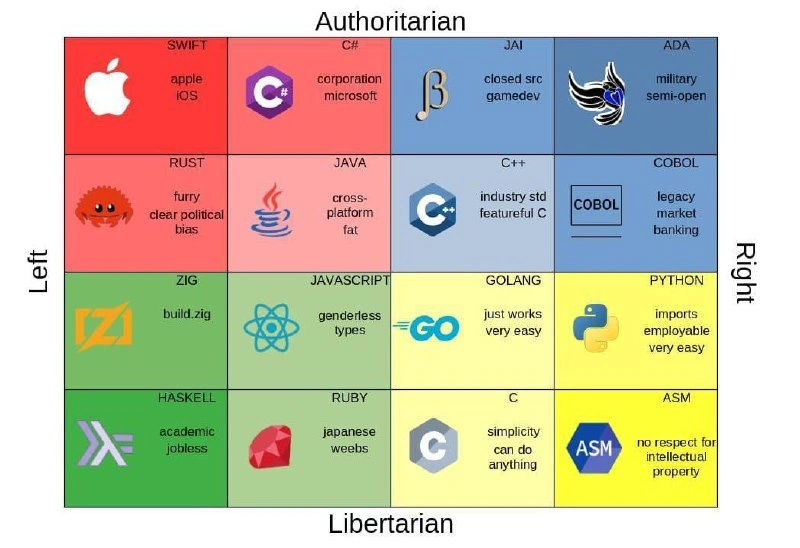
Let’s break this down in simpler terms. This meme shows a grid (four rows by four columns) with different programming language logos in each cell, kind of like an alignment chart or a “political compass” graph. Each axis of the chart has a label. The vertical axis goes from “Authoritarian” at the top to “Libertarian” at the bottom. In non-political terms, that’s describing how controlled or free the language’s world is. A language up in the “Authoritarian” zone tends to be one where there are strict rules or a controlling organization (like a big company) behind it. A language down in the “Libertarian” zone is more free-form – it lets programmers do pretty much whatever, and its community isn’t dominated by any single authority.

The horizontal axis goes from “Left” on the left side to “Right” on the right side. Here, “Left” versus “Right” is used playfully to indicate progressive vs. conservative tendencies in the programming community or the language’s philosophy. “Left” in this context means innovative, cutting-edge, or aligned with newer ideas (and sometimes a bit idealistic). “Right” means traditional, established, and aligned with older, time-tested practices (sometimes a bit old-fashioned or purely practical). So, each language gets placed somewhere in these four quadrants based on those two axes.

Think of it this way:

  • Top row (Authoritarian) = languages with strong guidance or restrictions (from a company or design)
  • Bottom row (Libertarian) = languages that are free-for-all, giving a lot of freedom to the coder
  • Left column (Left/progressive) = communities or languages that embrace new philosophies or are somewhat counter-culture in tech
  • Right column (Right/traditional) = communities or languages that stick to older traditions or mainstream, practical use

Now, in each cell of the grid, the meme shows a language logo, the language’s name, and some snarky descriptors (snarky means jokingly sarcastic descriptions). These descriptors are stereotypes – exaggerated generalizations – about the typical users or culture of that language. Let’s go through them group by group:

Top-Left Quadrant (Authoritarian + Left):

  • Swift – Logo: the white silhouette of a swift bird on an orange background (or the Apple logo, which was mentioned). Swift is Apple’s programming language for iOS and macOS apps. It’s labeled “apple iOS.” Authoritarian fits because Apple is in control of Swift’s ecosystem – if you write Swift, you’re probably developing for Apple devices, and Apple sets strict rules on app development and distribution. It’s left-leaning here maybe because Swift was a new, modern move by Apple (replacing the old Objective-C) and they even made it open-source (progressive in spirit, compared to their older closed approach). The community stereotype: Swift developers are often enthusiastic Apple followers – doing things “the Apple way.” They live in a tightly curated world (Xcode, App Store guidelines), which is the authoritarian aspect, but they believe they’re using the latest and greatest language tech for mobile, which is the progressive side.

  • C# – Logo: a purple hexagon with “C#”. It’s labeled “corporation microsoft.” C# was created by Microsoft for the .NET framework (around 2000). It was very much a corporate answer to Java. So, authoritarian: yes, historically you were in Microsoft’s universe, using Visual Studio, following Microsoft’s documentation and updates. Over time C# and .NET have become more open (today .NET is cross-platform and open-source), but there’s still a sense that the direction comes from Microsoft’s design teams. It’s slightly to the left of center here because, at least at its birth, C# was the new challenger to Java (which was Sun/Oracle’s thing). So it had a bit of a “disruptor” vibe in early 2000s, introducing new features to outdo Java. The stereotype on the chart simply highlights that C# folks often work in enterprise/corporate environments (banks, big IT departments, etc.), basically saying “this is the Microsoft crowd.”

Top-Right Quadrant (Authoritarian + Right):

  • JAI – Logo: kind of a stylized β (beta) symbol. Labeled “closed src gamedev.” JAI is an interesting one because it’s not widely known unless you’re deep into programming communities. It’s a new language being developed by Jonathan Blow (a famous game developer known for games like Braid). It’s closed source (meaning the source code of the language compiler is not publicly available for others to see or contribute to). So “closed src” is literally why it’s authoritarian – one guy calls the shots and you can’t access the internals yet. “gamedev” means it’s targeted at game development. JAI is placed on the right side because it isn’t trying to revolutionize programming theory; it’s aiming to be a very practical, efficient language for making games (which is a fairly commercial, straightforward goal – no big social or academic mission). The community around JAI is small and revolves around one person’s vision, so it’s a bit like a tiny dictatorship in language form (albeit a possibly benevolent one if you like Jonathan Blow’s ideas). The stereotype here is that people excited about JAI likely share a certain mindset: they may dislike the complexity of C++ (common in game dev) and also not be fans of more “progressive” new languages like Rust. They’re following a single leader’s project, which leans rightward in this meme’s terms (one strong vision, not a committee or community consensus).

  • ADA – Logo: a winged shield or something similar (Ada’s icon often has like an eagle or a military emblem vibe). Labeled “military semi-open.” Ada is a language created in the late 1970s under contract from the U.S. Department of Defense. In fact, the DoD required its use for many projects for a long time. That’s about as authoritarian as it gets – imagine a general saying “All defense software must be in Ada.” Ada was designed for reliability and correctness, often used in things like avionics (airplane software), rockets, and other safety-critical systems. “semi-open” suggests that Ada is standardized (ISO, etc.) and has open-source implementations (like GNAT), but it’s not a language that grew organically from a grassroots community; it was very much top-down in origin. On the right-hand side because Ada is not exactly trendy or cutting-edge now – it’s used in very conservative industries (military, aerospace, some banking). Ada’s community stereotype: very strict, detail-oriented engineers (the language notoriously enforces a lot of rules at compile time to prevent errors). It’s not widely used by hobbyists; it’s used when software must not fail. So think of Ada folks as the no-nonsense, possibly older-generation engineers who prioritize safety over cool new features – hence more “traditional” or right-leaning in the meme’s schema.

Second Row (Moderately Authoritarian, middle of vertical axis): This is just below the top row, meaning these languages have some structure or controlling influence, but not as rigid as the top row.

  • RUST – Logo: a cute red crab (Rust’s unofficial mascot, Ferris). Text: “furry clear political bias.” Rust is a system programming language introduced in the 2010s, focusing on memory safety and concurrency. It was originally a Mozilla project. Rust is moderately authoritarian in that it has very strict compile-time checks – the compiler is famously picky (it won’t let you compile until your code is correct in terms of memory safety, lifetimes, etc.). Its community also established a formal Code of Conduct and a structured RFC (request for comments) process for improvements. In other words, Rust is not a chaotic free-for-all; it’s carefully managed by a core team and now a foundation. Now the “left” part: Rust’s community culture is known for being progressive and modern. “clear political bias” is pointing to the fact that many influential people in the Rust community openly advocate for inclusivity, safe spaces, and potentially have personal progressive political views. Without diving too deep: there have been some internet flame wars with certain programmers accusing Rust community of being “too political” (e.g., banning certain hate symbols, being strict about respectful communication). “furry” here is a humorous poke at a specific subculture in the Rust world: a notable number of Rust contributors identify as furries (people with an interest in anthropomorphic animal characters, often with unique personas or avatars). This is just an odd, fun fact – the Rust community tends to be very welcoming of different identities, and it turned out quite a few are furries, which became a lighthearted meme of its own. So the descriptor is saying: Rustaceans (Rust fans) are sometimes characterized (half-jokingly, half by critics) as very politically correct and possibly literal Furries. The reality of course is Rust is a serious language with serious engineers – but yes, its community culture is more openly socially conscious than, say, the C community, which some find amusing.

  • JAVA – Logo: a steaming coffee cup (since Java is named after coffee). Text: “cross-platform fat.” Java is one of the most widely used programming languages (since mid-90s). “Cross-platform” refers to Java’s big marketing point: a Java program can run on any operating system that has a Java Virtual Machine (JVM). Write once, run anywhere – that was Java’s promise. It achieved that by having this big runtime environment (the JVM) that is the same everywhere. Now, “fat” is the not-so-kind joke. Java programs (especially in enterprise settings) had a reputation for being heavy or bloated – requiring lots of memory, having many layers of abstraction and big frameworks (like JEE, huge application servers). Think of a simple task taking dozens of config XML files and factory classes – that’s the “fat.” The community stereotype: Java developers are often enterprise folks who value stability and backwards compatibility. Sun Microsystems (and later Oracle) had a lot of influence on Java – so while there’s community input, it’s somewhat authoritarian in that a formal body (JCP) decides the language evolution. On this chart Java is near the middle horizontally because it’s not as culturally edgy as, say, Rust or Python’s community; but it’s also not as conservative as COBOL or Ada in mission. It sits kind of neutral/traditional. Many see Java as the workhorse language – reliable, everywhere (from Android apps to server backends), but not exactly “cool” or slim. The meme is basically teasing Java devs as possibly corporate, dealing with giant monolithic apps that consume a ton of RAM (hence fat).

  • C++ – Logo: a blue hexagon with “C++”. Text: “industry std featureful C.” C++ is basically an extension of C (hence the name – “++” implies an increment or adding on top of C). It’s been around since the 1980s and is used heavily in industry (systems software, games, high-performance applications). “industry std” means it’s the industry standard for a lot of native applications – if you’re writing a performance-critical app, C++ is a common choice. “featureful C” is a playful phrase to indicate that C++ has a lot of features compared to C. Over the years, C++ grew to include object-oriented programming, templates (which enable generic programming), exceptions, etc. It’s powerful but complex. Stereotype: C++ programmers pride themselves on knowing all these intricate features and using the right ones to write efficient code. The language is managed by a committee (ISO standard), so in that sense it’s somewhat authoritarian (not one person, but a group of experts decide its direction every few years). However, that committee is influenced by big companies (Microsoft, Google, etc. all have folks on it) and the process is formal. So not as free-form as say Python’s open community proposals. On the left-right axis, C++ is to the right side: it’s not trying to be avant-garde; it’s maintaining decades of legacy while slowly evolving. It’s seen as more conservative because it emphasizes backward compatibility and doesn’t throw out old stuff easily. People joke that C++ carries all of C’s baggage plus its own – hence featureful and maybe a bit overloaded. A young trendy coder might see C++ community as old-school or overly concerned with efficiency and control, whereas C++ folks see themselves as pragmatic and grounded in reality.

  • COBOL – Logo: just the word “COBOL” in a gray box typically. Text: “legacy market banking.” COBOL is one of the oldest programming languages still in use (developed around 1959!). It’s famously used in business, finance, and administrative systems (like a lot of bank back-ends, insurance company systems, and government data processing). “legacy” means it’s from an older generation but still around – often not because people want to code in it, but because it’s embedded in critical systems that haven’t been rewritten. “market” probably refers to business market / financial market – COBOL was built for those domains. “banking” is a prime example: tons of banking software is COBOL running on mainframe computers. The stereotype: COBOL developers are often older, or if younger, they learned it specifically to maintain legacy systems because it pays well (a niche skill). The language itself is very verbose (an if statement in COBOL might be a full English sentence). It was created by committee with government oversight, which is authoritarian in origin. On the horizontal axis, COBOL is far right because nothing screams traditional like a language from the 60s that hasn’t changed much and is used by conservative industries to this day. There’s no radical community around COBOL – it’s almost invisible, until something breaks. Then suddenly everyone’s reminded how crucial but antiquated it is (“We need COBOL devs urgently to fix unemployment system!” was a real headline in some states a few years back). So in the meme, COBOL represents that far-end of tradition and corporate legacy. It shares the authoritarian row because the environments it runs on (like IBM mainframes) and the nature of its usage are highly controlled (not just anyone can deploy code to a bank mainframe, there are strict processes).

Third Row (Moderately Libertarian): These languages allow more freedom and are often more community-driven or permissive, but they’re not the absolute extreme of “anything goes.” We see a lot of popular modern languages here.

  • ZIG – Logo: a yellow-green zigzag or lightning bolt with the word Zig maybe. Text: “build.zig”. Zig is a relatively new language (mid-2010s) aimed at systems programming, created by Andrew Kelley. It’s like an alternative to C or Rust – focusing on manual memory management but with some modern improvements (no hidden control flow, ability to use compile-time code execution, etc.). “build.zig” refers to Zig’s build system. In Zig, project build configurations are done by writing a Zig script (commonly a file literally named build.zig). So instead of using Make or CMake (common external build tools in C/C++ projects), Zig incorporates its build instructions within the language. This is a bit of an in-joke: if you hang around Zig community, they emphasize how having one way to build things (the Zig way) is beneficial. Others might find it oddly self-contained, but Zig folks like it. Zig is placed on the left because it’s part of a new wave challenging older languages (progressive in the programming sense). It doesn’t carry C/C++ legacy cruft; it tries some new ideas (for instance, no classical OOP, and a fresh approach to error handling). It’s libertarian-ish because it’s open source, community-involved, and gives the programmer a lot of low-level control (like C does). But maybe not all the way at the bottom because the language still guides you in certain ways (it’s smaller and more opinionated than pure C, albeit nowhere near something like Java’s heavy structure). The stereotype: Zig developers are often performance enthusiasts who got a bit frustrated with either C++ being too complex or Rust being too strict. They want a middle ground where they are free to control things but with a nicer tooling and safety net. Being new and small, Zig’s community is a tight-knit, passionate bunch – kind of the underdog vibe (hence leftish).

  • JavaScript – Logo: interestingly the meme shows a React.js logo (the atom-like icon) for JavaScript, which is a bit odd since React is a framework/library in JavaScript, not the language itself. Perhaps they chose it because it’s a well-known icon and JavaScript’s official logo (the letters “JS”) isn’t as iconic. Text: “genderless types.” This is referring to the dynamic typing of JavaScript. In JS, you don’t declare types for variables; a variable can hold a number at one moment and a string the next. This flexibility is joked about as “types with no gender” – i.e., they’re fluid and can change. It’s a cheeky metaphor (in the real world, gender fluid vs in code type fluid). JavaScript is moderately libertarian: there isn’t a single company controlling JavaScript now (it’s standardized by ECMA, and multiple companies implement it in browsers). Developers have a lot of freedom in how they write JS – you can write in different styles, use myriad frameworks or none at all. It’s chaotic and creative. On the left-right line, JavaScript is not all the way left (because it’s extremely popular and mainstream now, powering huge parts of the industry), but it definitely started as a kind of rebel (remember, it was once seen as a toy language for making animations in the browser, not a “serious” language). Over time it’s become more respected, but its culture remains quite open to experimentation (just look at the endless stream of new libraries on npm). The community tends to be inclusive and diverse due to the sheer number of people using it (everyone from self-taught beginners making websites to hardcore front-end engineers). So it sits sort of center-left: mainstream usage but generally forward-looking and not too hung up on old traditions (the web moves fast!). The “genderless types” is a fun way to teach a newcomer: in Java or C#, a variable’s type is fixed (like it has a “gender” that can’t change – e.g., an int stays an int). In JavaScript, types are like identities that can be swapped:

    let x = 42;         // x is a number now
    x = "hello world";  // now x is a string!
    

    JavaScript won’t complain; it will just go with it. This dynamic nature is powerful but can lead to odd bugs if you’re not careful, hence it’s a point of humor and occasional frustration among devs.

  • Golang (Go) – Logo: a blue circle with the Go gopher (the cute little cartoon gopher mascot) or just the word Go. Text: “just works very easy.” Go is a language made by Google in 2009, designed to be simple and efficient for building servers and infrastructure software. The phrase “just works” sums up one of Go’s main selling points: it compiles to a single native binary that you can just run – no need for a separate runtime install (unlike Java’s JVM or Python’s interpreter). It’s also known for having a clean, minimalistic design, so it’s easy to pick up the basics. Many developers find that when they write something in Go, they rarely hit weird edge cases; the language avoids a lot of complexity that C++ or Java may have. “very easy” is how Go fans might describe it – perhaps overstating it, but indeed, companies often pick Go so that new engineers can get productive quickly (compared to, say, mastering C++ quirks). On the graph, Go sits to the right-of-center because it was built by a corporation (Google) and it’s very pragmatic and industry-focused (it’s not trying to push a new theory of programming; it intentionally left out things like generics for years to keep it simple). The community is often engineering-focused and less about ideology – more about getting things done reliably. However, it’s not far-right like COBOL or C because it’s a relatively new language (so it had new ideas like built-in concurrency with goroutines) and it’s open source from the start with a fairly modern community ethos. On the vertical axis, it’s towards libertarian because, aside from a few enforced conventions (like everyone uses gofmt to format code the same way), Go is pretty unrestrictive: it doesn’t enforce OOP or FP paradigms, it’s not going to nanny you much (for example, unlike Rust, Go will let you have data races – it’s on you to use channels or locks properly). So it gives freedom, but within a simple framework. The stereotype caption is something a Go developer might say: “I wrote it in Go, it just works and was very easy to set up.” They take pride in the simplicity and approachability.

  • Python – Logo: the two-toned yellow and blue snake icon. Text: “imports employable very easy.” Python is a hugely popular high-level language known for its simple syntax and readability. The word “import” is literally a Python keyword to include external modules/libraries. The meme highlights that Python’s strength is its vast collection of libraries for everything. Python developers often lean on imports to do heavy lifting. For example, want to parse Excel files? import pandas. Want to do machine learning? import tensorflow or import scikit-learn. There’s a running joke that Python is basically glue – you glue together libraries that are often written in C behind the scenes. So a Python script may just be a bunch of imports and a few lines of code calling those libraries. That’s efficient, but also somewhat humorous when comparing to lower-level languages where you’d implement more from scratch. “employable” suggests that knowing Python is great for getting a job – which is true. It’s taught in universities, used in scripting, web development (Django, Flask), scientific computing, you name it. So recruiters love to see Python on resumes now. “very easy” refers to the fact that Python is often recommended as a first programming language because its syntax is closer to English and you can do useful stuff with few lines. For example:

    import math
    print(math.sqrt(16))
    

    That will print 4, simple. No need to define classes or types, etc. Python is at the bottom (libertarian) because it’s very flexible: dynamic typing, no enforced way to do things (you can script quick one-liners or write large OOP systems, up to you). And its community, while it had a guiding leader (Guido, the BDFL, who stepped down in 2018), is broad and open. On the right side horizontally, Python is mainstream now – it doesn’t carry a counter-culture vibe. It’s used in academia and big corporations like Google (lots of their code is Python), and basically everywhere. So culturally, it’s more neutral/traditional at this point compared to something like Haskell or even JavaScript. The combination (bottom-right quadrant) basically tags Python as the friendly, conventional, Swiss-army knife language that lots of people use to get jobs done straightforwardly. The meme playfully exaggerates: “Python is easy and will get you hired, you just import stuff and you’re golden.” For many use cases, that summary isn’t far off!

Bottom-Left Quadrant (Libertarian + Left):

  • HASKELL – Logo: a purple lambda symbol (λ) or sometimes an H stylized with a lambda. Text: “academic jobless.” Haskell is a purely functional language that came from academia. “Academic” because it’s largely taught in universities to demonstrate functional programming concepts, category theory, and type systems. It’s known for things like monads (if you’ve heard the joke “A monad is just a monoid in the category of endofunctors, what’s the problem?” – that’s Haskell territory). As a libertarian language, Haskell has no central corporate owner. It’s an open project (Glasgow Haskell Compiler is open source). The community is relatively small and very driven by academic interests and open-source volunteers. It’s left/progressive in the programming sense: it pushes very abstract, theoretical ideas (immutable data, no side effects, laziness) that challenge the imperative norm. “jobless” is a tongue-in-cheek stab at the reality that pure Haskell jobs are few. People say learning Haskell teaches you a new way of thinking but you might not directly use it at work unless you specifically seek out a Haskell role or use it on a project by choice. It’s kind of an unfair but popular joke in programming: “Haskell programmer, unfortunately unemployable except as a Haskell programmer.” Of course, companies like Jane Street or some fintechs/hardware firms do use Haskell, but it’s niche. This label resonates because a junior might ask “should I learn Haskell?” and someone jokingly might reply “Only if you don’t need a job or if you already have one and just want to expand your mind.” So the meme positions Haskell as the ultimate idealist’s language: free and uncompromising (bottom-left), but impractical for mainstream career (hence the jesting pity of “jobless”).

  • RUBY – Logo: a red gem (ruby gemstone). Text: “japanese weebs.” Ruby was created in Japan by Yukihiro Matsumoto (Matz) in the mid-90s. It became really popular in the mid-2000s due to the Rails web framework. Ruby’s design philosophy was to make programmers happy – it’s very flexible, allows multiple ways to do something, and reads kind of like English. It’s libertarian because, like Python, it’s dynamically typed and you can monkey-patch just about anything (you can even add methods to base classes at runtime). There’s no big corporation controlling Ruby (though companies adopted it, it remained community-driven with Matz as a benevolent leader). It had a very colorful, friendly community that often emphasized fun and creativity. The “weebs” part: weeb is slang for someone who is really into Japanese culture, especially anime, who isn’t Japanese. Ruby’s origin being Japanese meant a lot of Western early-adopters playfully embraced bits of Japanese language or culture out of respect and enthusiasm. For instance, Ruby conferences in the US sometimes had Japanese food or cultural references, Ruby’s documentation would have little cartoons, etc. Also, some prominent Ruby programmers are fans of anime and such. This all makes the Ruby community feel a bit like an anime club compared to something like the Java community (more suit-and-tie, metaphorically). Calling them “Japanese weebs” is a roast – it implies Ruby enthusiasts might be a little too into the fact that Ruby is Japanese or maybe they themselves are anime geeks. It’s in good humor: many Ruby devs would chuckle and maybe even self-identify that way (“Yeah I do watch Naruto and love Ruby, so what?”). On the left axis, Ruby is placed somewhat left-of-center because when Rails came out, it was considered a “hipster” choice – a fresh, developer-friendly approach against the enterprise Java world. That was progressive at the time. It valued convention over heavy configuration, and programmer joy over strict performance. So culturally, Ruby was the cool startup language circa 2008, not the stodgy enterprise one. It’s perhaps not as radical now (lots of Rails apps run serious businesses), but it still has that artsy, passionate community vibe.

Bottom-Right Quadrant (Libertarian + Right):

  • C – Logo: a blue letter C in a hexagon. Text: “simplicity can do anything.” C is one of the oldest high-level languages still widely used (developed in early 1970s at Bell Labs). It’s the foundation of many other languages (Python, Ruby, and others are actually written in C under the hood, as are operating systems like Linux, and countless software). C is extremely minimalistic – it has a small set of keywords and features. But with those, a programmer can directly manipulate memory and the machine’s resources. That’s the “can do anything” – you have the power to write anything from a tiny microcontroller program to a complex OS, if you have the skill. The flip side of that power is you must be very careful (buffer overflows, manual memory allocation, etc.). The “simplicity” is relative: the language spec is simple, but using it correctly requires knowledge and discipline. C is libertarian because it doesn’t enforce much on you – you manage your own memory, types can be bypassed (casting from one type to another freely), and there’s no runtime environment policing your program. It’s basically just above assembly in abstraction. There’s also no single entity controlling C now – it’s standardized by an international committee, and multiple compilers exist. On the horizontal axis, C is to the right side because it’s as classic and time-tested as it gets. It’s not a newfangled experiment; it’s a workhorse that’s been around for 50 years. It’s not about new programming paradigms or academic theories, it’s about efficient, straightforward computing machinery. The community (if we consider those who love C specifically) often prides itself on understanding the machine at a low level. They might poke fun at people using garbage-collected languages or very high-level languages, because in C you have to manage everything – it’s the “real programming” in their eyes. The caption here is affectionate in a way – acknowledging that with C’s elegant simplicity, one can indeed achieve almost anything (with great power comes great responsibility, basically). For a new developer, it might be surprising that something so old is still everywhere, but once you learn about operating systems or performance-critical code, you realize C’s philosophy still wins when you need control and speed more than convenience.

  • ASM (Assembly) – Logo: a blue hexagon with “ASM”. Text: “no respect for intellectual property.” Assembly language isn’t one language but a group of languages that correspond directly to machine code instructions for CPUs. It’s as low-level as you can go in programming without toggling actual 1s and 0s. Each type of processor (x86, ARM, etc.) has its own assembly language (its own set of instructions). Assembly is fiercely libertarian: there are no rules other than what the hardware imposes. You want to overwrite memory? Go ahead and MOV a value into that memory address. You want to jump to an arbitrary location in code? Sure, set the instruction pointer. High-level languages might stop you from doing illegal operations (like accessing memory you don’t own), but in assembly, you’re the boss and also the one who will crash the system if you mess up. Now, “no respect for intellectual property” is a humorous exaggeration of what assembly programmers (especially hackers or reverse engineers) do. Since assembly is what you get when any high-level program is compiled, understanding it means you can reverse-engineer compiled software. For example, if there’s a proprietary program without source code, a skilled person can use a disassembler to get assembly code and start figuring out what that program does, maybe modifying it. This is how old copy protections on software were cracked: people would find the check in the assembly and patch it out. It disregards the original author’s intent (and sometimes license), thus “no respect for IP (intellectual property).” Also, writing in assembly gives you the freedom to exploit hardware quirks and bugs – a lot of security exploits are demonstrated in assembly because you can craft CPU instructions to do nefarious things that a normal language might prevent or at least not make obvious. Assembly is at far-right because it’s fundamental, old, and used in very pragmatic cases (like writing a fast routine or needing direct control). It’s certainly not “progressive” in language design – it’s literally the native tongue of the machine. The community around assembly is mostly hardware geeks, performance hackers, or reverse engineering folks. They often operate outside the glossy corporate world. You wouldn’t typically write a large app entirely in assembly today (that would be very slow and error-prone), but knowing some assembly is very useful for certain domains. It carries a kind of renegade mystique in programming. The meme is poking fun at that renegade nature by implying assembly devs are the type to tear down any software’s walls, ignoring legal/ethical boundaries, because at that level, code is just code. Of course, many assembly use cases are totally legitimate (writing low-level parts of an OS, optimizing critical loops, etc.), but the stereotype leans into the hacker/cracker image.

After going through all these, you might notice how each language’s description is a caricature. The meme is basically a big inside joke that you’d get if you’ve hung around programmers discussing languages. It’s mapping programming language_tribalism onto a known format (political compass). The reason it’s funny is that developer communities often do behave like tribes or factions. There are endless debates (“holy wars”) about which language is superior. Each language community tends to have its CommunityInJokes and stereotypes: e.g., “Java is enterprise and boring,” “JavaScript devs keep inventing new frameworks,” “C programmers are old-school and hate anything with garbage collection,” “Haskell people only talk about monads.” These are exaggerations, but with a grain of truth that makes them relatable.

For example, if you’re new and ever asked, “Which programming language should I learn?” you might have encountered strong, biased answers from different camps:

  • A Python developer might say, “Learn Python, it’s easy and there are tons of jobs” (aligns with that “employable, very easy” description).
  • A C++ developer might say, “Learn C++ if you want to understand how computers really work and have performance” (aligns with “industry standard, featureful (but complex) power”).
  • A Rust fan might say, “Learn Rust, it’s the future and fixes all the problems of C++ (and by the way, our community is super friendly and modern)” – though someone cynical might frame that as “Rust has an agenda or bias,” hence the meme’s wording.
  • A Haskell enthusiast could say, “Learn Haskell to really expand your mind; jobs aren’t everything – it’s about the beauty of coding” (hence academic but jobless).

The political_compass_meme format itself is often used online to humorously classify anything into four extremes. In real political compasses, you might see extreme ideologies in each quadrant. Here we see extreme programming mindsets. No one is really strictly in one box, of course – but exaggeration is the point.

For a junior developer or someone outside these circles, some terms need definition:

  • Open source vs Closed source: Open source means the code for the language or its tools is publicly available for anyone to see, use, and contribute to. Closed source means it’s proprietary – controlled by an individual or company, who doesn’t share the code. In the meme: JAI is “closed src” (closed source) whereas something like Python or Ruby is fully open source.
  • Cross-platform: Software that runs on many operating systems (Windows, Mac, Linux, etc.) without modification. Java prides itself on this (JVM runs anywhere).
  • Legacy: Technology that’s old but still in use. Legacy code or legacy systems refer to outdated tech that persists because it still works (and rewriting would be risky or costly). COBOL being “legacy” is that scenario – old language still running important stuff.
  • Mainframe: Mentioned implicitly with COBOL – a type of powerful computer used by large organizations for bulk data processing (like an IBM mainframe). Mainframes often run legacy languages.
  • Dynamic vs Static typing: Dynamic languages (like JavaScript, Python, Ruby) don’t require specifying variable types, and those types can change at runtime – that’s the “genderless types” idea for JS and part of why Python is easy. Static languages (like C, C++, Java, Rust, Ada) require type declarations and the type of a variable is fixed – the compiler enforces correctness of types before the program even runs. Static languages are usually considered more rigid (authoritarian in meme-speak) but catch errors early; dynamic are more flexible (libertarian here) but you find errors at runtime.
  • Memory management: A big one for systems languages. C and C++ (and Zig, Rust to some extent) require explicit memory management (you allocate and free memory). Languages like Java, Go, Python have garbage collectors that free memory for you – easier (very easy!), but less control. Assembly gives you total control (you manually move bytes around – ultimate freedom/danger). Rust tries to give control but with safety (which is why its compile-time rules are so strict).
  • Frameworks and libraries: For JavaScript, the comment about always new frameworks points to how JavaScript’s ecosystem is famously fast-moving (a new library or framework gets hyped every year). For Python, the mention of imports points to its rich libraries (NumPy, Pandas, Django, etc.). For Ruby, Rails is the big framework that made it popular. So communities sometimes revolve around these tools (Rails devs vs Django devs vs Spring (Java) devs – akin to sub-tribes).
  • Furry / Weeb: These are subculture slang terms. A furry is someone who is part of the furry fandom – they might have an anthropomorphic animal avatar or persona (like a humanized fox or dragon), attend conventions, etc. Not at all related to programming normally, but the Rust community has many members who casually mention being furries, making it a quirky association. A weeb (weeaboo) is a non-Japanese person overly obsessed with Japanese culture, especially anime and manga. Calling someone a weeb is a playful tease (sometimes derogatory, but within nerd communities often used jokingly among friends). The Ruby community’s early alignment with Japanese culture (due to Ruby’s origin) is why that joke lands.
  • “No respect for intellectual property”: means someone who doesn’t care about laws or rules about copying software. If you write assembly, you can reverse-engineer or modify any software’s binary code, effectively ignoring the original creator’s license intentions. It’s an exaggeration that assembly programmers inherently do that, but it’s highlighting the capability. Intellectual property (IP) in software usually means the source code or binary is the property of the creator – you’re not supposed to, say, dig into a closed-source program’s code. But with assembly skills, you can dig into the machine code.

All these labels are written in a sarcastic, humorous way, but reading them is a great peek into how developer communities view each other or themselves. It’s like insider shorthand:

  • Apple/Swift devs: seen as followers of Apple’s strict ecosystem.
  • Microsoft/C# devs: corporate developers, maybe a bit less flashy.
  • Up-and-coming niche language devs (JAI, Zig): seen as cult followings around a guru or a new idea.
  • Old guard languages (COBOL, Ada, C): either in legacy critical jobs or hardcore systems, carrying a lot of history.
  • Web and scripting language devs (JavaScript, Python, Ruby): more free-form, fast and loose, geared towards getting things done quickly, sometimes accused of lacking rigor by the old guard.
  • Systems language devs (C++, Rust, C): concerned with performance and correctness, sometimes at odds with each other (C++ vs Rust is a modern “war” of sorts – safety vs familiarity).
  • Academic language devs (Haskell): in their own world of theory and elegance, not bothered by market trends.

The whole chart is a form of LanguageComparison humor. It doesn’t tell you which language is actually better – it just jabs at the extreme images each has. In reality, of course, these languages all serve different purposes and many developers know multiple. But part of programmer culture is this lighthearted (and sometimes heated) rivalry, which very much resembles tribalism – hence the language_tribalism tag. People wear t-shirts with their favorite language, make jokes about others (like “Friends don’t let friends code in PHP” was a popular one, though PHP isn’t on this particular chart). It’s akin to sports team rivalries or fanbases in entertainment.

One more thing to note: the meme_chart_layout itself – using the political compass format – immediately signals that we’re about to see some extreme stereotypes. It frames the info like it’s Very Serious and Analytical (like a political chart), which is ironic because the content is deliberately tongue-in-cheek. Senior devs have seen this format used often (e.g., “Editor preferences on a political compass” or “Coder personality chart”). For a junior dev or someone unfamiliar, it’s basically a fancy grid to categorize things.

The categories and tags at the bottom (“Languages, DevCommunities”) simply mean this meme is about programming languages and their communities. And indeed, understanding it fully combines knowledge of programming and people’s behavior.

If you’re just learning programming, what can you take away from this (besides a chuckle)? It shows that:

  • Each language has its own culture and typical domains where it’s popular.
  • Developers often form communities around languages that can be passionate (sometimes to the point of stereotypes).
  • No language is one-size-fits-all; each was created with particular goals in mind, which shaped its community and usage.
  • It’s good to be aware of these dynamics, but also take them with a grain of salt. Stereotypes are exaggerations – not all Java devs are dull enterprise coders, not all JavaScript devs disregard type safety knowingly, etc.

The meme is a fun way to get introduced to some programming folklore. Now you’ll know why someone jokes about Haskell and unemployment, or why Rust folks get teased for having a crab mascot plushie, or why COBOL is synonymous with “legacy.” It’s all part of the rich tapestry of DeveloperHumor and the unending LanguageWars (which, thankfully, are mostly friendly these days).

Level 3: Compiled Ideologies

In this satirical political_compass_meme, various programming languages are plotted like political factions, complete with snarky labels. It’s a programming_language_alignment_chart turning language communities into ideological tribes. Seasoned engineers immediately recognize classic LanguageWars vibes here – the kind of DeveloperHumor that exaggerates our language_tribalism. Why is this funny? Because it maps nerdy compiler choices to a left-vs-right, authoritarian-vs-libertarian spectrum – as if choosing Python or C++ were as polarizing as real politics! It’s an IndustrySatire on how passionately (and irrationally) devs defend their favorite languages. The meme deftly plays on DeveloperStereotypes and CommunityInJokes, so those who’ve survived decades of “my language is better than yours” debates will nod knowingly (perhaps with a groan or a chuckle).

Let’s unpack the axes first. The vertical axis runs from “Authoritarian” at the top to “Libertarian” at the bottom. In tech terms, this isn’t about government – it’s lampooning how top-down vs. free-form a language community or ecosystem is. At the top (authoritarian) we find languages tightly controlled by a corporation or authority, or with strict rules and design rigidity. At the bottom (libertarian) lie languages that give developers maximal freedom (and rope to hang themselves), often community-driven or low-level with minimal safety nets. Meanwhile, the horizontal axis goes from “Left” on the left side to “Right” on the right side. Here “left” versus “right” hints at progressive vs. conservative tendencies in the programming world. “Left” in this context often means innovative, open-source, academically inclined or having a bold, new philosophy (sometimes even a clear socio-political stance in the community). “Right” here implies traditional, enterprise mainstream, or pragmatically driven by market and legacy. So each language gets a position that mixes how controlled vs. free it is and how progressive vs. traditional its culture feels. The result? A satirical map of our DevCommunities as if they’re political parties. It’s developer tribalism drawn as a four-quadrant battlefield.

Now, picture the top-left quadrant: that’s the Authoritarian-Left zone. These languages have a strong guiding hand and a bit of progressive/quirky flair. Swift sits here, wearing Apple’s logo proudly. “apple iOS” is the tagline because Swift was born inside Apple’s walled garden. If any language screams “my way or the highway”, it’s Swift – Apple dictates the rules (App Store guidelines, annual iOS updates that force you to adopt new Swift versions). Yet Swift is kind of “left” in spirit because it was a bold move to open-source it and replace Objective-C with something modern and safer. Its community is full of Apple enthusiasts who see themselves as creative trendsetters (progressive in tech culture, even if Apple’s ecosystem is closed). Next to Swift is C#, identified with “corporation microsoft.” C#’s placement (still upper quadrant and slightly to the left-of-center) reflects its origin: a language engineered by Microsoft during the .NET push, originally very proprietary (hello, Authoritarian), but now more open-source friendly (.NET Core, anyone?). It’s depicted as corporate because it grew under Microsoft’s heavy hand – the joke is C# coders have historically been Windows/Visual Studio folks following the One True Stack from Redmond. Yet why a bit “left”? Perhaps because Microsoft shocked everyone by embracing open-source in recent years, or simply because C# was a shiny new alternative to Sun’s Java back in the day – a disruptor in its own corporate way. Either way, Swift and C# communities are like loyal citizens of big kingdoms (Apple-land and Microsoft-world), happily trading some freedom for strong leadership and polished tools.

Sliding to the top-right quadrant, we hit Authoritarian-Right: languages with strict control and very traditional or pragmatic vibes. Here we see JAI and ADA. JAI is labeled “closed src gamedev” – it’s a still-experimental language spearheaded by game dev Jonathan Blow. It’s not publicly released (closed source, you can’t freely inspect or contribute), so that’s authoritarian in the sense of one man controlling it. JAI’s community (more like a fan club anticipating it) tends to align with game industry pragmatism (hence more “right” – focused on making games run fast, not on academic purity or social activism). It’s almost the archetype of a benevolent dictator model: one creator with a vision, the rest waiting for his command – a bit like a tiny monarchy in the language world. And then there’s ADA with the “military semi-open” tag. Ada was literally designed by committee for the U.S. Department of Defense (talk about Authoritarian origins!). It was mandated for military and aerospace projects in the ’80s and ’90s. Ada’s standard is managed and somewhat open (you can implement it, there are open compilers), but the culture around it is very strict (think ultra-formal coding standards, certification, no monkey business because lives might be on the line). Ada lands on the “Right” because its use-case is conservative: defense, aviation, high-assurance systems run by huge institutions – not exactly the playground for hipster coders or rebel hackers. Its community stereotype is an aging regiment of engineers in uniform (figuratively), maintaining legacy missile code and air-traffic systems. So, top-right languages are those “by the book” languages entrenched in establishment industries or single-vision projects.

Now, the middle rows of the chart capture languages that are moderate on the control vs freedom axis. The second row from the top still leans somewhat authoritarian (structured communities or heavy-handed design), but not as extreme as the top. From left to right we have Rust, Java, C++, COBOL. Each of these carries a unique community stereotype the meme pokes at:

  • Rust (“furry, clear political bias”) sits to the left side, meaning it’s seen as a progressive or new-age community, albeit with some structure. Rust emerged from Mozilla with the grand mission to fix memory safety in systems programming – a noble (some might say ideological) goal. Rustaceans (Rust fans) are portrayed as having a “clear political bias” because the community openly values inclusivity, safe coding practices, and has famously enforced a Code of Conduct. In the grizzled parts of the internet, you’ll hear jokes (or gripes) about Rust being “for SJWs” or full of left-leaning folks. The “furry” part of Rust’s label riffs on a specific community quirk: believe it or not, a noticeable subset of Rust contributors and fans proudly identify with the furry subculture (people who create anthropomorphic animal personas – think mascot costumes and avatars). Rust’s mascot is a cute crab named Ferris, and it’s not unusual to see Ferris drawn in a cuddly, cartoonish style. This overlap of techies and furries in Rust’s circles became an in-joke. So Rust’s square basically screams: “This language has an outspoken, culture-conscious community (and lots of anime animal avatars on its forums).” Ironically, Rust is also quite strict technically (the compiler is notoriously protective and will scold you for the tiniest memory misstep), which is why it’s still somewhat high on the authoritarian axis. Rust’s community has structure (official forums, an RFC process for language changes, an organized foundation), but its ethos is very much next-gen and idealistic – a curious mix of rule enforcement and rebel spirit.

  • Java (“cross-platform fat”) occupies a spot near center – maybe slightly left-of-center on the horizontal axis (since originally Sun Microsystems championed “Write Once, Run Anywhere” as a somewhat idealistic tech promise), but it’s a well-established industry stalwart, not edgy or niche. Java’s definitely authoritarian-ish: its design and evolution were tightly controlled by Sun/Oracle (and the JCP – Java Community Process – which is bureaucratic). The tag “cross-platform fat” is a cheeky jab. “Cross-platform” notes Java’s big selling point: the JVM lets Java run on any OS, which was huge in the 90s (no need to recompile for Windows vs Linux, etc.). But “fat” hints at Java’s not-so-svelte reputation. Java apps, especially early enterprise ones, were heavy in memory usage and bundled with monstrous frameworks (ever heard of “JEE container with 500 MB of libs”? Yeah, fat). Also, Java’s runtime (the JRE) and its design philosophy were often seen as verbose or bloated (all those factory factories and XML config files in enterprise apps!). So “fat” is the stereotype: powerful and ubiquitous, but not lean. The Java community stereotype: suits and enterprise developers who love stability, and maybe some old-timers still lovingly tuning their JVM garbage collector parameters. Java’s not far-right because it originally had a bit of a disruptive streak (it challenged Microsoft and C++ in the 90s) and because it’s not as stodgy as COBOL or C in heritage – but it’s certainly mainstream now.

  • C++ (“industry std featureful C”) sits to the right-of-center. It’s still in that second row (semi-authoritarian) because the language has a steering committee and a standard – a form of centralized control – and it comes with a ton of rules and complexity. But horizontally, it leans right: this is as traditional as it gets for general-purpose languages. We’re talking a language from the 1980s that built layer upon layer of features on top of C to satisfy every possible need. The meme calls it “featureful C,” which is a wry understatement. Indeed, C++ is basically C plus everything but the kitchen sink (multiple inheritance? templates? template metaprogramming? constexpr? lambdas? – you name it, C++ added it over the decades). It’s the “industry standard” for performance-critical software – operating systems, game engines, high-frequency trading systems, you’ll find C++ entrenched there. With such widespread use, its community tends to be more conservative about change (every new standard cautiously balances decades of backwards compatibility). The stereotype: C++ developers are battle-hardened, maybe a bit grumpy about newcomers, and pride themselves on mastering a beast of a language. They might roll their eyes at the “woke new languages” on the left, because hey, they’ve been shipping products in C++ since before some of those languages’ creators were born. The authoritarian streak is in the language’s design: rather than say “one way to do something,” C++ offers 10 ways and leaves it to you (or your style guide) to decide, which ironically creates its own kind of anarchy – but the standards committee ultimately calls the shots on what features get in every few years, hence some central control.

  • COBOL (“legacy market banking”) hugs the far right edge in that second row. COBOL is the poster-child for traditional, conservative, enterprise computing. The horizontal far-right placement is because COBOL is as old-school and capitalist as it gets: it was literally designed in the late 1950s for business data processing. Its name even stands for COmmon Business-Oriented Language. Banks, insurance companies, and big iron corporate systems still run on COBOL – not because it’s trendy, but because it’s reliable and converting those millions of lines to something else is risky. The “market” part nods to how COBOL dominates certain industries (financial, governmental), and “legacy” is key – nobody picks COBOL for a new project in 2025 unless they have to interface with existing mainframes. It’s the language that refuses to die; there are stories every time a state’s unemployment system fails (“written in COBOL from the 70s!”) and suddenly COBOL programmers (often retired folks) are pulled out of retirement at high consulting rates to patch it. COBOL’s vertical position (still somewhat authoritarian) arises from its history: it had a very rigid specification (the US government played a big role in standardizing it in the 60s), and its ecosystem is not open in the modern sense – you work on COBOL in the context of an IBM mainframe that’s about as locked-down and hierarchical as technology gets. The community stereotype? What community! COBOL devs aren’t on Reddit meme-ing; they’re quietly ensuring your ATM transactions go through and your old insurance records are intact, all while using a language that reads almost like English and adheres to very strict formatting (ever see those 80-column punch card legacy rules? That’s authoritarian). So COBOL is the stodgy grandpa on the far right: respected for its service record, but definitely not hip or revolutionary.

Moving further down, the third row from the top represents the more libertarian-leaning languages (freer, community-driven, or less controlling languages), but that third row is still in the middle—so not extreme free-for-all, just relatively relaxed. From left to right, we have ZIG, JavaScript, Golang, Python:

  • ZIG (“build.zig”) sits on the left side of this row, meaning it’s considered a bit progressive or off-beat. Zig is a fairly new systems programming language (created by Andrew Kelley) that positions itself as a simpler alternative to C/C++. It’s very much a part of the newer wave of languages (hence to the left, since it challenges the status quo with fresh ideas like safety and explicitness without a huge runtime). The tag “build.zig” is a wink that likely only those following Zig will get: in Zig, every project has a build.zig file – Zig comes with its own built-in build system (no Makefiles or external scripts; you write build instructions in Zig itself). This is a point of pride (and sometimes frustration) in the Zig community, symbolizing how Zig likes things explicit and self-contained. Being on the libertarian half of the chart, Zig’s community is open-source and community-driven (no giant corporation dictates Zig’s evolution; it’s on GitHub, people contribute freely). But Zig isn’t placed all the way at the bottom – likely because its design, while community-informed, is still strongly guided by its creator’s philosophy (Kelley’s vision of no hidden control flow, manual memory management with modern niceties, etc.). So Zig is free of big-corp influence (hence libertarian side), but not chaotic – it has a clear mission. Its leftish lean comes from being a newcomer aiming to “do better” than C/C++ (which is a kind of progressive stance in system programming). The stereotype: Zig fans are the kind of low-level programmers who got disillusioned with both C++'s complexity and Rust’s heavy compiler, so they opted for a lean, mean language that’s still in its teens. They might rant about how much they love control (manual memory management) yet hate boilerplate and complexity – a very DIY ethic, which is quite libertarian indeed.

  • JavaScript (“genderless types”) is next, slightly left-of-center horizontally. JavaScript is everywhere – it’s the language of the web, practically unavoidable if you do front-end or a lot of back-end these days. Why is it not on the far right despite being so popular? Because culturally, JavaScript has been a bit anarchic and cutting-edge. It was deployed in browserswithout serious corporate gatekeeping (yes, ECMA standardizes it, but any browser vendor can ship new JS features). Plus, the community is vibrant, full of rapid innovation (and chaos – ever heard jokes about JavaScript frameworks that last 6 months?). The tagline “genderless types” is comedic gold poking fun at JS’s dynamic typing. In JavaScript, variables don’t have a fixed type – today a variable can hold a number, and tomorrow a string or an object. It’s type-fluid, if you will. The meme likens this to having no fixed gender – a playful nod given how in wider culture discussions about gender fluidity are often framed as progressive (“left”). So JavaScript’s anarchic type system is cast as a ultra-liberal trait. A senior dev sees this and chuckles, recalling all those WAT moments with JS: e.g. [] + {} yields “[object Object]” or the infamous typeof null === "object" (null is an object? JS has no strict type rules, indeed!). “Genderless types” encapsulates countless Stack Overflow questions from juniors confused why their variable magically became undefined. The JS community itself is pretty libertarian: it’s huge, diverse, often ruled by the law of “use whatever works.” It’s also notoriously un-opinionated at the language level (you can write JS in many styles, from functional to OO, no one stops you) – which again is a very free-for-all vibe. The leftwards tilt stems from how JavaScript has been at the forefront of some cultural battles in tech (like pushing web inclusivity, new paradigms like Node.js for non-browser usage, or simply its propensity for new, experimental frameworks). It’s the wild child that went from a 10-day hack (prototype in 1995) to the lingua franca of the web – such a trajectory breeds a certain irreverence for tradition.

  • Golang (“just works very easy”) sits slightly to the right-of-center in that third row. Go was created at Google, which already gives it a more corporate parentage (so not far-left). But Google open-sourced Go from the start and built a very practical, engineering-focused community around it – meaning it wasn’t forced on anyone as a monopoly language; it earned adoption by being simple and useful. The vertical position (libertarian-ish) reflects Go’s simplicity and “tools, not rules” philosophy. If Rust’s personality is a strict high-school teacher nitpicking your mistakes, Go’s personality is the chill coach telling you “no worries, we’ll fix it in post” (with a garbage collector cleaning up after you). The tagline “just works very easy” captures the Go community’s bragging point: Go is easy to learn, easy to deploy (a single static binary, cross-compile with a flag, deployment done), and it favors convention over configuration. “It just works!” is a common refrain – sometimes said with genuine admiration and sometimes as a sarcastic jab (like, “sure, Go’s simplistic – of course it just works, it doesn’t let you do anything fancy!”). Senior devs have seen the wave of Go adoption especially for cloud services and tools: no inheritance, no complex template meta-programming – just straightforward code that any competent dev can understand. That pragmatism is why Go nudges towards the right on this chart: it’s not out to revolutionize programming theory or advance a social cause; it’s here to get the job done with minimal fuss. The meme nails it: the Go community stereotype is the engineer who rolls their eyes at C++’s complexity and Python’s slowness and says, “I rewrote it in Go and now it’s fast enough and simpler.” They value practicality (right-leaning) and aren’t big on heavy-handed policy (so lower on authoritarian scale). The language design itself is intentionally minimalistic, almost libertarian in not imposing patterns (though one could argue the gofmt auto-formatter is a bit authoritarian about code style – but most Go devs accept it gratefully as it removes arguments).

  • Python (“imports employable very easy”) takes the far right spot of the third row. Python is a fascinating one here. It’s labeled as extremely libertarian (bottom-ish row) meaning the community and language aren’t very controlling. True: Python is highly flexible (dynamic typing, multiple programming paradigms supported, you can script quick dirty things or write large systems). It was created by Guido van Rossum as a hobby project and grew organically in the 90s, pretty much the opposite of top-down design. Even though Python had a BDFL (Benevolent Dictator For Life – Guido himself) for decades, his style was more librarian than tyrant. The community has PEPs (Python Enhancement Proposals) which anyone can contribute to – a fairly open process. “imports employable very easy” hits several jokes at once. First, Python has a rich ecosystem of libraries; Python devs often joke that “there’s an import for everything.” Need to do web scraping, machine learning, or visualize a graph? Just import a library (BeautifulSoup, scikit-learn, matplotlib…). That one word, import, is practically Python’s magic spell for “get stuff done quickly by leveraging others’ code.” So the meme teases Python by highlighting how reliant it is on imports (instead of writing everything from scratch, Pythonistas glue things together – and that’s fine). Second, “employable” is a nod to the fact that Python skills are in high demand. It’s taught in schools, used in academia, and exploded with the rise of data science. Knowing Python often directly translates to getting a job (tons of entry-level programming jobs list Python as a desired skill). Contrast that with Haskell’s “jobless” tag in the opposite corner of the chart – Python is the practical choice that pays the bills. Finally “very easy” – Python prides itself on simple, readable syntax and an overall beginner-friendly vibe. The language’s Zen (import this) includes “simple is better than complex.” Newcomers often learn Python as their first language precisely because it’s approachable and you see results fast. So from a stereotype perspective: Python’s community is huge, diverse (right-leaning in the sense of mainstream and conventional now), and the language is permissive and easy to pick up (hence the libertarian bottom side). Everyone from a kid writing a Minecraft mod to a PhD data analyst uses Python with relatively little central coordination – it’s the big tent of programming. The authoritarian streak is barely there (maybe the only strict thing is whitespace indentation – which is ironically a minor dictatorial rule every Python dev follows). But overall, “imports employable very easy” might as well be the slogan of PythonNation: “We’ve got a library for that, learning it is a breeze, and it’ll get you a job.”

Finally, the bottom row gives us the fully Libertarian quadrant. These languages maximize freedom (or as detractors might say, chaos) and lack any strong centralized governance. This is the wild west of programming languages – and each has a distinctly different flavor, left to right: Haskell, Ruby, C, ASM.

  • Haskell (“academic jobless”) sits at bottom-left: the farthest left you can go and fully libertarian. Haskell is a purely functional programming language often seen as a brilliant academic experiment turned niche tool. Left-most means it’s extremely ideologically pure or progressive in the programming sense – indeed, Haskell pioneered concepts from category theory and lambda calculus (monads, anyone?), pushing the frontier of type systems and purity. It’s the antithesis of coding for the masses; it’s coding for philosophizing about coding. The tag “academic” is spot on: Haskell was cooked up in academia (late 80s) and has since been the pet language for computer science researchers and functional programming enthusiasts. They love it for its elegant mathematics and guarantees (pure functions, no side effects by default, lazy evaluation). It’s almost a religion for some of its fans – they’ll extol the virtues of things like functors and monoids in everyday conversations. But the cruel reality: “jobless” – Haskell jobs are scarce. A running joke is that learning Haskell will make you a better programmer… but you’ll likely be coding in something else to pay rent. There are some industrial uses (fintech, certain compilers or tools, a few select companies daring to use it in production), but nowhere near the market share of Python or Java. Hence, Haskell sits far-left (pure idealism, little mainstream adoption) and bottom (no single entity controls Haskell; it’s open-source, community-driven by academics and volunteers, with multiple compilers like GHC). It’s the ultimate free-spirited, non-conformist language – even the syntax looks alien to a C or Java developer. The community stereotype: brilliant but somewhat aloof PhDs, mathematicians writing code so abstract you wonder if they’re casting spells. They argue about theoretical purity with almost militant zeal (some call them “functionality fundamentalists” lovingly). And yes, many Haskellers lament how underappreciated their gem of a language is in the “real world” – thus the self-deprecating “jobless” jibe.

  • Ruby (“japanese weebs”) is next, one step to the right (so still pretty left but not as far out as Haskell). Ruby is libertarian (bottom row) because it’s an open-source language built by a community (originally just Yukihiro “Matz” Matsumoto and global contributors). Its design philosophy was “developer happiness” – no hard rules, multiple ways to do things (very freedom-oriented). Ruby’s horizontal placement slightly to the left indicates a community that’s a bit off-beat and certainly not enterprise-conservative. “japanese weebs” is a playful-insult tag. Ruby was created in Japan, and for a while in the ’90s, documentation and community were largely Japanese. Western developers who got into Ruby sometimes jokingly tried to learn Japanese to read the mailing lists or docs. The term “weeb” (short for weeaboo) is internet slang meaning someone (often non-Japanese) obsessed with Japanese culture (anime, manga, etc.). By saying “Japanese weebs,” the meme suggests Ruby’s community is full of people who idolize Japanese culture or at least have that quirky, enthusiastic devotion – possibly referencing how Ruby fans adore Matz (a humble, anime-loving Japanese developer) or how Ruby conferences and culture often embraced Japanese terms and a friendly, quirky vibe. It’s a tongue-in-cheek way to say “Rubyists are basically anime nerds who love elegant code.” Back in the mid-2000s, Ruby (and especially Ruby on Rails) was the hot new thing – attracting creative types, startups, and yes, a lot of self-proclaimed nerds who might also be posting chibi anime avatars on forums. Compared to Python or Java, Ruby felt like a hipster language: focused on beauty and expressiveness, with a very welcoming community motto (MINASWAN: “Matz is nice and so we are nice” – practically a hug culture). It wasn’t backed by a mega-corp (though companies like Twitter, GitHub, Shopify built on it), so it remained more anarchic in governance (Rails had DHH as a strong personality though). The “weeb” label is an exaggeration – not every Ruby dev is an anime fan – but it highlights that the community had a distinct cultural flavor, one that’s playful and somewhat niche relative to big enterprise languages.

  • C (“simplicity can do anything”) sits in the bottom row but creeping toward the right side. C is as libertarian-right as a language can reasonably be. Libertarian because there’s no gatekeeper: C has been an ANSI/ISO standard for ages, multiple compilers exist (GCC, Clang, MSVC, etc.), and you can do whatever you want with it – it’s a low-level language without runtime constraints. “simplicity can do anything” captures the C ethos perfectly. C is a very small language (the core language can be learned quickly – only few keywords, simple syntax), yet with that minimal toolset you can build an OS, a database, an embedded system, you name it. It’s the ultimate “freedom but responsibility” language. No built-in garbage collection, no fancy type system holding your hand – you manage memory manually, you can cast types freely, you directly poke hardware or use pointer arithmetic. It gives you power but if you misuse it, crash (or worse, a security vulnerability). The tagline is partly praise, partly a warning: with C’s simplicity, a skilled programmer truly can do anything (the whole world’s critical software infrastructure has a lot of C under the hood), but that includes foot-guns – you can also shoot yourself in the foot because nothing stops you from doing dangerous things. The community stereotype for C spans decades of hackers and engineers who value performance and control. C is old (born in 1972) and venerable; since it’s the lingua franca of operating systems (hello Linux kernel) and embedded programming, it’s used in very conservative contexts (right-leaning in that sense – lots of legacy code, and an attitude of “if it ain’t broke, don’t add fancy abstractions”). Yet C was also the “liberty” language of its time – it freed programmers from assembly and gave them a high-level way to be productive without losing control. It’s fiercely non-pretentious: no objects, no generics (until recently some basic ones arrived via C11/C++ interop), just straightforward functions and structs. C programmers often tout how a simple, lean language leads to clarity and efficiency, implicitly critiquing all the “authoritarian” languages with heavy runtime or complex rules. So C is bottom-right: minimal governance (no single owner since Bell Labs gave it to the world, and the standard committee is relatively hands-off in modifying core behaviors) and traditional as heck (the joke is every new language claims to displace C, yet here we are, still writing C in critical systems because it works).

  • ASM (“no respect for intellectual property”) occupies the extreme bottom-right corner. ASM (Assembly) isn’t a single language, but rather a category of the lowest-level machine code human can write, specific to each CPU (x86 assembly, ARM assembly, etc.). Why the far bottom-right? Well, Assembly is the ultimate libertarian programming environment: there is zero abstraction – you directly tell the CPU what to do, instruction by instruction. There’s no compiler enforcing type safety or memory safety, no runtime checking array bounds – nothing. You’re on your own in a wild frontier of binary opcodes. It doesn’t get more free (or dangerous) than that. And it’s far-right because it’s the oldest, most bare-metal way to program (dates back to the dawn of computing), and is often used in very pragmatic scenarios (like when you need absolute performance or to interact with hardware directly). The “no respect for intellectual property” tagline is a humorous way to capture the hacker ethos often associated with assembly. Since assembly deals with raw machine code, it’s what you use when you’re reverse-engineering software – i.e., disassembling someone else’s program to see how it works (which software licenses frown upon). It’s also what you use to write ultra-optimized routines or game cheats, or to crack copy protections. Essentially, if high-level languages are polite and play within constraints, assembly laughs at constraints. Assembly programmers can bypass DRM, patch binaries, or write shellcode that exploits vulnerabilities – all by manipulating the ones and zeros directly. The meme phrase implies that an assembly guru can (and will) tear apart proprietary software to change it or repurpose it, effectively flouting “intellectual property” by ignoring the intended usage and doing whatever they want with the compiled machine code. It’s an exaggeration, of course – not all asm programmers are software pirates – but it hits on the stereotype of the hardcore hacker. Also “no respect for intellectual property” nods to the fact that assembly has no concept of protected code or private APIs – if the machine can execute it, you can write it. Nothing is sacred. The assembly community isn’t really an organized community like say Python’s; it’s more a mindset that spans across old-school hardware enthusiasts, demo sceners (who write crazy optimized graphics in assembly), and folks who write critical performance inner loops. They are definitely a libertarian bunch: fiercely independent, often working alone or in small groups, and certainly not beholden to any large organization’s vision for how programming should be done. They do it the way the machine understands, period.

Stepping back, the brilliance of this meme is how it compresses multiple dimensions of LanguageComparison into two familiar political axes, producing absurd yet insightful combinations. A senior engineer will appreciate the accuracy hidden in the humor. For instance, placing Haskell opposite Python (diagonally) speaks volumes: Haskell is pure but impractical (academic-left-libertarian), whereas Python is practical but not so pure (industry-right-libertarian). Or compare Swift (top-left) vs ASM (bottom-right): one is a high-level, modern language tightly controlled by a corporate ecosystem, and the other is primitive code you control entirely – they’re worlds apart, and the meme positions them accordingly. The chart format parodies how developers sometimes treat language choices with the same passion (and bias) as political identities. It’s a send-up of language_tribalism: the idea that using a certain language makes you part of an “in-group” that has particular values and attitudes, often in opposition to other groups. Just as political compass memes exaggerate political stereotypes (“authoritarian left” might label someone a Stalinist vegan collective, while “libertarian right” might label someone an anarcho-capitalist), here we get exaggerated developer personas.

Also, the meme’s snarky descriptors (“jobless,” “weebs,” “furry,” “fat,” etc.) are the kind of ribbing you’d hear from opinionated developers on forums or Twitter. It’s the dev community’s mirror held up to itself. We’ve all seen flame wars: a C++ veteran scoffing at JavaScript’s loose types (“those kids have no discipline!”), or a Ruby dev playfully calling themselves a weeb because they attended RubyKaigi in Tokyo and love anime, or a systems programmer mocking Java as an overweight giant or Rust as full of overly politically correct folks. These jokes can be affectionate or biting, but in either case you recognize the patterns. The chart encapsulates decades of these insider quips in one visual.

For those of us who have been around, there’s also a strong sense of history here. Notice how the far right column (traditional) consists of older languages or those tied deeply to legacy systems: Ada (1970s, DoD), COBOL (1960s, business), Python (1990s but now establishment in many fields), Assembly (as old as computers). Meanwhile, the far left column (progressive) has newer or more radical languages: Swift (2014, relatively new and modernizing Apple dev), Rust (2010s, modern safety and community ethos), Zig (late 2010s, experimenting with simpler systems programming), Haskell (90s academic – not new now, but perpetually on the fringe pushing radical functional ideas). That left column says “these are the languages trying to change the status quo or born from niche philosophies,” whereas the right column says “these have been in use forever or align with big, unchanging institutions.” A senior dev sees a timeline: from Assembly (bare metal, 1950s) through C (1970s) and COBOL (ancient but still here) to Python (became huge around 2000s) on the right; and on the left from Haskell’s academic revolution (90s) to Ruby’s cultural twist (2000s) to Rust/Zig’s modern system shake-up and finally Swift’s attempt to reinvent app dev under a new paradigm. It’s practically a cross-section of programming language evolution, tongue firmly in cheek.

Ultimately, the meme is a CommunityInJoke that lands because it rings true: developers often champion their preferred language with quasi-religious fervor, complete with stereotypes about the “others.” Seeing it presented as a meme_chart_layout – a nice grid with familiar logos and sarcastic captions – we can laugh at ourselves. It encourages us to recognize the DevCommunities as diverse tribes, each with strengths and foibles. The humor here is partly self-deprecation (“Haha, yeah I’m a Python dev and I do say ‘just import it’ a lot!”) and partly poking fun at others (“C++ is so feature-bloated, exactly, they’d put the whole kitchen sink in if they could!”) – but ultimately it’s all in good fun. For a veteran, this chart is a trip down memory lane of forum fights and tech trends, distilled into a colorful quadrant. It reminds us that, much like in real politics, extreme positions are comical and the reality is we all coexist, using bits of each other’s ecosystems (hey, that C library might be powering your Python module, and that JavaScript front-end talks to a COBOL system in a bank). LanguageWars never truly have a winner, but they do produce hilarious TechHumor, and this meme is a prime example – using a political compass framework to illustrate that the “platform wars” of tech are as much about culture and identity as about technical merit.

Description

A political compass meme mapping programming languages onto Authoritarian-Libertarian (Y-axis) and Left-Right (X-axis) quadrants in a 4x4 grid. Each cell has a language logo, name, and stereotypical description. Row 1 (Authoritarian): Swift ('apple, iOS'), C# ('corporation, microsoft'), JAI ('closed src, gamedev'), Ada ('military, semi-open'). Row 2 (Auth-Center): Rust ('furry, clear political bias'), Java ('cross-platform, fat'), C++ ('industry std, featureful C'), COBOL ('legacy, market, banking'). Row 3 (Lib-Center): Zig ('build.zig'), JavaScript ('genderless types'), Golang ('just works, very easy'), Python ('imports, employable, very easy'). Row 4 (Libertarian): Haskell ('academic, jobless'), Ruby ('japanese weebs'), C ('simplicity, can do anything'), ASM ('no respect for intellectual property')
Comments

32
Anonymous ★ Top Pick According to this chart, switching from Rust to COBOL isn't a career change, it's a full political realignment from 'furry activist' to 'banking conservative'
  1. Anonymous ★ Top Pick

    According to this chart, switching from Rust to COBOL isn't a career change, it's a full political realignment from 'furry activist' to 'banking conservative'

  2. Anonymous

    Whichever quadrant you occupy, HR still filters your résumé by ‘5+ years of React’

  3. Anonymous

    The real political divide isn't left vs right, it's developers who check in node_modules versus those who've actually read the .gitignore best practices - though both sides unite in their shared trauma of resolving merge conflicts in package-lock.json at 3 AM

  4. Anonymous

    This political compass perfectly captures the eternal tension in language design: Swift users living under Apple's benevolent dictatorship while ASM programmers exist in a lawless wasteland where segfaults are just 'freedom.' Meanwhile, Rust occupies the authoritarian-left quadrant not because of its borrow checker, but because its community will absolutely enforce memory safety through strongly-worded blog posts and conference talks about why your C code is morally wrong

  5. Anonymous

    Rust's borrow checker: authoritarian left's iron fist ensuring safety, while ASM libertarians crash freely into null pointers

  6. Anonymous

    In production the real axis isn’t left/right - it’s compliance vs pager: Go when it “just works,” Python to glue, C for latency, and COBOL because the money printer runs on mainframes

  7. Anonymous

    Career guidance from this map: get hired on Python’s “imports,” ship on Go because it “just works,” spend a quarter arguing lifetimes in Rust, retire maintaining COBOL, and when prod explodes, libertarian C and ASM have you single‑stepping at 3am

  8. @Jabroni2 9mo

    C# is open source now

  9. @sysoevyarik 9mo

    Jai mentioned 🤯 (I have access to beta, BTW)

  10. @il_commissario 9mo

    nah, Python is pretty left imo

  11. @Agent1378 9mo

    Php where?

    1. dev_meme 9mo

      In the "only exists because of wordpress" (cropped out to prevent people from starting a bloody massacre here)

      1. @Agent1378 9mo

        that's a load of bs

  12. @gulitsky 9mo

    That makes more sense

    1. @pulsar_sp 9mo

      makes less sense to me then the OP, tbh

  13. @pulsar_sp 9mo

    ok, only in some aspects

  14. @q_rsqrt 9mo

    makes zero sense

  15. @deerspangle 9mo

    Three most corpo options, Swift, C# and Java, all listed as left wing... Big hmm🤔

  16. @RiedleroD 9mo

    marked my own in blue. I guess I'm quite firmly open source progressive :3 (marked astolfo to mean trans, marked mastodon to mean fedi, did not mark JS because I avoid it as much as possible. no thinkpad because I have an ideapad, no qB+pirate bay because my gf does that and pirate bay is full of honey pots, no GPLv3 because it's extreme overreach compared to the perfectly fine GPLv2, no "absolutely proprietary" because stallman is an absolute dickhead)

    1. @RiedleroD 9mo

      also I will say that I'd pot monero firmly on the very right side

      1. @ramillimar 9mo

        I don't think that defending pedos moves monero anywhere on political compass, being an asshole isn't a politically biased trait

        1. @RiedleroD 9mo

          those were unrelated statements

    2. @hur7m3 9mo

      He might be a dickhead and an extremist, but he did a lot for OSS. Deserves some respect in my book.

      1. @RiedleroD 9mo

        respect is hard-earned and easily lost. I've got none left after he defended pedophilia

        1. @hur7m3 9mo

          One shit personality trait/action/opinion doesn't discard everything a person did ever.

          1. @TheFloofyFloof 9mo

            If he had his way linux wouldn't be nearly as big as it is today

            1. @hur7m3 9mo

              That's why I said "extremist".

          2. @RiedleroD 9mo

            it absolutely does in the "defending pedophilia" case

            1. @TheFloofyFloof 9mo

              But you see he apologized after the fallout and being kicked from the FSF (temporarily to save face)

              1. @RiedleroD 9mo

                oh great the pedophile apologist started lying so people would stop hating him. cool

            2. @hur7m3 9mo

              You do you ¯\_ (ツ)_/¯

  17. @drznpy 8mo

    The weird thing is that this resonates with me

Use J and K for navigation