The TCP/IP Three-Way Handshake of Dirty Talk
Why is this Networking meme funny?
Level 1: Ready, Set, Go!
Imagine you and a friend want to start a game. You wouldn’t just run off without checking in, right? First, you ask, “Hey, do you want to play this game with me?” Your friend smiles and says, “Yes, I love playing this game with you!” Then you grin and respond, “Awesome, let’s do it!” In those three little exchanges, both of you made sure the other was happy and ready to play. It’s just like a handshake or a friendly high-five before the fun begins – a way to be sure you both agree on what’s about to happen.
This meme is funny because it shows that even when grown-ups are doing something completely different (like sharing lovey-dovey or silly dirty talk), they unknowingly follow the same pattern as two computers saying hello! In the computer world, before sending lots of information, computers kind of go “Are you there and okay with this?”, “Yep I am, are you ready too?”, “Yes I am – let’s go!” Just like two friends double-checking with each other. We usually don’t think a computer handshake and a romantic conversation have anything in common, so seeing them compared like that is super silly. It makes us laugh because it’s a big “aha!” moment – even machines and people follow a similar ready-set-go pattern when they start doing something together.
Level 2: Establishing Connection
Let’s break down the technical references in this meme for newer developers or those not deeply into networking. TCP stands for Transmission Control Protocol, one of the core protocols that keep the internet running. When two computers want to communicate reliably (say, your laptop fetching data from a server), they use TCP to make sure no messages get lost and everything arrives in order. The first thing TCP does is something called a three-way handshake. Think of it as the computers politely saying “hello and are you ready?” to each other before they start exchanging lots of information. This handshake has three steps:
- Client ➡️ Server – SYN: The client sends a SYN packet (synchronize) to the server. This is basically the client saying, “Hey, I’d like to start a conversation. You up for it?”
- Server ➡️ Client – SYN-ACK: If the server is ready, it sends back a SYN-ACK packet (synchronize-acknowledge). In human language this means, “Sure, I got your message and I’m okay with starting. Here’s my acknowledgment and my own hello.”
- Client ➡️ Server – ACK: Finally, the client sends an ACK packet (acknowledge) to confirm the handshake. This is like saying, “Great, we’re both on the same page. Let’s proceed!”
After this exchange, both computers know the connection is established and they can begin the real data transfer. In networking terms, the connection’s state is now established and all subsequent messages will be reliably sent with sequence numbers and acknowledgements. This is Networking 101 for reliable connections.
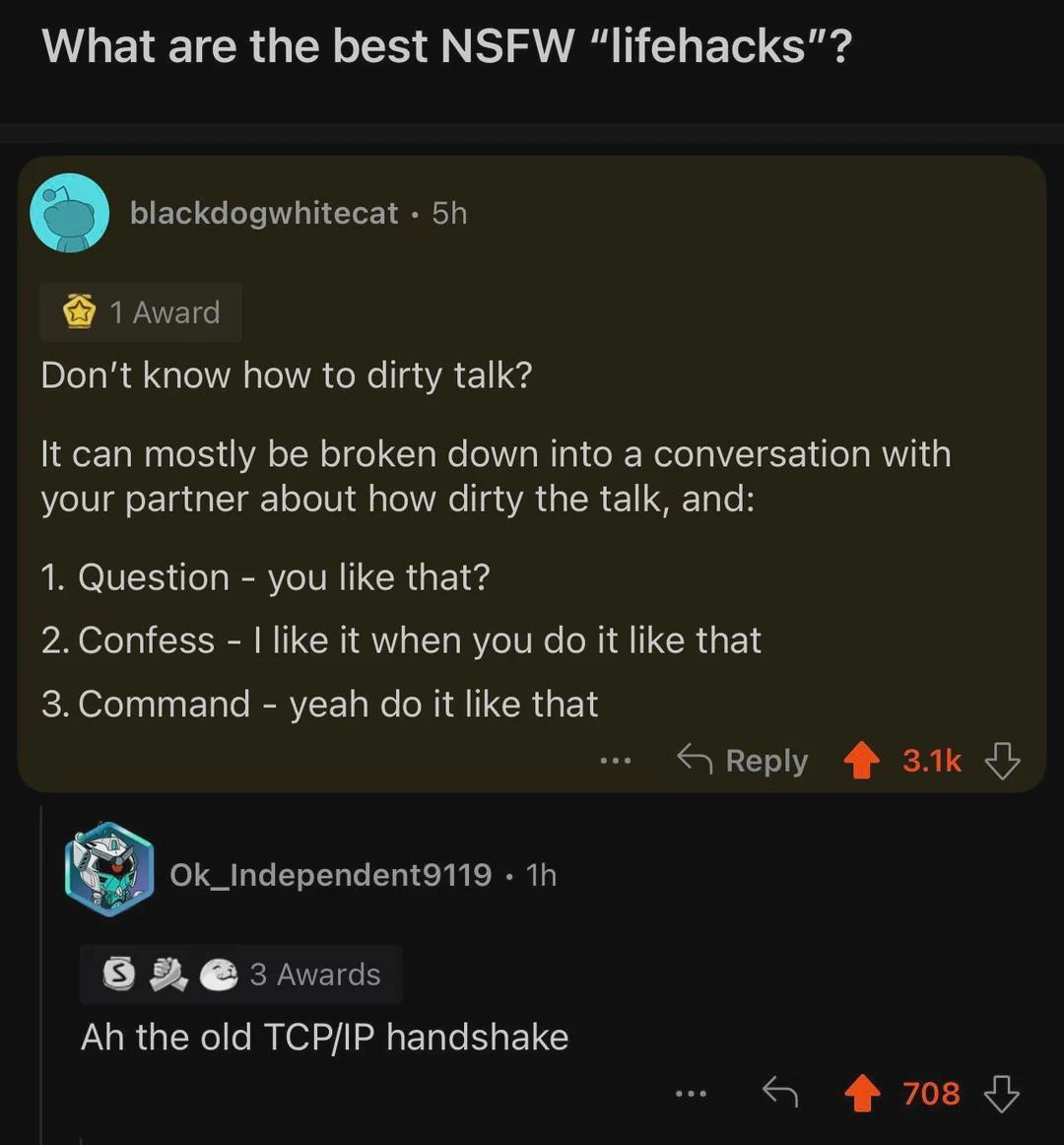
Now, the meme cleverly maps this TCP handshake onto an NSFW lifehack about “dirty talk.” NSFW means “Not Safe For Work,” a label for adult or inappropriate-for-work content – in this case, advice on intimate talk. The Reddit post asked for the best NSFW “lifehacks,” and one user gave a three-step formula for people who “don’t know how to dirty talk.” Here’s how the mapping works:
| Dirty Talk Step | TCP Handshake Step | What it Means |
|---|---|---|
| 1. Question – “you like that?” | Client SYN |
Initiator sends out a feeler to start the interaction. |
| 2. Confess – “I like it when you do it like that.” | Server SYN-ACK |
Partner responds positively and adds their own signal (acknowledgment). |
| 3. Command – “yeah do it like that.” | Client ACK |
Initiator confirms the response and gives the go-ahead to continue. |
In simpler terms, the first line is one person asking a question to initiate some spicy fun (“Do you like what I’m doing?”). The second line is the partner responding and acknowledging they’re into it (“I really enjoy it when you do that.”). The third line is the first person confirming that response and encouraging to proceed (“Great, keep doing that!”). This is exactly how a TCP three-way handshake functions: a request, a response, and a confirmation. The joke comment “Ah the old TCP/IP handshake” is pointing out that this sexy conversation formula is structurally the same as the handshake computers do according to the TCP/IP protocol suite. It’s a pun because a handshake in tech is a formal initialization sequence, and here we have an informal, cheeky “handshake” between two people in bed. For a developer who knows about packets and handshakes, it’s immediately recognizable and absurd in a funny way. If you’re new to these terms: just remember, protocols like TCP often mirror real-life communication patterns – even something as unexpected as flirtatious dialogue in this case. That’s why the meme falls under TechHumor/DeveloperHumor: it’s taking a normal human scenario and viewing it through the lens of a nerdy networking joke.
Level 3: SYN-ACK Seduction
To an experienced developer, the comment “Ah the old TCP/IP handshake” immediately lights up the brain. It’s the kind of wry, tech humor that mash-ups two completely different contexts: steamy NSFW talk and cold, hard networking protocols. The first Reddit user “blackdogwhitecat” broke down dirty talk into a neat three-step formula: Question (“you like that?”), Confess (“I like it when you do it like that”), and Command (“yeah do it like that”). Any seasoned network engineer can’t help but see the parallel to the three packets of a TCP three-way handshake: SYN, SYN-ACK, ACK. The second user “Ok_Independent9119” pokes fun at that parallel, effectively saying “Haha, this is basically the same as a TCP connection setup,” and 708 people upvoted because they instantly got the joke. It’s a classic case of nerd humor where a spicy human interaction gets reframed in dry engineering terms.
Why is this so funny to developers? First, the mapping is uncannily perfect. TCP connection setup is all about one side asking to connect, the other agreeing, and then both confirming – a networking choreography to establish trust. In the bedroom scenario, one partner asks a question to check their partner’s enjoyment (“SYN?”), the partner responds positively and adds their own encouragement (“SYN-ACK!”), and then the first partner gives the green light acknowledgement (“ACK!”). It’s consent and communication, following the exact same three-step rhythm as our machines do to establish a reliable channel. Seasoned devs find it hilarious because it frames a bedroom communication in the nerdiest possible way – by comparing it to the most routine low-level network protocol routine we deal with in computing.
There’s also humor in the phrasing “the old TCP/IP handshake,” as if this technique is some legendary move or lifehack passed down among romantically-inclined sysadmins. 😂 It’s a tongue-in-cheek way to say “Yep, seen this pattern before!” Developers love referencing well-known tech patterns in everyday life; it’s a form of geeky shorthand. And indeed, the original advice reads almost like a snippet from a manual or textbook. It’s numbered 1, 2, 3 – just like how a tutorial or a professor might list steps for the TCP handshake on a whiteboard. The Reddit screenshot’s dark-mode aesthetic and upvote counts (3.1k for the advice, 708 for the handshake quip) show that this resonated with a lot of people. In a community thread about “lifehacks,” instead of the usual hacks, you get this unexpectedly precise breakdown of sexy talk. The icing on the cake is a fellow developer in the thread dryly likening it to a fundamental network protocol. It’s a pinpoint hit on that intersection of developer humor and real-life absurdity: we can’t even discuss intimacy without unknowingly following an RFC-style protocol! For those in the know, it’s a delightful recognition of a pattern: the consent handshake if you will. This meme encapsulates that senior-engineer mindset where everything – even romance – secretly operates like a protocol or an algorithm. Once you see the analogy, you can’t un-see it, and that’s why the joke lands so well among tech folks.
Level 4: Transport Layer Tango
At the deepest technical level, this meme hides a reference to the TCP three-way handshake – a foundational algorithm of computer networking. In TCP (Transmission Control Protocol), establishing a new connection is like a little choreographed dance between two machines. One side (the client) starts by sending a synchronize (SYN) packet to say “Hello, I’d like to open a conversation.” The other side (the server) replies with a synchronize-acknowledge (SYN-ACK) packet, essentially answering “Hello back, I hear you – and I’m ready to sync up.” Finally, the client sends an acknowledge (ACK) packet to confirm “Great, we’re in step – connection established!” This SYN, SYN-ACK, ACK exchange is the textbook TCP/IP handshake described in networking courses and RFC specifications. It’s a reliability ritual at the transport layer that ensures both parties agree to talk before any real data flows.
Why three steps? It turns out two messages weren’t enough to guarantee both sides know about each other – a classic realization from the Two Generals Problem in distributed systems theory. The third “ACK” provides mutual certainty: each host knows the other has agreed to connect. The TCP handshake, defined in the seminal RFC 793, brilliantly solves this with a minimal three-packet sequence. Under the hood, each side even exchanges an initial sequence number during this handshake. For example:
Client -> Server: SYN (Seq = X) // "I want to start, my initial sequence number is X."
Server -> Client: SYN, ACK (Seq = Y, Ack = X+1) // "Let's start, my Seq is Y. I acknowledge your Seq X."
Client -> Server: ACK (Ack = Y+1) // "Got your Seq. We're both synced up and ready!"
By the end of this syn-ack exchange, both client and server have synchronized their sequence numbers and acknowledgments. They’ve effectively said “I’m ready if you are.” This creates a reliable networking connection where each byte is tracked and delivered in order. The meme’s genius is mapping this exact protocol onto a human interaction: an intimate conversation also has an initiator, a response, and a final confirmation. Just as TCP’s handshake establishes a trusted link with a careful back-and-forth, the outlined “dirty talk” sequence establishes comfort and consent between partners via a similar call-and-response pattern. It’s a nerdy network protocol joke hiding in a NSFW context – a perfect little protocol layer pun that delights those of us who can’t unsee the world in terms of packets and handshakes.
Description
A Reddit screenshot from a thread titled 'What are the best NSFW lifehacks?' User blackdogwhitecat (1 Award) explains dirty talk as three steps: 1. Question ('you like that?'), 2. Confess ('I like it when you do it like that'), 3. Command ('yeah do it like that'). The reply by Ok_Independent9119 (3 Awards) says 'Ah the old TCP/IP handshake' drawing a perfect parallel between the SYN/SYN-ACK/ACK protocol and intimate communication. The original post has 3.1k upvotes and the reply has 708
Comments
7Comment deleted
Dirty talk is basically TCP: you SYN ('you like that?'), they SYN-ACK ('I like it when you do that'), and you ACK ('yeah, do it like that'). If nobody responds, it's a connection timeout and you should probably stop
Proof that even in the bedroom you still need a proper SYN, SYN-ACK, ACK before anyone starts transmitting payloads
Finally, a use case for TCP's reliable, ordered delivery with acknowledgment - though the timeout and retransmission mechanisms might kill the mood, and god help you if packet fragmentation occurs
When your relationship communication follows RFC 793 better than your microservices architecture - at least here the three-way handshake is guaranteed to establish a reliable connection, unlike that eventually-consistent message queue you've been debugging for three days
TCP in bed: Reliable delivery with round-trip consent, but zero throughput until that final ACK lands
SYN: “you like that?”; SYN‑ACK: “I like it when…”; ACK: “yeah, do it like that” - textbook connection establishment. Also, it’s TCP, not “TCP/IP”; IP is just the L3 chaperone
Question, Confess, Command is basically SYN, SYN‑ACK, ACK - because in this domain anything UDP gets dropped and escalated by Compliance