The Recursive Nature of Debugging
Why is this Debugging Troubleshooting meme funny?
Level 1: Hidden Monster
Imagine you’re cleaning your room. First, you pick up all the toys on the floor – that’s the easy part you knew about. Then you open your closet and find a big mess of clothes to organize – okay, you expected there was some chaos in there even if you didn’t know how bad it was. Finally, as you’re moving things around, you discover a half-eaten sandwich way under your bed that has turned into a furry green mold monster! 🤢 You had no idea that was hiding there. Now your simple clean-up task just got a lot harder (and grosser). The meme is like this: we laugh because we’ve all been that person thinking a job would be simple (just pick up the toys), only to uncover a much bigger mess and even a scary surprise we didn’t see coming. It’s funny in the comic because the surprise is drawn as a huge sea monster, but it feels pretty true to life – sometimes the biggest problems are the ones we never even knew to look for.
Level 2: Under the Surface
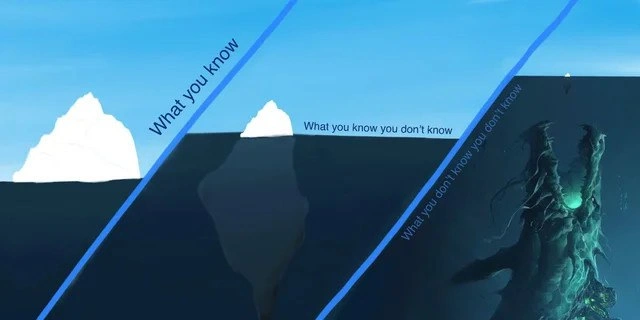
This meme uses an iceberg as a perfect visual metaphor for software project complexity. The part of the iceberg you see above water is small, while a huge mass is hidden below. And in the comic’s third panel, there’s even a giant sea monster lurking in the darkest depths. Each part of this image corresponds to a level of knowledge about the project:
What you know (the tip of the iceberg): This is the stuff you’re already aware of and understand. In a software project, that might be the core features or tasks that you’re confident about. For example, if you’re building a website, you know you need a homepage and a login form. You’ve built pages like that before, so it’s familiar territory. This visible part is usually small compared to everything else, but it’s what everyone focuses on initially.
What you know you don’t know (just below the waterline): This represents the tasks or challenges you’re aware of but don’t fully understand yet. You recognize there are things you need to research or figure out. In the website example, you might know that you’ll have to set up a database even if you’ve never done it, or that you need to integrate with an external API (like a payment gateway or a Google/Facebook login) even though you’re not sure how it works yet. You haven’t solved these problems before, but at least you can point them out and say, “Yes, that’s a thing we’ll have to learn or clarify.” These known unknowns are larger in size than the tip, meaning they often take more time and effort than the obvious stuff. Still, you can plan for them by allocating extra time, asking for help, or doing prototypes. You expect this hidden chunk of work, even if it makes you a bit nervous.
What you don’t know you don’t know (the deep abyss with the monster): This is the scary part – the problems that surprise you completely. These are issues you didn’t even suspect when you started the project. Using our example, this could be something like discovering a security requirement you never heard about, or the client suddenly insisting on a feature that wasn’t in the original plan (e.g. “Actually, can we make this work offline on old Internet Explorer?”). It could also be an unexpected bug or interaction: maybe once you launch the site, you find that users from a different country are entering data that breaks your system (like an emoji 😃 in a username causing a crash because you didn’t know to handle Unicode characters). These unknown unknowns feel like a sea monster emerging from the deep because they were completely off your radar. They tend to cause panic and confusion, since you didn’t budget time or resources for them.
In simpler terms, this meme is saying a software project’s scope (all the work that needs to be done) is mostly hidden and not fully understood at first. New developers often underestimate how much is beneath the surface. You might think, “Yeah, I just have to do A, B, and C” (the visible tip), but once you start, you realize there’s also D, E, and F that you knew about but didn’t consider (the submerged iceberg), and then G, H, and a crazy Z show up out of nowhere (the deep sea monster). The further down you go, the more uncertainty and risk you encounter.
This iceberg idea is a common discussion in project planning and risk awareness. Teams will often ask in meetings: “Okay, what are our known unknowns here? And is there any way to uncover some unknown unknowns early?” They know that the second category (things you know you don’t know) needs research and spikes (experiments to learn something quickly) to handle. For the third category, teams sometimes add a buffer or contingency in the schedule – basically extra time to deal with surprises. For instance, an experienced project manager might say, “This task looks like 5 days of work, but let’s schedule 7 days just in case we hit any snags.” They’re implicitly acknowledging that unknown unknowns lurk beneath. Unfortunately, it’s hard to convince people of invisible problems that haven’t happened yet, so often this buffer gets trimmed away by optimists or higher-ups, leading to MisalignedExpectations later when surprises do occur.
Let’s connect some key terms often related to this meme’s theme:
Technical Debt: This is what happens when you take shortcuts to solve problems quickly rather than the “right” way. It’s called debt because you save time now (like borrowing money) but you’ll “pay” for it later with extra work (like paying interest on a loan). In the context of unknown unknowns, when a surprise problem pops up close to a deadline, developers might slap together a quick fix just to keep things on track. That fix might not be clean or scalable. Later, the team will have to refactor or re-write that part properly, which is the “debt” coming due. The meme’s sea monster forcing emergency action leads to exactly this kind of technical debt.
Deadline Pressure: This refers to the stress of an approaching deadline, especially when you realize you have more work than time. In a project, when those hidden tasks and surprises start surfacing, suddenly the team is scrambling to meet the original deadline. People might work late, cut corners, or skip testing due to this pressure. The meme’s tiny boat doesn’t know it yet, but it’s on a collision course with extra work that could make finishing on time very hard.
Misaligned Expectations: This happens when different stakeholders (developers, managers, clients) have different assumptions about how the project is going. For example, the client might think everything is fine because the visible features (the tip) were completed, but the developers are freaking out about the huge iceberg of work remaining. Or management expects the project to ship on a certain date, unaware of the lurking issues that have arisen. The meme highlights how easy it is for expectations to drift apart: those who only see the surface think all is well, while those underwater with the iceberg know there’s a lot more going on. Regular communication and status updates can help align expectations, but it’s tricky when the issues are unexpected in the first place.
Scope and Scope Creep: Scope means the full list of features and tasks in a project. Scope creep is when that list grows over time beyond what was originally agreed. Unknown unknowns often cause scope creep. For instance, you planned to build a simple app (original scope), but then you discover you also need a reporting dashboard or a data migration tool (new tasks get added – the scope “creeps” larger). This is like the iceberg getting bigger as you learn more. Scope creep isn’t always anyone’s fault – it can happen because the team learned new info or the world changed during the project – but it needs to be managed, or else the project can go on and on.
Overengineering: This is the opposite extreme of being caught off-guard by unknown unknowns. It’s when developers try to anticipate every possible thing that could ever happen and build the system to handle it all, no matter how unlikely. That can lead to an overly complex design that’s hard to build and maintain. Imagine adding six extra lifeboats and a submarine to that tiny boat just in case of sea monsters – probably overkill and slows the boat down. In software, overengineering might look like implementing a super generic plugin system or abstract framework for a simple task, thinking it will handle any future scenario. It usually ends up being wasted effort if those scenarios never occur (or funny enough, the real unknown problem is something the over-engineered design didn’t account for either!). So, it’s a balance: you want to be prepared for the unknown as much as reasonable, but you can’t go overboard (pun intended) and try to solve every imaginary problem before it happens.
In summary, what this meme teaches newer developers is that most of a project’s complexity is hidden at first. It reminds us to stay humble with our estimates and to always dig deeper during planning if possible. Good engineers learn to ask, “What am I missing? What could I be assuming that’s not true?” Identifying the known unknowns early is crucial – maybe you haven’t done cloud deployment before, so you ask someone with experience or do a small trial run. As for the unknown unknowns, the best you can do is build flexibility into your plan and not assume everything will be smooth. That could mean writing code that’s easy to modify or leaving some time at the end of the schedule for “buffer” or bug fixing. And when an unknown unknown inevitably strikes, don’t be too hard on yourself – even the best in the business get blindsided. The difference is that experienced teams expect to encounter a few sea monsters and have a mindset (and sometimes tools) to respond when it happens. It’s a normal part of RealWorldComplexity: systems in the real world always have quirks and surprises once you go live.
So when you see that meme with the poor little boat above a massive iceberg and a monster, remember: in software projects there’s always more lurking beneath the surface. It’s simultaneously a warning and a comfort. Warning: plan thoroughly and be aware that things will likely get more complicated than they seem. Comfort: if you feel overwhelmed by unforeseen problems, know that this is a common experience – you’re not the only one who has discovered a “kraken” in their project. The key is learning, adapting, and maybe keeping a sense of humor about it (hence the meme!). After all, every project is a voyage into the unknown, and sometimes you just have to navigate through unexpected storms as they come.
Level 3: Eldritch Depths
In the depths of a project, it’s rarely the obvious iceberg tip (the tasks you planned for) that sinks your schedule. It’s the enormous hidden mass below—and sometimes an eldritch tentacled horror thrown in for good measure. This three-panel meme nails that truth with the classic iceberg metaphor:
In the first panel labeled “What you know”, we see the tiny visible iceberg tip. That represents the tasks or complexities we think we understand at the start of a project. It’s the code we confidently list in our initial plan – the part everyone agrees on. It’s the “sure, that’s straightforward” stuff, like implementing a known feature or using a familiar library.
The second panel, “What you know you don’t know”, reveals the much larger submerged iceberg chunk. This is everything we identify as gaps early on. Senior engineers immediately flag these known unknowns as risks: maybe we need to integrate with an unfamiliar API, scale the system to millions of users, or comply with a security regulation that we’ll have to research. We’re aware of these challenges (they loom underwater), but we haven’t solved them yet. For example, you know you’ll have to optimize database queries for speed, even if you’re not sure how at first. These are big, but at least you can see them coming and plan for them (with some healthy dread).
Then comes the third panel, “What you don’t know you don’t know”, plunging into near-black depths where a glowing green sea monster lurks. This is the domain of the unknown unknowns – the surprises no one anticipated that can torpedo your project out of nowhere. This monstrous creature represents the truly scary stuff: the hidden complexity or sudden crises that nobody imagined during planning. It’s the vendor API that unexpectedly changes its contract right before launch. It’s discovering that a core library has a severe memory leak only under production load. It’s the client casually mentioning a critical requirement two days before deadline (“Oh, it needs to work offline in IE11, didn’t we tell you?”). These are the nightmare scenarios that cause collective facepalms and panicked late-night Slack messages. In other words, the third panel is where project plans go to die and Technical Debt is often born.
For a seasoned developer, this meme is equal parts funny and painful because it’s so true. We’ve all made optimistic estimates based on the visible tip of the iceberg, only to discover a massive load of work lurking beneath the surface. That tiny boat sailing calmly in the meme? That’s us at project kickoff, blissfully unaware of the Kraken below. The humor lands because every experienced engineer recognizes that feeling when a project’s real scope reveals itself and it’s an order of magnitude more daunting than anyone guessed. It’s the software equivalent of thinking you hooked a small fish and realizing you’ve snagged a giant sea monster.
This meme riffs on the classic idea of known knowns, known unknowns, and unknown unknowns often cited in project management. In software ProjectManagement, what you know are the requirements and tasks you can clearly see and have done before. What you know you don’t know are the acknowledged risks or research topics – maybe new technologies or third-party systems you’ll have to figure out. And what you don’t know you don’t know are the blind spots – the requirements that appear late, the interoperability issues that only surface in real-world use, all the “gotchas” that nobody considered. The meme’s iceberg of knowledge vividly illustrates how our ProjectEstimationTechniques so often fail: we plan for what we see (and maybe a bit for known risks), but we can’t factor in the terra incognita. That’s why even “generous” time estimates blow up – because the unknown unknowns were doing heavy weightlifting out of sight, ready to strike at the worst moment. Hofstadter’s Law captures it well: “It always takes longer than you expect, even when you account for Hofstadter’s Law.” In other words, no matter how much buffer you add for HiddenComplexity, reality can always serve up an even bigger surprise.
When those deep surprises strike, you can kiss your on-time delivery goodbye. Suddenly the team is working weekends, triaging a crisis that wasn’t even on the radar. Cue the DeadlinePressure and MisalignedExpectations: management thought the project was smooth sailing (after all, the plan looked solid with that small iceberg tip), but now engineers are begging for more time as they wrestle a many-tentacled problem from the abyss. I’ve been in war-room meetings explaining to a baffled product owner why a “trivial change” ballooned into a two-week firefight – essentially walking them through panels two and three of this meme in real life. It’s often a hard sell: non-technical stakeholders see just the tip (“you said login page, how hard can that be?”), unaware that underneath lies a whole identity management system and a surprise compliance audit requirement that came up. These hidden factors mean the scope of work quietly expanded underwater. We got hit by classic scope creep – the project scope kept growing as new unknown tasks emerged – and now expectations have to be reset (never a fun conversation).
And let’s talk about how teams respond when the unknown unknowns attack. Often, it’s all hands on deck, patch-the-hole-in-the-boat mode. Under panic, developers implement quick fixes and workarounds just to slay the immediate monster and keep the project afloat. Sure, you vanquished the sea creature (the app isn’t crashing anymore, the last-minute requirement is bolted on), but now you’ve introduced messy code or a fragile subsystem as a consequence. That emergency patch is what we call Technical Debt: a quick solution that makes future maintenance harder, like debt you’ll repay with interest later. We end up with functions named fixTempHack() and comments like // TODO: improve this scattered in the code. It’s as if we defeated one Kraken only to breed a clutch of sea serpent eggs in our codebase. The meme’s monster from the depths might be gone for now, but its tentacles live on in your repository, quietly increasing complexity for the next project phase. To illustrate, here’s what that scramble often looks like in code form:
try {
launchProject(); // Launch the project as planned
} catch (KrakenException e) {
// The unknown unknown emerges from the depths...
applyQuickHack(); // patch the immediate problem
incurTechnicalDebt(e); // we'll pay for this later
extendDeadline(2_weeks); // timeline takes a hit, of course
}
When the proverbial Kraken appears, the team’s mindset is “just make it work now, we’ll clean it up later.” Later, of course, nobody has time to fully clean it up. This is how TechDebt accrues, and it aligns perfectly with the meme: the hidden monster drags your project down both in the moment and long after, unless you purposely schedule time to refactor and pay back that debt.
Now, some might think the solution is to plan for every possible unknown from the start – but that way lies madness and OverEngineering. If you let fear of the deep unknowns drive your design, you might end up with a ridiculously complex architecture trying to account for every edge case in advance. It’s like outfitting that tiny boat in the meme with torpedoes, lifeboats, floodlights, and a full naval escort just in case of monsters. The result is an over-engineered system that is cumbersome, expensive, and still might not handle the particular weird issue that actually occurs. We’ve all seen architectures that try to be future-proof for every scenario (“extensible plugin systems”, endless abstraction layers, etc.), only to collapse under their own weight or be bypassed when an unimagined scenario hits. The meme implicitly reminds us: you cannot foresee everything. Good engineering is about finding the right balance – use solid DesignPatterns and Architecture principles to handle known complexity, stay flexible to adapt to new challenges, but don’t build an entire cathedral for a possible dragon that may never show up. Because chances are, the real dragon will be something you didn’t think of anyway!
Ultimately, the iceberg metaphor resonates because it captures a universal developer experience: RealWorldComplexity is always greater than it appears on the surface. Integrating systems, dealing with live data, handling user behavior – these things always unveil surprises. Experienced teams develop a healthy respect for the unknown. We do code reviews, prototyping, and SystemComplexityAnalysis to unearth as much hidden scope as possible (like sending divers to map that iceberg underwater). We maintain risk awareness: calling out “here be dragons” in project plans for areas we suspect might hide monsters. But no matter what, there’s always that one thing that will slip by until it’s chewing on your hull in the dark. The meme is both a warning and a commiseration: if you feel like a project has unseen horrors waiting below, you’re not alone — that’s just software engineering. Seasoned devs chuckle at this iceberg comic because we’ve all been that little boat, blindsided by a giant block of hidden scope or a tentacled horror from the deep. It’s a humorous reminder to stay humble in our estimates, plan for uncertainties, and never assume you’ve seen the full picture until you’re safely in port (a.k.a. the project is delivered and running in production… and even then, watch out for the next Kraken in maintenance!). 😉
Description
A meme with the text 'Debugging is like being a detective in a crime movie where you are also the murderer.' This is a witty and relatable analogy for the process of debugging code. As a developer, you are trying to solve a problem that you yourself created, often inadvertently. The meme captures the sense of irony and frustration that comes with this realization. Senior developers, in particular, can appreciate this sentiment, as they have often had to debug complex issues that were the result of their own subtle mistakes or oversights
Comments
7Comment deleted
The six stages of debugging: 1. That can't happen. 2. It happened. 3. That shouldn't happen. 4. Why is that happening? 5. Oh, I see. 6. How did that ever work?
Sprint planning: we budget for the iceberg we see, pad for the mass we suspect, then deploy and watch an awakened 2003 Perl daemon redefine “Definition of Done.”
The scariest part isn't the monster at the bottom - it's realizing that every architectural decision you've confidently defended in the last decade lives somewhere in that middle layer
The iceberg perfectly captures the senior engineer's journey: Junior devs live confidently in the sunshine above water, mid-levels nervously explore the visible depths they can see, and seniors? We're down in the abyss, discovering yet another layer of 'unknown unknowns' every time we think we've hit bottom - usually right after confidently telling a stakeholder 'this should be straightforward.'
Known unknowns are Jira epics; unknown unknowns are the ones that nuke your SLOs at 3AM
Software is an iceberg: the part you know is in the README, the part you know you don’t know is in the risk register, and the abyss is a prod cron job called do_not_delete.sh running as root since 2011
Every architecture diagram shows the iceberg; the postmortem discovers the kraken - summoned by a retry storm, stale DNS, and the implicit 30s timeout you inherited from 2009