Skip to content
DevMeme
4391 of 7435
When a Simple Bug Fix Turns Into a Major Refactor
Bugs Post #4803, on Aug 15, 2022 in TG

When a Simple Bug Fix Turns Into a Major Refactor

Why is this Bugs meme funny?

Level 1: Better Safe Than Sorry

Imagine you have a staircase with only 5 steps. Now, Python is like a careful friend who stops you at the top and says, “There are only 5 steps, don’t try to take a 6th step – you’ll fall!” 🛑. That’s sensible, right? They won’t let you walk into thin air.

On the other hand, C is like a friend who, when you’re at the top of those 5 steps, hears you say “I’m going to step up to step 6,” and just grins boldly, saying “Sure, go ahead – your wish is my command!” 😅. Of course, there is no 6th step... so what happens? You take that next “step” and whoosh – you’re stepping into nothing and you tumble down or smack into the floor. Ouch! That’s what we’d call a crash. Your daring friend didn’t warn you at all.

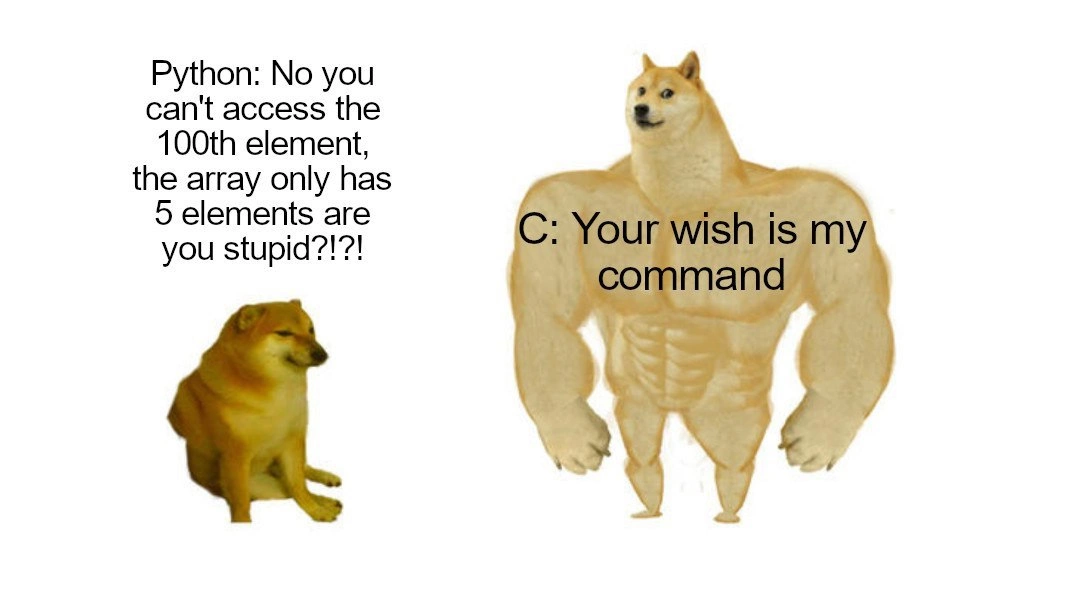
In the meme, the small dog (representing Python) is basically scolding, “Don’t be silly, there’s no 100th element!” – it’s like the friend preventing you from getting hurt. The big muscular dog (representing C) proudly says, “Whatever you say!” – like the friend who lets you do something dangerous just because you asked. The joke is funny because one side is overprotective (maybe even a bit mocking about it) and the other side is overly permissive. In real life, having some safety (even if it feels strict) can save you from big accidents. Python is that safety net, stopping the mistake right away. C just lets you do it and you find out the hard way. It’s a classic case of better safe than sorry – and that’s why we can laugh, remembering times our code “fell off the stairs” in C when we really wished it had a guardrail like Python’s.

Level 2: Safety vs Segfaults

Let’s break down the basics behind this meme. It’s comparing how two programming languages, Python and C, handle accessing arrays (or lists) out of bounds. An array (or a list, in Python terms) is just an ordered collection of items. Each item is at a certain index (position number). If an array has 5 elements, those are typically indexed 0, 1, 2, 3, 4 (assuming 0-based indexing, as both Python and C use). An out-of-bounds index means you’re trying to access a position that isn’t valid – for example, index 100 in an array that has only 5 items. That’s like saying “give me the 100th item” when there are only 5; it doesn’t make sense.

  • In Python, if you do this, the Python runtime immediately throws an error called IndexError. This is a built-in safety feature. It’s Python’s way of telling you, “Hey, you asked for something that doesn’t exist.” The program will stop (unless you handle the exception) and display a message (e.g., “list index out of range”). This prevents any unpredictable behavior – Python refuses to continue with a bad index. The meme exaggerates this as Python calling you stupid for even trying. In reality, the error message is polite, but the feeling as a coder is often “oops, that was a dumb mistake.”

  • In C, things are very different. C will not stop you from using an invalid index. If you have an array of 5 ints in C and you try to access the [100]th element, C will happily compile your program with no errors or warnings. When you run it… a few things could happen:

    • Often, your program will crash with a segmentation fault at runtime. A segfault means your program tried to access memory that the operating system says you’re not allowed to touch. It’s a hard crash – the program is terminated by the OS for breaking the rules. You’ll typically just see a message like “Segmentation fault (core dumped)” in the terminal. Not very descriptive, right?
    • Sometimes, it might not crash immediately. C doesn’t automatically check the index, so it will calculate some memory address beyond the array. If that memory is within your program’s allowed range, C will just read whatever garbage is there (or write to it). Your program continues running with potentially wrong data. This is even worse because the bug might not be obvious – it could corrupt something and cause weird behavior later on. We call this undefined behavior because the C language spec doesn’t define what should happen in this scenario. It’s basically a gamble.

In short, Python is a memory-safe language – it prevents you from doing unsafe things like out-of-bounds access by design. C is a memory-unsafe language – it gives you direct access to memory and leaves safety entirely up to you, the programmer. Why would C do that? Mainly for performance and flexibility. C was designed to be super fast and close to the hardware. Every extra check (like an index check) has a small cost, and C was created when computers were much slower than today. So the philosophy is “don’t pay for what you don’t use.” If you as the programmer don’t explicitly check your indices, C won’t either. It assumes you know what you’re doing. This is sometimes called manual memory management or manual safety checking – you have to remember to do it yourself (or use habits and tools to avoid mistakes). Python, conversely, abstracts that away – it manages memory for you (like garbage collection for freeing memory, and automatic checks for bounds).

To see the difference, consider these two code snippets side by side:

Python Example:

arr = [1, 2, 3, 4, 5]
print(arr[4])    # This is fine, prints 5 (the fifth element, since index 4 is last valid index)
print(arr[5])    # This will raise an IndexError, because valid indices are only 0-4

If you run this Python code, the first print will output 5, and the second line will cause:

IndexError: list index out of range

Python stopped the program at the second print and told us exactly what went wrong.

C Example:

#include <stdio.h>
int main() {
    int arr[5] = {1, 2, 3, 4, 5};
    printf("%d\n", arr[4]);   // Valid access, prints 5
    printf("%d\n", arr[5]);   // Oops, out of bounds! C won't stop this.
    return 0;
}

For the C code:

  • The first printf will print 5 (since arr[4] is the fifth element, valid).
  • The second printf is accessing arr[5], which is out-of-bounds. C does not check this. This line might print some random integer (whatever value resides in memory after the array), or it might cause a crash right then and there. If arr is on the stack, arr[5] could be reading some other variable’s value or an unused region. If you’re unlucky enough that arr[5] touches memory outside your program’s accessible area, you get a segmentation fault and the program exits.

Thus, Python gives you an indexerror_vs_undefined_behavior scenario: one clearly tells you the index is invalid, the other might explode or do nonsensical things without warning. Beginners often find Python easier because mistakes like this are caught and reported in a straightforward way. In C, you have to be much more careful. It’s a bit like having training wheels versus riding a high-performance motorcycle with no helmet – one is forgiving, the other demands respect and caution. This meme uses a popular format (buff Doge vs Cheems) to personify Python and C. Cheems (Python) is depicted as the cautious one enforcing rules (“index bounds checking”), while Swole Doge (C) is the gung-ho one (“no checks, do whatever – but suffer the consequences”). The tags like MemorySafety, UndefinedBehavior, and SegmentationFault all relate to this core difference: safety features versus raw power. And the tag OffByOneError is a nod to how easy it is to make a mistake by just 1 in an index, which in one language gives a neat error, and in the other can be a disaster.

So, in summary: Python and C handle array indexing very differently. Python errs on the side of safety (raising errors for invalid accesses), whereas C gives you freedom that can easily backfire (potentially causing crashes or weird bugs). That’s why developers chuckle at this meme – it captures the essence of a classic LanguageComparison in a single, silly image.

Level 3: No Bounds Bravado

In this meme’s swole Doge vs Cheems format, each doge represents a programming language’s attitude towards array indexing errors. Cheems (small, nervous dog) is labeled as Python, effectively saying: “No, you can’t access the 100th element, the array only has 5 elements – are you stupid?!?!” This dramatizes Python’s protective behavior: it refuses to do something clearly invalid. On the right, the muscular Swole Doge represents C with the caption: “Your wish is my command.” C’s attitude is portrayed as buff and fearless: “Oh, you want the 100th element? Sure, I’ll do exactly that without question.” The humor here comes from exaggerating each language’s approach to a common bug.

Every seasoned developer recognizes this contrast. In Python (and other high-level languages like Java or C#), if you try to grab an element past the end of a list/array, the runtime immediately stops you with a loud IndexError (essentially saying, “Dude, index 100 is out-of-bounds! What are you thinking?”). It’s a bit like a stern schoolteacher catching you making a silly mistake; it might sting your pride for a second (the meme jokingly adds “are you stupid?!?!” to Python’s message), but it saves you from disaster. The program doesn’t continue with bad data – it tells you exactly what went wrong and where. Any junior dev who’s run a Python script has likely seen errors like IndexError: list index out of range and learned quickly what that means. It’s a clear, immediate feedback: you tried to access something that isn’t there.

Now enter C (and its siblings in the CFamilyLanguages like C++). C takes a very different, more perilous approach: it trusts you completely. If you index past the end of an array in C, nothing in the language will stop you. There is no automatic error or exception. The meme’s Swole Doge flexing and saying “Your wish is my command” perfectly captures this vibe – C will dutifully do exactly what you ask, even if you’re asking for trouble. This bravado can yield hilarity or terror for developers: it might print bizarre values (reading whatever bytes reside in memory after the array), or it might crash the program on the spot with a segmentation fault. It could even silently corrupt data – a bugbear of veteran programmers. That kind of bug is the worst: your program might keep running after scribbling over some memory it shouldn’t, and then fail much later or in a different part of the code. Debugging that is a nightmare: you’re hunting a Heisenbug that vanishes when you try to observe it. Seasoned C programmers have scars from chasing down such Bugs: one stray index and you’ve got hours of fun with gdb or print statements, trying to figure out why everything went sideways. Meanwhile, Python devs just get a neat stack trace pointing to the offending line.

The meme pokes fun at this exact disparity. It’s an everyday LanguageComparison joke: the overly strict parent (Python) versus the “cool” but irresponsible uncle (C). Python code might nag you (“Index out of range!”) but at least you know where you stand. C code, on the other hand, is like a friend who says “I won’t judge, do whatever” and then you realize jumping off that bridge wasn’t such a great idea. Many of us have experienced the difference firsthand. For example, imagine a loop bug: you have an array of 5 items but accidentally loop 0…5 instead of 0…4. In Python, on the very first iteration where index = 5, the code will throw an immediate exception and halt at that line. You’ll instantly know you went one too far (an OffByOneError, classic!). In C, the same mistake means the loop will blithely march on. When index = 5, it will access memory beyond the array’s end. If you’re lucky, the program crashes right there with a SegmentationFault, tipping you off that something’s wrong (though it won’t tell you exactly what or where – just an ominous “core dumped”). If you’re unlucky, the program won’t crash immediately – it might overwrite some important data (like the loop’s own control variable or a neighbor variable in memory). The loop might then do bizarre things or the program might crash much later, far away from the original mistake. That’s when a simple bug turns into hours of debugging detective work.

Why does this “no bounds bravado” exist in C? It’s largely historical and architectural. C was designed in the early 1970s for systems programming (think writing operating systems, where you want direct hardware control). It emphasizes performance and minimal abstraction – the philosophy is “trust the programmer.” Array bounds checking was seen as unnecessary overhead; after all, the thinking was that a careful programmer would avoid out-of-bounds accesses. This mindset persists in C and C++: the language gives you raw power and assumes you know how to wield it. The result is super efficient code when you’re right, and UndefinedBehavior chaos when you’re wrong. In modern development, we’ve learned that even the best programmers slip up, hence a huge industry focus on MemorySafety: we now have tools (like address sanitizers, static analyzers) and even new languages (like Rust or safer subsets of C++) trying to eliminate or catch these errors. But existing legacy code (and plenty of new code too) in C/C++ still produces the occasional epic segfault or memory corruption. It’s almost a rite of passage for systems developers to debug a weird crash only to facepalm and say “oh, it was an out-of-bounds array access…”.

The meme captures that shared experience with humor. On the surface, it’s the absurd image of a meek dog scolding you versus a jacked dog obeying a ridiculous command. For developers, it’s “too real”: Python’s IndexError might feel like a smack on the hand, but we appreciate it after dealing with C’s “sure, go ahead” followed by a hard crash (or worse, silent data corruption). In a world of manual_memory_management, C is unforgiving — but boy does it lift heavy! 🏋️‍♂️ The swole dog can do low-level tasks Python wouldn’t dare, but you better know what you’re doing or you’ll end up with a pile of Bugs. So the next time you see a SegmentationFault after an innocent off-by-one in C, remember this meme and have a little laugh (after you finish crying). It’s a tongue-in-cheek reminder that sometimes it’s nice to have a language save us from ourselves, and sometimes we want the power (and peril) of going commando with our code.

Level 4: Manual Memory Mayhem

At the machine level, an array index is just an offset into a block of memory. In a low-level language like C, using an index is essentially pointer arithmetic with zero automatic checks. The CPU doesn’t ask “are you sure?” – it simply calculates the memory address base_address + index * element_size and goes there. If that address falls outside the memory your program owns, the operating system steps in and segmentation fault 💥 – program down. But if the address does happen to exist (say, in the middle of another valid object or unused space), C will blithely read or write it. This is undefined behavior: the C standard literally says “anything can happen”. The program might return nonsense values, overwrite unrelated data, or appear to work fine and then inexplicably crash later. It’s like entering a parallel universe where normal rules don’t apply. The compiler assumes you won’t do out-of-bounds access – so much so that it might optimize away sanity checks, leading to wild outcomes if you violate that assumption.

By contrast, Python (a memory-safe language) performs runtime bounds checking on list accesses. Internally, a Python list stores its length, and every time you do list[index] Python runs a quick check: is index < length? If not, it raises an IndexError immediately, refusing to perform an invalid memory access. This adds a bit of overhead per access, but it guarantees you’ll never accidentally read from random memory. The design prioritizes safety and clarity over raw speed. There’s a fundamental trade-off here: C’s “no guardrails” approach gives blazing performance and flexibility for systems programming (you can even do pointer arithmetic into the middle of an array, or treat raw memory as different data types), but you accept the risk and responsibility. Python’s philosophy is “better to raise an exception than produce garbage.”

Historically, this memory safety vs. manual memory management battle has been the source of countless bugs and vulnerabilities. For example, the infamous Heartbleed bug in OpenSSL (2014) was caused by reading past the end of a buffer in C – something Python’s checks would have prevented with a simple IndexError. In C, that out-of-bounds read happily picked up whatever bytes were next in memory (sensitive data, in that case). The meme’s Swole Doge saying “Your wish is my command” is basically C’s stance: it will follow your instructions to the letter, even into chaos. Meanwhile, Cheems Doge (Python) yells “No you can’t access that!” because under the hood it’s doing the responsible thing: array_bounds_checking. This deep dichotomy comes from how each language was built: C was created when hardware was slow and every CPU cycle counted – bounds checking was considered too costly. Python came later with developer productivity and bug prevention in mind, willing to spend extra cycles to catch mistakes. Newer languages like Rust try to offer a middle ground: the performance of C with safety guarantees (via compile-time checks instead of runtime). But in the classic showdown of Python vs C, we’re seeing the textbook example of MemorySafety on one side and “undefined behavior gone wild” on the other.

Description

A meme using the 'Domino Effect' meme format. A small domino is labeled 'Fixing a simple bug.' A series of increasingly larger dominoes are labeled with things like 'Realizing the bug is in a legacy module,' 'Discovering the module has no tests,' 'Finding out the original developer left the company 5 years ago,' and 'Deciding to rewrite the entire module from scratch.' The final, giant domino is labeled 'Spending the next 3 months on a massive refactoring project.' This meme perfectly captures the 'yak shaving' that can occur when a seemingly simple task snowballs into a much larger project. Senior developers are all too familiar with this scenario, and have learned to be wary of 'simple' bug fixes in legacy code


Comments

7
Anonymous ★ Top Pick The best way to avoid a yak shave is to never fix a bug in the first place
  1. Anonymous ★ Top Pick

    The best way to avoid a yak shave is to never fix a bug in the first place

  2. Anonymous

    Python slaps you with IndexError; C quietly hands you whatever’s after the array and schedules the post-mortem for 3 AM - performance is just undefined behavior that hasn’t paged you yet

  3. Anonymous

    C giving you undefined behavior is just its way of implementing eventual consistency across your entire address space

  4. Anonymous

    Ah yes, the eternal dichotomy: Python treats you like a junior dev with training wheels, throwing IndexError exceptions when you try to access array[99] in a 5-element array. Meanwhile, C is that grizzled systems programmer who hands you a loaded gun (raw pointer) and says 'sure, go ahead and dereference whatever address you want - I'm not your babysitter.' Python's bounds checking is the language equivalent of 'we need to talk about your life choices,' while C just shrugs and lets you walk off the cliff into undefined behavior territory, potentially overwriting the stack, corrupting heap metadata, or summoning nasal demons. The real kicker? Both approaches are 'correct' for their use cases - Python prioritizes developer safety and rapid iteration, while C gives you the rope to either climb to performance nirvana or hang yourself with a buffer overflow. Senior engineers know the punchline: the segfault you get at 3 AM in production because someone forgot array bounds in C is exactly why we invented languages with runtime checks, but also why embedded systems still run C - because sometimes you need that raw, unfiltered access to memory, consequences be damned

  5. Anonymous

    Python babysits your indices; C hands you the pointer and a prayer for no Valgrind fireworks

  6. Anonymous

    Bounds checking is a runtime error in Python; in C it’s a social construct - until ASan shows up with receipts

  7. Anonymous

    Python throws IndexError; C lets arr[100] compile - then defers the exception to prod as “undefined behavior,” delivered via the SRE’s pager

Use J and K for navigation