Skip to content
DevMeme
4393 of 7435
When a Junior Developer Touches the Legacy Code
LegacySystems Post #4809, on Aug 16, 2022 in TG

When a Junior Developer Touches the Legacy Code

Why is this LegacySystems meme funny?

Level 1: Brain Overload

Imagine you have a really big book of magic spells that you want to read. It has 1,366 pages – that’s like four Harry Potter books back to back! By the time you’ve read only a few chapters, your head is already aching. You feel so tired and confused that it’s almost as if the book is sucking the thoughts out of your brain. That’s what this funny picture is showing. The top part is like a giant instruction book for a very hard subject (a programming language called C++), and it even says “Don’t Panic!” as a cheeky way to encourage you. The bottom part shows a wizard literally pulling a wispy memory out of his head with a wand, looking all drained and woozy. The joke is: learning something super complicated (like all those computer rules in C++) can make you feel empty-headed – as if a magic spell is yanking out your brains. It’s a silly way to say “this is too much to take in!” Anyone who has tried to study something really challenging has felt like that wizard, tired and thinking “Wow, I’ve barely started and I already need a break.” So the meme uses a magical scene to show how overwhelming and soul-draining a huge, difficult book can be. It’s funny because it’s a little true – sometimes learning hard stuff makes your brain feel like it’s gone. But don’t worry (and as the quote says, “Don’t Panic!”) – it’s just a joke to make us laugh about how we all get overwhelmed by big tasks sometimes.

Level 2: Steep Learning Curve

Let’s break down the meme in simpler terms. C++ is a programming language (part of the C family of languages, which also includes C and languages inspired by C’s syntax like C# and Java). C++ is famous for being very powerful but also very complex – it has a lot of features and rules. People often say it has a steep learning curve, meaning it’s hard to learn and you have to climb through a lot of knowledge before you feel comfortable.

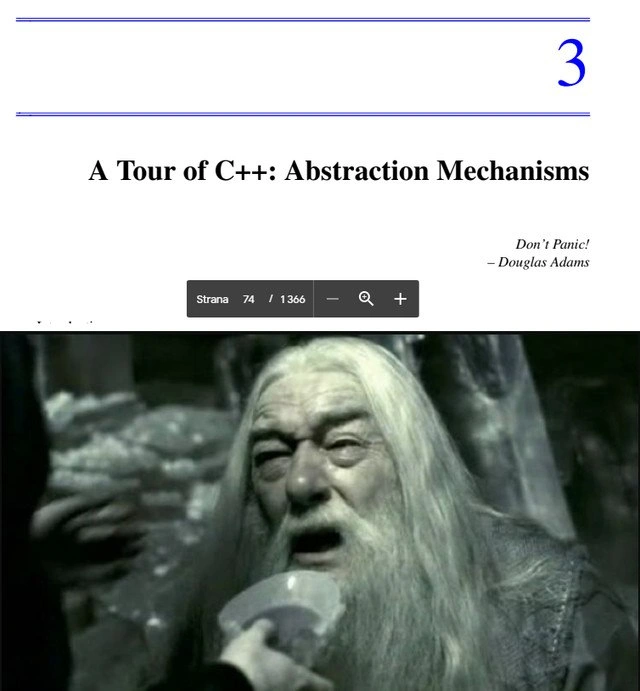
In the top part of the meme, we see what looks like a digital book or PDF document open to a chapter titled “A Tour of C++: Abstraction Mechanisms.” The interface says “Strana 74 / 1366” which means “Page 74 of 1366” in that viewer’s language. So, this book or manual has 1366 pages in total – that’s huge! By page 74, you’re only about 5% through the whole thing. The chapter is discussing abstraction mechanisms in C++, which refers to the ways the language lets you manage complexity by abstracting (hiding or organizing) details. For example, some key C++ abstraction mechanisms likely covered are:

  • Classes and Objects: C++ lets you create classes (blueprints for objects) to abstract real-world entities. A class groups data and functions so you can treat complex data as a single unit (an object). This is part of object-oriented programming, an abstraction technique.
  • Inheritance and Polymorphism: These mechanisms let one class derive from another, and let you use a derived class wherever a base class is expected. It’s a way to abstract common patterns – e.g., you might have a generic Animal class and specific Dog or Cat classes inherit from it. This avoids repeating code, but it adds rules to learn.
  • Templates (Generic Programming): Templates are a powerful abstraction in C++ that let you write code that works with any data type. For instance, std::vector<int> and std::vector<float> are both based on a single std::vector<T> template. The compiler generates the specific version for you. Templates are extremely flexible but can produce very confusing error messages and tricky scenarios because they essentially allow the programmer to write code that writes code.
  • RAII and smart pointers: Without getting too deep, C++ uses patterns like RAII (Resource Acquisition Is Initialization) and tools like std::unique_ptr or std::shared_ptr to abstract memory management. Basically, these are ways to ensure that when you’re done with something (like a file or some memory), it gets cleaned up automatically. It’s an abstraction over manual new and delete calls.

So the chapter “Abstraction Mechanisms” is likely explaining things like the above – how C++ lets you create abstractions so you’re not dealing with raw machine details all the time. That’s important, but each of those features has a lot of details. It can be overwhelming for someone learning.

Now, also on the top image, there’s an italic quote on the right side: “Don’t Panic! – Douglas Adams.” Douglas Adams was an author who wrote The Hitchhiker’s Guide to the Galaxy, a very popular science fiction comedy novel. In that novel (and its adaptations), “Don’t Panic” is written on the cover of the guidebook as a friendly piece of advice to travelers facing the vast, confusing universe. It’s a phrase often quoted in tech and geek culture to humorously say “Stay calm, even if this looks complicated.” Seeing it in a C++ documentation context is a little joke: the author or meme is winking at us, saying “Yes, this stuff is crazy, but try not to freak out!” It’s meta-humor – a joke about a joke – referencing a famous humorous quote to lighten the mood of an intimidating page.

Now to the bottom image: it’s from a fantasy movie. It shows an old wizard (the character Albus Dumbledore from the Harry Potter series) sitting weakly while using a wand to pull a glowing, cloud-like strand out of his own head. In the story, he’s actually extracting a memory to put into a magical basin for viewing – it’s a cool wizard thing, not as creepy as it looks. But taken out of context, it absolutely looks like his brain or soul is being yanked out, right? 😅 His expression is dazed, as if each strand taken is draining his energy. This is a visual gag known around the internet as the “wizard memory extraction” scene, and it’s often used in memes to represent someone losing thoughts or feeling their brain emptying.

So, why put these two images together – the C++ book and the wizard? The meme is saying: reading about C++ abstractions on page 74 of a 1366-page manual is so mentally taxing, it feels like it’s sucking out your soul (or brain). It’s documentation humor combined with a bit of programmer dark humor. Many developers have felt exhausted when trying to learn a complex technology from huge textbooks or specs. For example, imagine reading endless pages about C++ template syntax or subtle rules for multiple inheritance; your head might start to swim. This meme captures that feeling in a funny, exaggerated way. The wizard literally pulling stuff out of his head is how it feels when you pour out all your mental energy trying to absorb the dense material.

In simpler terms, C++ is hard to learn and has a lot of details – that’s the LanguageComplexity aspect. The LearningCurve is steep: you don’t just gently learn C++ in a day or two; it often takes many weeks or months to become comfortable, and even experienced programmers constantly refer back to documentation. The meme uses a DeveloperHumor style that other programmers will relate to: “Haha, I’ve been that wizard after a long day of reading C++ docs.” It’s also a bit reassuring in a communal way – if you’re struggling with C++’s massive documentation, you’re not alone, and it’s okay to find it draining. Even the “Don’t Panic” quote is there as a tongue-in-cheek pat on the back. In summary, the meme humorously explains that learning C++ (especially through a giant document) can be so hard and exhausting that it feels like your brain is being magically pulled out of your head. It’s an exaggerated way to say “this is really challenging stuff!” with a nod to both pop culture (Douglas Adams, Harry Potter) and programmer in-jokes.

Level 3: C++ Brain Drain

If you’ve spent any time in the trenches of systems programming, the humor of this meme hits home immediately. It pairs a snapshot of dense C++ documentation with an image of a wizard having his thoughts magically yanked from his head – a perfect visualization of how it feels to study C++ in depth. The top half shows a PDF viewer on page 74 of 1366, meaning the reader isn’t even 10% through this tome on “A Tour of C++: Abstraction Mechanisms” and already needs a Douglas Adams quote, “Don’t Panic!”, for moral support. (Experienced devs smirk here because “Don’t Panic” is printed on the fictional Hitchhiker’s Guide to the Galaxy as a cheeky reassurance – seeing it in a C++ manual is like the author winking, “Yes, this is really that intimidating, but keep calm!”) The enormous page count itself is a joke: C++’s learning curve is practically legendary. Many senior developers remember cracking open Bjarne Stroustrup’s The C++ Programming Language (a brick of a book, roughly 1,300+ pages) or the official ISO standard text, and feeling their eyes glaze over by chapter 3. Here, page 74 is likely deep in a chapter about advanced abstraction features – perhaps templates or inheritance – and the meme humorously suggests that by this point the content is already extracting the reader’s soul.

The bottom image cements the punchline: it’s a scene reminiscent of Dumbledore (the wise old wizard from Harry Potter) using his wand to pull silvery strands of memory out of his own mind. His face looks drained and disoriented as the glowing wisps (his thoughts) are drawn away – exactly how a developer’s face might look after wrestling with C++ template specialization rules for hours. In developer slang, we even talk about “brain dump” or “brain melt” when overwhelmed by information, and C++’s complexity can absolutely cause that. The meme-maker intentionally blurred the wizard’s face, but any tech-savvy fan recognizes the “memory extraction” trope. It’s visual developer humor gold: reading about C++ abstractions is equated to literally having your brain contents siphoned off. Seasoned C++ programmers often joke that template metaprogramming is “black magic” or “template wizardry.” Well, here we have an actual wizard, but instead of casting spells, he looks like he’s having his brain emptied – the ultimate portrayal of C++ abstraction overload.

This meme also pokes at the documentation experience. Page 74 out of 1366 in a PDF suggests a giant manual or specification. We’ve all scrolled through huge technical PDFs with that sinking feeling of “I’m only on page 74… there’s over 1300 more pages to go?!” 😱. It’s a mix of awe and horror. The inclusion of “Don’t Panic!” is meta-irony that seasoned devs appreciate: it’s as if the documentation itself knows you’re freaking out. (The quote is by Douglas Adams, beloved by many programmers for his humor – a sly nod to nerd culture.) The categories Languages and Learning come through strongly: C++ is a CFamily language known for power and complexity, and learning it is often a marathon, not a sprint. The meme captures the learning curve pain perfectly. By page 74, you’re likely deep in concepts like generic programming or multiple inheritance, and you might already be questioning your life choices. The phrase “Abstraction Mechanisms” itself sounds dry and academic – and indeed, that chapter is probably detailing things like classes, inheritance, virtual functions, templates, and maybe even concepts (a newer C++ feature). Each of those is a hefty topic. Veteran devs reading that title might chuckle darkly: “Ah yes, the part where your brain starts overheating trying to grok template metaprogramming and policy-based design.” The meme exaggerates (only slightly) by implying those pages are literally draining the reader’s life force.

In real life, many of us have felt this way. Imagine a programmer earnestly deciding to read the official C++ documentation or Stroustrup’s book end-to-end to really learn the language. A few chapters in, surrounded by dense text, complex code samples, and jargon like “covariant return types” or “SFINAE” (Substitution Failure Is Not An Error, a notoriously tricky template rule), one can practically feel the mental fatigue. You get that thousand-yard stare just like the wizard in the image. It’s hilarious because it’s true: LanguageComplexity in C++ is no joke, and the cognitive load can make you feel like you’ve left part of your brain on the desk. Even senior developers who love C++ will admit that its verbosity and many intricacies demand a lot of focus. The meme resonates as shared trauma and DeveloperHumor – “C++ made me feel like a mind-wiped wizard too!”

One more layer of humor for the initiated is the notion of a “memory leak.” In programming, a memory leak is when a program forgets to free memory, causing a gradual brain– er, memory – drain. Here we have a wizard literally leaking memory out of his head. 🧙‍♂️ It’s a visual pun: extensive C++ reading might cause a mental memory leak, where your brain can’t retain all those details. In summary, from a seasoned dev perspective, this meme brilliantly mashes up documentation humor with a fantasy visual to capture the soul-crushing enormity of learning C++. It says: “We’ve been on this journey, and by the time you grasp C++ abstractions, you might feel a bit like Gandalf after facing the Balrog” – drained, hair askew, but maybe a bit wiser for the ordeal. And the kicker is that it’s only page 74... there’s so much more to go. Don’t panic, indeed.

Level 4: The Turing Tar Pit of Templates

At the deepest level, this meme highlights how C++’s powerful abstraction mechanisms come at the cost of immense complexity. The massive “A Tour of C++: Abstraction Mechanisms” document (page 74 out of 1366) hints at the colossal C++ standard or a comprehensive reference manual. In theoretical terms, C++ is designed to offer zero-cost abstractions – high-level constructs (like classes, templates, and inline functions) that incur no runtime overhead compared to low-level C code. Achieving this ideal means pushing as much work as possible to compile-time, which effectively shifts the complexity onto the programmer and the compiler. This is why templates in C++ are so powerful and notoriously complicated: the C++ template system is Turing-complete, meaning you can (in theory) compute anything at compile time using template metaprogramming. That’s an astonishing capability – you’re writing programs that run inside the compiler to produce your actual program – but it turns compiling into a wizard’s duel of logic and details. No wonder the ISO C++ standard itself spans well over a thousand pages of dense rules! It formalizes every corner case of these features so that your high-level code can run blazingly fast, as if it were handwritten assembly. But the intellectual price for those zero-cost abstractions is paid in sweat and brainpower: mastering the intricacies of templates, inheritance, operator overloading, and subtly different cast operations can feel like an epic mental workout.

From a computer science perspective, abstraction is about managing complexity by hiding details behind simpler interfaces – encapsulating messy internals so that users of an interface don’t need to know them. C++ gives you extremely powerful tools to do this: you can create template-based generic libraries, overloaded operators that make user-defined types act like built-ins, and class hierarchies modeling real-world domains. However, a famous saying in CS is that “All problems can be solved by another level of indirection, except for the problem of too many layers of indirection.” In C++, every new abstraction layer (like a template that generates code or an object-oriented interface) adds an indirection that hides complexity at runtime, but that complexity doesn’t magically disappear – it’s just moved elsewhere. Often it’s moved into compile-time logic or into the cognitive load of the programmer who must understand the abstraction’s implementation when things go wrong. This is analogous to the wizard in the image extracting a silvery strand of memory and dropping it into a bowl: he’s abstracting a memory out of his mind for later, which frees his head temporarily but now that memory lives in an external system (a Pensieve). Similarly, C++ lets you pull details out of your main code flow (for example, by using templates or function polymorphism to handle different types behind the scenes), but those details live on in the language’s enormous specification and in the complex interplay of compiler-generated code. The meme’s surreal humor comes from this exact paradox: the very mechanisms meant to simplify programming at usage time are so elaborate that learning them feels like having your brain matter siphoned off into an intricate manual. Stroustrup (the creator of C++) championed the idea that a good abstraction imposes no extra runtime cost – and indeed C++ template-based code can be as efficient as hand-tuned code – but as developers quickly learn, “no cost at runtime” can mean heavy cost at design time, paid in understanding template metaprogramming tricks, deciphering compile errors that span multiple pages, and reading voluminous documentation. In short, the meme nods to a fundamental trade-off in language design: C++ gives you low-level power with high-level convenience, but mastering those abstraction mechanisms may demand a degree of expertise (or sorcery) that can leave even experienced wizards (or programmers) mentally exhausted.

Description

A meme using the 'Two Buttons' meme format. A cartoon character is shown sweating nervously as they try to choose between two red buttons. The first button is labeled 'Leave the legacy code alone and work around it.' The second button is labeled 'Try to refactor the legacy code and spend the next 3 weeks fixing everything you broke.' This meme perfectly illustrates the dilemma that developers, especially junior developers, face when they encounter a legacy codebase. It's often a no-win situation. Leaving the code alone can lead to more technical debt, but trying to fix it can be a risky and time-consuming endeavor. Senior developers can relate to this situation, as they have often had to make this difficult choice themselves

Comments

7
Anonymous ★ Top Pick The best way to get a legacy system to run is to tell a junior dev that it's 'impossible' to get it running
  1. Anonymous ★ Top Pick

    The best way to get a legacy system to run is to tell a junior dev that it's 'impossible' to get it running

  2. Anonymous

    Page 74: “Don’t panic.” Page 75: CRTP via SFINAE, and suddenly I’m that wizard getting my templates siphoned into a Pensieve - by page 1366 even the optimizer can’t find a concrete instance of me

  3. Anonymous

    Slide 74 of 1366: Still haven't reached the part where they explain why template metaprogramming error messages look like someone's PhD thesis in ancient Sumerian

  4. Anonymous

    When your C++ abstraction mechanisms tutorial quotes 'Don't Panic!' but spans 1,366 pages, you know you're in for a journey that makes template metaprogramming look straightforward. The real abstraction here is pretending that SFINAE, CRTP, and perfect forwarding won't haunt your code reviews for the next decade

  5. Anonymous

    C++ abstractions: Don't panic - your template error is just the universe improbably expanding at compile time

  6. Anonymous

    Calling it a “tour” is optimistic - by page 74 of 1366 you discover that in C++, “zero‑cost abstraction” means the CPU pays nothing and your CI pays compound interest

  7. Anonymous

    Page 74 of 1366 says “Don’t Panic,” while the next thousand quietly force‑feed you SFINAE, rvalue refs, and ABI constraints - just to pass an int

Use J and K for navigation