Skip to content
DevMeme
1621 of 7435
The Art of Professional Googling
Debugging Troubleshooting Post #1812, on Jul 29, 2020 in TG

The Art of Professional Googling

Why is this Debugging Troubleshooting meme funny?

Level 1: Treasure Hunt in a Library

Imagine you’re in a huge library with millions of books scattered everywhere. You have a big question to answer, like “How do I fix this toy?” or “Why does my flashlight keep turning off?” Finding the answer is going to be like a treasure hunt. Now, most people might randomly grab a few books or ask a librarian for help, but think of a person who’s spent a ton of time in this library. This person (let’s call them a programmer, in our story) knows exactly how to find the right book in just a few minutes. They know which section likely has the answer, maybe even the shelf and the page number, because they’ve done this search so many times.

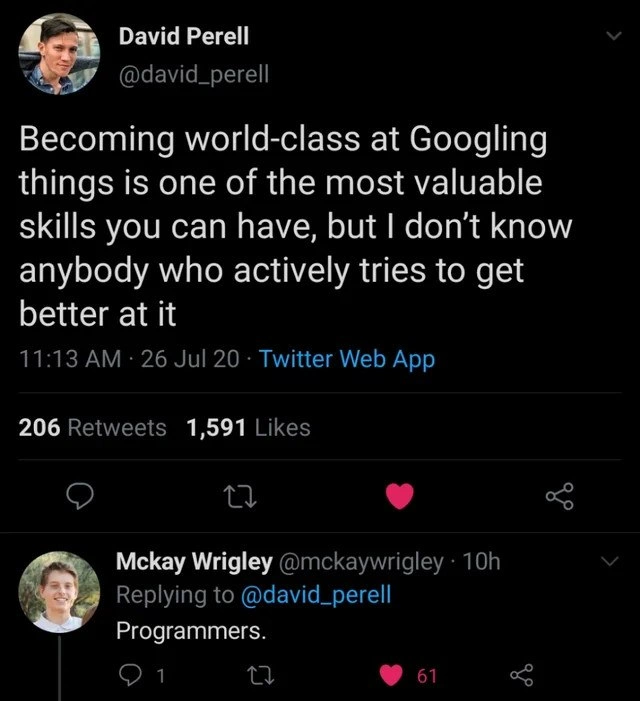
The meme is joking that being really good at using Google is like having that special library skill. The first tweet says “Being world-class at Googling things is super valuable, but nobody tries to improve at it.” The funny reply just says “Programmers.” Why? Because programmers are like those expert treasure hunters in the huge library of the internet. They practice every day looking up answers to solve problems. If a programmer’s computer gives a weird error (like a strange message or code that doesn’t work), they’ll quickly go to Google, which is like asking the giant library for help. Over time, they’ve learned little tricks to find the answer faster – kind of how a skilled treasure hunter knows to follow the map carefully and ignore false clues.

So the joke in simple terms: Someone said “nobody really trains to search things better,” and someone else humorously pointed out “Well, programmers do.” It’s funny because it’s true – people who write code spend a lot of time searching online for answers, almost like how a detective searches for clues. Being good at Google is their secret weapon, just like having a perfect treasure map in that giant library. It makes them really effective at solving problems, even if it just looks like they’re magically smart. In reality, they’re just really good at finding the right information quickly. That’s the whole idea: good programmers aren’t born knowing everything, they’re just excellent at figuring things out – and Google is one of their best friends.

Level 2: Stack Overflow to the Rescue

For those newer to coding, let’s break down why “Programmers” is such a fitting answer in the meme. First, consider what “being good at Googling” means. It’s more than just typing a question — it’s about knowing how to search smartly. Developers often call this skill Google-Fu (like kung-fu, but for Google) to emphasize the art and technique involved. Learning to code is not just about writing syntax; it’s also about debugging, which nearly always starts with figuring out why an error happened. And guess what? To do that, programmers turn to Google constantly.

When something breaks, a beginner might not realize that nearly every error message or weird bug they encounter has probably been seen by someone else. As you gain experience, you start recognizing that error messages are your clues. A programmer will literally copy-paste an error like SyntaxError: unexpected token < into a search bar. Why? Because chances are high the exact same error (down to the weird < symbol) has been asked about on the internet. Often the search results will include a Stack Overflow page – that’s a hugely popular question-and-answer site where developers help each other solve coding problems. Finding a Stack Overflow link in your Google results is like striking gold; it usually means someone had the same problem and there’s a discussion (with solutions!) waiting for you. No wonder one of the context tags is copy_paste_from_so – it’s a tongue-in-cheek reference to copying code from Stack Overflow answers into your own project (something almost every programmer has done at least once, hopefully with caution and understanding).

Now, what does it mean to actively get better at Googling? For programmers, it means learning tricks to filter and refine search results. Here are some Google Search Tips commonly used in debugging:

  • Exact match with quotes: Putting an error or phrase in quotes (e.g., "[Errno 13] Permission denied") tells Google to find that exact text. This is super useful for unusual error messages.
  • Site-specific search: Using site:stackoverflow.com or site:github.com in your query limits results to just that site. Programmers do this to find answers in known places. For example, TypeError undefined is not a function site:stackoverflow.com will show only Stack Overflow discussions about that TypeError.
  • Exclude terms: Sometimes an error might relate to multiple contexts (maybe a Python error vs a JavaScript error with similar wording). A developer can add -python to the query to exclude Python results if they’re working in JavaScript, or vice versa. This helps narrow down to the right technology.
  • Add relevant keywords: If you search just “login error” you might get very broad results. But if you include your framework or language like “login error” Django admin, you’ll get answers specific to what you’re using.
  • Look beyond page one: This isn’t a search operator, but it’s a habit. Programmers will often go past the first page of Google results, especially for a niche bug. The best answer might be hiding on page 2 or 3, or in an older forum post. We know not to give up if we don’t see a solution immediately.

By practicing these techniques, developers sharpen their search skills over time. A junior developer might start by typing a full question like “How do I fix my code it doesn’t work please help” and get poor results. A more experienced dev will trim that down to the key error or symptom, and maybe add the programming language. For example, instead of searching “why does my app crash when I click save button,” a programmer might search something like: app crashes "NullReferenceException" save click C#. See how that query has the specific error term in quotes and mentions the language (C#)? It’s much more likely to find a relevant answer. This kind of search query optimization becomes almost second nature after you’ve debugged a dozen tricky issues.

The term “Programmers” in the meme’s reply is highlighting that developers do consciously improve at this. It’s part of the learning curve in tech. No one explicitly says “today I will train my Googling ability,” but by facing new errors and unknowns each day, you naturally get better at asking Google the right questions. In developer culture, being resourceful is huge. You’ll often hear phrases like “Google is your friend” or see jokes like “I’m not a great programmer, I’m just really good at Google.” New developers quickly learn that it’s okay not to know everything off-hand — what matters is knowing how to find the answer. This revelation can be empowering: it’s the moment you realize even senior engineers are constantly looking things up. In fact, walking into any office of programmers, you’ll likely see multiple browser tabs open: one for documentation, a couple for Stack Overflow, maybe a tutorial or a GitHub issue thread. Debugging via search is just a normal part of the developer life hack toolkit.

We also have the fun term “google_fu” (sometimes spelled Google-Fu). You might hear a colleague say, “Her Google-Fu is strong,” after she finds an incredibly obscure solution in just a few minutes. It’s a compliment meaning that person knows how to search effectively. And yes, people actually share advanced search operators tips with each other, almost like sharing cheat codes. A classic bit of Developer Humor is that half of programming is just typing questions into a search engine and the other half is sifting through the answers. It’s relatable because it contains a lot of truth – nobody can keep all the APIs and error messages in their head, so we rely on the collective memory of the internet.

In summary, the meme is calling out that while most people might not “train” their Googling abilities, programmers kind of do it by default. It’s a key part of being productive and trouble-shooting efficiently. So the next time you see a coder solving a tough bug, remember: their secret weapon might just be world-class Googling skills refined through countless debugging sessions. And if you’re new to coding, rest assured – every time you struggle and then search for an answer, you’re actively practicing this valuable skill, getting a little better at it day by day, just like all the programmers in on the joke.

Level 3: Google-Fu Mastery

At the heart of this meme is a sly nod to a core developer skill that isn’t taught in any class: being world-class at Googling. The top tweet by David Perell wonders why nobody actively practices getting better at search, and the cheeky reply retorts with a one-word answer: “Programmers.” This contrast is funny because it reveals an open secret in software development — effective search is practically a superpower for engineers.

Seasoned developers know that writing code often goes hand-in-hand with searching the web for answers. When a mysterious error or bug pops up, the first instinct of an experienced programmer is usually to copy the exact error message (perhaps something like NullPointerException at line 42) and paste it into Google. Over years of debugging, developers hone this skill until their coworkers joke about their "Google-Fu" being strong (a playful term comparing search prowess to martial arts). The meme’s humor hits home because programmers absolutely do “actively try to get better” at Googling — by necessity! Every failed build and every cryptic stack trace is another opportunity to refine one’s search tactics.

From an industry perspective, this is about Developer Experience (DX) and productivity. Modern software development moves fast: new frameworks, libraries, and errors surface all the time. No one can memorize everything, so the ability to quickly find relevant information becomes crucial. Programmers develop an almost encyclopedic knowledge of search operators and strategies. They’ll use site:stackoverflow.com to narrow results to the beloved Q&A site Stack Overflow, or put error text in quotes to get exact matches. They learn which keywords to include (for example, adding “JavaScript” if an error could apply to multiple languages) and which ones to omit. This is advanced search query optimization in practice, and over time it genuinely feels like mastering a craft.

The senior engineers reading this are likely nodding and laughing because we’ve all been there: on a deadline, frantically Googling an obscure error message. We know the feeling when a perfectly phrased query returns a goldmine GitHub issue or an old forum thread that saves the day. The tweet resonates strongly in developer culture because it acknowledges something outsiders rarely realize. To the non-programmer, “Googling things” might seem trivial or even like cheating. But experienced devs recognize it as an art form — one that can make or break your debugging session. In fact, many would agree that being good at searching is just as important as being good at coding. That’s why the reply “Programmers.” is so spot-on and hilarious: it calls out the one tribe of people who treat Google like an extension of their brain.

This meme also hints at the collective knowledge-sharing of the programming community. The reason Google is so effective for us is because other developers have encountered similar problems and shared their solutions on forums, blogs, or Stack Overflow. It’s a virtuous cycle: we search, we find answers, we solve our problem, and often we give back by posting our own fixes for the next person. Over the years, programmers build up pattern recognition for common issues and the exact search phrases that will surface the solution. The tweet’s premise (“nobody actively tries to get better at Googling”) gets turned on its head by implying that programmers do practice exactly that, albeit informally, every single day on the job.

Ultimately, the humor has a hint of pride behind it. It’s as if the reply is saying: “You don’t know anyone who practices search? Well, you must not know many developers.” It’s a playful wink to the fact that one of our “secret weapons” is just being really darn good at finding information. Ask any developer who’s been paged at 3 AM due to a production outage — their first move isn’t diving into some mental oracle of all code knowledge. It’s usually heading straight to Google, crafting a careful query, and combing through results for that lifeline of insight. We’ve become world-class digital detectives, and we’re proud of it. The meme captures this inside joke perfectly, celebrating the underrated skill that keeps the coding world spinning.

Description

The image is a screenshot of a Twitter exchange in dark mode. The initial tweet is from David Perell (@david_perell) on July 26, 2020, which reads: 'Becoming world-class at Googling things is one of the most valuable skills you can have, but I don't know anybody who actively tries to get better at it'. Below this is a reply from Mckay Wrigley (@mckaywrigley) that simply says, 'Programmers.'. The humor lies in the profound truth of the one-word reply. For software engineers, particularly experienced ones, 'Googling' is not a casual activity but a core competency that is actively and constantly refined. It's the primary tool for debugging obscure error messages, understanding unfamiliar libraries, researching architectural patterns, and staying current. The joke resonates with senior developers because they understand that effective searching is a skill involving precise query formulation, using advanced search operators, and quickly evaluating the quality of information from sources like Stack Overflow, official documentation, and technical blogs
Comments

7
Anonymous ★ Top Pick The difference between a mid and senior dev isn't knowing the answers; it's knowing how to phrase the question to Google so precisely that the top result is a 10-year-old Stack Overflow thread with a one-line answer from a user who hasn't been active since 2013
  1. Anonymous ★ Top Pick

    The difference between a mid and senior dev isn't knowing the answers; it's knowing how to phrase the question to Google so precisely that the top result is a 10-year-old Stack Overflow thread with a one-line answer from a user who hasn't been active since 2013

  2. Anonymous

    Senior domain knowledge is just knowing which mix of `site:`, `filetype:patch`, and `-react` turns a 500-line stack trace into the exact Stack Overflow answer you wrote in 2008

  3. Anonymous

    After 20 years in tech, I've realized my job title should really be 'Senior Solutions Archaeologist' - I don't write code anymore, I just excavate increasingly obscure Stack Overflow answers from 2011 that somehow still work better than the official documentation

  4. Anonymous

    The irony is exquisite: developers spend thousands of hours mastering obscure language features, memorizing Big O complexities, and debating tabs vs spaces - yet the single skill that saves us daily (advanced Google-fu with site:stackoverflow.com, filetype:pdf, and strategic quote placement) remains entirely self-taught through desperate 3 AM debugging sessions. We've collectively achieved unconscious mastery of boolean search operators while consciously refusing to acknowledge it's even a learnable skill. Perhaps the real 10x engineer was the search queries we crafted along the way

  5. Anonymous

    Staff-level Googling is turning a 300-line stack trace into a six-word query that lands on a 2018 GitHub issue with a one-line workaround and a closed “won’t fix” PR

  6. Anonymous

    Senior devs don't practice Googling; we evolve through survival of the fittest query in the Stack Overflow ecosystem

  7. Anonymous

    Our incident runbook is just a list of Google queries sorted by MTTR

Use J and K for navigation