The Ultimate Segfault: Neuralink Edition
Why is this Bugs meme funny?
Level 1: Tech That Bites Back
Imagine you have a super cool device that can play music directly into your mind – no headphones needed, you just think of a song and it plays in your head. Now imagine the tiny computer inside that device has a little oopsie (a bug). Normally, when your phone or music player has a bug, maybe the music stops or the app shuts down, and you just restart it. Annoying, but no one gets hurt. But if this device is connected to your brain, a bug could be a much bigger deal. The joke here is saying: what if a simple computer mistake caused not just the music to stop, but actually gave you a serious brain ouch? It’s an extreme thought – like your MP3 player glitching and accidentally shocking you instead of just turning off. People in tech find it darkly funny because it’s such a wild scenario. We’re used to computer errors giving us headaches figuratively (like, “ugh, this error is a headache!”), not literally. This meme basically says, “Ha! Won’t it be crazy (and scary) when a tiny coding mistake in your gadget can literally make your head hurt?” It’s a joke that makes you chuckle a bit and then think, “Wait, that would actually be pretty terrible…”
Level 2: Null Pointers & Brain Chips
Let’s break down the joke in simpler terms. The meme is imagining a future where we have brain-computer interfaces (like Neuralink’s brain chip) and asking: what if a classic programming mistake happens in that context? The mistake in question is “dereferencing a null pointer.” If you’re new to programming, that phrase sounds pretty opaque, so let’s explain it step by step:
- Pointer: In programming (especially in languages like C or C++), a pointer is a variable that holds a memory address. Think of it like a slip of paper with a house address written on it. If you want to get something from that house, you use the address on the paper to go there.
- Null pointer: This is a special kind of pointer that doesn’t have a valid address written on it. It’s like a blank slip of paper or one that says “address: 0” which essentially means “nowhere.” In code,
NULLis used to denote this “points to nothing” value. - Dereferencing: This means using the pointer to access the house (memory) it points to. If the pointer has a real address, dereferencing it lets you read or modify the data at that address. If the pointer is null (no real address), dereferencing it is like trying to open a door at address 0 – which isn’t a real, owned house. It’s a big no-no in computing.
In a normal program, if you try to dereference a null pointer, the computer’s protection mechanisms kick in. It’s not allowed to access address 0 (or any invalid address), so the CPU and operating system will block it. When that happens, the program will crash immediately. We call this a segmentation fault (segfault for short) on systems like Linux/Unix, or you might just get a generic crash on Windows or a pop-up saying the program has performed an illegal operation. In higher-level languages like Java or C#, you’d get a NullPointerException or a similar error, which is basically the language catching the mistake and throwing an error in software. But the end result is the same: your program stops in its tracks.
Here’s a tiny C code example illustrating a null pointer dereference:
int *ptr = NULL;
printf("%d\n", *ptr); // Oops! Trying to use ptr when it's NULL -> crash (segfault)
In this snippet, ptr is a pointer to an integer, but right now it’s set to NULL (meaning it’s not actually pointing to any valid memory). The next line tries to *ptr, which means “go to the address in ptr and get the integer there.” Since ptr doesn’t have a real address, the CPU will raise its hands and say “error!” – likely crashing the program.
Now, usually when a program crashes due to a bug like this, it’s a frustration, not a tragedy. Maybe you lose some unsaved work, or you have to restart the application. As developers, we try to avoid these bugs because they make software unreliable, but if one slips by, it’s rarely more than an inconvenience or, at worst, a cause for some financial loss or reputation damage if it’s a serious system. No one’s life is on the line when Microsoft Word or a music app on your phone crashes with a null pointer error.
But Neuralink’s brain chip changes the game. Neuralink is a real company working on devices that go into a person’s skull and connect to the brain. The idea is to help humans interact with computers in a much more direct way. For example, instead of moving a mouse or tapping a screen, a Neuralink device might pick up signals from your brain that indicate what you want to do. Conversely, it could send signals into your brain to, say, make you “hear” sounds or see visual information without using your ears or eyes in the traditional way. It’s like science fiction coming to life: you think “play song,” and the chip streams the song straight into your auditory cortex (the hearing part of the brain). Very cool and very futuristic.
Now, here’s where the meme’s joke comes in. That brain chip is run by software – code written by programmers. And as we established, programmers can accidentally write bugs, like forgetting to check if a pointer is null. If you have software bugs in a device that’s inside your head, the stakes are a lot higher than a phone app bug. The tweet in the meme says, sarcastically, “I for one am excited for the days when dereferencing a null pointer causes an aneurysm.” In plain words, that’s “Won’t it be great when a simple coding mistake can literally blow a blood vessel in your brain?” Of course, the person doesn’t actually think that would be great – they’re using irony to highlight how scary that prospect is.
So, imagine you’re using this Neuralink music streaming thing. The code responsible for delivering music to your brain might do something like: load music data into a buffer (a chunk of memory), then run a function to send that data as signals to the brain. If due to a bug that buffer is NULL (perhaps the music failed to load or some variable got messed up), and the program doesn’t catch that, it might try to use the null buffer. On a normal computer, that would crash the program. On a brain implant, what happens? Ideally, the implant’s software would crash safely – maybe it reboots the device or shuts down output to the brain. But if things went really wrong, maybe the bug could cause the device to send a burst of random signals. It’s not like the code wants to do that, but bugs are by definition unintended. That random signal burst is the kind of thing that could potentially make the person feel something weird, cause a seizure, or in the meme’s hyperbolic terms, cause an aneurysm (which is basically one of the worst things that can happen in your brain).
This crosses into the realm of what we call safety-critical systems. These are systems where a software failure can actually endanger people. Airplane control software, medical devices like insulin pumps or pacemakers, automotive systems like anti-lock brakes, etc., all fall in this category. Engineers who work on those have a mantra: no bugs is the only acceptable number of bugs. They have processes like rigorous code reviews, testing, and often coding in languages or styles that reduce the chance of errors (for example, avoiding pointers or using languages that manage memory for you, or using static analysis tools that can catch a null pointer usage before the code even runs). But even with all that, there’s always that fear: something might slip through. If a bug in a pacemaker can cause it to deliver a wrong shock to the heart, a bug in a brain implant could similarly do something bad to the brain.
The meme is a form of dark humor among developers, acknowledging that fear. It’s basically saying, “Hey, here’s a nightmare scenario: a trivial bug causes a major medical emergency. Can you imagine? Yikes!” It’s funny in a grim way because it’s both absurd and, in a distant possible-future, not completely impossible.
Think of it like this: we’re merging computers with people. Normally, when your computer “freezes” or “crashes,” you might jokingly say “ugh, that froze my brain” if you’re frustrated. In the future, if your brain-computer literally freezes, it might really affect your actual brain. The meme exaggerates to make a point: as our tech gets closer to us (now it’s literally under our skin, or in our skull), the consequences of errors become very personal.
For someone not deep into programming, it’s like if you heard a car mechanic joke, “I’m excited for the day a car’s check-engine light gives the driver a heart attack.” You’d think, why on earth would a check-engine light do that?! Exactly – it shouldn’t, and if it did, something’s very wrong. The mechanic is really saying cars are getting so high-tech that maybe one day a simple error could directly affect the driver’s well-being, which is a scary thought disguised as a joke. Same with this meme: a developer is really saying, “Brain tech is awesome, but if we bring our usual programming bugs into it, that could be really bad,” and they’re laughing about it to deal with how serious that idea actually is.
So in summary, null pointer dereference = a common, often silly bug that crashes programs. Neuralink brain implant = a cutting-edge device that could make humans like cyborgs (part human, part computer). Combine them in a thought experiment: if the implant’s program crashes due to a null pointer, could it crash you? The meme’s answer is a dark joke: yes, to the point of an aneurysm. It’s a way for tech folks to poke fun at the hype and remind everyone (and themselves) that when hardware and wetware (brains) mix, you’d better write your software carefully. It’s scary, but by joking about it, we make the idea a little less intimidating and underscore the importance of getting it right.
Level 3: Blue Screen of Brain
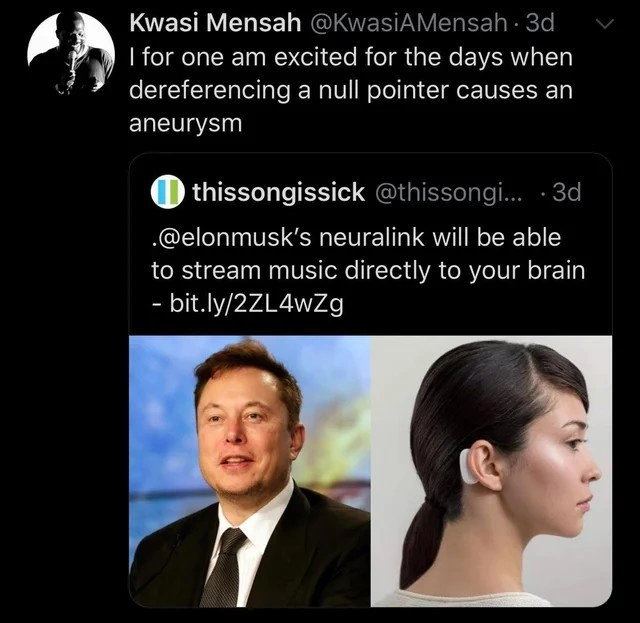
“I for one am excited for the days when dereferencing a null pointer causes an aneurysm.”
That’s the tweet setting the stage, delivered with the kind of dry, sarcastic tone that only a battle-hardened engineer could muster. In the meme, this dark one-liner floats above a news snippet excitedly touting Neuralink’s latest feat – streaming music directly to your brain – complete with Elon Musk’s smiling face and a slick image of a woman wearing a futuristic brain implant. The contrast is immediate and hilarious: the bottom half says “Look at this amazing high-tech future!” while the top half basically says “Yeah, and just wait until a classic bug turns that future into a nightmare.”
Seasoned developers find this funny in a laugh-through-the-pain kind of way. We’ve all chased a segmentation fault at 2 AM – those dreaded crashes usually caused by some null pointer or memory mishap. It’s a frustrating rite of passage in software engineering: one minute your program works, the next it just vanishes with a cryptic error because you referenced something that wasn’t there. Typically, the consequence is you cursing under your breath, restarting the program, and maybe losing a bit of work. Nobody gets physically hurt; only ego and uptime take a hit. Now this meme comes along and says: imagine that same trivial bug, but instead of killing your program, it nearly kills you. It’s such an outrageous escalation that you can’t help but smirk at the insanity of it.
Part of the humor is how it literalizes a common figure of speech among coders. We often say things like “ugh, that bug gave me a headache” or “debugging this issue was brain-melting.” These are metaphorical ways to vent about a tough problem. The meme flips it and asks, what if a bug literally gave you a brain injury? It’s the kind of morbid irony that engineers joke about after surviving enough software crises. We laugh not because it’s truly funny for someone to get hurt, but because it’s a way to cope with the knowledge that, yeah, if we’re not careful, even something as silly as a null pointer could have dire consequences in the right (or wrong) context.
The meme is also a commentary on tech hype vs. reality. Neuralink and similar projects are hyped as the next revolution: brain implants curing diseases, letting us interface with machines telepathically, uploading Spotify playlists straight to our neurons – real cyberpunk stuff. The marketing is glossy and optimistic. But the experienced dev in the back of the room is thinking about all the things that can go wrong. It’s like seeing a concept sports car and immediately worrying about the engine reliability or the brakes. Here, Elon Musk’s vision is the shiny sports car, and our cynical developer is muttering, “Hope you folks remembered to tighten the lug nuts – a.k.a. check for null pointers – or someone’s gonna get hurt.” The tweet is basically that mutter written out loud. It’s poking fun at the fact that under all the futuristic glamor, the technology still runs on code, and code has bugs.
There’s a shared PTSD (Programmer Traumatic Stress Disorder, if you will) being tapped into. Many of us have stories of the “stupid little bug” that caused a big outage or a massive headache at work. The null pointer that crashed the demo in front of clients. The uninitialized variable that took down a server on a weekend. These memories are painful, but with time they become the stuff of dark humor among engineers: “haha, remember when a missing if check cost us two days of downtime?” Now amplify that feeling to a life-and-death scale. It’s both terrifying and perversely comical. Comical because it’s so extreme, and terrifying because it edges on possible in a future where code and biology entwine. The meme is basically every senior dev’s worst nightmare presented as a one-liner. We laugh because the alternative is to seriously ponder it and lose sleep.
It also highlights why fixing bugs in such scenarios is harder than it sounds. Why not just write perfect code, right? Well, even the best of us make mistakes. And when you’re pushing new frontiers (like brain implants), you’re bound to encounter unknown unknowns. The tweet hints at that inevitability: no matter how careful we are, there’s a grim expectation that something will slip through. It’s almost like a resigned “welp, it’s not if, but when.” In traditional software, that attitude leads to robust backup systems, automatic restarts, patches, etc. In implanted devices, those are much harder to implement. You can’t exactly have your brain chip “reboot” without causing a bit of a scene (or a seizure). And you definitely can’t just “ship a hotfix” to a device inside someone’s skull as casually as updating a phone app, especially not when a bug might incapacitate the user. The meme’s author is presumably well aware of these challenges and is using humor to voice a very real concern: software quality becomes literally life-critical when the hardware is in a human body.
The phrase “causes an aneurysm” is extreme, but it’s a stand-in for any severe harm. It could have been “causes a seizure” or “turns someone into a vegetable for a minute.” The choice of an aneurysm ups the shock factor (no pun intended) and also references that colloquial saying “this is gonna give me an aneurysm,” which people say when they’re extremely frustrated or stressed. So it works on that slang level too. Seasoned devs appreciate that layered wordplay: it’s simultaneously a meme-y exaggeration and a tongue-in-cheek use of programmer lingo meets medical catastrophe.
Another reason this resonates is the longstanding tension between rapid innovation and cautious engineering. Silicon Valley culture often prides itself on breaking things, iterating quickly, and not being bogged down by “what ifs.” But when “what if” includes someone’s brain being fried, that cavalier approach doesn’t fly. The meme is the grumpy engineer reminding everyone of Murphy’s Law. It’s like, “Sure, stream music to the brain is cool, but have you considered the blue screen of death that might play along?” The “Blue Screen of Brain” subtitle we used here riffs off the infamous Blue Screen of Death from Windows – a dreaded crash screen. A BSOD in the brain is a horrifyingly literal twist: the brain goes blank or “reboots.” It underscores the stakes in a darkly comic way.
Let’s talk about the imagery for a moment. Elon Musk’s photo next to a woman with a Neuralink device is basically saying “tech visionary and the brave new user.” Overlay that with the text of the tweet, and it’s a bit like someone graffiti-tagging a safety warning onto a flashy billboard. The meme creator essentially did a quote-tweet dunk. The original post says “Neuralink will do cool thing X,” and this person adds, “...and it might come with terrifying bug Y, lol.” That “lol” is the nervous laugh of someone who writes code for a living and has seen how bad things can get even in far less critical situations. It’s engineer humor meeting tech marketing.
In the developer community, there’s also an ironic saying: “It’s not a bug, it’s a feature.” In this dystopian joke, aneurysms on null dereference would be the worst feature ever. It’s so absurd that it fits the style of jokes we make to criticize something indirectly. No one truly thinks Neuralink will ship a product that unsafe, but by joking about it, we’re indirectly saying, “This had better be taken seriously, because the potential for harm exists.”
To sum up why those in the know chuckle at this:
- We’ve all been burned by null pointers: It’s one of the most common programming mistakes, and yes, it always causes trouble (though usually just digital trouble).
- Dark exaggeration of consequences: Taking a minor error and inflating its outcome to catastrophic levels is classic programmer humor (think “download more RAM” or “nuke the site from orbit” kind of silliness).
- Reality check on hype: It humorously reminds everyone that flashy new tech isn’t all rainbows; there are demons in the details (or bugs in the code, in this case).
- Coping mechanism: Laughing at a scary prospect makes it a bit less scary. Engineers joke about disaster scenarios in part to acknowledge them and mentally prepare (or just to release some anxiety).
In essence, “Blue Screen of Brain” is a wry senior-engineer way to say: “We love new tech, but please, for the love of all that is holy, don’t let it fail in the old ways that we know too well.” It’s funny, it’s sardonic, and it carries a kernel of truth that every experienced dev nods at. After all, behind every groundbreaking innovation, there’s a weary programmer praying that a null pointer isn’t lurking, ready to literally blow someone’s mind.
Level 4: Memory Safety vs. Mind Safety
For decades, null pointer dereference has been the quintessential memory bug in low-level programming. A pointer is essentially a memory address, and a null pointer is what you get when that address is 0 – meaning it points to nothing valid. Dereferencing it (attempting to read or write via that pointer) triggers a hardware exception. Modern CPUs, with their memory management units, mark address 0 as off-limits to catch such errors. The result? A segmentation fault: the process is forcibly terminated and you might see something like “Segmentation Fault (core dumped)” as a merciful outcome. In a normal app, that’s annoying but contained – your OS says “nope” and stops the program before it can do more damage.
Now, consider a futuristic scenario like Elon Musk’s Neuralink – a brain-computer interface (BCI) chip implanted in your skull, promised to stream music directly to your brain. In such a system, a familiar pointer bug could escalate from a harmless program crash to a full-blown biomedical crisis. We’re talking about traditional software bugs colliding with hardware that’s wired into living tissue. This is where memory safety meets mind safety: a trivial coding mistake could send unintended electrical signals coursing through your neurons. The meme jokes about it causing an aneurysm (a burst blood vessel in the brain) – an exaggeration for effect, but it’s hinting at something real: undefined behavior in code can translate to undefined (and unsafe) behavior in a human body.
At a deep technical level, this is a classic cyber-physical system problem. We’ve known how to manage memory in computers for ages, but now the computer’s memory writes might literally write to you. If a pointer goes null in a neural implant’s firmware, what happens? Ideally, the device’s runtime or OS (if it has one) catches it – maybe it triggers a fault on the chip, similar to a segfault, and reboots or goes into a safe mode. But if it doesn’t, or if the error corrupts the state in a sneakier way (imagine writing over a buffer that controls the output voltage to your brain electrodes), the consequences are unpredictable. Undefined behavior in C/C++ has caused everything from program freezes to bizarre outputs – now picture that, but the “output” is neuron stimulation. Instead of a frozen app, you might get a frozen synapse. Instead of gibberish on a screen, maybe gibberish firing in your auditory cortex. It’s chilling to consider.
This is why safety-critical code demands extraordinary rigor. In aerospace, automotive, and medical devices, developers use strict coding standards (like MISRA C for automotive/medical C code) and even formal mathematical proofs to avoid these scenarios. Some industries have adopted languages with built-in memory safety – for instance, Ada in aviation, or more recently Rust, which can guarantee at compile-time that you can’t dereference null (unless you explicitly opt out). The dark humor of the tweet shines a light on this: if we don’t get serious about memory safety in our brain implants, a simple bug could be fatal.
And it’s not purely hypothetical. History gives us grim lessons: the Therac-25 radiation therapy machine (mid-1980s) had a software race-condition bug that led to patient deaths because the machine delivered massive overdoses of radiation. That was a case of software oversight causing real physical harm. In a Neuralink-like scenario, streaming music to your brain involves a chain of low-level operations: reading data from a wireless signal, decoding that data (likely via some C code handling bytes and buffers), and then outputting electrical pulses through electrodes. Each step has pointers and memory under the hood. If a pointer is mismanaged – say the code tries to read from a null buffer where audio data should be – the resulting behavior could be anything from the device shutting down (if we’re lucky and it fails safe) to some spurious high-frequency signal jolting the brain (if we’re unlucky and the bug bypasses fail-safes). The meme quips about an aneurysm, which is probably hyperbole; a null dereference won’t magically pop a blood vessel. But could it trigger a seizure or stimulate pain receptors? In a worst-case, if the device went haywire, it’s not outside the realm of possibility. That’s the scary kernel of truth underneath the joke.
In theoretical computer science and systems engineering, undefined behavior is the bane of reliability. When code does something the spec says is “undefined,” absolutely anything can happen – compilers might make wild assumptions, hardware might carry on with garbage data. Usually that means your program crashes or produces nonsense. But now that programs can directly interface with the human nervous system, “anything” could include physiological side effects. The hardware-software convergence here blurs the line between a software crash and a medical emergency. In a PC, a segmentation fault isolates damage to the process’s memory space. In a brain implant, the “memory space” isn’t just an abstract region – it could correspond to real neural activity if the isolation between software and tissue isn’t perfect.
What’s the solution at this level? It involves cross-disciplinary safeguards. We need to bring the error rates in code down to near-zero: using memory-safe languages or restricted coding patterns, exhaustive testing (perhaps simulating the device in a lab with real neural responses), hardware interlocks that limit what the device can physically output (so even if software goes crazy, it can’t zap beyond safe levels), and redundancy (backup systems that take over if one fails). The meme’s dark punchline comes from imagining none of those protections in place – treating a brain implant like just another gadget that might throw the occasional Blue Screen of Death. “Dereferencing a null pointer causes an aneurysm” is basically saying, what if a crash in the code literally equaled a crash in the brain? It’s a scenario that makes engineers shudder… and then nervously laugh, because it’s both absurd and uncomfortably plausible given how often we deal with bugs.
In short, this meme highlights a collision of two worlds: the bug-prone software world and the fragile human body. It underscores why bridging that gap is a monumental responsibility. The humor works because it’s an exaggeration of a real concern – it implicitly tells us, “Hey, if we ever put C code in your cortex, we’d better be damn sure to handle those NULL checks.” After all, nobody wants a NullPointerException to end up as a neurosurgeon’s emergency call. A segmentation fault in a regular program might dump core; a segmentation fault in your brain implant might dump you. So as we contemplate hooking computers directly to our minds, the old mantra gains a very literal weight: be careful with that pointer, or it might point back at you – with a vengeance.
Description
This image is a screenshot of a Twitter exchange in dark mode. It features a tweet from user 'thissongissick' which says, '.@elonmusk's neuralink will be able to stream music directly to your brain', accompanied by a picture of Elon Musk and a woman with a futuristic earpiece device. Above this, user Kwasi Mensah has quote-tweeted it with the comment: 'I for one am excited for the days when dereferencing a null pointer causes an aneurysm'. The humor is a dark, tech-savvy take on the concept of brain-computer interfaces. 'Dereferencing a null pointer' is a classic, critical programming error, especially in low-level languages like C or C++, that causes a program to crash, often with a 'segmentation fault'. The joke projects this software failure onto the human brain as the new hardware, imagining a scenario where a common bug has catastrophic, biological consequences - an aneurysm. This resonates deeply with experienced engineers who understand the fragility of software and the hell of debugging pointer issues, making the idea of running that code directly on their brain both terrifying and morbidly funny

Comments
7Comment deleted
My biggest fear with Neuralink isn't AI taking over, it's getting a stack overflow from thinking in recursion too deeply
Funny how fast the budget for a C→Rust refactor gets approved once the ops team points out that SIGSEGV is now an FDA-reportable adverse event
After 20 years of explaining why we need null safety in production systems, we're about to find out what happens when 'undefined behavior' becomes literal brain damage - suddenly that TypeScript migration doesn't seem so unnecessary anymore
Finally, a use case where Rust evangelists can legitimately claim 'the borrow checker could save your life' - because when your music player has direct memory access to your hippocampus, a segfault isn't just a core dump, it's a medical emergency. This is what happens when you let C programmers design wetware APIs
Neuralink SDK: when the C bindings drop, a segfault is a HIPAA incident and “unsafe” stops being theoretical - see you all in Rust
SRE runbook, 2030: if the BCI audio driver NULL‑derefs, page neurosurgery, roll back OTA, and schedule the rewrite in Rust
Rust devs: 'Borrow checker just became humanity's best friend - prevents aneurysms, one lifetime at a time.'