Skip to content
DevMeme
4464 of 7435
Cursor vs Precursor: a stone-age take on modern UI pointers
UX UI Post #4893, on Oct 4, 2022 in TG

Cursor vs Precursor: a stone-age take on modern UI pointers

Why is this UX UI meme funny?

Level 1: Caveman Cursor

Think of it this way: a long, long time ago, a caveman might point at something using a sharp stone arrowhead on the end of a stick. Now, fast forward to today – you point at things on your computer screen using a little arrow icon (the cursor) that you move with your mouse. This meme is joking that the stone arrowhead from the caveman days is like the great-great-grandfather of your computer’s arrow pointer! It’s funny because it mixes something really old with something modern. It’s like saying, “Before we had fancy computers, we pointed at stuff with actual arrows!” The word precursor means something that came before, so they label the arrowhead “Precursor” to mean it’s a before-cursor, an ancient version of the cursor. Of course, cavemen didn’t have computers, but imagining that the little arrow on your screen has a Stone Age ancestor is silly and that’s why it makes us smile. It’s a bit like comparing a horse-drawn cart to a car and saying the cart is the “pre-car” – we know one evolved into the other in a way. Here we’re comparing a physical arrowhead to a digital arrow pointer. Both are pointy, both are used to aim at things, one was for hunting and the other is for clicking – and that unexpected connection is what makes it a fun, relatable joke for everyone.

Level 2: From Stone to Silicon

Let’s break down the joke in simpler terms. On the left side of the image is a cursor – that’s the arrow on your computer screen that you move around with your mouse or trackpad. You see it every time you use a computer to click on buttons, links, or icons. It’s one of the basic elements of a graphical user interface (GUI), which is just a fancy term for the visual part of software where you can interact with things on screen (windows, buttons, etc.) instead of typing commands. Now, on the right side of the meme, there’s what they call a “Precursor.” A precursor basically means something that came before. It’s a word often used to describe an earlier version or ancestor of something. In the image, the precursor is shown as a stone arrowhead – a tool from the Stone Age that people used at the tip of spears or arrows for hunting and pointing at targets (in a literal, shoot-an-arrow kind of way).

So why put these two together, cursor and precursor? The humor here is a play on words and images. The word cursor sounds a lot like precursor, and visually, a computer’s cursor arrow kind of looks like a small arrowhead (triangular and pointy). The meme is joking that the ancient arrowhead is the ancestor of the modern computer pointer. Of course, this isn’t true in a direct way – cavemen weren’t inventing computers – but it’s a funny comparison. It’s like saying UX design (user experience design) goes way back. Think about it: both an arrowhead and a cursor arrow are used to point at something. The arrowhead let prehistoric humans point (or rather, shoot) at animals or targets. The cursor arrow lets us point at buttons and files on our screen to tell the computer, “This, I choose this.” It’s a visual metaphor – using one image (the arrowhead) to symbolize the idea of something that came before the other image (the cursor).

For someone who’s a bit new to tech or not super technical, there are some key concepts here. First, the mouse cursor (or pointer) is central to how we use computers today. It’s so common that we don’t even think about it – it’s just the arrow that moves when we move the mouse. In fact, in web development or front-end programming, there’s even a CSS property called cursor that lets developers change how the cursor looks when it’s over certain elements. For example, setting cursor: pointer; in CSS will typically turn the cursor into a hand icon (often used to indicate a clickable link or button). There are other fun cursor icons too: a text cursor (an I-beam shape for when you’re over text), a crosshair, a wait cursor (like a spinning wheel or hourglass). But the default is almost always that arrow shape. Why an arrow? Because an arrow clearly points at something, which makes it intuitive. When you see an arrow on the screen, you instinctively know the tip of the arrow is the exact spot you’re selecting or clicking.

Now, the arrowhead on the right is an ancient tool – literally a piece of stone carved into a pointed shape. Thousands of years ago, humans used these as tips for arrows or spears. They are one of the earliest “technologies” in human history. If you think about it, an arrowhead’s whole purpose was to point and go in the direction it’s aimed, usually to hit a target. It doesn’t take much imagination to see how that relates to the idea of a pointer on a screen which you aim at a target (like a button) to “hit” it (by clicking). The meme is making a wordplay pun: cursor vs. precursor. The prefix “pre-” means before, so precursor means “the thing that came before.” And the joke is, what came before a modern cursor? A prehistoric cursor – an arrowhead! It’s a goofy kind of logic that results in a funny comparison.

For a junior developer or someone just learning about UI design, there’s also a charming reminder here: every high-tech idea often has a very simple, low-tech origin if you go back far enough. We use terms like “pointer” or “cursor” daily, but we don’t often think about why the cursor is shaped like an arrow. This meme playfully suggests, “Well, maybe because we’ve been using arrows to point at things since the dawn of time!” It’s not literally why (the real reasons involve early computer history and design choices), but it’s a fun way to appreciate the continuity. It also highlights the creativity in tech humor – combining a bit of history, a bit of wordplay, and something every developer/designer can relate to (the ubiquitous mouse pointer). In short, the meme is easy to get once you know: a cursor is the on-screen arrow, a precursor is something from before, and here that something is an ancient arrowhead. It’s a simple joke that anyone who uses a computer and knows what an arrowhead is can chuckle at.

Level 3: Archaeology of Pointers

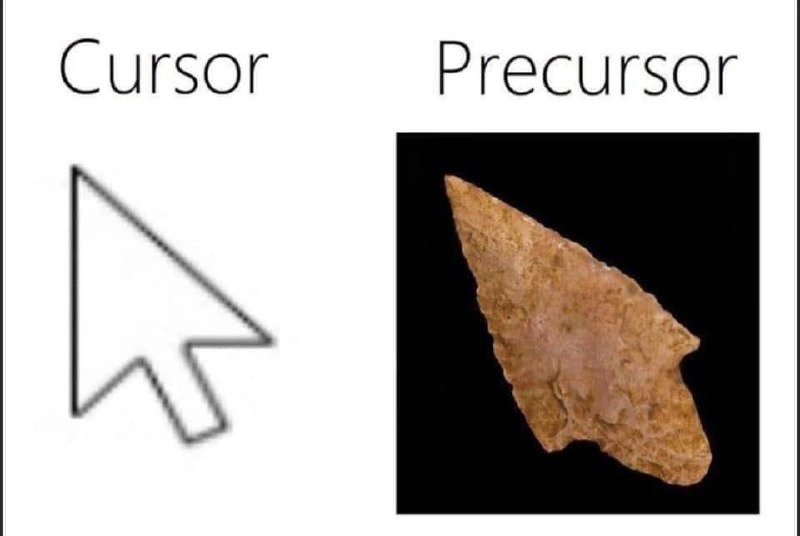
At first glance, this two-panel meme reads like a clever exhibit in a tech history museum. On the left, we see the classic black-and-white GUI cursor: that familiar arrow-shaped pointer born in the pixel era. On the right, under the label "Precursor," there's a photograph of a stone arrowhead against a dark background. This juxtaposition sets up an etymological pun and a visual gag. A seasoned developer or UX designer will immediately appreciate the wordplay: cursor versus pre-cursor. The prefix "pre-" means before, and here the meme proposes a tongue-in-cheek ancestry for our modern UI pointer – a literal prehistoric pointer from the Stone Age. It’s a bit like saying the caveman’s arrowhead was the original version of today’s mouse cursor. The humor operates on multiple levels: linguistic, visual, and historical.

From a senior perspective, there’s a layer of UX irony here that's especially delightful. We spend our days pushing pixels, obsessing over every little UI detail, and here the meme reminds us that the act of pointing at something is as old as humanity itself. The arrow cursor on your screen is a fundamental element of UX design – it’s how users interact with graphical interfaces. This meme cheekily suggests that even in prehistoric times we had a “pointing device,” albeit one made of flint. It’s a visual metaphor bridging front-end design with prehistoric technology. In essence, the stone arrowhead is portrayed as the “ancestor” of the modern cursor icon. For those of us in tech, the joke lands because it connects our high-tech world to the very low-tech past in one image. It’s relatable: even if you’re a hardcore front-end developer wrestling with z-index or responsive layouts, you can chuckle at the idea that pointing – the core action behind a click – is a timeless human behavior. This is classic tech humor where we laugh at the overlap of serious technology with something primitively simple.

Diving a bit deeper, there’s genuine history and design insight hiding behind the silliness. The arrow-shaped pointer in GUIs is not arbitrary – it became a standard during the early days of graphical user interfaces at places like Xerox PARC and later Apple. Originally, the arrow in the GUI was drawn at a 45-degree angle (rather than straight up) because of simple technical reasons: on low-resolution screens of the 1970s and 80s, a slanted arrow was easier to recognize and draw with the pixel grids. That cursor icon was literally designed pixel-by-pixel, often a 16x16 or 32x32 pixel bitmap. The arrowhead in the meme’s right panel, by contrast, is made of chipped stone – but notice the visual similarity in shape! The triangular pointed form of a flint arrowhead resembles the silhouette of the mouse pointer. This parallel is what makes the meme’s concept click (pun intended). It’s as if the meme is saying, “Long before we had high-DPI displays and CSS cursor styles, we had actual pointers – and they were made of rock.” For veteran developers, there’s also a whiff of design evolution here. We’ve gone from physical arrows used for hunting and direction to digital arrows used for navigating virtual spaces. The meme compresses that entire evolutionary journey into two side-by-side images – a spark of joy for the TechHistory buff in all of us.

There’s also a bit of self-referential developer humor: those of us in frontend or UI development deal with cursors all the time – usually in code rather than stone. We change cursor styles with CSS (cursor: pointer; to turn the arrow into a hand icon on hover, for example), we agonize over the perfect iconography for custom interactions, and we certainly appreciate a well-placed visual pun. By labeling the arrowhead Precursor, the meme playfully imagines a timeline of UI design that extends back to the cavemen. It hints that the act of pointing at what you want – whether that’s prey in a hunt or a file to open on your desktop – is a universal concept. For an experienced developer or designer, there’s an almost anthropological chuckle here: user experience is fundamentally about guiding attention, and what is an arrowhead if not a tool for guiding a projectile to its target? We can’t help but admire how relatable humor emerges from such a mash-up of domains. This is the kind of joke you’d share in the office Slack channel: it’s simple enough for anyone to smirk at, but if you’ve got a background in computing or design, you appreciate the deeper cleverness. It’s a reminder that even in the fast-paced world of tech, a good old-fashioned wordplay pun (with a dash of history) can make us smile.

Description

Two side-by-side panels deliver a visual pun. On the left, a bold black-outlined computer mouse pointer is captioned "Cursor." On the right, under the heading "Precursor," a photograph of a tan, chipped stone arrowhead sits against a solid black square. The joke plays on the linguistic overlap while hinting that the prehistoric arrowhead is the ancestral version of today’s GUI pointer, humor familiar to front-end and UX engineers who spend their days chasing pixels and cursors. It blends UI design history, wordplay, and developer humor into an accessible meme

Comments

6
Anonymous ★ Top Pick Prehistoric pointer spec: 0 DPI, single-threaded, real-time haptics, and every click triggered an irreversible state transition - makes today’s UI thread jank feel quaint
  1. Anonymous ★ Top Pick

    Prehistoric pointer spec: 0 DPI, single-threaded, real-time haptics, and every click triggered an irreversible state transition - makes today’s UI thread jank feel quaint

  2. Anonymous

    After 20 years of explaining pointer arithmetic and cursor positioning to juniors, I finally understand why our ancestors gave up on stone tools - at least a segfault doesn't require bandages, and you can't accidentally commit a flint arrowhead to production

  3. Anonymous

    Before we had pointer events and mouse listeners, we had actual pointers that listened for mammoths. The cursor has come full circle: from hunting megafauna to hunting memory leaks, but the fundamental problem remains the same - trying to hit a moving target while your hand cramps up

  4. Anonymous

    Cursor vs precursor: the original pointer was non-null, single-owner, move-only - Rust would approve; undo wasn’t in the spec

  5. Anonymous

    Proof we’ve been dereferencing pointers since the Paleolithic - same Fitts’s Law, different drivers; the original hardware cursor shipped with zero DPI and 100% on‑prem

  6. Anonymous

    Precursursor: zero npm deps, survives ice ages, but try hot-reloading that flint

Use J and K for navigation