Skip to content
DevMeme
2832 of 7435
Phone book era vs social-media era: shifting outrage over public data
DataPrivacy Post #3129, on May 19, 2021 in TG

Phone book era vs social-media era: shifting outrage over public data

Why is this DataPrivacy meme funny?

Level 1: Changing What’s “Private” and What’s Not

Think about it like this: a long time ago, everyone’s phone number and address were in a big phone list book that anybody could get. It’s like if your school put every student’s home address and number on a board that anyone could see. Back then, people didn’t mind – it was normal because that’s how you could call your friend or send a letter. There wasn’t a sense that this basic information was super secret.

Now, times have changed. We have the internet and social media (like Facebook) where you share pictures and stories with your friends. But people do worry a lot more about privacy today. They’d be upset if the company running the social site took all the information you share (like what you like to do, where you go, who your friends are) and started giving it to other businesses or using it to make money without asking you.

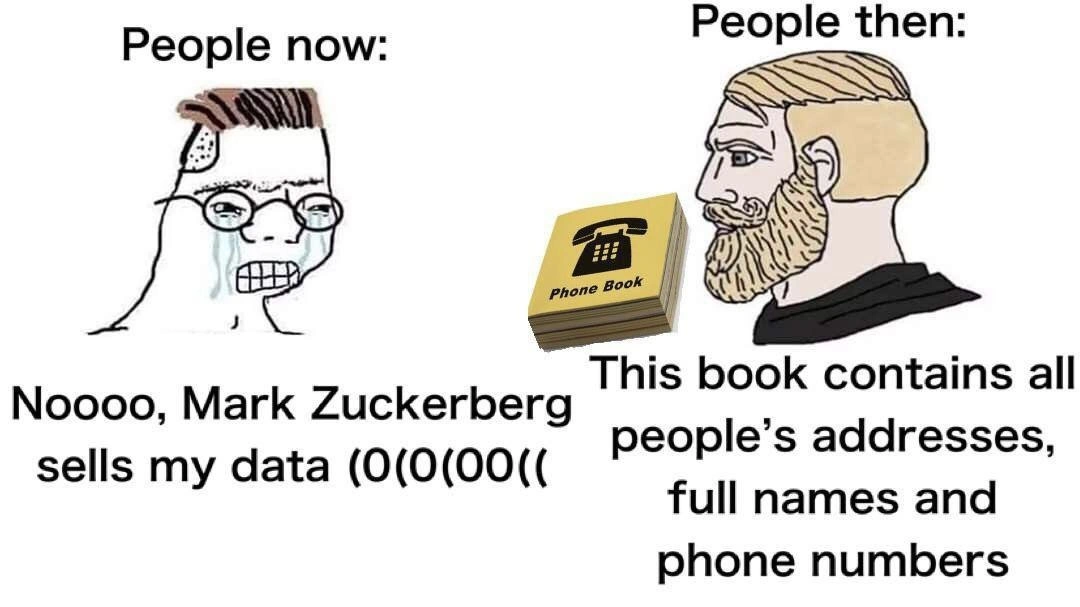
The meme is funny because it shows a cartoon guy from today crying and saying “No, Mark Zuckerberg (the Facebook boss) sells my data!” — he’s very upset that his personal info might be used by the website. Next to him, a cool-looking cartoon guy from the past is totally okay telling everyone that a phone book has all of our names, addresses, and numbers. In other words, people in the past were okay sharing personal info with the public, but people now get very upset about it.

It’s like if your grandparents said: “We used to put our phone number on a public list and it was fine,” and you’re thinking: “No way, I don’t want my phone number shared without permission!” The joke highlights how our idea of privacy has changed. What made people in the past comfortable can make people today uncomfortable. And that’s why it’s humorous – it makes us realize how differently we think about personal information now compared to back then. It’s a simple picture showing that in the past everyone’s info was openly available and nobody cried about it, but today if a website shares your info, people cry out “Not fair!”

Level 2: Phone Book vs Facebook

Let’s break down the joke in simpler terms. On the “People now” side (left), there’s a drawing of a crying, upset face (the Crying Wojak meme character) saying “Nooo, Mark Zuckerberg sells my data!” This represents modern folks (like social media users today) who are upset that their personal information is being shared or sold by big tech companies. Mark Zuckerberg is the CEO of Facebook, a major social-media platform. When the meme says “sells my data,” it’s talking about how people worry that Facebook and similar sites take the information you share (like your birthday, likes, friend connections, online habits) and sell it or use it for profit. In real life, companies like Facebook mostly make money by showing targeted ads using your data rather than literally handing your data over for cash, but from a user’s perspective it feels like the company is trading away your privacy. This feeling leads to serious PrivacyConcerns – people now really care about who has their data and what’s being done with it.

On the “People then” side (right), there’s the Chad meme character (a blond, confident-looking guy) pointing to a Phone Book. He’s saying, “This book contains all people’s addresses, full names, and phone numbers.” The phone book is literally an old-style printed book that used to list personal contact information for everyone. This was common in the past (before the internet). Phone books (often with a yellow or white cover) were delivered to homes and had two sections: the White Pages, listing individuals alphabetically with their address and landline phone number, and the Yellow Pages, listing businesses. If you wanted to call someone, you’d flip through this big book to find their number. It included basically public data about almost every adult: where they lived and how to contact them. And guess what? People were fine with it back then! It was normal. If someone in 1985 said, “I found your number in the phone book,” you wouldn’t freak out – you’d probably be glad they called.

So the meme contrasts old vs new data sharing attitudes:

  • People Then (Old Days): “Here’s a big book with everyone’s personal contact info. That’s totally fine and convenient.” 😎
  • People Now (Digital Age): “Wait, a website I joined is using my personal info to make money? That’s NOT okay!” 😭

It’s highlighting a big change in what we think is okay to share publicly. In the past, having your name and number out there wasn’t seen as a big deal – it was actually helpful. Now, we talk a ton about Data Privacy. We have things like privacy policies, settings to hide our info, and laws such as GDPR (in Europe) or other data protection rules to govern how companies handle user data. None of that existed in the phone book era. There was a sort of unwritten understanding: the phone company gives us this book to help us contact each other, and we trust that it’s fine. There was no concept of social media, no constant tracking of what you do, and no targeted advertising based on your personality.

Why are people (today) upset with Mark Zuckerberg? Because Facebook and other social platforms collect a lot more than just your phone number. They know who your friends are, what you like, what you talk about, where you go (if you tag locations or carry your phone), and they use that to show you ads or content tailored to keep you engaged. There have been scandals where data from Facebook was misused – for example, the Cambridge Analytica incident where a third-party got hold of millions of users’ data without permission and used it for political ads. So modern users feel a bit betrayed: they signed up to share fun posts with friends, not to become a product themselves. This feeling is summed up by “sells my data” – they express it like the company took something private and is making money off it behind their back.

Meanwhile, why is the Chad (people then) so relaxed about the phone book? Because that was a time when giving out basic info (name, address, number) was an accepted trade-off so people could reach you. Society didn’t view it as dangerous; it was practical. Also, importantly, the phone book didn’t gather any extra info about you. It didn’t know your interests, it wasn’t tracking your behavior, and it wasn’t trying to sell you anything based on your listing. It was just a contact directory. So the context was very different.

The meme uses Chad vs. Crying Wojak characters from InternetCulture to exaggerate this difference:

  • The Crying Wojak (also known as “Feels Guy” in some circles, depicted with tears and a distressed look) often represents someone being overly sensitive or whining about something. Here, that’s the modern internet user upset about privacy on social media. The text “Noooo, ... (0(0(00((” is mimicking a crying sound or someone wailing.
  • The Chad (a popular meme archetype for a confident, no-nonsense person) represents the old-school viewpoint. Chad is unbothered, even a bit smug. He’s essentially saying, “This was totally normal, and I’m cool with it.” His posture and tone imply, “I don’t see the problem.”

Data Privacy Irony: The humor comes from noticing the irony (the unexpected contrast) between those two reactions. It’s ironic because objectively, a phone book printing your address and phone number is a huge public exposure of personal data by today’s standards. Yet people weren’t upset about it at all. Now we have social media where, in theory, you can choose what to share and with whom, but people are extremely upset at the idea of their data being used without explicit permission.

For a junior developer or someone new to these concepts:

  • Data Privacy is about protecting personal information and deciding who gets to see or use it. In the phone book days, data privacy as a concept wasn’t in the spotlight; today it’s a big deal in tech.
  • PrivacyConcerns are the worries people have that their info might be misused (like identity theft, or companies spamming them, or just the creepiness of being watched).
  • SocialMedia refers to websites or apps (like Facebook, Instagram, Twitter, etc.) where people share content and socialize online. They are generally free to use, which means the companies often make money in other ways – usually by advertising.
  • SurveillanceCapitalism is a term you might hear that describes how companies spy (surveil) on user behavior and turn it into profit (capital). Facebook, Google, and many apps do this: they collect data about what you do and then earn money by using that data (often for very personalized ads or recommendations). The meme implicitly references this – Mark Zuckerberg (Facebook) “selling data” is basically an accusation of surveillance capitalism.
  • TechHistory in this context is looking at how technology and society used to handle things versus now. The phone book is part of tech history (an old-school solution to a communication need), and early internet culture versus modern internet practices show an evolution in thought.
  • InternetCulture is reflected in the meme format and characters. Using Wojak and Chad is itself a product of internet meme culture, where certain drawing characters stand for certain attitudes.
  • The generational privacy comparison is basically comparing your grandparents’ idea of privacy (which might be “sure, I’m in the phone directory, so what?”) to a teenager’s idea of privacy today (“don’t share my email without asking!”).

In simpler terms: The meme is teaching us that what people consider “private” or “public” data isn’t fixed – it changed over time. Years ago, having your phone number in a public book was considered normal and even necessary. Today, having your phone number or address exposed without permission would be seen as a privacy violation. And yet, at the same time, many people willingly share lots of personal info on social media – but they expect control over it. They’re okay sharing a selfie with friends, but not okay with a corporation analyzing that selfie to sell them products. The meme points out the humorous inconsistency: we’re more protective of our data now, even though we also share more data than ever.

So, the right side (People then: Chad) is basically saying “We openly published everyone’s contact info and nobody batted an eye.” The left side (People now: Crying Wojak) is saying “We share info online and now we freak out that it’s being used behind the scenes.” The developer humor here is subtle: it nudges us to think about how data governance and user expectations have had to evolve. If you’re working on any app that handles user data, you know you have to be careful – users today demand privacy and transparency. But historically, neither users nor companies thought that way. The meme cleverly uses that contrast to get a laugh and maybe a reflective “huh, that’s true.”


Level 3: The Yellow Pages Paradox

In the left half of the meme, we see the classic Crying Wojak (the upset, nerdy cartoon face) wailing, "Noooo, Mark Zuckerberg sells my data (0(0(00((". On the right, the bearded Chad (the confident, stoic character) points to a hefty Phone Book and calmly says, "This book contains all people's addresses, full names and phone numbers." This humorous juxtaposition hits experienced developers right in the irony: our collective attitude toward data privacy has flipped 180° over time.

Back in the TechHistory of the pre-Internet era, phone companies published phone books (often with yellow covers, hence Yellow Pages). These massive directories listed everyone’s name, address, and landline phone number. Yes, phone_book_public_data was literally delivered to every doorstep annually. Privacy concerns? Practically non-existent by today’s standards. If you had a phone, you were public by default. Only a rare few opted out (unlisted numbers), but the norm was openness. Communities accepted it calmly – it was simply how you found a friend’s number or a local plumber. There was no outrage; in fact, people then would’ve found it strange if such basic contact info weren’t publicly available.

Fast-forward to the social-media era: now we have platforms like Facebook (founded by Mark Zuckerberg) where users voluntarily share personal details and daily lives. However, in this era of SurveillanceCapitalism, that data isn’t just sitting innocently in a book – it’s fueling algorithms and targeted ads. Tech giants track your clicks, likes, location, and interactions to monetize your data. The phrase “Mark Zuckerberg sells my data” is a dramatic way of saying social media platforms profit from user information. (Technically, they sell targeted access to you via ads rather than handing over spreadsheets of your info, but to the average user it feels the same as selling data.) This modern reality has given rise to intense PrivacyConcerns – people feel betrayed when they discover their free app or network is actually making money off their personal life behind the scenes.

The meme’s humor comes from this data_privacy_irony: People now scream in outrage about digital privacy and data harvesting, while people then literally published their personal data for all to see and shrugged. It’s a hilarious generational_privacy_comparison. Developers who’ve been around a while witness this and think, “We went from mailing everyone a public data directory to freaking out about online data – what changed?” The answer isn’t that people were naive then and smart now; it’s that context and expectations changed. In the phone book days, the use of data was limited – no giant corporation was cross-referencing your address with your shopping habits or political views. The InternetCulture hadn’t taken over yet, so nobody imagined the concept of a billion-dollar company built on profiling its users.

Today, thanks to scandals (like Cambridge Analytica) and leaks, users are hyper-aware. The outrage from the Crying Wojak side represents modern netizens who feel violated by SocialMedia data practices. Meanwhile, the Chad side represents an old-school, jaded perspective saying, “We used to give away this kind of info without fuss. Why so upset now?” It’s almost mocking the present-day panic by showing how casually people treated similar data before. The dev community chuckles here because we see how InternetCulture and capabilities evolved: The phone book was essentially an analog database. It had lots of personal data, but its governance was simple – it was static, detached from behavior, and not easily cross-linked to every aspect of your life. Facebook, by contrast, is a dynamic database of both your static info and your behaviors, preferences, social graph – and it’s all centralized under one company’s control. A phone book was a tool; Facebook is a platform and a marketplace where your data is the commodity.

To highlight the contrast, consider the following comparison that senior devs appreciate:

Era Personal Data Sharing Privacy Expectation Who Benefits?
Phone Book Era Physical directories (White Pages for people, Yellow Pages for businesses) listing name, address, number for virtually everyone. Data was public by default. Most people weren’t worried about misuse; it was just how phones worked. Utility: helped the community connect. Phone companies printed them as a service (indirectly to make having a phone more valuable). Minimal direct profit from the personal data itself.
Social Media Era Online platforms (e.g. Facebook) collecting profiles: name, contact info, plus photos, interests, friend networks, and daily interactions. Data is private by expectation, with users shocked when it’s shared or exploited. People assume platforms should guard their info. Profit: platforms engage in surveillance capitalism, turning user data into targeted ads money. The company (not the user) reaps huge profits from personal data.

In other words, data governance norms shifted. If a modern developer proposed a new app that works like an old phone book (publicly exposing user info by default), the Privacy team and legal department would have a heart attack. 🔐 What was standard practice in the analog era would be seen as a gross privacy violation in the digital era. The meme captures that absurdity perfectly.

From a developer perspective, the meme pokes at how design assumptions evolve. We once built systems assuming openness (everyone’s data out in the open). Now, we design with privacy in mind, adding consent screens, privacy settings, and encryption. Yet, users still share plenty on social platforms – the difference is they expect control and consent. The crying Wojak is essentially every user who feels they didn’t consent to the fine-print where their data fuels advertising algorithms. The Chad is the boomer-dev or TechHistorian reminding us that not long ago, we handed out personal info in books that every neighbor (or telemarketer) could flip through. It’s a classic case of old_vs_new_data_sharing where both eras have their quirks: the old one had zero digital security, and the new one has security but also the paradox of surveillance-by-corporations.

To really drive it home for senior devs, here’s a tongue-in-cheek pseudo-code of the two eras’ "features":

# 1985: Adding a person to the phone book (public by default)
phone_book.add_entry(name="John Doe", address="123 Elm St", phone="555-1234")
# (No privacy toggle. Once listed, anyone with the book can see this info.)

# 2021: User joins a social media platform (sharing but with settings, theoretically)
user_data = {
    "name": "John Doe",
    "address": "123 Elm St",
    "phone": "555-1234",
    "friends": ["Alice", "Bob", "Charlie"],
    "likes": ["music", "tech memes", "pizza"],
    "posts": ["Hello world!", "Lovely day at the park..."],
}
platform.create_profile(user_data)
platform.set_privacy(user="John Doe", visibility="FriendsOnly")
# Behind the scenes: Platform still monetizes John Doe's data via targeted ads

In the snippet above, the phone book entry is straightforward and public. The social media profile has more data and some privacy setting (e.g. “Friends Only”), but notice the comment – even if John Doe restricts who can see his posts, the platform itself is still using all that data commercially. This is the crux of surveillance capitalism: users get a free service and connection, companies get rich off the data exhaust. No one in 1985 imagined their phone book listing being used to, say, target them with personalized marketing in real-time. But in 2021, that’s exactly what happens with the digital equivalent of the phone book.

Ultimately, the meme strikes a chord with veteran developers because it highlights a PrivacyParadox: we’re outraged at Facebook for something roughly analogous (in principle) to what telephone companies did openly for decades. Of course, the details differ – the scope of data and potential for misuse today is astronomically higher – but the meme humorously glosses over nuance to make a point. The shared laughter comes from recognizing both how far we’ve come in data privacy awareness, and how absurd it is that we never questioned the old system. It’s a sarcastic reminder that context is everything. As technology evolves, so do social norms: what once was mundane (your info in the phone book) would now be considered a shocking breach of trust if done without consent. And conversely, what we accept as “normal” today (posting selfies and locations to hundreds of “friends”) might seem bizarrely exhibitionist to someone from the past. The meme distills this complex shift into a one-panel history lesson, giving seasoned devs a good chuckle about the generational privacy comparison we’ve all lived through.


Description

Split-panel Wojak meme. Left half captioned "People now:" shows the hunched, tear-streaming "Crying Wojak" character (face intentionally blurred) wailing: "Noooo, Mark Zuckerberg sells my data (0(0(00((". Right half captioned "People then:" shows a confident "Chad" profile pointing at a thick yellow directory labelled "Phone Book", calmly stating: "This book contains all people's addresses, full names and phone numbers". The visual joke contrasts modern anger at platform-level data monetisation with past acceptance of openly printed personal information, highlighting how expectations of privacy and data governance have evolved for developers thinking about data-privacy, surveillance capitalism, and historical context

Comments

16
Anonymous ★ Top Pick The phone book was basically a globally replicated, annually reindexed key-value store with public read permissions - nobody panicked until we wrapped it in an ad-tech SDK
  1. Anonymous ★ Top Pick

    The phone book was basically a globally replicated, annually reindexed key-value store with public read permissions - nobody panicked until we wrapped it in an ad-tech SDK

  2. Anonymous

    Phone books were just production databases with read-only public access, no rate limiting, and the only GDPR compliance was hoping someone didn't tear out your page

  3. Anonymous

    The real architectural evolution: from O(1) lookup in physical phone books to O(n²) complexity in privacy policies nobody reads, where n = number of third-party data brokers. At least the phone book had a clear schema and you could grep it with your finger

  4. Anonymous

    Phone books were the original open API: no auth, no rate limits, just paginated dumps of your PII for a quarter

  5. Anonymous

    We didn’t fix privacy; we just replaced the world-readable paper CSV with a sharded Kafka topic and called it consent management

  6. Anonymous

    Phone books had O(n) lookup and zero joins; adtech made it O(1) with infinite LEFT JOINs - turns out privacy was an indexing problem

  7. @Supuhstar 5y

    Yeah that was bad. But also it wasn't as harvestable at it is now

    1. dev_meme 5y

      From my PoV today problem is AMOUNT of data and the fact that this data in pure form accessible ONLY by big corps (G, F, you name it) and you never know what they do with it. Which algh use on it/train using it and to which consequences it may lead. Not to mention targeting and spying. Btw, you were there when I posted relevant link to Signal blog about it?

      1. @Supuhstar 5y

        Yup, all that

      2. @anatoli26 5y

        What link? Post it again please

        1. dev_meme 5y

          Link is just few messages later

          1. @anatoli26 5y

            🤔

  8. @dugeru42 5y

    also post service in us still sells that data to companies, some of which sends you junk mail

    1. dev_meme 5y

      Junk (paper) mails is still common practice worldwide :(

      1. @dugeru42 5y

        in some countries is targeted, which is enabled by selling data,

  9. Deleted Account 5y

    The problem with Facebook and others is in amount of data they sold. Not only phone numbers and names. And moreover - in some countries like former USSR, even this data never was published in general.

Use J and K for navigation