Why seasoned devs avoid smart-home gear: knowing IoT security breeds fear
Why is this IoT meme funny?
Level 1: Better Safe Than Sorry
Imagine a dentist who treats a lot of cavities and toothaches every day. You might think they love candy (since they work with teeth, maybe they know all about sweets), but actually they avoid eating too much candy themselves. Why? Because they know how easily candy can cause cavities and pain. In other words, their special knowledge makes them more careful and a bit afraid of the downside of too many sweets. This meme is saying the same kind of thing, but about a computer expert and smart gadgets in the home. The expert knows all the scary things that can happen with those internet-connected devices (like someone hacking them or spying through them), so they choose not to have any in their own house. It’s a funny way of saying that sometimes knowing too much about how something works can make you extra cautious. The tech expert would rather be safe than sorry – even if everyone else thinks smart lights and talking fridges are cool, they feel safer sticking with the old-fashioned stuff that isn’t connected to the internet.
Level 2: Convenience at a Cost
IoT (Internet of Things) refers to everyday objects that are connected to the internet, allowing them to send and receive data. Think of smart light bulbs you control with your phone, smart thermostats that learn your schedule, refrigerators that tell you when you're low on milk, or voice-activated speakers like Alexa. A smart home setup means your house is filled with these gadgets for convenience: you can dim the lights by voice, have your coffee maker start itself, or check a security camera from work. It sounds futuristic and cool!
However, from a developer's perspective, each one of these devices is also a small computer on your network, and that raises security flags. More internet-connected devices means more possible ways for a hacker to sneak in. The total of all those potential entry points is what tech folks call the attack surface. For instance, if you have 10 IoT devices, that's 10 little doors an attacker might try to open. A seasoned tech person worries about things like default passwords and outdated software in these gadgets. There have been real stories of strangers hijacking poorly-secured baby monitors or home cameras just because the owners never changed the default password or didn’t apply updates. (If you’ve heard a creepy tale of a voice coming through a baby monitor that wasn’t the parent – yes, that can actually happen when someone breaks in digitally!) Those are the kinds of IoT nightmares our developer wants to avoid.
Privacy is another big concern. Many IoT devices collect data about you to function. A smart TV might track what you watch, a smart speaker is always listening for the wake word, and a smart thermostat knows when you're home or away. All that information usually gets sent to cloud servers (basically, other people’s computers on the internet). A developer with strong security awareness will care a lot about where that data goes and who can see it. It's not just about hackers – it's also about companies gathering a ton of personal details. That can feel pretty intrusive. It might sound like paranoia, but if a device in your living room is recording audio or watching activity, being cautious is just common sense to someone who knows what’s technically possible with that data.
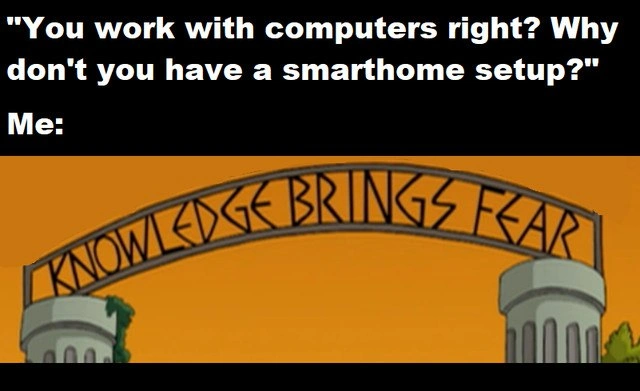
The top text of the meme ("You work with computers right? Why don't you have a smarthome?") is a question many techies get from friends or family. People assume tech workers will fill their homes with the latest gadgets. The bottom image is a reference to The Simpsons (a famous cartoon known for sneaky visual jokes), showing an archway engraved with "KNOWLEDGE BRINGS FEAR." This flips the usual saying "knowledge is power" (or the idea that "ignorance is bliss"). In simple terms, the more the developer knows about smart-home security problems, the more afraid they are to use those devices. It humorously highlights that knowing too much can make you extra cautious.
All of this boils down to the classic security vs. usability trade-off. Smart gadgets make life easier (high usability), but they can introduce security and privacy risks if not built carefully. Our seasoned developer is basically choosing safety over convenience: they’d rather manually flip a light switch or use a regular old coffee maker than worry about who might be hacking a high-tech version. For someone newer to tech, the meme is a little lesson wrapped in a joke – it shows that sometimes the coolest, newest tech isn’t worth it if it might compromise your privacy or security. In other words, the person in the meme values being safe and in control of their home more than the convenience of saying "Alexa, turn on the lights."
Level 3: Internet of Insecure Things
"You work with computers right? Why don't you have a smarthome setup?"
This seemingly simple question can make a veteran developer break into a cold sweat. The meme shows exactly why: the bottom panel features an ominous archway (drawn in Simpsons cartoon style) inscribed with the words "KNOWLEDGE BRINGS FEAR." That phrase perfectly captures the senior engineer's mindset. The more you know about IoT vulnerabilities and data privacy nightmares, the less appealing those shiny internet-connected gadgets become. It's a dark twist on "ignorance is bliss" – here, knowledge leads to paranoia, and a smart home starts to look like a personal minefield of digital threats.
Seasoned devs realize that each new "smart" appliance is another attack surface on their network – essentially another unlocked door for hackers. Experience has taught them that being highly security-aware often means having a healthy dose of suspicion toward anything that talks to the Internet. They've seen too many examples of convenience turning into catastrophe. Consider a few infamous issues that make them wary:
- Default passwords everywhere: Many IoT gadgets ship with logins like
admin:adminor1234. Guess what? Lots of people never change them. Attackers know this and scour the internet for devices still using these factory-default creds. It's like leaving a key under your doormat. (There's a reason one joke goes: "The 'S' in IoT stands for Security" – because there's no S in "IoT" at all!) - Rarely patched firmware: Unlike your phone or laptop that get regular updates, IoT devices often run old, unpatched software. That cute smart camera might be running firmware from five years ago with known holes. Mirai and other malware literally roam the internet looking for such outdated devices to exploit. Once a vulnerability is discovered, many gadgets never get a fix, effectively becoming permanent backdoors.
- Insecure protocols: Some devices still use outdated protocols like
telnet(which sends data in plain text) instead of encrypted connections. Others have open ports that nobody realizes are exposed. A lightbulb doesn't exactly have the CPU power for heavy-duty encryption, so manufacturers often cut corners. It's the Wild West of networking – we've seen smart home products that communicate without even a password, or that use ridiculously weak encryption keys. - Data privacy concerns: A smart speaker or thermostat isn’t just a convenience, it's also a data collector. Seasoned devs know that every voice command and sensor reading might be sent to a company’s cloud servers. That data privacy concern weighs heavily – who wants their daily routines, conversations, or even which room they're in being recorded? It's not just hackers snooping; it's also big companies logging a surprising amount of detail about your home life.
- Botnet potential: Worst-case scenario, a compromised IoT device can become a foot soldier in a cyberattack. Remember that massive internet outage in 2016? It was caused by the Mirai botnet enslaving thousands of insecure cameras and DVRs. To an experienced engineer, a "smart" toaster isn't just a toaster – it's potentially a machine that, if hacked, could launch attacks on others. Hard to look at a Wi-Fi fridge the same way after you realize it could be part of a DDoS swarm taking down websites.
To illustrate how easily an IoT gadget can be hijacked, imagine a developer poking at their own network for weaknesses. They might find something like this:
# Scan the local network for devices with default credentials
$ nmap -p 23 192.168.0.0/24 --script telnet-default-creds
# Bingo! Found an open Telnet service on 192.168.0.9 (likely the smart fridge).
$ telnet 192.168.0.9
Connected to SmartFridge.
login: admin
password: admin # oops, still using the factory default login
SmartFridge> send_spam --to all_contacts
SmartFridge> defrost_all # malicious commands executed!
In seconds, that innocent refrigerator goes from cooling your groceries to spamming your friends and melting all the ice cream. 😱 It sounds like a comedy plot, but it's uncomfortably close to reality – similar hacks have happened with insecure IoT appliances.
The developer in the meme isn’t just being curmudgeonly; they've probably spent hours debugging these issues or cleaning up after security breaches. They’ve learned first-hand that the security vs. usability trade-off usually leans toward "make it easy to use," with security often an afterthought. In the world of smart-home security, that trade-off can literally open doors for cyber criminals. So our seasoned dev chooses a locked-down approach: no IoT door locks, no cloud-connected nanny cams, maybe not even a smart light bulb. In other words, they're deliberately picking security over convenience at home. Flicking a light switch by hand never inspired so much peace of mind! Behind the humor of the meme, there's genuine relief in sticking with tech that can't be hacked remotely.
Ultimately, this meme hits home for a lot of developers because it's tech humor rooted in truth. It's funny and a little frightening at the same time, precisely because it's so relatable. When you know all the things that can go wrong, you might sleep a lot better in a house that doesn’t randomly connect your toaster to the wider internet. The archway declaring "Knowledge Brings Fear" says it all: the more an expert knows about the dark side of IoT, the more they opt to stay in the stone age of manual light switches – and they’re okay with that.
Description
The meme has two parts. At the top, on a solid black background, large bold white text reads: "You work with computers right? Why don't you have a smarthome setup?" and, on the next line, "Me:". The bottom panel is a cartoon scene (in the style of The Simpsons) showing a stone archway between two columns; the inscription across the arch, written in angular runic-style capitals, says "KNOWLEDGE BRINGS FEAR" against an orange sky. The punchline is that the developer’s deep understanding of security, privacy, and IoT attack surfaces makes them deliberately avoid installing internet-connected devices in their own home. It satirizes the classic security-vs-convenience trade-off familiar to senior engineers
Comments
25Comment deleted
I already audited one “smart” lightbulb - hard-coded telnet creds, expired TLS cert, and a UDP heartbeat to a domain parked since 2018; I’m not decorating my house with botnet chic
The only thing worse than debugging a distributed system at 3am is debugging your smart toaster that's now part of a botnet because the manufacturer thought 'admin:admin' was sufficient authentication for a device that can literally burn your house down
The smart home paradox: the more you understand TCP/IP, MQTT protocols, and CVE databases, the more your 'smart home' consists of a mechanical light switch and a door lock that requires an actual key. Because nothing says 'I work in tech' quite like explaining to relatives why your thermostat isn't mining cryptocurrency or participating in a DDoS botnet - because it's just a dial on the wall
Turning on a lamp shouldn’t require OAuth, a flaky MQTT broker, and two vendor clouds - my home threat model prefers a low-latency wall switch
Because after a decade of incident postmortems, I don’t let a vendor’s expired TLS cert decide whether my bathroom lights turn on
Smart homes: where Zigbee meshes flake harder than a legacy monolith under Black Friday load
What about home assistant Comment deleted
no Comment deleted
Pay x10 more to be extra lazy. No, thanks Comment deleted
I dont want my home to be smarter than me Comment deleted
Google keeps sending free Google home minis, and they're just... Awful. 90% of the time, we just use them to set timers. It gets the timer wrong a good chunk of the time, and about 80% of the time it takes multiple attempts to get it to stop the alarm at the end Comment deleted
Making coffee, this mornings dialogue with the Google home: > okay Google, thirty second timer < according to Wikipedia, thirty seconds is a South African.. > okay Google stop. Okay Google thirty second timer < .... > Okay Google, thirty second timer < alright, thirty seconds, starting now I need to just buy some crappy timer thing and throw these things in the trash. Comment deleted
Siri works better, but I only have it on button press Comment deleted
I've not tried siri before, but did get a macbook for work recently, so might try it out Comment deleted
I have it on iPhone Comment deleted
Yandex Station works great tho Comment deleted
are you a fckin Russian? Comment deleted
I am fucking russian and fucking yandex.lyceum teacher too Comment deleted
мдааа, они и тут есть. Шо ты тут забыл? Comment deleted
“Bleh, they are here too. What did you forgot there” Comment deleted
I prefer english internet Comment deleted
Yeah, me too Comment deleted
Timers, weather, music, funny jokes Comment deleted
I will make smarthome with it, but on diy things Because i am tired of fear Comment deleted
Oh noo, they'll know if I sleep or not because my smart bulb is sending data somewhere😱😱😱😱 Btw, it's not Comment deleted