Skip to content
DevMeme
7441 of 7506
Premium Codex Meets the Zero-Revenue Business Model

Premium Codex Meets the Zero-Revenue Business Model

Why is this AI ML meme funny?

Level 1: The Empty Lemonade Stand

It is like buying a very expensive automatic lemonade maker, working so hard that you become a skeleton, and then discovering that no one has bought a cup. The machine may make lemonade quickly, but it cannot make neighbors thirsty. The picture is funny because an enormous amount of effort and money goes in while exactly zero money comes out.

Level 2: Shipping Is Not Selling

Codex is an AI coding agent: it can work with source code and help perform software-development tasks. A paid plan can provide greater usage than a lower-cost plan. That is developer leverage—one person may complete some coding work faster—but leverage amplifies the direction already chosen. If the product idea is useful, speed can help. If nobody wants it, speed produces a more elaborate thing nobody wants.

Several startup terms explain the gap:

  • Revenue is money a business earns from customers. It is not the same as downloads, visits, accounts, compliments, or GitHub stars.
  • Overhead cost is an ongoing expense needed to operate, such as subscriptions and hosting.
  • Product-market fit means a product satisfies strong demand from a real market. It cannot be installed with npm.
  • A minimum viable product, or MVP, is the smallest version that can test an important assumption with users. “Minimum” refers to learning efficiently, not merely generating a small codebase.
  • Cost-benefit analysis asks whether the value gained from a purchase justifies its price, including alternatives and the builder's time.

For a personal project, $0/MO REVENUE may be completely normal. Most experiments begin there, and many are never intended to make money. The meme becomes founder humor because $200/MO CODEX is displayed like the input to a commercial production line. The creator is spending at business scale while earning at “my mother said it looks nice” scale.

The visual exaggeration makes the mismatch immediate. A skeleton should not have muscles capable of squatting, yet it strains beneath a barbell as if endless effort could overcome missing anatomy. Likewise, endless implementation cannot supply missing demand. The black background and high-contrast white type make the two dollar amounts read like the only entries on a very short financial report.

A healthier early workflow might alternate building with evidence gathering:

  1. Talk to potential users about a concrete problem.
  2. Build the smallest test of the riskiest assumption.
  3. Observe whether people use it without being chased.
  4. Ask for a meaningful commitment, possibly payment.
  5. Spend more on tooling when greater capacity solves a demonstrated constraint.

AI assistance can be excellent inside that loop. The joke targets the fantasy that the loop consists solely of step 2 repeated at machine speed.

Level 3: Negative Unit Economics

The entire founder journey is compressed into one brutally efficient pipeline:

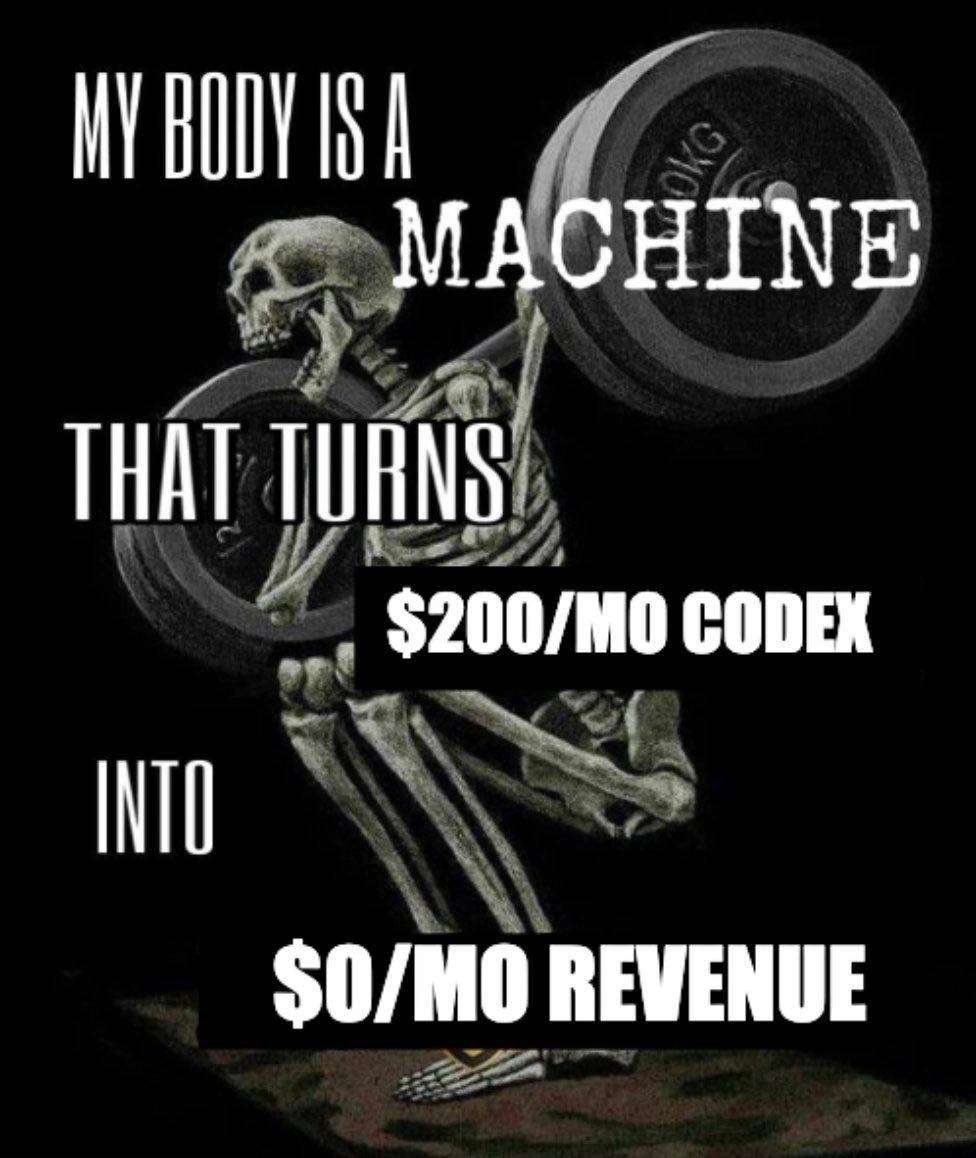
MY BODY IS A MACHINE THAT TURNS $200/MO CODEX INTO $0/MO REVENUE

The familiar “my body is a machine” setup normally promises some impressive transformation. Here, the input is a premium AI-coding expense and the output is literally nothing. The skeleton performing a deep squat under oversized plates makes the effort look heroic while also implying that the builder has been grinding long enough to become an archaeological specimen. Even the visible 25KG plate is doing more measurable work than the product's income statement.

The senior-level joke is about confusing developer throughput with business progress. Codex can reduce the time needed to draft features, inspect a repository, write tests, or attempt fixes. None of those activities proves that a customer has a painful problem, understands the product, trusts it, or will pay for it. Code is an intermediate asset; revenue appears only after a much messier chain involving discovery, positioning, distribution, onboarding, support, pricing, and retention. The machine in the image has optimized one stage of that chain while leaving the commercial stages disconnected.

This is a classic local optimization. A side-project builder sees coding as the bottleneck because coding is familiar, tractable, and emotionally rewarding. Purchasing a higher-usage tool makes that activity faster, so the builder can generate more screens, integrations, and rewrites. Yet the actual bottleneck may be finding ten people who care. If demand is zero, doubling implementation speed merely reaches the wrong destination sooner—with cleaner tests, if fortune smiles.

The $200/MO label also compresses a real product distinction for comic clarity. The charge is better understood as a high-usage subscription tier that includes Codex access, rather than proof that every Codex user must pay that exact amount. That nuance does not weaken the joke: the narrator has deliberately chosen substantial recurring overhead before establishing recurring income. The expense is visible, predictable, and billed automatically; the hoped-for customers remain theoretical.

From a startup perspective, the equation exposes terrible unit economics only in a loose, self-mocking sense. Unit economics normally compares revenue and variable cost per customer or transaction. With no customers, there is not yet a meaningful unit—just burn. A more useful early calculation is:

monthly cash flow = customer revenue - subscriptions - hosting - other costs
                  = $0 - $200 - ...

The ellipsis is where domains, APIs, databases, analytics, email services, and the one SaaS dashboard nobody remembers authorizing gather for their monthly feast.

The organizational version is equally familiar. Teams adopt an AI assistant and celebrate generated lines, closed tickets, or pull-request volume because those measurements are easy. They may not measure whether users complete tasks faster, defects decrease, support load falls, or revenue improves. Productivity myths flourish when proxy metrics become goals. More output can even create more review, maintenance, security, and support work, turning apparent leverage into a larger inventory of obligations.

None of this means a tool must directly earn its subscription fee to be worthwhile. Learning, experimentation, accessibility, enjoyment, and time saved all have value. A hobby is allowed to cost money. The self-deprecation works because the narrator implicitly framed the project as a business and then behaved as though buying production capacity would summon demand. The skeleton is not being mocked for creating; it is being mocked for giving a procurement decision the emotional status of product-market fit.

Description

Against a black background, a gray human skeleton strains in a deep barbell squat beneath large weight plates, one visibly marked "25KG." Tall white lettering around the lifter reads, "MY BODY IS A MACHINE THAT TURNS," while bold text on black blocks completes the statement with "$200/MO CODEX" and "$0/MO REVENUE." The bodybuilding image gives heroic physical intensity to the financially unproductive act of paying for a premium AI coding tool without monetizing anything built with it. The meme is self-deprecating founder and side-project humor about confusing expensive developer leverage and prolific code generation with product-market fit or revenue.

Comments

1
Anonymous ★ Top Pick Amazing unit economics: $200 in, null out, and somehow CI stays green.
  1. Anonymous ★ Top Pick

    Amazing unit economics: $200 in, null out, and somehow CI stays green.

Use J and K for navigation