Skip to content
DevMeme
7442 of 7506
Six Months Away, Syntax Becomes Ancient Lore

Six Months Away, Syntax Becomes Ancient Lore

Why is this Languages meme funny?

Level 1: The Forgotten Recipe

It is like knowing how to bake a cake but forgetting whether your favorite recipe says two eggs or three because you have not made it for half a year. You still understand baking; you just need to look at the recipe before answering quickly. The superhero's suspicious stare is funny because someone asked a small question, but it feels to him like a surprise exam on every tiny instruction he once knew.

Level 2: Braces Gone Missing

Programming syntax is the set of rules that makes source code grammatically valid. A missing parenthesis or misspelled keyword can cause a syntax error, meaning the parser cannot even understand the program's structure. A logic error is different: the program is valid and runs, but does the wrong thing. Someone can forget the first kind of detail while still being excellent at reasoning about the second.

Muscle memory is informal shorthand here. Typing code is not purely a physical skill; repeated practice builds fast, familiar routines for common patterns. After months without coding, those routines become harder to start. The first few minutes back might involve questions such as:

  • Does this language use else if, elif, or pattern matching?
  • Is the collection length .length, .size(), or len(...)?
  • Does an asynchronous call need await, a callback, or a returned future?
  • Which command runs the tests in this particular project?

Tools normally carry part of this memory. An IDE can autocomplete names, display parameter information, and flag invalid syntax. A language server gives editors language-aware features such as diagnostics and navigation. A compiler or interpreter supplies immediate feedback. In face-to-face conversation, all of that scaffolding disappears, leaving the developer to answer from cold storage while Homelander's expression says, “Please choose a less language-specific topic.”

The learning curve on returning is usually not the same as learning from zero. Seeing a few correct examples can reactivate patterns quickly because the underlying concepts and prior experience remain. A small practice project, familiar tests, and deliberate reference checking are more useful than trying to memorize an entire manual before touching the keyboard.

The wording “didn't code myself” also emphasizes hands-on work. Reading pull requests, discussing architecture, or supervising a team keeps someone near software, but it does not exercise exact construction in the same way. The meme's developer still belongs in the conversation; the blank stare represents the delay while broad knowledge is translated back into precise punctuation.

Level 3: Cache Miss in Public

The meme captures a distinction that programming interviews, technical conversations, and developer egos routinely blur: knowing how software works is not the same as retrieving a language's exact syntax on demand. Its caption says:

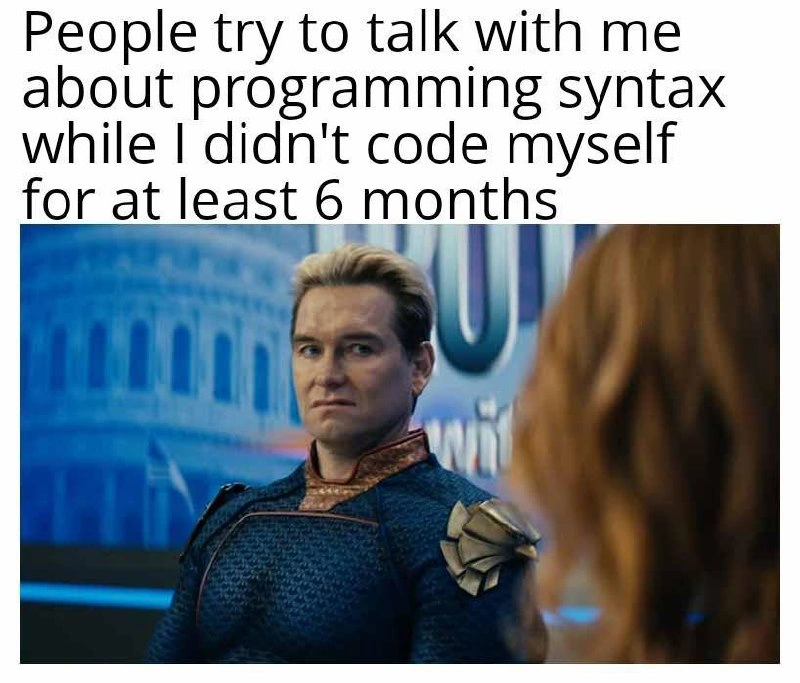
People try to talk with me about programming syntax while I didn't code myself for at least 6 months

Below it, Homelander sits in full superhero uniform and gives the person opposite him a tight, unreadable stare. The costume signals formidable power; the face signals that the next semicolon may constitute a hostile act. That mismatch turns an ordinary lapse in recall into a tense encounter with someone trying very hard not to reveal that the relevant mental page has been swapped out.

Syntax is a language's written grammar: where braces go, how functions are declared, which keyword introduces an asynchronous operation, and whether a collection method is named map, Select, or something else. Semantics describe what those constructions mean when executed. Six months away can make syntax retrieval slow while leaving deeper knowledge—control flow, data modeling, complexity, failure handling, testing, and system design—largely useful. The developer may still know what must happen but need documentation to remember whether this language spells it with a colon, an arrow, or ceremonial punctuation offered to the compiler.

That is why the best technical reading is a cache miss, not erased storage. Frequently used patterns sit in quick recall because repeated coding continually refreshes them. After a long break, the same knowledge may require a cue: opening an old project, seeing an IDE completion, reading one example, or making the compiler complain once. Retrieval feels embarrassingly slow in conversation because there is no editor, language server, test suite, or error message completing the feedback loop. The person asking sees a pause; the programmer experiences seventeen languages attempting to answer simultaneously.

Polyglot development makes the problem worse. Similar ideas use subtly incompatible forms:

const square = x => x * x;
square = lambda x: x * x
let square = |x| x * x;

Remembering the abstraction “create a function that squares its input” transfers well. Remembering which delimiters, terminators, inference rules, and conventions belong to today's language is a separate task. A developer returning after six months may produce syntactically plausible Esperanto: accepted by every language in fragments and by no compiler as a whole.

The career subtext is especially sharp. A programmer may stop writing code because a role shifted toward management, architecture, planning, incident coordination, customer work, or review. Time away may also follow unemployment, leave, illness, or burnout. Colleagues can still expect the old performance of instant fluency, so a harmless question about syntax becomes an identity test: Are you still really a programmer? Homelander's guarded expression externalizes the fear of being exposed by a detail that an IDE would normally resolve in seconds.

Experienced developers often become less impressed by memorized punctuation, not more. Production engineering rewards the ability to form a model, locate authoritative information, test behavior, and recognize dangerous assumptions. Exact recall matters when it improves flow, but treating it as the main evidence of competence encourages trivia interviews and confident guessing. The more languages and frameworks someone has used, the more reasonable it is to verify details. Of course, saying “I would check the documentation” lacks the cinematic force of silently considering laser vision.

The joke remains self-deprecating because practice genuinely matters. Concepts alone do not make someone immediately productive: toolchains change, libraries evolve, project conventions fade, and the small decisions required to turn a design into working code lose automaticity. Returning developers usually need a warm-up period. The trap is interpreting that temporary friction as proof that all prior skill vanished, then avoiding practice because the first session feels awkward. Muscle memory comes back by writing code, not by winning a staring contest.

Description

A white meme panel places large black text above a reaction image: "People try to talk with me about programming syntax while I didn't code myself for at least 6 months." Below, Homelander from The Boys sits rigidly in his dark blue superhero uniform, giving the person opposite him a blank, guarded stare against a cool blue background. His expression conveys the uncomfortable delay of a developer who still understands programming concepts but has lost immediate recall of punctuation, keywords, and language-specific grammar after a long break. The humor turns ordinary skill decay and fading muscle memory into an intensely suspicious social encounter.

Comments

1
Anonymous ★ Top Pick The concepts survived; the semicolons were garbage-collected.
  1. Anonymous ★ Top Pick

    The concepts survived; the semicolons were garbage-collected.

Use J and K for navigation