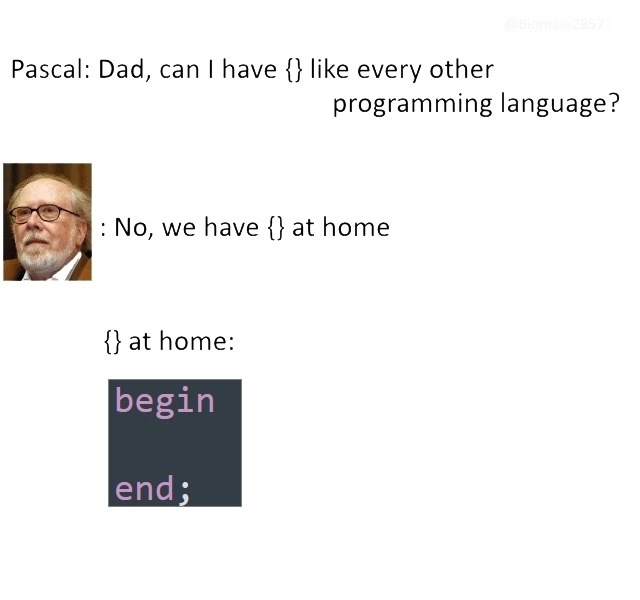
When Pascal wants curly braces but Dad offers begin/end at home
Why is this Languages meme funny?
Level 1: Not the Cool Toy
Imagine a kid who really wants the latest cool toy that all their friends have. Let’s say every friend has a shiny new action figure with moving parts. The kid asks Dad, “Can I get that awesome action figure, please? Everyone else has one!” But Dad replies, “No, we have an action figure at home.”
When the kid gets home, excited to see the “action figure,” Dad pulls out a homemade doll carved from wood. It’s an “action figure” only in name – it might technically be a toy figure, but it’s old-fashioned and not what the kid had in mind at all. The kid was hoping for the cool, modern toy, but got a plain old toy from the shelf instead.
In the meme, Pascal is like that kid. It wants the cool curly braces that other programming languages use (the fancy toy). Dad (the language’s creator) says, “We have that at home,” and gives Pascal the old-style begin ... end keywords (the homemade toy). It’s funny because you can feel the kid’s mix of disappointment and irony – “Technically, this is the thing, but it’s not the cool version I wanted.” The humor comes from that everyday feeling: when you’re hoping for something popular and new, but you get the older, boring version instead. Even though both versions do the job, the kid (and Pascal) can tell the difference, and it’s just not the same vibe!
Level 2: Curly or Wordy?
Let’s break down the joke in simpler terms. In programming, we often need to group lines of code together into blocks (for example, the body of an if statement or the contents of a function). Different languages have different ways to mark the beginning and end of a block (the technical term is block delimiters). The meme compares two styles:
Curly Braces
{ }: Many popular languages like C, C++, Java, C#, and JavaScript use{to start a block of code and}to end it. For example, in C you might write:if (x > 0) { printf("Positive"); x = x - 1; }Here the
{after the if-condition marks where the block of code begins, and the}marks where it ends. Everything inside the braces is what to do ifx > 0. Curly braces are concise – just a single symbol at start and end.Begin/End Keywords: The Pascal language (an older language from the 1970s) doesn’t use
{ }for blocks. Instead, it uses the wordsbeginto start a block andendto finish it. For example, in Pascal you might write:if x > 0 then begin WriteLn('Positive'); x := x - 1; end;Here
beginkicks off the block of code for theif, and theend;terminates that block. (Pascal often uses a semicolon;afterendto separate it from the next statement, similar to how we might put a semicolon after braces in some languages or at the end of a statement.)
Both of these do the same job – they tell the computer where a group of statements starts and stops – but one uses special symbols and the other uses whole words. This is a classic LanguageComparison: just a difference in syntax (the grammar and symbols of the programming language).
Now, the meme itself uses the popular "we have X at home" format. In that meme format, a child asks a parent for something exciting, and the parent says, "No, we have that at home," implying the parent doesn’t want to buy the new thing. The final panel reveals the "at home" version is a disappointing or funny knock-off of the desired thing. It’s a way to poke fun at how the substitute is never as good as what the child wanted.
In the text of this meme, Pascal (the child) asks, "Dad, can I have {} like every other programming language?" Pascal is basically asking for curly braces because that’s what all the other popular languages use to mark code blocks. The Dad character (who represents the authority or the language designer) says, "No, we have {} at home." The curly braces “at home” are revealed to be Pascal’s own syntax: begin ... end;.
So the joke is Pascal already has something that does the job of curly braces, but it’s not the trendy new thing. It’s as if a kid asked, "Can I have the cool sneakers with lights that all my friends have?" and the dad replies, "No, you already have shoes at home" – and those shoes turn out to be old, unfashionable boots. Here, begin/end is the old pair of boots: it works, but it’s not what the kid really wanted. Meanwhile, curly braces are the flashy new sneakers everyone else is wearing.
For a junior developer or someone new to coding, it helps to realize this is just a funny way to talk about syntax preferences. Pascal’s begin/end and C’s {/} achieve the same thing (defining a block of code) but in different styles. When the meme says "like every other programming language," it’s exaggerating a bit – not literally every language uses {}, but many of the popular ones do, so a newcomer might feel like Pascal is the odd one out. This can be a small source of confusion or annoyance: if you learned on a {} language and then see Pascal (or vice versa), you have to adjust to the new way of writing blocks. That’s the DeveloperExperience quirk being highlighted. It’s a lighthearted jab at how each programming language has its own little LanguageQuirks that you need to get used to.
In short, the meme is saying: Pascal wanted to be cool and use curly braces like the others, but dad (Pascal’s design) insisted on using begin/end at home. The contrast is funny because begin/end feels like an outdated substitute for the sleek curly braces that “everyone else” uses. And indeed, many devs find it amusing how languages have these arbitrary differences – it’s a source of endless CodingHumor to compare and debate which syntax is better, even though it doesn’t really change what the code does.
Level 3: Brace Yourself, Pascal
In this meme, Pascal is personified as a kid begging for curly braces {} (the code block symbols used by C-like languages) because "every other programming language has them." The grumpy Dad (the older man in the image, likely Niklaus Wirth – Pascal’s creator) responds, "No, we have {} at home." The punchline is the " {} at home" turns out to be Pascal’s own block syntax: the reserved words begin and end (with a semicolon). This setup humorously contrasts two different programming language syntax traditions:
- Curly brace syntax – the shorthand symbols
{ ... }used in many popular languages (C, C++, Java, C#, JavaScript, Go, and others) to group statements into a block. - Begin/End syntax – the more verbose keywords
begin ... end(often paired with a terminating semicolon) used in Pascal and some other older languages (like Ada or early BASIC variants withIF ... END IF).
For seasoned developers, this meme triggers a knowing grin because it pokes fun at a minor LanguageWars episode from programming history. In the 70s and 80s, Pascal vs C was a real debate. Each language had fervent fans, and something as trivial as block delimiters (begin/end vs {}) became a cultural marker. The DeveloperExperience_DX angle here is strong: anyone who’s switched between languages with different block styles has felt this pain. You brace for one syntax, muscle-memory kicks in, and suddenly you’re typing begin in C or a stray { in Pascal—cue the compiler errors and a facepalm.
The Dad’s reply "we have {} at home" is essentially Wirth (Pascal’s dad) saying: “Why do you need those fancy braces? I gave you perfectly good block markers at home!” It’s the coding equivalent of a parent insisting the off-brand solution is “just as good.” Of course, to the kid (Pascal and its programmers), it’s not the same. Curly braces are concise and ubiquitous, while begin/end feels like a clunky hand-me-down from an earlier era. Senior devs chuckle because we’ve seen this pattern in many forms: a language wants the shiny new feature or syntax that “all the cool languages have,” but its elders cling to tradition.
There’s also a historical witticism: Pascal’s design was influenced by the Algol family of languages, which prided themselves on readability and structured programming. Using English words like begin and end made code read almost like pseudocode or English sentences, which was great for teaching and clarity. C, on the other hand, coming from the Unix world, favored brevity and a tiny character set – hence curly braces (likely inherited from its BCPL/B lineage) to delimit blocks with minimal fuss. This led to a long-standing LanguageQuirk: Pascal code looked verbose but clear, while C code was compact but riddled with punctuation. The meme exaggerates by saying “like every other programming language” – a tongue-in-cheek overstatement. (Not every language uses {} – e.g. Python uses indentation and no braces at all – but in the world of mainstream compiled languages, curly braces became the default in the lineage after C.)
Ultimately, the humor lands because it’s so relatable: developers love poking fun at these little syntax differences. It’s a playful jab at how each programming language insists its way is the best, while newcomers just want a consistent experience. In this case, poor Pascal just wants to fit in with the cool kids using {}, but Dad Wirth is adamant that “Begin/End is perfectly fine – who needs those squiggly braces?” The result is a classic SyntaxHumor scenario: two ways to do the exact same thing (mark code blocks), yet programmers will passionately debate which is better as if it were a life-or-death matter. This meme encapsulates that absurdity in one DeveloperHumor-filled image.
Description
White background meme using the classic “we have X at home” format. Top text reads: "Pascal: Dad, can I have {} like every other programming language?" A small, blurred portrait of an older man’s face appears below as the 'Dad' character, followed by the line "No, we have {} at home". The final panel says "{} at home:" and shows a dark - theme code snippet box that displays the keywords “begin” (purple) and “end;” (purple with a semicolon) on separate lines. The joke contrasts Pascal’s block delimiters "begin … end" with the curly-brace syntax used by C-style languages, poking fun at historical language design choices and developer experience quirks
Comments
7Comment deleted
Pascal sold us on begin…end for readability; 20 years later I’m diffing 800-line blocks to find which polite little ‘end;’ forgot to clock in - give me noisy curly braces any day
The same engineer who convinced management that "begin/end" was more readable also insisted stored procedures should be our entire business logic layer because "the database is closer to the data."
Wirth's law states software gets slower faster than hardware gets faster - turns out typing 'begin...end;' instead of '{}' was the original benchmark
Pascal developers don't need curly braces - they've been practicing 'begin' and 'end' ceremonies since before most languages even had garbage collection. It's not verbose, it's 'self-documenting block boundaries.' Meanwhile, C programmers are still debugging that missing semicolon after their closing brace, wondering why Pascal's compiler caught their block mismatch three decades faster
Curly braces are just Pascal’s begin/end with compression - the AST is indifferent, but code reviews have been bikeshedding that optimization for fifty years
In Pascal dialects, {} are comments - so your automated brace-to-begin/end migration can silently compile to nothing faster than any feature freeze
Pascal blocks: so formally structured, they curtsy with 'begin' before every semicolon bow-out