Skip to content
DevMeme
273 of 7435
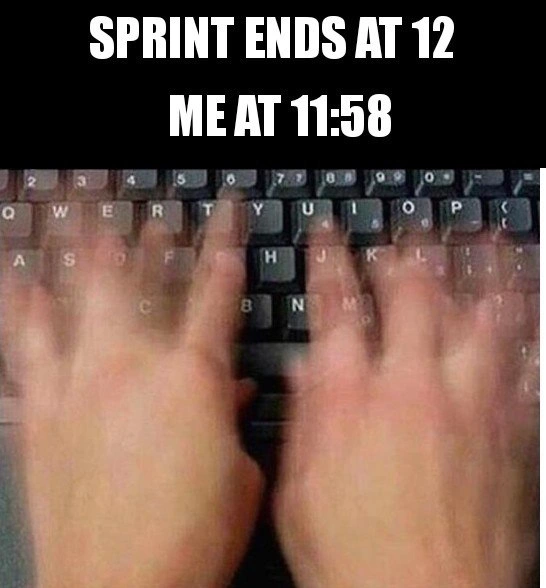
Frantic keyboard smash two minutes before the sprint deadline strikes
Agile Post #329, on Apr 22, 2019 in TG

Frantic keyboard smash two minutes before the sprint deadline strikes

Why is this Agile meme funny?

Level 1: Last-Minute Homework

Imagine you have a school project or homework due at 12 o’clock, and you haven’t finished it yet. Now it’s 11:58 – only two minutes left – and you’re scribbling answers as fast as you can, your hands almost a blur. Pretty stressful, right? But also a little funny when you picture how frantic it looks. This meme is just like that, but for a software developer. The top text says the work period (sprint) ends at 12, and the picture shows someone typing insanely fast at 11:58. It’s like a kid rushing to finish their homework right before the teacher says “Time’s up!”

The reason it’s funny is because we’ve all been there in some way. Whether it was a homework assignment or a chore, we sometimes leave things to the last minute and then panic to get them done in time. The developer in the meme is doing exactly that – procrastinating until the final moments and then racing the clock. The blurred hands on the keyboard show how frenzied it feels to try to beat a deadline with seconds to spare.

So essentially, this meme uses a simple everyday situation – rushing to finish something just before it’s due – and applies it to coding. You don’t need to know anything about programming to get the joke. It’s funny and a bit silly because it’s true in any context: waiting until the very last minute makes us all go a little crazy with panic and speed. And when we see it in a meme, we can laugh because, hey, we survived those moments and maybe even got the work in on time (just barely!). It’s a playful reminder not to procrastinate… but also a wink that says, “We know you probably will anyway, and you’re not alone when you do!”

Level 2: Crunch Time Coding

Now, let's break down what's happening in this meme in simpler terms. The text says "SPRINT ENDS AT 12 / ME AT 11:58". This is describing a scenario in Agile software development. In Agile, a sprint is a short, fixed period of time (often 1 or 2 weeks) during which a development team works to complete a set of tasks or user stories. Think of a sprint as a mini-project with a firm end date. For example, if a sprint runs from Monday to the following Friday, everything the team committed to should ideally be finished by that Friday at 12:00 (noon). Here, "Sprint ends at 12" implies that the deadline for finishing the sprint’s work is 12 o’clock (probably noon of the last day).

So where does the humor come in? The second line, "Me at 11:58," suggests that only two minutes before that deadline, the person (the developer) is frantically trying to finish their work. The image reinforces this: it shows a keyboard with hands blurring over the keys, indicating extremely fast typing. The poor developer is literally rushing to write or fix code in the last 2 minutes before time runs out. This visual of fast_typing_meme with a keyboard_motion_blur is a funny exaggeration, but it’s based on a real feeling many of us have experienced.

Why would someone be coding so late in the game? In a sprint, at the very start (during Sprint Planning), the team plans which tasks to complete. But sometimes things don’t go as planned. Maybe a task was harder than expected or other urgent bugs stole attention. As the sprint deadline looms, unfinished tasks cause DeadlinePressure. Developers might procrastinate (delay work) or simply run into unexpected problems that push everything to the eleventh hour. By 11:58, if something isn’t done, you’re in CrunchTime, which means an intense period of work right before a deadline. Crunch time coding often involves rushing to write code or fix bugs as the clock ticks down. It’s like cramming for an exam – you know the cutoff is minutes away, and you’re just desperately trying to get something working.

Let’s define a few terms to make this clearer:

  • Agile: A popular approach to software development that breaks work into small cycles (sprints). It emphasizes flexibility, regular feedback, and delivering work in small increments. Agile teams have rituals like daily stand-up meetings, sprint planning at the start, and sprint review at the end.
  • Sprint: In Agile, a sprint is a timebox (fixed time period) for doing a set of work. For example, a team might sprint for 2 weeks to add new features to an app. When the sprint “ends at 12,” it means that by 12:00, the sprint is over – ideally all the planned work is completed and ready to be reviewed.
  • Deadline: The latest time by which something must be done. Here 12:00 is the deadline for the sprint’s tasks. It’s like when a teacher says “the test will end exactly at noon, pencils down then.” The team’s work should stop at that time.
  • User Story: A piece of work or feature written from the end-user’s perspective (e.g., “As a user, I want to reset my password”). In a sprint, developers work on user stories. If by the end of the sprint a user story isn’t finished (maybe the code isn’t complete or the feature doesn’t work yet), it’s considered incomplete and might have to roll into the next sprint.
  • Commit/Push: Saving code changes to the team’s code repository. Developers use version control (like Git) to manage code. A commit is recording a snapshot of your changes, often with a message describing what you did. Push means sending those committed changes to the remote repository/server (like GitHub) so others can see them. When someone is furiously typing at 11:58, they’re likely trying to write code and then commit & push it before the 12:00 deadline. We often say things like “last_minute_commits” to describe code changes submitted right before the cutoff.

Now, the meme’s joke is essentially: I had the whole sprint to do this, but here I am doing it in the final two minutes. It pokes fun at a bit of procrastination or underestimation that many developers (especially new ones) experience. DeveloperProductivity can ebb and flow during a sprint – sometimes there’s a slow start and a frantic finish. If you’re new to a dev team, you might relate to that pressure: maybe you thought a task was almost done, but then find a bug at the last second, and frantically fix it so you can mark the task done by noon. Or perhaps you lost track of time and suddenly the crunch time is upon you.

The image of the blurred hands on the keyboard is something any coder will laugh at, because we’ve all had moments of typing like our life depended on it. That blur literally means the hands are moving super fast – a nice visual exaggeration of “I’m coding as fast as humanly possible right now!” In reality, typing faster doesn’t always solve coding problems faster (since thinking and debugging take time), but in that panicked moment at 11:58, you try anyway.

For a junior developer or someone still learning: imagine you have an assignment due at noon. You had two weeks, yet somehow you’re finishing it in the last five minutes. That’s basically what’s happening here, but in a software development team setting. It highlights a common AgileHumor scenario: even with modern workflows meant to distribute work evenly, people often crunch at the deadline just like students pulling an all-nighter. The meme is a light-hearted way to say, “Yup, I do that too sometimes – rush at the very last moment!” And it also implicitly advises: maybe we should start and finish our tasks a bit earlier next time to avoid that stress.

In summary, at Level 2 we see that this meme is about a developer rushing to finish coding right before the sprint ends. It teaches what a sprint and deadline are in Agile, and shows the concept of crunch time coding in action. Even if you’re new to these terms, the scenario is very relatable: it’s essentially procrastination meets programming. And in the developer world, it’s both a pain point (because it’s stressful) and a shared joke (because almost everyone has done it at least once).

Level 3: Deadline-Driven Development

At the senior engineer perspective, this meme hits a nerve. In an ideal Agile world, a sprint is supposed to encourage a sustainable pace – small, manageable goals with no last-minute crunch. But reality often laughs at our SprintPlanning. What we see here is the classic DeadlinePressure turning into what seasoned devs jokingly call "deadline-driven development". The sprint officially ends at 12, and there you are at 11:58, pounding the keyboard at warp speed. It’s a scene every experienced developer recognizes with a mix of horror and dark humor.

Why is this so funny (and painful)? Because it satirizes a common AgilePainPoint: despite all the Scrum ceremonies and two-week timeboxes, many teams still end up in CrunchTime right before the sprint deadline. You might have spent days bikeshedding on the perfect module design or gotten sidetracked by “just one more” improvement, and suddenly the clock is basically out. So you engage in a frantic coding sprint (pun intended) at T-minus 2 minutes, practically seeing keyboard smoke. The top caption "SPRINT ENDS AT 12" sets the stage – a fixed cutoff – and "ME AT 11:58" is the punchline: a developer in full panic mode, doing the two-minute drill like a quarterback in overtime. It’s DeveloperHumor drawn straight from life on a dev team.

This combination of elements is hilarious because it's too real. Every veteran dev can recall an 11th-hour commit (or twenty) as the sprint window slammed shut. We’re talking about those rapid-fire pushes to Git at 11:59, praying the CI pipeline is mercifully quick. It's the unspoken scrambles that Agile coaches pretend don't happen. You've got Jira showing half your user stories still "in progress" on the last day, and now you're furiously trying to flip them to "Done" before the review meeting. There's a term student syndrome – starting work at the last possible moment – and it’s alive and well in software teams. Parkinson’s Law teaches that "work expands to fill the time available," and sure enough, if the sprint gives us 2 weeks, we somehow end up needing every last second of it.

From an industry perspective, this meme highlights how Agile timeboxing sometimes just creates mini waterfall deadlines. Instead of one big crunch before a six-month release, you get micro-crunches at each sprint’s end. The humor has a touch of trauma: How many times have we promised “Next sprint we won’t cut it so close,” only to repeat the cycle? Real-world scenario: it's demo day at 12:00, and at 11:58 the feature still doesn’t work, so you’re literally coding with trembling hands. Maybe you’re even bypassing a few best practices in those final moments (guilty as charged!). Writing unit tests? No time for that now. Polishing code style? Nah, that variable named quickFix will do. It’s all about beating the clock. CrunchTimeCoding like this is basically an open secret in many teams.

The systemic issue here is procrastination meeting process pressure. Why does this keep happening even to smart developers? Sometimes it’s over-optimistic SprintPlanning, where we commit to more work than is feasible (and then ScopeCreep sneaks in). Sometimes it’s poor time management – maybe we left the hardest task for last. And often it’s just the nature of creative work: you don’t realize the hard parts until you’re knee-deep in code. By the time you do, it’s Day 10 of a 10-day sprint. Oops. Organizationally, there might be subtle incentives to look productive – managers tracking velocity (story points completed). You don’t want an incomplete story dragging down the metrics, so you heroically crunch to get it in under the wire. The result? A dramatic last-second push (and sometimes a literal push to production on Friday at 5, which always makes the CynicalVeteran in me cringe).

In terms of DeveloperProductivity, this last-minute smash is a double-edged sword: adrenaline-fueled bursts can produce astonishing output, but often at the cost of quality and sanity. Seasoned devs have war stories of the 11:58 code that “worked” just long enough to pass the sprint review, only to blow up in staging the next day. It’s funny because it’s true. We laugh, recalling all the times we coded like maniacs to meet an arbitrary cutoff, simultaneously proud of pulling it off and aware that we’re accumulating technical debt (and probably a few new bugs) with those rushed fixes.

Finally, let’s not forget the scrum rituals that follow. Immediately after noon, there’s likely a Sprint Review meeting. So at 12:01 you’re screensharing, slightly out of breath, demoing the feature you literally finished seconds ago. Living on the edge, right? The retrospective later will have everyone vowing to not repeat the chaos: “We should start testing before the last day,” “Let’s avoid these last-minute commits,” etc. But by the next sprint, human nature and deadline pressure strike again. This meme gets a knowing chuckle from devs because it’s a candid snapshot of that cycle. Sprint_deadline_rush is practically a rite of passage in software teams. Sure, Agile promises continuous delivery and steady progress, but when the crunch is on, we’re all just fast-typing blur hands hoping the code works.

In short, the meme pokes fun at our time-management pitfalls in Agile. It’s a tongue-in-cheek reminder that even in modern iterative development, procrastination and last_minute_commits are alive and well. The frantic keyboard smash at 11:58 is both absurd and completely relatable. We laugh so we don’t cry, and maybe we take a mental note (between chuckles) to start that next user story a bit earlier... or at least not literally 2 minutes before the sprint ends. Because as every battle-scarred coder knows, CrunchTime should be an exception – but oh man, does it make for great DeveloperHumor when it happens.

# Actual footage of me at 11:58 before the sprint deadline:
git add . 
git commit -m "final last-second fix, hope it works 🙃"
git push origin main   # code vrooming off with 2 minutes to spare

Description

The meme has a black banner on top with bold white text reading “SPRINT ENDS AT 12” on the first line and “ME AT 11:58” on the second. Beneath the banner is a photo of a standard Q-WERTY laptop keyboard where both hands are captured mid-motion; the extreme blur conveys frantic, last-second typing. The visual gag illustrates a developer rushing to finish work right before an Agile sprint cutoff, poking fun at procrastination and deadline pressure common in software teams. Technically, it references sprint ceremonies, incomplete user stories, and the all-too-real scramble to push code minutes before the review, highlighting time-management pitfalls in Agile environments

Comments

7
Anonymous ★ Top Pick 11:58: frantically rebasing, downgrading the coverage gate to 0 %, and force-pushing to main before Jira recalculates the burndown
  1. Anonymous ★ Top Pick

    11:58: frantically rebasing, downgrading the coverage gate to 0 %, and force-pushing to main before Jira recalculates the burndown

  2. Anonymous

    The same code that was "almost done" three days ago suddenly achieving quantum superposition between 'working on my machine' and 'production-ready' while the git history becomes a masterclass in creative commit messaging

  3. Anonymous

    The burndown chart was flat for 13 days - turns out it was just waiting for the 11:58 vertical drop we lovingly call 'velocity'

  4. Anonymous

    When your sprint velocity chart looks great until 11:58, then suddenly you're committing code faster than a distributed system can achieve eventual consistency. The real Agile manifesto: 'Working software over comprehensive documentation... especially in the last 120 seconds of the sprint when nobody's checking code coverage anyway.'

  5. Anonymous

    Sprint ends at 12; at 11:58 I make “Done” eventually consistent - feature flag default=false, flaky tests @Disabled, commit: “MVP, do not enable.”

  6. Anonymous

    At 11:58, the Definition of Done quietly becomes ‘merged behind a flag while CI is still red, demoed from localhost’ - velocity theater at its finest

  7. Anonymous

    Fingers at 11:58: the rare moment sprint velocity actually outpaces story point estimates

Use J and K for navigation