How devs flex security: graduating from default RSA to stylish ed25519 keys
Why is this Cryptography meme funny?
Level 1: Fancy Locks
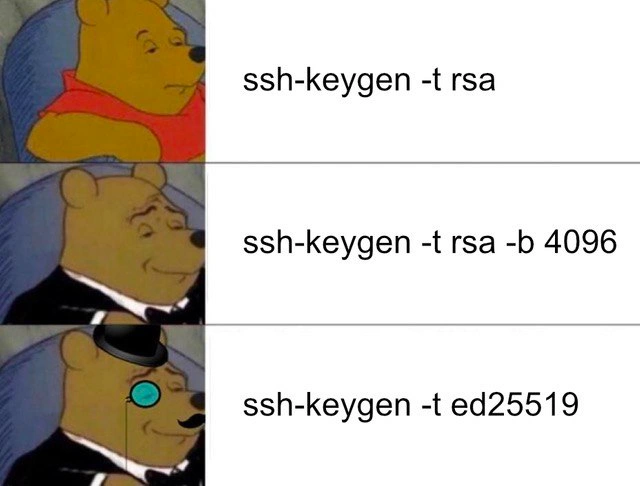
Imagine you have three treasure chests and a friendly bear (like Winnie-the-Pooh) guarding them. For the first chest, you use a regular lock and key – it’s like any basic lock you’d find on a diary or a garden shed. It does the job, but it’s nothing special. The bear looks normal and not very excited about it.
Now for the second chest, you decide to use a bigger, stronger padlock – one of those heavy-duty locks that’s twice as tough. This time, the bear puts on a nice suit and smiles a bit, as if to say, “Alright, this is a better lock! I feel safer with this.” It’s the same kind of lock (still a key and padlock, just bigger and more hardened), and our bear friend is looking a bit proud now because the treasure is more secure.
For the third chest, you go all out and use a super high-tech lock – imagine a lock that uses a fingerprint scanner or a secret code that’s really hard to crack. It’s a totally different, modern kind of lock. Now the bear pulls out a top hat and a monocle, looking ridiculously fancy and proud! It’s like he’s saying, “Behold, only the fanciest security for this chest!”
This is exactly what the meme is joking about: the developer (the bear) feels increasingly proud and “fancy” as he uses more advanced locks (or in real life, more advanced computer keys). It’s funny even if you don’t get the computer details, because you can see the bear getting so proud just by upgrading the locks. The core idea is like showing off how secure you can be: first normal, then strong, then super high-tech. We laugh because the bear in a top hat is a silly way to say, “I’m extremely pleased with myself for being so secure!” It’s a bit like a kid bragging about having the best, unbreakable toy safe. The humor comes from that over-the-top final pose – we all know adding a monocle doesn’t really make a lock better, but it sure makes the bear look like he thinks he’s the coolest security expert in the Hundred Acre Wood.
Level 2: Bigger Bits & New Curves
Let’s break down what’s happening in this meme in simpler terms. It’s all about SSH keys (secure shell keys) and how developers generate them using the command line. SSH is a protocol that lets you log in to remote servers securely, and instead of using a password, many developers use SSH key pairs (a private key and a public key) for authentication. You create those keys with a command-line tool called ssh-keygen (SSH key generator). The meme shows three variants of this command:
$ ssh-keygen -t rsa # generate an SSH key using the RSA algorithm (default key size, e.g. 2048 bits)
$ ssh-keygen -t rsa -b 4096 # generate an RSA key but specify 4096 bits length (bigger key for more security)
$ ssh-keygen -t ed25519 # generate a key using the Ed25519 algorithm (elliptic curve cryptography)
Now, here’s what each of those means:
ssh-keygen -t rsa: The-toption stands for “type.” RSA is an older encryption algorithm (from 1977) used for creating public/private key pairs. If you run this, it will create a pair of files (usuallyid_rsaandid_rsa.pubin your~/.sshdirectory by default). The public key file (id_rsa.pub) will start with the textssh-rsafollowed by a long string of characters (that string is the actual encoded key). Using RSA with default settings typically means a 2048-bit key. In simple terms, a 2048-bit RSA key has a very large number (with 2048 binary digits) at its heart. Bigger number = harder to guess. This has been the standard for a long time; if you follow basic tutorials, this is what you get. It’s secure by normal standards — breaking a 2048-bit RSA key by brute force is practically impossible with current tech. But in the meme, Pooh looks bored or unimpressed here, implying this is nothing special – it’s just the vanilla, everybody-has-it option. No flex, no wow-factor.ssh-keygen -t rsa -b 4096: Here,-b 4096explicitly sets the number of bits to 4096 instead of the default 2048. Bits measure the size of the key. Doubling the length from 2048 to 4096 makes an RSA key astronomically harder to crack (we’re talking on the order of $2^{2048}$ times harder in a simplistic sense!). In non-math terms, imagine a password so long that it’s twice as many characters – the complexity grows insanely. So why doesn’t everyone use 4096 bits by default? Mainly because 2048 is already very secure and using 4096 is kind of like using a sledgehammer where a hammer would do; it’s extra heavy. But many security-conscious folks do it anyway to be extra safe (and future-proof against any breakthroughs in cracking methods). In this panel, Pooh is in a tuxedo, which means he’s more formal or serious. That reflects how a developer might feel a bit more proud or confident using a stronger key. It’s like saying “I’m not basic, I take security seriously enough to tweak the defaults.” Technically, the RSA algorithm works the same way here as with 2048 bits; we’ve just increased the key’s size. So the improvement is quantitative (more bits), not qualitative (it’s still RSA). The meme shows this as an upgrade in style/tier, but not the ultimate form yet.ssh-keygen -t ed25519: This switches the type to Ed25519, which is a different algorithm altogether. Ed25519 is based on elliptic curve cryptography. You might notice there’s no-boption here – that’s because you don’t choose a key size with Ed25519; it’s standardized (equivalent to about 256-bit keys, but you don’t even have to specify it). The name “ed25519” comes from the specifics of the curve (a particular elliptic curve defined by the prime number 2^255 - 19). What’s important for a junior dev to know is: Ed25519 keys are newer and considered very secure and efficient. They produce a different kind of public key that usually starts withssh-ed25519in the.pubfile, followed by a shorter string compared to RSA’s. Even though the number of bits is smaller, the security level is comparable or better than RSA 3072-bit. The advantage is you get a smaller key that’s faster for computers to handle, without sacrificing security in any meaningful way for today’s standards. In this panel, Pooh is wearing a monocle and top hat – a comedic way to say this choice is fancy and modern.
So, why is this progression funny or notable? It’s showing a learning journey in tech security. As a developer gains experience, they often learn about better tools and practices:
- At first, you go with defaults (because you might not even know you can change them).
- Then you discover you can increase some parameters (like key length) to boost security, so you do that to be safer.
- Finally, you learn there’s an entirely better tool/algorithm available, and you adopt that to follow current best practices.
This meme specifically focuses on SSH key generation on the CLI (Command Line Interface), which is a very common task for developers deploying code or managing servers. The progression from RSA to RSA-4096 to Ed25519 is something that actually happened in the tech community over the years:
- A while back, everyone used RSA.
- Then security guides started saying “use 4096-bit RSA for new keys” (as computing power grew, we aimed for stronger keys just in case).
- More recently, guides say “actually, just use Ed25519, it’s better and faster.”
For a junior developer, the takeaway is: there are different kinds of keys and not all SSH keys are equal. The meme uses humor to point out that using more secure options can be seen as an upgrade, almost like prestige. It’s not to say RSA is broken or useless (it’s not!), but rather that the community kind of “levels up” the recommended practices over time.
Also, notice this is all done via simple terminal commands. Part of developer humor is being proud of knowing the right incantation in text form. The fact that Pooh gets more regal with each more advanced command is a playful jab at how we developers sometimes feel like “command-line wizards” when we use a slick one-liner or a non-default option. In reality, it’s just one extra flag or a different argument, but admit it – the first time you learned about Ed25519 and generated one, you probably felt a tiny bit like you joined an exclusive club!
In summary, panel by panel:
- Panel 1: Basic RSA key (likely 2048 bits) – good, but plain. (Pooh looks uninterested)
- Panel 2: RSA key with 4096 bits – extra secure RSA. (Pooh looks satisfied in a tuxedo, a step up in class)
- Panel 3: Ed25519 key – new-generation algorithm. (Pooh is ultra-fancy now, feeling superior)
This is a lighthearted way to learn that “not all encryption keys are the same.” As you delve into cryptography and security, you’ll encounter many algorithms and recommendations. Today, Ed25519 is a star for SSH keys. Tomorrow, who knows – maybe there’ll be an even fancier Pooh meme for quantum-resistant keys! The key (no pun intended) lesson: when it comes to security, staying updated with modern best practices is considered cool and important in the developer world.
Level 3: Encryption Glow-Up
From a seasoned developer’s perspective, this Winnie-the-Pooh meme humorously captures the “glow-up” of an engineer’s SSH key habits — a kind of security best-practices flex. It’s the infosec equivalent of fashion: starting with the off-the-rack default and graduating to haute couture cryptography. Here’s why experienced devs smirk knowingly at each panel:
In the first panel, Pooh is in his normal red shirt, next to ssh-keygen -t rsa. This is the basic default many devs start with. Historically, running ssh-keygen without any options would default to an RSA key (often 2048-bit) for your SSH authentication. It’s the “it works, ship it” of key generation – no customization, just the standard RSA algorithm that’s been around since the 1970s. Seasoned devs remember that for years RSA was the de-facto standard for SSH keys, partly because alternatives like DSA or ECC either weren’t available, weren’t default, or had trust issues (for example, DSA keys were limited to 1024 bits and fell out of favor, and early ECC had patent concerns). So panel 1 is adequate but unimpressive – Pooh’s plain expression says, “Yeah, I just typed the default command.” It’s akin to using the same old password everywhere: not terrible if it’s strong, but nothing to brag about.
In the second panel, Pooh is wearing a tuxedo and looking content, next to ssh-keygen -t rsa -b 4096. Now we see a bit of effort and refinement. The -b 4096 flag explicitly requests a 4096-bit RSA key, double the typical 2048 bits. This is the moment a developer goes, “I care about security; I’ll use a stronger key than the default.” It’s a common security-conscious step: if 2048 bits is good, 4096 bits is even better (at least against classical computers). Industry veterans know that while 2048-bit RSA is still considered secure, 4096-bit provides a larger safety margin for the future (and possibly some peace of mind against advances in factoring methods or the distant threat of quantum computers). There’s an element of over-engineering bravado here that seniors recognize: many of us bumped our key sizes just because we could – it costs little aside from a few extra milliseconds in SSH handshake, and it’s one way to show you’re serious about encryption. The tuxedo Pooh represents that upgrade in class: still the same bear (RSA algorithm), but now formally dressed (a bigger key) for improved security. In dev culture, this is like saying, “I didn’t just read the first page of the security manual; I read the appendix too.”
By the third panel, Pooh dons a top hat and monocle, exuding ultimate sophistication beside ssh-keygen -t ed25519. This is the modern elite choice: abandoning RSA altogether in favor of an elliptic curve algorithm that’s more efficient and arguably more secure per bit. Here, the meme telegraphs cryptography clout. An experienced engineer sees this and nods: switching to Ed25519 (or other elliptic curves) for SSH keys has been a best practice in recent years, especially after 2014 when OpenSSH introduced support for Ed25519 keys. By 2019, devs “in the know” were generating Ed25519 keys to stay ahead of the curve (pun intended). In many tech communities, saying “I use Ed25519 for my keys” is like a chef saying they use a fancy new cooking technique — it shows you keep up with improvements in your field. The monocle and top hat are a tongue-in-cheek portrayal of that cryptographic snobbery: the bear is practically saying, “Oh, you’re still using RSA? How quaint. I prefer the finer things – like Ed25519.”
The humor here also riffs on command-line culture and one-upmanship among developers. We’ve all encountered that colleague who’s proud of their .bash_history full of optimized commands and flags. Generating an SSH key is usually a quick, utilitarian task, but this meme makes it a stage for peacocking: each command is like a progressively fancier handshake in a secret club. First you use RSA by default (everyone starts there, boring). Then you learn you can crank up the key length – that’s the intermediate rite of passage, “Look, I even know how to specify key bits!” Finally, you discover the latest algorithm that all the cool security folks recommend – Ed25519 – and now you’re really flexing. The panels escalating Pooh’s attire exaggerate this social dynamic in tech circles: the more you deviate from the noob defaults (using stronger or newer crypto), the more refined or “1337” you appear in the eyes of peers.
Importantly, seasoned developers also see truth behind the joke: using Ed25519 is actually a good idea today. The meme might be lighthearted, but it’s disseminating a real piece of advice popular in security best practices — “Don’t use outdated defaults if better options exist.” Many orgs and senior engineers encourage newcomers to generate Ed25519 keys for SSH because they’re shorter (which matters when copying keys around), faster (for the CPU, which matters if you’re doing tons of connections or working on a low-power device), and have no known downsides for current use. It’s the sensible default for the future, possibly even the default that newer versions of OpenSSH and Git hosting services subtly prefer. So the monocled Pooh isn’t just a smug elitist; he’s also basically right. That duality makes the meme “funny because it’s true.” We laugh, having done the same progression ourselves: maybe you remember the day you retired your old 1024-bit DSA or 2048-bit RSA key and felt a tiny swell of pride using your spanking new Ed25519 key to push code to GitHub. It’s a proud developer-humor moment — celebrating a minor victory in the ongoing quest for better security.
In summary, the senior perspective sees this meme as a playful representation of tech progression and bragging rights. It encapsulates an inside joke: the tools get more secure and the developer’s swag increases in parallel. It’s Winnie-the-Pooh cosplaying as a cybersecurity hipster. And if you’ve ever been the person explaining to a teammate why Ed25519 is the way to go (possibly sounding a bit smug while doing so), this meme hits the sweet spot between humor and professional reality.
Level 4: Elliptic Elegance
At the deepest level, this meme is a nod to the evolution of cryptographic algorithms used for SSH keys. The commands ssh-keygen -t rsa vs ssh-keygen -t rsa -b 4096 vs ssh-keygen -t ed25519 reflect a progression from older RSA keys to modern Ed25519 keys. RSA and Ed25519 both belong to asymmetric cryptography (public-private key cryptography), but they rely on very different mathematical foundations:
RSA (Rivest–Shamir–Adleman) is based on the difficulty of factoring large prime-derived numbers. A default RSA key (often 2048 bits) uses two huge prime numbers multiplied together. The security comes from the fact that factoring the product (finding those primes) is astronomically hard. Upgrading to RSA 4096-bit (with the
-b 4096flag) means using even larger primes (around 617 decimal digits each!). This exponentially increases the key's strength: the key’s modulus is so large ( $2^{4096}$ range) that breaking it by brute force or integer factorization becomes essentially impossible with current computing power. It’s a classic brute-force approach to increasing security: more bits = more possible values = more work for an attacker. However, it also means larger key files and slightly slower operations (encryption, decryption, signing) because the arithmetic on 4096-bit numbers is heavy. RSA’s strength scales with key size, but so does its computational cost.Ed25519, on the other hand, is part of the modern family of elliptic-curve cryptography (specifically, it’s an instance of the EdDSA signature scheme using the Twisted Edwards curve called Curve25519). Instead of prime factorization, Ed25519’s security relies on the elliptic curve discrete logarithm problem: given a point multiplied by a very large number on an elliptic curve, it’s extremely hard to figure out what that number was. The curve behind Ed25519 is defined over a finite field (the prime $2^{255} - 19$, hence "25519") and has properties that make cryptographic operations both fast and secure. The elegance here is that even a 256-bit public key on this curve offers roughly equivalent security to a ~3072-bit RSA key (approximately 128-bit security level), but with much smaller key sizes and faster computations. This is why Ed25519 keys are considered stylishly efficient—strong security with less bloat. In practice, Ed25519 keys are only 32 bytes long (public key) and signatures are 64 bytes, versus RSA’s kilobyte-length keys and signatures for equivalent strength.
Crucially, Ed25519 was engineered with modern cryptographic best practices in mind: it’s resilient against side-channel attacks (constant-time implementations avoid leaking info via timing), it has no configurable key size (removing the risk of someone choosing an insecure size), and it produces deterministic signatures (avoiding pitfalls that plagued older ECC schemes like ECDSA where bad randomness could leak your private key). The algorithm was introduced by Daniel J. Bernstein et al. in 2011, and it quickly became a gold standard for new applications requiring digital signatures or key exchange (Curve25519 is also used for fast key agreement in protocols like Signal and TLS). By 2019, Ed25519 was the hot new thing in the security community, widely recommended for SSH authentication keys due to its strong security and performance.
The meme’s highest-brow joke, therefore, lies in this cryptographic aristocracy: using Ed25519 implies you’re privy to advanced mathematical tools beyond the old-school RSA. It’s like the difference between using raw prime numbers versus sophisticated algebraic curves in a finite field. The fancy Pooh with the monocle represents the elite refinement of one who understands elliptic-curve cryptography’s advantages. There’s an implicit pride in knowing the theory: that an ED25519 key’s strength doesn’t come from sheer size but from clever math. In the world of encryption algorithms, Ed25519 is like a savvy, efficient diplomat, whereas RSA is the brute-force heavyweight boxer. Both can protect you, but one does it with far more style and grace.
Description
Three-panel Winnie-the-Pooh meme illustrates escalating SSH key sophistication. Panel 1 shows casual Pooh in a red shirt beside the literal text “ssh-keygen -t rsa,” implying a basic, default RSA key. Panel 2 shows Pooh in a tuxedo looking pleased next to the text “ssh-keygen -t rsa -b 4096,” representing a stronger 4096-bit RSA key. Panel 3 shows Pooh in a tux, monocle, and top hat beside “ssh-keygen -t ed25519,” signaling elite taste for modern elliptic-curve keys. The meme humorously communicates cryptography best practices and the CLI culture of generating progressively more secure keys for SSH authentication
Comments
7Comment deleted
Generate an ed25519 key, symlink it to id_rsa, and let the decade-old bash scripts feel fancy about their “RSA best practices.”
The real flex is explaining to your security auditor why half your infrastructure still uses DSA keys from 2003 because "the senior architect who set it up retired and nobody wants to touch the key rotation script that's held together by bash, prayers, and a cron job that emails his AOL account."
Nothing says senior engineer like a 68-character public key that fits in one line of authorized_keys - brevity is the soul of crypto
The progression from default RSA to Ed25519 perfectly captures every senior engineer's journey: first you accept defaults, then you cargo-cult the '4096' from Stack Overflow, and finally you discover that Ed25519 gives you better security with smaller keys and faster operations - proving that sometimes evolution means doing less, but smarter. Bonus points if you've had to explain to security auditors why your 256-bit Ed25519 key is actually stronger than their mandated 4096-bit RSA requirement
We all know 'rsa -b 4096' is cardio for CPUs - the real upgrade is ditching ssh-rsa/SHA-1 for ed25519, right up until a 2012 jump host screams 'unknown key type'
We all flex with ed25519 - until the FIPS-only jump host appears, and suddenly we’re back in change control generating RSA‑4096 in a tux
RSA 1024 was fine until Shor's algorithm whispered sweet nothings; now ed25519 or enjoy your quantum-compromised fleet