The Ancient Graphics Driver Hack That Still Works
Why is this Debugging Troubleshooting meme funny?
Level 1: Playing Pretend
Imagine you have a very picky machine that only behaves when it thinks it’s dealing with a certain old game it really likes – let’s say a classic game called “Quake 3.” But you have a new game that keeps throwing a tantrum (crashing). What do you do? Well, you play pretend! You take the new game and dress it up with the old game’s name. It’s like putting on a costume: “Hey, I’m Quake3, let me in!” Suddenly, the grumpy machine sees the familiar name, smiles, and lets everything run smoothly. In real-life terms, the fix was literally to rename the game’s program file to quake3.exe – making the computer think it’s the old game. It’s funny because it’s such a childlike solution: when direct ways don’t work, just pretend to be someone else who the computer trusts. It’s as if a kid wasn’t allowed to get a cookie, so they put on their older sibling’s shirt and – ta-da! – the cookie jar opens for them. The humor comes from how silly yet clever this trick is. Who would guess that pretending to be an old famous game is the secret to calming down a cranky new program? It’s a simple name change, a little disguise, and the problem is solved – a real-life make-believe fix in the world of computers.
Level 2: What’s in a Name?
Let’s break down what’s happening in this scenario. A program (likely a video game or 3D application) crashes on start due to an OpenGL-related error. OpenGL is a graphics API — basically the set of instructions the game uses to talk to your graphics card (GPU) to draw images. A crash at startup means the game hit a serious problem as it was initializing graphics. Now, the “official” advice given is pretty unusual. For Nvidia graphics card users, the recommendation is to download a tool called Nvidia Inspector. This is a utility that lets power-users tweak driver settings that aren’t usually exposed in the normal control panel. One of those settings is called “Extension Limit.” In this context, an “extension” is an extra feature or capability in OpenGL that a graphics card might support. The “Extension Limit” setting with the specific value 0x00001B58 is effectively telling the Nvidia driver, “limit what you advertise to the game in terms of capabilities.” By doing so, the game is restricted to using only a certain range of older graphics features – in other words, enabling Shader Model 2.0++ and nothing beyond. Shader Model 2.0 is a term from the DirectX world (a comparable graphics API) referring to a generation of GPU capabilities circa mid-2000s. The “++” hints that they allow slightly more than plain 2.0, but not as much as the next full level (SM3.0). This mode likely covers what the game needs, but avoids whatever newer feature was causing trouble. In plain terms, the Nvidia solution is: “trick the game into thinking your fancy GPU is a little less fancy, so it doesn’t trip over advanced features it can’t handle properly.” This kind of workaround is common in PC game development: if you can’t fix the code, you adjust the environment.
For AMD graphics card users, the situation is bleaker – the post admits “there is no known fix right now” for them. That implies the crash might be happening on AMD GPUs too, but AMD’s drivers or tools don’t offer an equivalent tweak (or the game’s issue is specifically with AMD’s OpenGL implementation with no easy hack). This highlights how different vendors handle debugging & troubleshooting: Nvidia’s driver had a hidden switch we can flip, whereas AMD’s doesn’t (at least not publicly known). It’s a reminder that not all GPUs are equal when it comes to legacy support or driver flexibility.
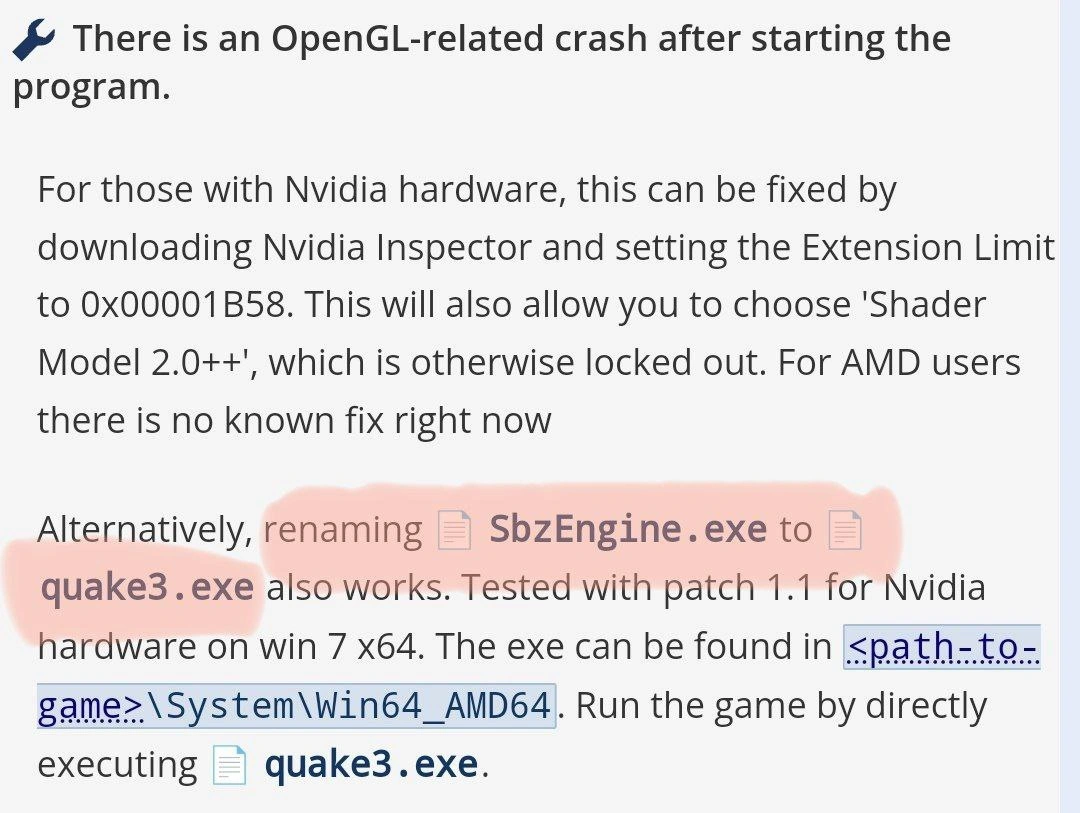
Now, the really funny part: “Alternatively, renaming SbzEngine.exe to quake3.exe also works.” SbzEngine.exe is presumably the original name of the game’s main executable file (the engine or program that’s running). They suggest renaming this file to quake3.exe. This feels like pure tech magic: how could changing a filename fix a crash? The answer lies in graphics driver profiles. Both Nvidia and AMD drivers contain profiles for specific games – these profiles can adjust settings or apply fixes when a known game is running. How do they detect the game? Often by the filename of the .exe. Quake 3 is a very well-known old game, and both GPU vendors’ drivers have special behaviors when quake3.exe is running (for instance, to fix old quirks or optimize for that game). By renaming SbzEngine.exe to quake3.exe, you’re effectively fooling the driver. The driver sees “quake3.exe” and automatically applies all the Quake 3 specific compatibility tweaks. One of those tweaks is likely the same extension limit or shader model restriction mentioned earlier. So this is just another way to activate the compatibility mode, without needing to manually toggle anything in Nvidia Inspector. You find the file in the game’s folder (the post even gives a path: <path-to-game>\System\Win64_AMD64 which tells us it’s a 64-bit Windows 7 game binary), rename it, and then run the game by double-clicking the newly named quake3.exe. The game doesn’t care what its file is called, but the driver does. It’s a bug fix by way of disguise! This kind of rename trick is not common in casual computing, but in the realm of legacy software and PC gaming, it’s a known trick-of-the-trade when dealing with stubborn compatibility issues.
Think of it this way: the developers discovered that if they make the game pretend to be Quake 3, it doesn’t crash. It’s a bit of a last resort fix, because ideally you’d patch the game or the driver properly. But when you’re dealing with older operating systems (this was on Windows 7 x64) and possibly an older game engine, you take what you can get. The presence of “Tested with patch 1.1 for Nvidia hardware on Win7 x64” suggests this was formal advice around a specific update, meaning the devs endorsed it, at least temporarily. No one’s happy about such a hack, but if it keeps the game running for players, it’s worth it. So in summary: by changing the game’s name to a famous one, we exploit the GPU driver’s built-in knowledge of that old game to work around a crash. It’s a nifty example of a debugging workaround in graphics programming, where the solution isn’t to change a single line of the game’s code, but rather to change how the game presents itself to the system. Truly, what’s in a name? In this case, everything needed to stop a crash!
Level 3: Quake Ex Machina
From a senior developer’s perspective, this meme highlights the absurd lengths we go to when debugging and troubleshooting a stubborn bug. The image describes an official fix where, instead of patching the engine or driver properly, you rename your game’s binary to quake3.exe. It’s as if Quake 3, a classic game from the last millennium, swoops in as the unexpected savior – a true “Quake ex machina.” Experienced devs find this hilarious because it’s a textbook workaround: a hacky solution that sidesteps the actual problem. We’ve all been there: something’s broken in a way we can’t easily fix, so we employ a crazy trick to fool the system into working. Here the trick is basically impersonation. By pretending to be Quake 3, the program triggers the NVIDIA driver’s special-case code written for that game. The humor (and pain) lies in the fact that this is considered an “official GPU fix,” not just some fringe mod. It implies the developers or community were basically shrugging and saying, “Yeah, we couldn’t figure out a normal fix, so just cosplay as Quake III and you’re good.”
Why does this bizarre solution exist? On Nvidia hardware, someone discovered that using the tool Nvidia Inspector to set an Extension Limit (with that magic number 0x00001B58) enables a hidden compatibility mode dubbed "Shader Model 2.0++". In simpler terms, it makes the fancy new GPU pretend it’s a slightly older GPU. That stops the program from doing whatever newfangled OpenGL thing was making it crash. It’s a clever debugging sleight-of-hand: instead of fixing the root cause in code, just change the environment so the bug doesn’t show up. If you’re an old-hand in game development, you might recall that legacy software support often falls back on such tricks. Graphics drivers, especially, are full of bugs in software (and silenced bugs) where the vendor has hardcoded workarounds for specific game titles. Seeing quake3.exe in the solution instantly tells a senior dev that this is leveraging one of those legacy compatibility paths. It’s both brilliant and cringe-worthy – brilliant because it works, cringe-worthy because it underscores some fragile or messy part of the graphics pipeline that nobody had time (or ability) to fix correctly.
Another layer to the joke is the side note: “For AMD users there is no known fix right now.” Ouch. This adds a dose of dark humor for those who know the GPU industry. AMD’s drivers historically handle OpenGL differently (and often not as forgivingly as Nvidia’s). The meme subtly says: Nvidia users can jury-rig a solution via an Nvidia Inspector tweak, but AMD users are left in the cold. That’s a tongue-in-cheek way of saying “Nvidia’s driver has a backdoor we can exploit, but AMD’s doesn’t (or nobody’s found it).” If you’ve been around long enough, you remember countless forum threads where one GPU brand had a workaround for a game and the other brand’s users just had to wait for an official patch. It’s a shared trauma in game development and PC gaming: the frustration of AMD users left behind by some obscure bug that only the other guys have a fix for. The meme’s highlighted text “renaming SbzEngine.exe to quake3.exe also works” perfectly captures a moment of victorious desperation that any seasoned dev or modder recognizes. It’s the kind of solution you try at 2 AM after exhausting all rational options – and when it works, you’re equal parts relieved and incredulous. Of course, you then share it on a forum so others can laugh and cry along with you at the sheer ridiculousness of it. In summary, the humor here comes from the debugging and troubleshooting reality that sometimes fixing a graphics bug means embracing a shady workaround that really shouldn’t have to exist… but it does, and we’re thankful it saves our bacon.
Level 4: Hardcoded Heuristics
Deep in the entrails of GPU drivers, there’s a labyrinth of hardcoded heuristics designed to keep old games running smoothly on new hardware. Graphics drivers often perform executable fingerprinting – essentially checking the name of the running program – to apply special case fixes or performance tweaks. In this case, naming the program quake3.exe is like a secret handshake with the driver. Why Quake 3? Quake III Arena (circa 1999) is a legendary OpenGL game, and GPU vendors have long included compatibility code for it. Renaming a newer engine’s EXE to “quake3” exploits that legacy driver profile hack. Under the hood, the driver likely limits or adjusts certain OpenGL features whenever it detects Quake3’s name, because it “knows” how Quake3 is supposed to behave. This trick forces the driver to enable a conservative, known-good code path (one tuned for Quake 3’s expected OpenGL calls), thereby avoiding whatever modern glitch is causing the crash. It’s a bit like conjuring a ghost of PC gaming past – the code paths of a 90’s game – to haunt a 2010s-era engine into behaving.
There’s also a granular technical angle with that mysterious “Extension Limit” 0x00001B58 value. In OpenGL, a program queries which extensions and shader versions the GPU supports. Too many extensions or a higher shader model might confuse a program that wasn’t coded to expect them. Drivers historically had to cap or lie about supported features for certain apps to prevent crashes (for example, some older games would crash if the extension string was longer than they anticipated – classic buffer overflow territory). Shader Model 2.0++ is a clue: this engine likely was written around the era of Shader Model 2, with some extra features, but not full Shader Model 3. By setting the extension limit to 0x00001B58 (an internal driver code corresponding to “limit features to SM2.0++”), the Nvidia driver essentially tells the game “Hey, I only support up to the older stuff you’re comfortable with.” This prevents the game from attempting a newer OpenGL feature that triggers the crash. Renaming the binary to quake3.exe achieves the same outcome automatically, because the driver’s Quake3 profile probably includes that exact extension cap (Quake 3 wouldn’t use anything beyond OpenGL 1.x/2.0-era features). In essence, the fix exploits decades of accumulated graphics programming lore embedded in the driver. It’s a wild demonstration of backwards compatibility: the game development equivalent of solving a modern problem with a prehistoric spell. And yes, it’s totally bonkers that this works – but it’s rooted in very real design decisions in driver engineering. These low-level OpenGL crash workaround tactics remind senior engineers that sometimes the safest fix is not to push forward, but to lie about who you are and what you can do, all to avoid provoking a long-forgotten bug.
Description
A screenshot of a technical guide detailing a fix for an OpenGL-related program crash. The text explains that for Nvidia users, the crash can be fixed by either adjusting a specific setting in Nvidia Inspector or, alternatively, by renaming the program's executable file from `SbzEngine.exe` to `quake3.exe`. The guide also notes that there is no known fix for AMD users. This meme resonates with experienced developers and PC gamers who have encountered bizarre workarounds for legacy compatibility issues. It highlights the layers of specific, hardcoded fixes within graphics drivers, where renaming an executable can trick the driver into applying a different, more stable rendering path intended for a classic game like Quake III
Comments
20Comment deleted
Modern DevOps is all about elegant infrastructure-as-code solutions, but let's not forget the ancient incantation of the elders: `ren SbzEngine.exe quake3.exe`. Some problems aren't solved with Kubernetes; they're solved by tricking a 15-year-old DLL into thinking it's 1999 again
If your render pipeline can’t dodge the crash, just cosplay as Quake III - Nvidia’s driver whitelists are apparently the true shader compiler
When your modern game engine needs to cosplay as a 1999 arena shooter to convince the GPU drivers to behave - because apparently Nvidia's driver team still thinks Quake 3 is the pinnacle of OpenGL optimization profiles
Ah yes, the classic 'rename your executable to quake3.exe' workaround - because apparently Nvidia's driver team has a whitelist from 1999 that grants Quake 3 special OpenGL privileges. It's 2024 and we're still exploiting driver heuristics that assume 'if it's named quake3.exe, it must be well-behaved.' Meanwhile, AMD users are left in the cold with 'no known fix' - a phrase that strikes fear into the heart of any engineer who's ever had to support cross-vendor graphics code. Nothing says 'production-ready' quite like telling users to YOLO rename system binaries and hope the driver gods smile upon them
Renaming to quake3.exe: the legacy OpenGL pattern where Carmack's ghost fixes your extension limits better than any shim
Nothing says cross-platform rigor like fixing an OpenGL crash by renaming the process so the driver applies its Quake 3 compatibility shim
Nothing says mature graphics stack like fixing an OpenGL init crash by renaming SbzEngine.exe to quake3.exe so the driver loads a 20-year-old app profile; somewhere there’s a switch(processName) deciding your rendering pipeline
Alternatively?🤨 Comment deleted
A good chunk of Nvidia's "driver" is just profiles for various games since late 90's, hence renaming to quake3 will activate the setting. Comment deleted
Famously Windows has tonnes of the same, too. Like doing memory management for some games that do it badly and stuff. It's wild how many edge cases the OS seems to handle itself Comment deleted
The thing is, Nvidia still puts those profiles to firmware for Linux. And there are crazy things like a bit flag for certain video memory workaround made for No One Lives Forever 2 that has never been reused and is still supported (I tested it on Maxwell and Pascal cards). Comment deleted
Should replay this game damn Comment deleted
X server also gets special treatment from the kernel afaik Comment deleted
By the executable's name?😁 Comment deleted
by the executable name Comment deleted
Shiiiet. I also love the part about "let's revert it" yet it's still out there. Comment deleted
@sylfn ban plz Comment deleted
Renaming your game executable to hl2.exe was an easy way to get more FPS, and the person telling me this was an Nvidia employee. Comment deleted
so that's why nvidia is better than amd Comment deleted
Lmao Comment deleted