Skip to content
DevMeme
5509 of 7435
The Unholy Trinity of Tech: Blockchain, Gen AI, and a Jaded Senior Dev
IndustryTrends Hype Post #6039, on Jun 4, 2024 in TG

The Unholy Trinity of Tech: Blockchain, Gen AI, and a Jaded Senior Dev

Why is this IndustryTrends Hype meme funny?

Level 1: Shiny but Slow

Imagine you have two super fancy kitchen gadgets and an experienced grandma helping you cook. One gadget is a trendy new oven that everyone claims will change cooking forever – but the catch is it asks all your neighbors to approve each ingredient you add, so making dinner with it takes ages. The second gadget is a magical recipe book that can come up with any dish you want; it’s amazing, but you haven’t figured out how to earn money with it (and sometimes its recipes include odd mistakes, like forgetting to add salt). Then there’s Grandma, who’s been cooking for 30 years. You’d think she never slips up, but today she’s scrambling around the kitchen looking for the salt shaker she misplaced – that one little thing she missed is making the soup taste bland. In the end, the fancy oven and the magic recipe book do produce a meal, but it took all day with lots of hassle, and the soup tastes pretty much the same as if you’d used an ordinary pot. It’s funny because it shows that even the most shiny, hyped-up new things (and even an expert cook) can end up being impractical or slow. After all that fuss, they basically did the same old job in a much more complicated way.

Level 2: The Hype Trifecta

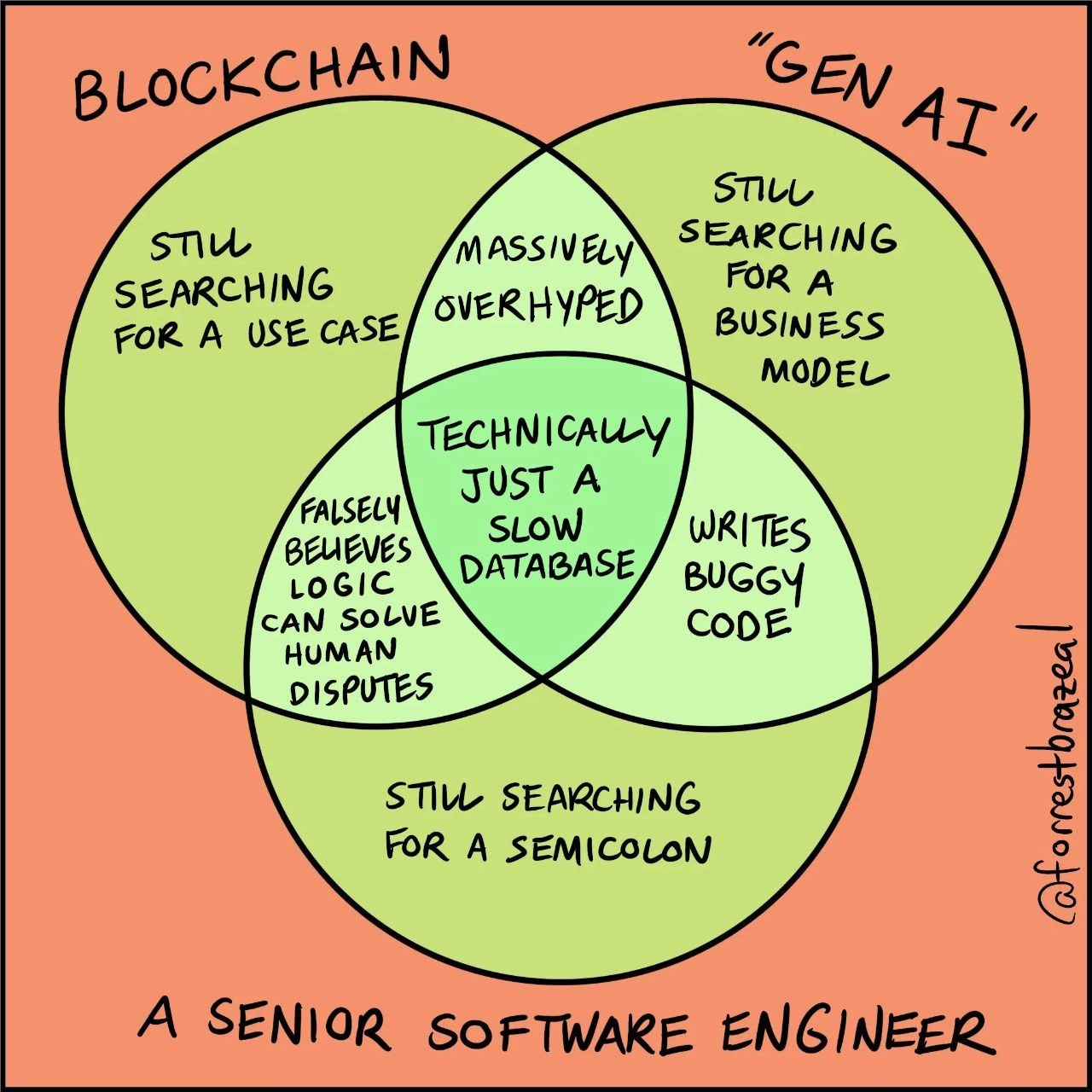
At first glance, this meme is a Venn diagram with three big labels: Blockchain, Gen AI (short for Generative Artificial Intelligence), and A Senior Software Engineer. Each label corresponds to a green circle, and where the circles overlap, there are phrases that describe what those groups have in common. If you’re newer to tech, let’s break down what each of these terms means and why combining them leads to the joke.

  • Blockchain: This is a technology originally made famous by Bitcoin. A blockchain is essentially a special kind of database that stores information (like transactions) across many computers in a network rather than in one central place. Because everyone in the network must agree on each new entry (using algorithms and cryptography), it’s very secure against tampering — you can trust the record without trusting any single person. However, it’s also not very fast or efficient compared to a normal database. Imagine having to get dozens of friends to agree every time you write a new line in a shared notebook; it would take a while! That’s why the meme says blockchain is “still searching for a use case.” In the last decade, people have tried to apply blockchain to all sorts of problems (supply chains, voting systems, medical records) hoping to find a killer app beyond cryptocurrency. But in many cases, a simple traditional database or another existing technology worked better. In short, blockchain is a clever invention that’s great for certain niche purposes (like Bitcoin or securing data in a tamper-proof way), but it hasn’t universally caught on for everyday applications. It’s a bit like a fancy new tool everyone is excited about, but nobody is quite sure what it’s best used for yet.

  • Gen AI (Generative AI): Generative AI refers to artificial intelligence models that can create new content similar to what humans might create. For example, ChatGPT is an AI that can generate human-like text (answer questions, write stories or code), and there are AIs that generate images or music in a similar way. The meme’s Gen AI circle says “still searching for a business model.” This means that even though these AIs can do impressive things, companies are still figuring out how to make money from them sustainably. There’s a lot of excitement around tools like AI chatbots or image generators, but questions remain like: Will people pay to use them? How do you turn this cool technology into a profitable service or product? It’s reminiscent of early internet companies that had millions of users but hadn’t figured out how to turn popularity into profit. On a technical note, generative AI works by learning patterns from a huge amount of data. For instance, a text model like ChatGPT has essentially read the internet during its training. It then tries to produce output (like an answer or a paragraph) that follows the patterns it learned. The meme also says Gen AI “writes buggy code.” That’s pointing out a known issue: if you ask an AI to write programming code, the result often has mistakes (we call those bugs). Because the AI doesn’t truly understand the code — it’s just predicting what looks like a plausible solution — it might omit a crucial step or use the wrong command. Developers using these AI tools have learned they’re helpful for quick drafts, but you must test and fix the AI’s code, much like you would double-check a human junior programmer’s work.

  • A Senior Software Engineer: This means a very experienced programmer, someone who has been coding professionally for many years (often 10+). You might expect a person with the title “senior” to have totally mastered programming and never make mistakes. The meme has fun with this by saying the senior dev is “still searching for a semicolon.” In many programming languages (like C, C++, Java, and JavaScript), a semicolon (;) is used to mark the end of a statement. If you forget a semicolon where one is needed, the whole program can fail to compile or run properly. It’s a ridiculously common error — even though it’s a tiny character, forgetting it can break your code. The joke here is that even an engineer with 20 years of experience can spend an embarrassing amount of time debugging something as small as a missing semicolon. It’s a playful reminder that no matter how “senior” you are, you’re still human. To visualize this, imagine a senior coder staring at their screen, frustrated, only to eventually sigh in relief, “Ah, it was missing a semicolon on line 312.” For example, in C code it might look like this:

    #include <stdio.h>
    int main() {
        printf("Hello, world!")  // <- Oops, missing semicolon here will cause a compile error
        return 0;
    }
    

    In the snippet above, the printf line is missing a ; at the end. Even one character missing can prevent a program from running. So “searching for a semicolon” is a tongue-in-cheek way to describe a scenario any programmer can relate to, newbie or veteran.

Now, let’s look at the overlapping parts of the Venn diagram — these are the labels in the intersections, showing traits that the groups share:

  • Blockchain ∩ Gen AI = “MASSIVELY OVERHYPED.” When two circles overlap, it means those two share something. In this case, both blockchain and generative AI have been surrounded by a lot of hype. Overhyped means people talk about it like it’s going to solve everything and change the world, often before there’s real evidence it can deliver on all those promises. If you’ve seen social media posts or news headlines claiming “Blockchain will revolutionize X” or “AI will replace humans in Y,” that’s the kind of hype being referenced. The meme is saying both technologies had their turn being massively hyped up. And indeed, they did: blockchain was the hot tech buzzword a few years ago, and more recently generative AI (with things like ChatGPT) became the new craze. This overlap is a humorous reality check that both of these “revolutionary” tech trends might have been talked about a bit too optimistically compared to what they’ve actually achieved so far.

  • Blockchain ∩ Senior Engineer = “FALSELY BELIEVES LOGIC CAN SOLVE HUMAN DISPUTES.” This phrase is a bit more nuanced. It’s highlighting a mindset that can be common in both some blockchain projects and in some very analytical engineers. Blockchain systems (especially smart contracts on platforms like Ethereum) were built on the idea that code and algorithms could enforce agreements perfectly, removing human error or dishonesty. The saying “the code is law” came about, meaning if the code says it, that’s the final word. However, in famous incidents (for example, when a smart contract was hacked in 2016, causing a big dispute in the Ethereum community), people ended up stepping in to correct or override what the code did. In other words, human judgment was still needed. On the other side, engineers (especially those who have been in the field a long time) often approach problems very logically. That can extend to how they deal with team disagreements or user issues — they might think if they just present the most logical solution, everyone will agree. But human disputes (in a team or with customers) aren’t always resolved by logic alone; emotions, misunderstandings, and personal interests get involved. So this overlap humorously points out a shared folly: thinking that pure reason or code can solve fundamentally human problems. It’s saying both the blockchain idealists and the overly logical senior geeks sometimes overestimate how far rational solutions can go in messy human situations.

  • Gen AI ∩ Senior Engineer = “WRITES BUGGY CODE.” Here the meme connects the AI and the senior dev with a very down-to-earth trait: both can produce code that isn’t perfect. We already touched on how generative AI can write code that has errors. Now, you might wonder, “Okay, but why say a senior engineer writes buggy code? Aren’t they experts?” Yes, they are, but writing code without any bugs is extremely hard, no matter your skill level. Senior engineers usually tackle more complex problems, and with complexity comes a higher chance of mistakes. Even if their fundamentals are solid, they might introduce a bug when integrating many systems or simply because everyone has an off day. The phrase “writes buggy code” applied to a senior is a bit of self-deprecation from the developer community: it’s admitting that even the best of us screw up. And that’s something a generative AI and a human have in common — fallibility. So this overlap is both a joke and a humble reminder that nobody in programming is perfect, not even the AI that was trained on billions of lines of code, and not even the veteran coder with a wall full of certificates.

Finally, at the very center of the Venn diagram, where all three circles overlap, is the phrase “TECHNICALLY JUST A SLOW DATABASE.” This is the big punchline of the meme, the part that makes many developers laugh out loud. It’s saying that if you boil down blockchain and generative AI (and even a lot of what senior engineers build or deal with), you end up with something that’s essentially a database... only slower than it should be. Let’s unpack that in simple terms. A database is software that stores information and lets you retrieve or update it efficiently. For example, a library catalog or a contacts list on your phone are backed by some kind of database that lets you quickly find what you need. Calling something “just a slow database” is a cheeky way to downplay a complex system as not doing much more than basic data storage, and doing it poorly performance-wise.

Why would we say that? Well, blockchain, at its heart, stores data (transactions, records) and you can retrieve them. It adds a lot of security and decentralization, but from a performance standpoint, it’s slow to add and look up data because of all the extra steps (remember, all those “friends” have to agree before anything is final). Generative AI, in a loose sense, also stores information — not in a straightforward way, but in the patterns of its neural network. When you ask it a question, it’s sort of like querying a huge, fuzzy database of knowledge. But getting an answer from it involves tons of computation (it has to churn through those neural network connections), which is slower and more resource-intensive than, say, looking up an entry in Wikipedia or a properly indexed database table. And the senior software engineer? This one is a bit tongue-in-cheek: you could say an experienced dev is a walking database of past solutions and knowledge. If you ask them something (“How do we scale our server?”), they’ll search their memory (maybe recalling five different projects and what worked before) and eventually retrieve an answer. But that might not be instant, especially if it’s 3 AM and they’re on their third cup of coffee trying to remember what they did six years ago. In a joking way, the meme suggests that after all the hype and brilliance, what do we get? Something that behaves like a basic data store, but slower.

It’s funny (especially to folks in tech) because it cuts through the hype. It’s like telling someone who’s bragging about their super expensive, complicated gadget: “So... it’s basically just a clock that’s bad at telling time, huh?” It’s an exaggeration, of course — blockchain and AI are more than just databases — but there’s a grain of truth that makes it comedic. Often new tech gets hyped as if it’s completely groundbreaking, but when you peel back the layers, parts of it resemble older ideas (with new twists) and inherit some old problems like slowness or bugs. The senior engineer’s presence in the mix adds a human element, showing even the experts are not above this fray.

In summary, each part of the diagram is jabbing at a different target:

  • Blockchain: A cool innovation that’s maybe a solution still looking for the right problem, and inherently not speedy.
  • Gen AI: A dazzling new tool that hasn’t figured out how to pay the bills and can mess up, despite its brilliance.
  • Senior Dev: A highly skilled human who, for all their expertise, can stumble on the tiniest of issues.
  • All together: After all is said and done, these grand things often end up doing something ordinary (like storing info) in a more convoluted or slow way.

For someone new to the industry, the meme is basically saying: “Don’t be too intimidated by fancy tech or big titles — they all have their issues and limits, often in ways that make us chuckle.” It’s highlighting a kind of equalizing truth in technology: every system and person has flaws, and incredible hype usually meets reality eventually. Developers find it funny because it’s a reminder not to take the buzzwords (or ourselves) too seriously, delivered in a simple Venn diagram that anyone who’s been around the block can appreciate.

Level 3: Been There, Overhyped That

This meme resonates with every seasoned developer who’s weathered multiple tech hype cycles. Seeing Blockchain and Gen AI lumped together with “A Senior Software Engineer” in one Venn diagram is already comical — it's like mixing oil and water and... a semicolon? But that juxtaposition is precisely the point. These three circles represent two flashy, over-marketed technologies and one grizzled human who’s seen it all. The humor emerges from highlighting that, despite their differences, all three have striking parallels in overpromising and under-delivering. A senior dev reading this meme likely smirks because they remember when blockchain was pitched as solving everything from banking to world hunger, and now the same breathless claims are being recycled for AI.

Let’s start with the Blockchain hype. Around 2016–2018, everyone and their dog was jamming “blockchain” into project pitches — often without a real need for it (hence “still searching for a use case,” as the meme quips). We saw absurd scenarios like “Uber for laundry, but on the blockchain!” and dubious ICOs raising millions on just buzzwords. Engineers at meetups would quietly ask: couldn’t this just be done with a regular database? Many times the answer was yes, but saying “blockchain” made investors’ eyes light up. The overlap of blockchain and senior engineer in the meme reads “falsely believes logic can solve human disputes.” This hits on a classic blockchain ideological stance: smart contracts and decentralized networks were supposed to eliminate the need for messy human trust and legal systems because the code would enforce fairness. The idea was that pure logic and cryptography could replace lawyers and courts. Any senior dev who’s dealt with real-world users can tell you how naïve that is. People will find ways to argue even when the code is technically right — whether it’s disputing a smart contract’s outcome or two developers fighting in a code review despite the spec. The blockchain world learned this the hard way with incidents like contentious hard forks (remember the Ethereum/Ethereum Classic split after a major smart-contract hack? The “code is law” logic met human politics, and politics won). So yes, logic alone doesn’t settle human disputes; even decentralized networks eventually need off-chain governance and old-fashioned negotiation. The meme calls this out, and a senior dev chuckles knowingly because that lesson repeats every generation: tech can’t magically fix people.

Next, Generative AI hype gets a similar teardown. The meme says Gen AI is “still searching for a business model,” which is painfully accurate. In the past couple of years (2022–2024 being peak mania), we’ve seen an explosion of AI demos and products: AI that writes essays, generates code, creates images of cats as Renaissance paintings — you name it. Everyone is excited, but veteran engineers recall the last AI boom-and-bust or other fads where excitement didn’t equal profit. Sure, ChatGPT can write a poem or spit out code, but how do you monetize that at scale? Companies are scrambling for answers. It’s reminiscent of the dot-com bubble when web startups had millions of users but no revenue plan. Generative AI often requires huge computing resources (which cost money), so offering an AI-powered app for free can burn cash fast. Meanwhile, investors pour money in because AI is the hot buzzword, expecting that “we’ll find the revenue later.” A senior dev has seen this movie before. The overlap of Gen AI and senior engineer says “writes buggy code,” drawing on another shared experience: if you’ve tried having an AI code assistant generate functions, you know it often produces subtle bugs or even syntax errors with supreme confidence. It’s like pair-programming with a overeager newbie who never runs their code. Experienced developers find that both amusing and alarming — amusing because even cutting-edge AI makes rookie mistakes, and alarming because less experienced devs might take the AI’s output at face value and ship those bugs. But let’s be honest, any human coder (even seniors) also writes bugs. We’ve all had the humbling experience of our code crashing or misbehaving due to an overlooked mistake. The difference is, an AI can introduce 100 bugs in 30 seconds, whereas a person might at least only introduce one at a time! So that overlap is a tongue-in-cheek reminder that neither advanced AI nor a “10x engineer” is infallible. Everyone’s code has bugs; the fancy new AI just manages to create errors at scale and speed.

Now about the Senior Software Engineer circle on its own, labeled “still searching for a semicolon.” This is classic developer self-deprecating humor. No matter how senior you are, there are days when you’re tearing your hair out over a program that won’t compile, only to realize you left out a ; or used the wrong bracket somewhere. It’s the coding equivalent of a master chef burning toast — embarrassing but very human. The meme playfully implies that while blockchain folks are off hunting for killer apps and AI folks hunt for profits, the senior dev is stuck hunting through code for that one stupid missing character. It humanizes the elder engineer: sure, they can design scalable systems and debug race conditions in their sleep, but ask them to spot a missing semicolon after 12 hours of coding and they might miss it like anyone else. It’s funny because it’s true — every developer has been owned by a trivial typo at some point. In fact, a running joke in programming teams is that a huge percentage of bugs turn out to be something as silly as a missing semicolon or mis-typed variable name. The meme’s author chose that detail to show that even the “wise old guru” of the team deals with mundane problems, a nice contrast to blockchain’s grandiose vision and AI’s futuristic sheen.

So, where do all these circles meet? The overlap of all three reads “MASSIVELY OVERHYPED” around the top intersection and “TECHNICALLY JUST A SLOW DATABASE” smack in the center. To an experienced engineer, this is the punchline that ties everything together. It’s saying: take the hottest decentralized tech, the flashiest AI, and the most knowledgeable coder – and recognize that we hype them up like crazy, but in the end, they have glaring shortcomings that make them far less magical than promised. “Massively overhyped” is something you could stamp on countless tech trends. It’s practically the slogan for that peak-of-inflated-expectations phase in the Gartner Hype Cycle. Blockchain? It was overpromised to revolutionize every industry by 2020, and while it found some niches (cryptocurrency, niche financial contracts, NFTs for digital art), it didn’t replace banks or create a trustless utopia. Gen AI? It’s been portrayed as the dawn of true AI revolution or at least the end of Google Search, but a year into the hype, it’s also generating as much confusion as insight (the internet is flooded with AI-generated spam and errors along with the cool stuff). Even the archetype of a “senior developer” can be overhyped in tech culture — think of how recruiters or media sometimes talk about “rockstar developers” who can do anything. In reality, that myth falls flat; even the best devs hit limitations and burnout.

The center label “technically just a slow database” is the meme-maker planting a flag of skeptical realism. It’s the ultimate deflation of buzzwords: after all the grand talk, these innovations often boil down to reinventing wheels in less efficient ways. To put it in perspective, here’s how the expectations vs. reality often pan out:

Concept Hype Promise (Expectation) Reality (Punchline)
Blockchain “This will revolutionize trust and replace intermediaries. Everything will be decentralized and secure!” A glorified distributed ledger that’s basically a slow database with extra steps. Great for tamper-proof logs, but try scaling it for fast transactions…
Generative AI “This will automate creativity and coding. AI will generate flawless code, art, and answers, transforming industries overnight.” An extremely expensive autocomplete that often hallucinates facts and writes buggy code. Impressive and useful at times? Absolutely. Ready to run things solo? Not so much.
Senior Dev “An all-knowing wizard who has seen every problem and writes perfect code from memory.” A human who still googles error messages and sometimes forgets a semicolon. Highly skilled, yes, but still learning and messing up like everyone else.

In other words, the meme is poking fun at the contrast between how we talk about these things versus what they really are. A senior engineer reading it nods and laughs because they’ve lived this contrast. They’ve sat in meetings where leadership insists on slapping blockchain onto a project that didn’t need it, just to sound innovative. They’ve watched startups claim their GPT-powered app will change the world, while the demo crashes or the AI confidently outputs nonsense. And that senior dev has also had humbling moments where, despite all their knowledge, they introduced a bug by forgetting a simple line of code.

Ultimately, the humor here is a form of industry catharsis. It’s a gentle roast of our collective obsession with new tech trends, seen through the eyes of someone who’s been around long enough to be jaded. By equating buzzy technologies to a “slow database,” the meme deflates the pomposity around them. And by including the self-deprecating semicolon gag, it reminds us not to put veteran engineers on too high a pedestal either. We’re all prone to mistakes and subject to the laws of computing. The blockchain evangelist, the AI researcher, the senior coder — at the end of the day, each faces their own version of a frustrating limitation. That shared fallibility is what brings all three circles together. The Venn diagram format is the perfect vehicle here: it visually merges these disparate things to deliver a singular punchline. It’s a big reality check served with a side of humor, and if you’ve “been there, overhyped that,” you can’t help but chuckle in agreement.

Level 4: Hashes & Hallucinations

The meme’s core punchline, “technically just a slow database,” isn’t just snark — it reflects fundamental computing trade-offs. Blockchain technology introduces heavy-duty theoretical machinery like distributed consensus algorithms (think Byzantine fault tolerance and Proof-of-Work) to guarantee trust without a central authority. These algorithms solve the famed Byzantine Generals Problem using cryptographic hashes and network-wide agreement, ensuring no single node can corrupt the ledger. But all that cryptographic ceremony has a cost: transactions must propagate across many nodes and undergo expensive verification. The CAP theorem whispers that you can’t have consistency, availability, and partition tolerance all at once; blockchains favor consistency and trust, sacrificing speed. Each new block in a chain is essentially an append to a globally replicated log, often requiring minutes of computation and communication to confirm. In database terms, it’s like every INSERT operation is reviewed by a global committee through encrypted handshakes and math puzzles. Sure, the data becomes tamper-evident, but the throughput is glacial. No wonder seasoned architects joke that a blockchain is basically an append-only linked list (Merkle chain) functioning as a database decentralized database with latency that would make a 1970s mainframe blush.

Meanwhile, Generative AI — especially large language models (LLMs) — operates on a different kind of complexity, but the result can feel oddly similar. An LLM like GPT-4 is essentially a gigantic state machine with billions of parameters absorbing a massive corpus of text. During inference (when you prompt it), what is it doing? In a sense, performing an ultra-complex lookup on an internal compressed representation of the training data. There’s no explicit database table of facts, but the model weights implicitly store tons of information. Retrieving something coherent from this stochastic parrot means crunching through huge matrix multiplications across dozens of transformer layers. Computationally, that’s far heavier than a straightforward SQL query to a well-indexed relational database. And the kicker: the model might hallucinate — producing a plausible-sounding but incorrect result — because it has no guaranteed way to verify facts like a structured database would. So while Gen AI feels magical, at a low level it’s brute-force pattern matching over terabytes of data, technically a slow, probabilistic database of everything it read. It’s also “still searching for a business model” because all this computation is expensive. Companies pour GPU cycles into these models hoping for transformative applications, but until those materialize, it’s like owning a supercomputer that mostly just… autocompletes text. The hype promises an AI revolution, yet under the hood we have perplexity scores, token prediction probabilities, and a lot of trial-and-error to get something useful — impressive, yes, but efficient and monetizable? Not by default.

Now consider the Senior Software Engineer in the third circle. You might not think of a grizzled coder’s brain or codebase as a “database,” but humor us. A veteran engineer’s head is full of decades of accumulated bug fixes, APIs, and war stories — a sort of mental knowledge base. Retrieving the right snippet of wisdom under pressure can be slow (who hasn’t seen a senior dev mutter “I know I solved a similar concurrency issue in ’07… just give me a minute to recall…”). On top of that, the senior’s own code, especially if it’s old or overly clever, can turn into a convoluted datastore of business logic and hacks accreted over time. When the meme says they’re “still searching for a semicolon,” it’s poking fun at how even the most experienced programmer can be stumped by a trivial syntax error. This is the human equivalent of an unexpected latency spike: a missing ; in C or Java can halt the entire build, sending the guru into a painstaking line-by-line debug session at 3 AM. It’s a reminder that in computing, tiny details (one missing byte or bracket) can bring the whole system down, and no amount of experience makes you immune. The other senior-only jab — “falsely believes logic can solve human disputes” — speaks to the engineer’s worldview. Seasoned devs often approach social or project issues with Vulcan logic, assuming every conflict has a rational resolution. But in the messy real world (and especially in blockchain governance or AI ethics debates), pure logic doesn’t account for emotions, power struggles, or trust. Smart contracts were touted with the motto “code is law,” implying we’d resolve contractual disputes with perfect logic; in practice, hacks and unforeseen cases led to human legal intervention anyway (the DAO hack rewind, anyone?). Similarly, a senior dev might think a well-reasoned technical argument will win any meeting, only to discover office politics or feelings trump facts. It’s a humbling realization: not all problems have a deterministic technical fix.

In the center of this Venn diagram, where all three circles overlap, lies the phrase “TECHNICALLY JUST A SLOW DATABASE.” This is the meme’s final wink, equating flashy innovations (and even human expertise) to the simplest of tech truths: at the end of the day, it’s all just data storage and retrieval, made slower by unnecessary complexity. Why slow? Because each domain has, in its own way, delivered less performance or clarity than the hype suggested. Blockchain’s decentralized design makes it inherently slower at data writes and reads than a well-tuned centralized DB. Gen AI’s enormous “brain” can’t give you a straightforward factual answer as quickly or reliably as a smaller specialized system could — it might even invent data that was never there. And our illustrious senior dev? Sometimes the wealth of experience and systematic thinking means they take the scenic route to a solution (and their code isn’t always the fastest either, especially if they’re implementing an elaborate, “clever” solution where a simple script would do). In essence, the meme reduces lofty concepts to an absurdly low common denominator: all that hype, all that complexity, yet here we are, reinventing a basic datastore and making it slower. It’s a pretty cynical take, compressing a decade of bold promises into a one-liner that’d draw a knowing chuckle from anyone who’s chased performance issues or been burned by over-engineered solutions. After all, in computing we often rediscover that elegant simplicity outperforms grandiose complexity. Imagine telling a blockchain bro or an AI evangelist that their pride and joy amounts to a sluggish ledger or a glorified autocomplete – the truth in the joke might just sting a bit.

Description

This image displays a Venn diagram with a salmon-colored background, comparing three concepts: 'BLOCKCHAIN', '"GEN AI"', and 'A SENIOR SOFTWARE ENGINEER'. The diagram humorously highlights the perceived flaws and cynical overlaps between these subjects. The 'BLOCKCHAIN' circle contains the text 'STILL SEARCHING FOR A USE CASE'. The '"GEN AI"' circle says 'STILL SEARCHING FOR A BUSINESS MODEL'. The 'A SENIOR SOFTWARE ENGINEER' circle has 'STILL SEARCHING FOR A SEMICOLON'. The overlaps are where the core jokes lie: Blockchain and Gen AI are 'MASSIVELY OVERHYPED'. Blockchain and the Senior Engineer 'FALSELY BELIEVES LOGIC CAN SOLVE HUMAN DISPUTES'. Gen AI and the Senior Engineer both 'WRITES BUGGY CODE'. The central intersection, where all three overlap, reads 'TECHNICALLY JUST A SLOW DATABASE'. The meme provides a deeply cynical but relatable perspective for experienced engineers, equating the overhyped, solution-in-search-of-a-problem nature of recent tech trends with their own jaded self-awareness and daily struggles
Comments

11
Anonymous ★ Top Pick This Venn diagram is the most efficient data structure for compressing three decades of tech industry disillusionment into a single, highly-relational schema
  1. Anonymous ★ Top Pick

    This Venn diagram is the most efficient data structure for compressing three decades of tech industry disillusionment into a single, highly-relational schema

  2. Anonymous

    If we ever chain the LLM to the ledger, we’ll finally have a distributed, append-only source of hallucinations - at nantransactions per token

  3. Anonymous

    After 20 years in tech, you realize the real distributed consensus problem isn't Byzantine fault tolerance - it's getting three VPs to agree that maybe, just maybe, we don't need a blockchain for our employee cafeteria menu system

  4. Anonymous

    After two decades of architecture reviews, you realize that both blockchain and GenAI proponents share the same fatal flaw: they're solving for Byzantine fault tolerance in systems where the real problem is stakeholder alignment. Meanwhile, you're still hunting for that missing semicolon because at least that's a problem with a deterministic solution - unlike convincing your CTO that a Postgres cluster with proper indexing would outperform their 'revolutionary' blockchain solution at 1/100th the cost and latency

  5. Anonymous

    Blockchain chases use cases, GenAI chases profits - seniors chase semicolons across two decades of legacy sprawl

  6. Anonymous

    Proof you’re senior: you can replace both blockchain and GenAI with Postgres + cron + a vector index - lower latency, clearer semantics, and yes, the semicolon gets found

  7. Anonymous

    Every hype cycle ends the same: we reinvent a database with worse latency, rename schema to “prompt,” and discover consensus is just marketing’s quorum

  8. @azizhakberdiev 2y

    it was all part of plan of gpu producers

  9. @yyynnncompute 2y

    false coder has a linter and a formatter === no need for semicolon search HUMAN MASTER RACE!

  10. @qwnick 2y

    AI is not a database, it's function approximator

    1. @ColonelPhantom 2y

      yeah it's an approximation of a database lmfao

Use J and K for navigation