Skip to content
DevMeme
5507 of 7435
Malware Authors Taunt Security Researchers with Debug Symbols
Security Post #6037, on Jun 2, 2024 in TG

Malware Authors Taunt Security Researchers with Debug Symbols

Why is this Security meme funny?

Level 1: While You Sleep, We Work

Imagine you’re a detective trying to catch a sneaky thief. You follow clues and finally open the thief’s secret box, hoping to find stolen goods. But instead, you find a piece of paper with a big goofy cartoon face on it, and it says, “While you were sleeping, I was busy stealing!” It’s not what you expected at all, right? It’s a taunt — the thief is playfully saying, “I’m always working, even when you’re resting, and you still haven’t caught me!” You might feel a mix of surprise, a little creepiness, but also a chuckle because it’s such a prank.

That’s basically what’s happening in this meme. The “box” here is a computer program that a security expert is examining. The thief (a malware author) left a silly picture made of text characters (an ASCII art face) inside a place where the expert would find it during their investigation. When the expert finds it, the computer even asks innocently, “Do you want to search for this file?” as if the funny message were a real thing. It’s like the computer itself is in on the joke!

For a simple analogy: it’s like doing a puzzle and discovering that someone sneaked in a prank piece that, when you put it in, forms a little smiling face saying “Gotcha!”. It doesn’t break the puzzle, but it sure surprises the person solving it. The core of the joke is a surprise message from the bad guy to the good guy, hidden in a normal process. It’s funny because even though the bad guys are… well, bad, they’re being cheeky and creative. It turns a serious chase into a moment of cartoons and jokes. So the meme is highlighting that even in the serious world of catching computer viruses, there can be these cartoonish, playful moments where the villain leaves a gag for the hero, saying “I’m working while you’re sleeping – bet you didn’t see that coming!”

Level 2: Debugging Trollface

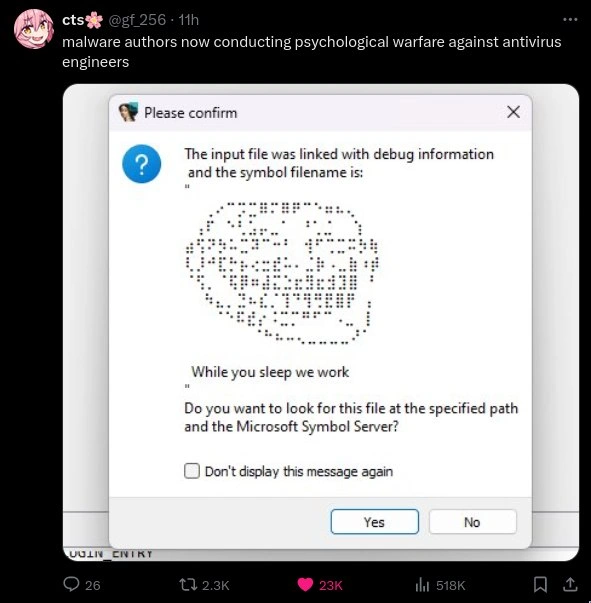
Let’s break down what’s happening in simpler terms. The image shows what looks like a normal Windows 11 dialog box titled “Please confirm”. The message in it says:

  • “The input file was linked with debug information and the symbol filename is:” – This is a standard line you’d see if you’re debugging a program. It basically means “this program was compiled with extra debug info, and it expects to find a file with the program’s symbols (a .pdb file) at the following location.” In software development, a symbol file (with extension .pdb on Windows) contains information that helps translate raw machine code back into human-readable function names or line numbers. Developers use these when debugging to understand what the program is doing.

  • Normally, after that colon, you’d see a path to a file, like C:\MyApp\MyApp.pdb. But here, the text that follows is a massive block of ASCII art representing a smirking face! 😏 ASCII art means a picture made up of text characters (like using dots, slashes, and other symbols to draw an image). It’s something you might see in old forums or text art memes. So instead of a normal file path, the malware author has set the file name to a bunch of carefully arranged characters that look like a meme face. It’s as if the computer is showing you a picture in the error message. That’s highly unusual!

  • After the art, it says: “While you sleep we work”. That’s a creepy little message left by the malware creator. It’s basically telling the analyst or engineer, “hey, we (the malware authors) are busy working even when you’re sleeping.” It’s a taunt – a way to say “we’re always one step ahead” or just to spook the person a bit. Kind of like a villain saying, “I’m out here doing my thing 24/7, you can’t catch me easily.”

  • Then the dialog asks: “Do you want to look for this file at the specified path and the Microsoft Symbol Server?” with Yes/No options (and a “Don’t show again” checkbox). This part is standard for Visual Studio or Windows debuggers. It’s asking if you want it to search for that missing .pdb file, either on your machine (at that crazy path, which obviously doesn’t exist) or on Microsoft’s online Symbol Server (which hosts debug symbols for official Microsoft products). In almost all cases with random malware, the answer is No, because that .pdb isn’t something you can actually fetch – it’s not a Windows system component, it’s just a filename the malware’s author invented. Clicking “Yes” would be a wild goose chase (and you generally wouldn’t want to ping Microsoft for a symbol that obviously isn’t theirs).

So why did the malware author do this? In malware analysis and reverse engineering, analysts often use debuggers to step through malicious code. The malware author realized this and thought, “What if I leave a funny surprise for whoever tries to debug my program?” It doesn’t make the malware stronger or more hidden in any technical sense; it’s purely a troll — a prank. It’s like graffiti aimed at the poor engineer who’s just doing their job. It might make them laugh or at least do a double-take. It’s also a bit of psychological warfare in that it’s trying to say “we’re watching you” or “we’re clever”, possibly to intimidate new analysts. But seasoned analysts mostly find it amusing because it’s so extra. 😂

This ties into social engineering, but in a non-traditional way. Usually, social engineering in security means tricking an innocent user (like getting someone to click a phishing link by pretending to be their bank). Here, instead, the trick is aimed at the antivirus engineers themselves! The malware isn’t just attacking computers; it’s poking the humans analyzing it. It’s a form of hacker humor. In fact, this kind of thing has a long history in hacker culture: sometimes viruses or crackmes include secret messages like “Greetings from X” or “Catch me if you can!” directed at the security community. It’s bragging rights and entertainment rolled into one.

For a junior developer or someone new to debugging, the key takeaways are:

  • Debug info: Many compiled programs can have associated files (like .pdb) that contain helpful info for debugging. If these are missing, your IDE or debugger might prompt you, giving the file path it expected.
  • Malware authors = creative: They will exploit anything, even a file name, to confuse or joke around with people. It’s not always about writing the most elegant code; sometimes it’s about psychological tricks.
  • ASCII art in a file name?! Yes, it’s possible to embed unusual characters into metadata. The result is a normal system message turning into something out of the ordinary.

In summary, the meme shows a malware developer turning a dull error prompt into a prank message for the analyst. It’s funny because it’s unexpected and shows a bit of the cat-and-mouse game between hackers and those who try to stop them. The security folks get the joke because it’s a scenario only someone digging into malware would ever see. It’s as if the bad guy left a clown face on the backdoor just to say “ha ha, got you looking!”. For anyone who’s gone debugging code and gotten weird errors, the idea of the error itself trolling you is both relatable and absurd.

Level 3: ASCII Art of War

For seasoned developers and security engineers, the humor in this meme comes from a “I can’t believe they went there” moment. Reverse-engineering malware is already a cat-and-mouse game, but now the mouse (malware author) is toying with the cat (analyst) on a psychological level. The tweet says “malware authors now conducting psychological warfare against antivirus engineers”. That sounds dramatic, but in a sense it’s true: the malware creator has turned a mundane debug information prompt into a personal taunt. It’s basically a Windows dialog troll.

Imagine you’re a tired malware analyst working late. You load a suspicious program in your debugger or analysis VM, and Windows pops up a dialog: “The input file was linked with debug information and the symbol filename is: [giant ASCII smirking face] … ‘While you sleep we work’ … Do you want to look for this file on the Microsoft Symbol Server?” For a split second you might be confused — is this real? Did the malware just talk to me? Then it clicks: the hacker deliberately put a trollface in the PDB path. It’s a cheeky hacker culture flourish, basically them saying: “Gotcha! I’m in your head.” 😈

This is funny to experienced folks because it’s an unexpected crossover of two worlds: the serious, sterile world of debugging dialogs and the chaotic world of internet meme humor. The .pdb path should just be a boring filename, but here it’s been weaponized for psychological warfare. It’s like an error message with attitude. The phrase “While you sleep we work” is the cherry on top – a smug reminder that malware authors often operate in the shadows at all hours, perhaps implying they never rest in trying to outsmart the antivirus engineers. It’s simultaneously a taunt and a bit of hacker bravado.

From a senior engineer’s perspective, this reflects a real phenomenon: malware developers often implement anti-analysis and anti-debugging tricks to frustrate those trying to study their code. We’ve seen malware that detects debuggers or VMs and then refuses to run or self-destructs. We’ve seen them encrypt or pack their code to make analysis a nightmare. But this is different – it doesn’t stop the analysis, it just messes with the analyst’s mind. It’s a pure troll move, showing off creativity. The analyst knows it’s harmless (no one’s actually hacked your brain, it’s just text in a binary), but it can make them pause and maybe even laugh. It turns a dry technical process into a bizarre encounter with the malware author’s personality. Ironically, it’s almost a form of hacker art. 🎨

Why is this meme blowing up with thousands of likes? Because anyone who’s spent long hours debugging or doing malware analysis can relate to how unexpected and absurd this is. It highlights the lengths to which adversaries will go – not just technically (writing virus code) but psychologically (writing ASCII art to say “hello” in a creepy way). It’s also funny because the antivirus engineers are usually the ones playing tricks on malware (e.g., sandboxing them, fooling them to reveal behavior), and now the malware is turning the tables in a low-key way. The tweet plays it up as “psychological warfare”, which is tongue-in-cheek, but it resonates because defense is tough enough without your tools popping up spooky troll faces!

In essence, the combo of the official-looking Windows “Please confirm” dialog and the utterly unofficial ASCII meme face is what gets the laugh. It’s an inside joke for security folks: it’s scary how far attackers will go, but also you have to admire the dark humor. As a community, we share a bit of a wtf chuckle and maybe a sigh, knowing that even our debugging symbols aren’t safe from trolling. This meme captures that too real moment where technical work and internet prank culture collide in the realm of Security.

Level 4: Symbol File Subterfuge

At the deepest technical level, this meme reveals a clever abuse of how compilers and debugging symbols work in Windows executables. When a program is compiled with debugging support (like using MSVC’s /Zi flag), the linker embeds a path to a .pdb (Program Database) file in the binary’s debug information section. This PDB symbol path is usually a harmless string that points to where the debug symbols were on the developer’s machine (e.g. "C:\Projects\App\build\MyApp.pdb"). It’s stored in the PE (Portable Executable) file’s debug directory in a fixed format (CodeView). Typically, tools like a debugger or the OS’s loader will use this to locate symbols for stack traces or interactive debugging.

Malware authors, however, can manipulate this metadata to serve their own ends. Since the PDB filename isn’t used by the program at runtime (it’s only there for debuggers and symbol resolvers), an attacker can set it to literally any string – even one containing line breaks and funky characters – without affecting the malware’s execution. In this case, the malware’s developer intentionally gave the PDB file a path that forms ASCII art. That means the binary’s debug section contains a multi-line ASCII picture (likely a smirking trollface meme composed of dots and slashes) followed by the phrase “While you sleep we work”. Normally, newline characters or unusual symbols aren’t expected in file paths, but the debug directory isn’t subject to strict validation since it’s just a note to the debugger. The debug prompt UI simply displays this string as-is, newlines and all, resulting in the meme-worthy dialog. It’s a subterfuge: turning an ordinary compiler record into a canvas for ASCII-art psychological warfare.

From a computer science perspective, this is a reminder that seemingly auxiliary data like debug symbols can be an attack vector – not for direct code exploitation, but for social engineering within technical workflows. There’s a parallel to steganography and obfuscated code: hiding messages in places only a skilled analyst would look. It also hints at a trust issue: developer tools trust that debug info is benign and meaningful. No one anticipated it’d be weaponized to taunt engineers. Historically, malware and hacker culture have produced similar stunts – for example, early viruses often included hidden text greetings or jokes in their binary padding. This modern example takes that to the next level by exploiting a compiler-generated artifact (the PDB pointer) to deliver a prank via the OS’s own debugging prompt. It’s a quirky collision of low-level compiler/linker internals with human-facing mischief. The fundamental insight is that anything in the binary, even a debug string, can be co-opted for attacker goals if it’s observable. In the arms race of malware vs. analysts, every bit of metadata – even a PDB filename – becomes fair game for creativity.

Description

A screenshot of a tweet from user 'cts @gf_256' which reads, 'malware authors now conducting psychological warfare against antivirus engineers'. The attached image displays a Windows 'Please confirm' dialog box. The dialog explains, 'The input file was linked with debug information and the symbol filename is:'. Instead of a filename, there is a large ASCII art of the 'Trollface' meme, followed by the ominous message, 'While you sleep we work'. The dialog then asks the standard question, 'Do you want to look for this file at the specified path and the Microsoft Symbol Server?'. The humor is deeply rooted in the cybersecurity world, where a malware creator has embedded a taunting message and a classic meme into the program's debug path. This message is specifically designed to be seen by security researchers during reverse engineering, turning a technical analysis task into a direct, mocking confrontation
Comments

11
Anonymous ★ Top Pick The best malware doesn't just bypass your EDR; it leaves a snarky comment in the debug symbols to question your life choices at 3 AM. It's the equivalent of a buffer overflow leaving a note saying, 'you should've used Rust.'
  1. Anonymous ★ Top Pick

    The best malware doesn't just bypass your EDR; it leaves a snarky comment in the debug symbols to question your life choices at 3 AM. It's the equivalent of a buffer overflow leaving a note saying, 'you should've used Rust.'

  2. Anonymous

    Next up in the ATT&CK matrix: T1566-PDB - phishing the debugger’s soul with an ASCII payload

  3. Anonymous

    The real horror isn't the skull in the PDB filename - it's realizing the malware author has better work-life balance messaging than your startup's 'unlimited PTO' policy that nobody actually takes

  4. Anonymous

    When your malware's PDB path is more memorable than your actual exploit chain. Nothing says 'advanced persistent threat' quite like embedding ASCII trollfaces in debug symbols to haunt reverse engineers at 3 AM. It's the digital equivalent of leaving a 'kick me' sign on the back of every antivirus analyst - except the sign is baked into the binary metadata and will show up in every debugging session for eternity. Peak psychological warfare: making security researchers question their career choices one symbol lookup at a time

  5. Anonymous

    Antivirus scans relentlessly, but our PDB paths hit back with Unicode psyops: 'While you sleep, we work' - the symbol server's revenge

  6. Anonymous

    Anti-debugging for humans: make the PDB name ASCII art so the symbol loader hammers MSFT servers all night - turning IsDebuggerPresent into IsAnalystPatient()

  7. Anonymous

    We’ve hit peak AX: threat actors packing ASCII trash into the PE’s CodeView (RSDS) PDB path so every debugger pops a “While you sleep we work” modal - finally, a social-engineering attack on the symbol loader

  8. @Algoinde 2y

    https://www.youtube.com/watch?v=HlUe0TUHOIc

    1. @Agent1378 2y

      Facking amazing

    2. @affirvega 2y

      thanks this was very fun to watch :3

  9. @ZgGPuo8dZef58K6hxxGVj3Z2 2y

    Why you stole @pepsimantr pfpicture? /s

Use J and K for navigation