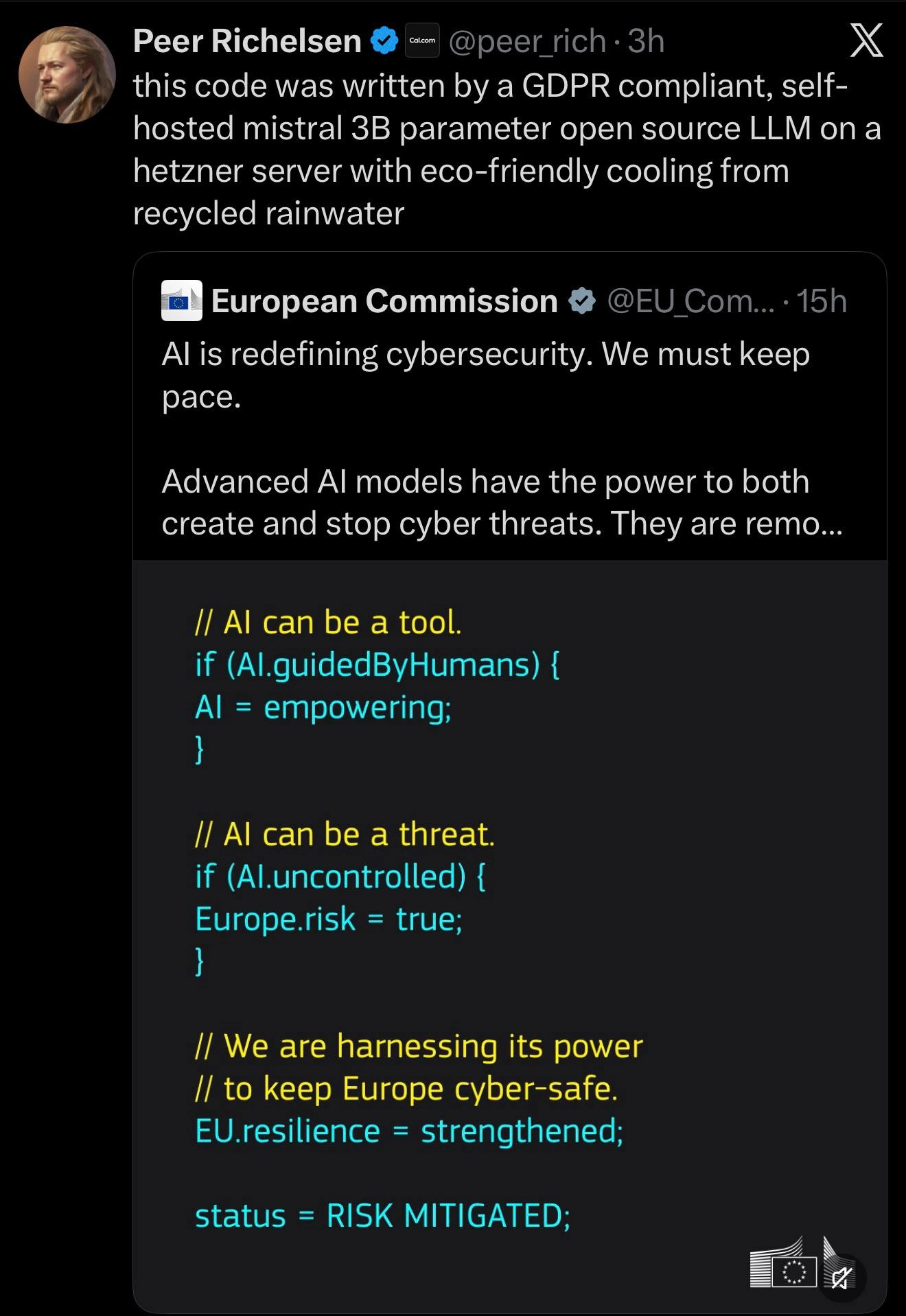
European Cybersecurity, Now Fully GDPR-Compliant Pseudocode
Why is this AI ML meme funny?
Level 1: The Perfect Sticker Collection
Imagine drawing a pretend safety machine, writing “DANGER SOLVED” at the bottom, and then covering it with stickers that say “local,” “green,” “open,” and “follows the rules.” The stickers describe nice goals, but they do not prove the machine works. That is why the reply is funny: it answers official make-believe code with an absurdly perfect list of fashionable virtues.
Level 2: Buzzwords Do Not Compile
Pseudocode looks like programming but is written for people, not a particular compiler. It can explain an algorithm clearly, but only when its conditions and actions have concrete meanings. Here, “guided by humans,” “empowering,” and “resilience strengthened” are slogans disguised as variables. No measurement tells us when those values change.
Cybersecurity risk is the possibility that a threat will exploit a weakness and cause harm. Risk mitigation means reducing likelihood or impact with a specific control, such as limiting permissions, isolating systems, validating model actions, monitoring unusual behavior, or requiring approval for destructive operations. It rarely means risk has vanished. A credible status report would name the threat, control, evidence, owner, and remaining exposure.
For the infrastructure claims, ask practical questions:
- Which data reaches the model, logs, backups, and administrators?
- Which processing purpose and retention period apply?
- Can the model execute tools, and how are permissions restricted?
- How are the model, server, and dependencies updated?
- What tests demonstrate that the cybersecurity control works?
- What happens when the model is wrong or manipulated?
Those questions turn compliance requirements and security principles into engineering work. “Self-hosted” may be part of an answer. “Open source” may be part of an answer. Neither is the whole answer, and recycled rainwater—however commendable—remains a disappointing authorization system.
Level 3: Compliance by Comment
The European Commission graphic presents cybersecurity governance as cheerful pseudocode:
// AI can be a tool.
if (AI.guidedByHumans) {
AI = empowering;
}
// AI can be a threat.
if (AI.uncontrolled) {
Europe.risk = true;
}
// We are harnessing its power
// to keep Europe cyber-safe.
EU.resilience = strengthened;
status = RISK MITIGATED;
Peer Richelsen’s reply answers this policy-shaped code with a policy-shaped infrastructure résumé:
this code was written by a GDPR compliant, self-
hosted mistral 3B parameter open source LLM on a
hetzner server with eco-friendly cooling from
recycled rainwater
Every phrase is chosen to sound maximally European, responsible, sovereign, and sustainable. The joke is not that privacy, open technology, local control, or efficient cooling are bad. It is that stacking desirable labels cannot make empty pseudocode executable—or make a security claim true. The reply performs the same maneuver as the graphic: assign enough virtuous properties, then declare the risk handled.
As code, the graphic is wonderfully unburdened by implementation. AI.guidedByHumans and AI.uncontrolled are unexplained booleans, as though “human involvement” automatically means good control and “uncontrolled” were a state the system could reliably identify from inside itself. AI begins as an object with properties and is then overwritten by empowering, which is not defined. Europe.risk and EU.resilience belong to different objects. Most beautifully, the branch can set risk to true, but nothing ever clears it before the unconditional declaration status = RISK MITIGATED; the space in RISK MITIGATED would also upset an actual parser. The security program’s strongest feature is that it cannot run long enough to be breached.
Real cyber-risk management does not reduce to guidedByHumans. It identifies assets, threat actors, entry points, privileges, dependencies, failure impact, and existing controls. It then tests safeguards, monitors failures, prepares incident response, and records residual risk—the danger left after mitigation. Human oversight can help, but humans can rubber-stamp model output, misunderstand alerts, leak credentials, or approve a dangerous action. “A human was somewhere in the loop” is an org chart, not a security property.
The reply’s GDPR claim is another deliberate category error. GDPR compliance is not an intrinsic certification attached to an LLM or a source file. It depends on a processing operation: what personal data is collected, for which purpose and legal basis, who acts as controller or processor, where data flows, how long it is retained, what security measures apply, and how people exercise their rights. Self-hosting can give an organization more control over those answers, but it does not answer them automatically. A server can be in Europe, powered by angelic rainwater, and still retain personal prompts forever with unrestricted administrator access.
The other labels describe real trade-offs rather than magic switches:
- A 3B-parameter model is relatively small, which may lower compute needs, but parameter count alone does not establish accuracy, safety, or total energy use.
- Open-source or open-weight availability can support inspection and local deployment, but operators still need dependency review, access control, updates, logging, and model-supply-chain security.
- Self-hosting can reduce third-party data exposure while transferring patching, hardening, backup, and incident-response duties to the operator.
- European hosting can support data-location and sovereignty goals, but geography does not replace encryption, authorization, minimization, or contracts.
- Efficient cooling can reduce environmental impact; it does not sanitize a prompt or validate a threat model.
The meme was posted on July 9, 2026, directly after the Commission presented its July 7 Action Plan on Cybersecurity and Artificial Intelligence. The real plan was more substantial than the social graphic: it described model evaluation capacity, secure testing for critical sectors, work with ENISA, implementation of existing cybersecurity law, and investment in European AI capabilities. That context makes the satire sharper, not weaker. A complicated action plan was promoted through code whose final operation effectively reads announce_success().
This is the recurring problem with security theater in technical communication. Executives and institutions need an accessible story, so controls become adjectives: “responsible,” “human-guided,” “resilient,” “compliant.” Engineers need mechanisms: authentication boundaries, evaluation criteria, audit evidence, accountable owners, failure thresholds, and recovery procedures. The graphic speaks in the first language while borrowing the visual authority of the second. The reply exposes the mismatch by supplying an equally impressive chain of attributes that cannot survive a single follow-up question.
Description
A dark-mode X screenshot shows verified Cal.com founder Peer Richelsen (@peer_rich, "3h") commenting, "this code was written by a GDPR compliant, self-hosted mistral 3B parameter open source LLM on a hetzner server with eco-friendly cooling from recycled rainwater." He is quoting a verified European Commission (@EU_Com..., "15h") post that reads, "AI is redefining cybersecurity. We must keep pace. Advanced AI models have the power to both create and stop cyber threats. They are remo..." Above European Commission branding, its attached dark graphic presents cyan-and-yellow pseudocode: "// AI can be a tool. if (AI.guidedByHumans) { AI = empowering; } // AI can be a threat. if (AI.uncontrolled) { Europe.risk = true; } // We are harnessing its power // to keep Europe cyber-safe. EU.resilience = strengthened; status = RISK MITIGATED;" The reply mocks the non-executable, slogan-like code by attributing it to a comically complete checklist of European technology values: GDPR compliance, self-hosting, a small open model, EU hosting, and sustainable cooling. The broader satire targets policy communication that compresses difficult AI-security governance into undefined variables and a final assignment declaring the risk solved.

Comments
1Comment deleted
The code is GDPR-compliant because no personal data survives the parser.