Death Reviews the Feature-Flag Rollout Strategy
Why is this Deployment meme funny?
Level 1: The Skeleton’s Shortcut
Imagine you build a new water slide and suggest letting a few people try it while an emergency stop button is ready. A skeleton whispers that a true master would remove the button and send the whole town down at once—on Friday, just before everyone goes home. It is funny because the praise sounds grand, but the person giving it is the clearest possible hint that this shortcut ends badly.
Level 2: The Safety Switch
Production, or prod, is the live system used by real customers. A deployment copies a new version of software into that environment. A release makes a new feature available. Those events can happen together, but a feature flag lets a team deploy first and release later.
Common rollout patterns include:
- Internal enablement: only employees or test accounts see the feature.
- Targeted enablement: a chosen customer or region receives it.
- Percentage rollout: a stable fraction of users is assigned to the new path.
- Progressive rollout: that fraction grows as monitoring stays healthy.
- Emergency disablement: operators switch the risky behavior off quickly.
The flag should assign the same user consistently; otherwise one refresh might show the old version and the next the new one. Engineers also attach telemetry so they can compare failures and performance between variations. “Nothing is on fire” is not enough if the new checkout quietly halves completed purchases.
The skeleton calls the flag evidence of doubt, but safety engineering assumes even excellent code can meet an unexpected environment. Seatbelts do not insult drivers, and flags do not insult developers. The joke is that removing a cheap layer of control is presented as a royal display of skill, while the literal figure of Death waits to review the resulting production incident.
Level 3: Memento Deploy
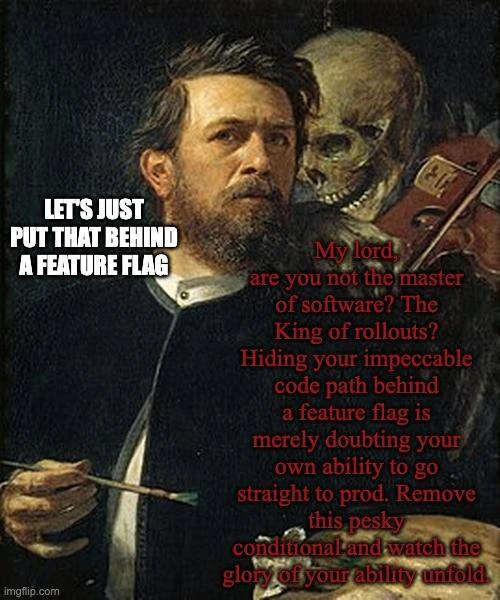
Arnold Böcklin’s 1872 Self-Portrait with Death Playing the Fiddle already places mortality at the artist’s shoulder. The meme gives Death a new instrument: overconfidence bias. The engineer proposes the cautious move—
LET’S JUST PUT THAT BEHIND A FEATURE FLAG
—and the skeleton answers with lavish professional flattery: “master of software,” “King of rollouts,” and an invitation to “go straight to prod.” Death does not argue that the safeguard is technically wrong. It reframes prudence as cowardice until deleting a safety control feels like proof of talent. Every catastrophic rollout deserves a tiny executive coach.
A feature flag is a runtime decision that separates deploying code from exposing behavior. Both old and new implementations may be present in production, while configuration selects which path a request receives:
if flags.enabled("new_checkout", user):
return new_checkout(user)
return stable_checkout(user)
That “pesky conditional” buys options. A team can enable the new path for employees, then one percent of customers, then progressively larger groups while watching error rate, latency, and business metrics. If the new path fails, the flag can act as a kill switch without waiting for a build and redeployment. The value is not distrust of the programmer; it is recognition that production contains traffic patterns, data shapes, dependency failures, and user behavior no pre-release environment reproduces perfectly.
The meme’s central technical joke is therefore about blast radius. Going directly from zero exposure to everyone makes the first real observation also the largest possible experiment. A gradual rollout limits how many users encounter an unknown failure before telemetry detects it. In risk terms, a flag changes the deployment from one irreversible-looking bet into a sequence of decisions:
deploy dark → expose narrowly → observe → expand or disable
The post’s “Especially on Friday” adds the familiar on-call threat. Friday is not cursed by the calendar; it is risky when the people needed to investigate, authorize rollback, repair data, or contact a vendor are about to become unavailable. A mature continuous-delivery system can ship safely any day if changes are small, observable, reversible, and supported. Removing the flag precisely when the response window is weakest replaces risk management with weekend-based load testing.
Feature flags are not magical armor, however. The guarded code is still deployed, so module initialization, database migrations, background jobs, and shared-state changes can escape the conditional. Turning a flag off cannot undo corrupted data or restore a removed schema. The “off” path must remain compatible and tested, the configuration service needs a safe fallback, and metrics must identify which variation each request used. Otherwise the team owns a decorative switch wired to nothing important.
Flags also create conditional complexity. With $n$ independent Boolean flags, the theoretical state space is $2^n$ combinations. Most teams do not test every combination, so abandoned toggles accumulate into configuration debt and obscure which code is actually live. A sound rollout flag therefore needs an owner, an intended default, an expiration or cleanup task, and an explicit success and rollback plan. Once the new behavior is fully established, remove the flag and the obsolete path. A temporary scaffold left forever eventually becomes architecture, usually without the dignity of a design review.
The painting makes that lifecycle lesson unusually sharp. Böcklin holds his brush and listens warily while the skeleton leans close with its single-string fiddle. In the meme, the developer still has the implement of creation, but Death supplies the seductive rollout policy. The red speech is absurdly verbose because dangerous advice often arrives dressed as certainty: your code is impeccable; controls are for lesser engineers. The wary face says the engineer already knows confidence is not a rollback mechanism.
Description
The meme overlays Arnold Böcklin's dark 1872 painting "Self-Portrait with Death Playing the Fiddle," showing the bearded artist gripping a paintbrush while a grinning skeleton leans over his shoulder with a violin. Large white block text on the left says, "LET'S JUST PUT THAT BEHIND A FEATURE FLAG." Red serif text beside the skeleton replies, "My lord, are you not the master of software? The King of rollouts? Hiding your impeccable code path behind a feature flag is merely doubting your own ability to go straight to prod. Remove this pesky conditional and watch the glory of your ability unfold"; a small "imgflip.com" watermark sits at bottom left. The skeleton personifies the seductive overconfidence behind removing a rollout safeguard, especially before a risky production deployment, while the painter's wary expression supplies the engineer's better judgment.
Comments
1Comment deleted
Death approved the rollout plan: zero flags, infinite blast radius.