From OOP trash to FP trash: paradigm switch doesn’t fix bad code
Why is this CodeQuality meme funny?
Level 1: New Wrapping, Same Old Mess
Imagine you have a big box of toys, and the toys are all completely mixed up and messy. Your room is chaos because of it – let’s say it’s a total disaster zone. Now you get a new box and think, “If I move all my toys into this new box, my room will be clean!” You take everything out of the old box and put it into the new box in a slightly different way. But you didn’t throw away any junk toys and you didn’t organize things by type or anything – you just moved the mess from one box to another. After all that effort, your room is still messy, right? You just have a different box sitting there with the same jumbled-up stuff inside. This meme is joking about that kind of situation, but with coding: the person basically put their messy code into a new container (a new coding style), but it’s still a mess. It’s funny in a “oh no, I did all that work for nothing!” kind of way. The core idea is simple: just changing the packaging doesn’t fix what’s inside. Whether the box is red or blue, trash inside it is still trash – and that’s why we chuckle at the meme.
Level 2: Paradigm Primer: OOP vs FP
Let’s break down what’s happening in this joke for a less experienced developer. The meme is about two different programming styles – Object-Oriented Programming (OOP) and Functional Programming (FP) – and how simply switching from one to the other didn’t improve the code. It’s really focusing on CodeQuality and a big refactoring attempt that failed.
OOP (Object-Oriented Programming) is a way of organizing code by creating “objects” – these are like bundles that contain data (attributes or properties) and functions that operate on that data (methods). For example, in OOP you might have a Dog class. A Dog object made from that class could have properties like name or breed (data), and methods like bark() or wagTail() (behavior). OOP is great for modeling real-world things and their interactions. However, if an OOP codebase isn’t designed carefully, it can turn into what's jokingly called spaghetti code – a tangled mess where everything is so interconnected that it's as hard to follow as a bowl of spaghetti. In the meme, when the author says their OOP code was “inherently trash,” they mean the code was poorly written or structured to begin with (full of bugs or hard to maintain). It’s self-deprecating humor – they admit the code stinks. Common issues in bad OOP code include things like classes doing too many things, or deeply nested inheritance hierarchies, or global state being modified all over the place. All that can make OOP code confusing and "trash" if not managed well.
FP (Functional Programming) is another style, almost a different mindset. In FP, the focus is on functions. You write functions that take input and produce output, and you try to avoid side effects – meaning your functions shouldn’t secretly change some outside variable or object; they should just return a new value. FP also emphasizes immutability, which means once a piece of data is created, you don’t change it, you create a new updated version instead. For a quick example, imagine you have a list of numbers and you want to add 1 to each number. In an OOP style, you might loop through and update each number in the list. In an FP style, you’d create a new list with each number +1, and the original list stays unchanged. Many modern languages let you use both paradigms, but purely functional languages (like Haskell or Erlang) enforce these rules strictly. The idea is that by avoiding hidden changes to data (no sneaky side effects), the code is easier to reason about and test. A function in FP, if it’s pure, will always give the same output for the same input and won’t mess with anything else – which sounds great for reliability.
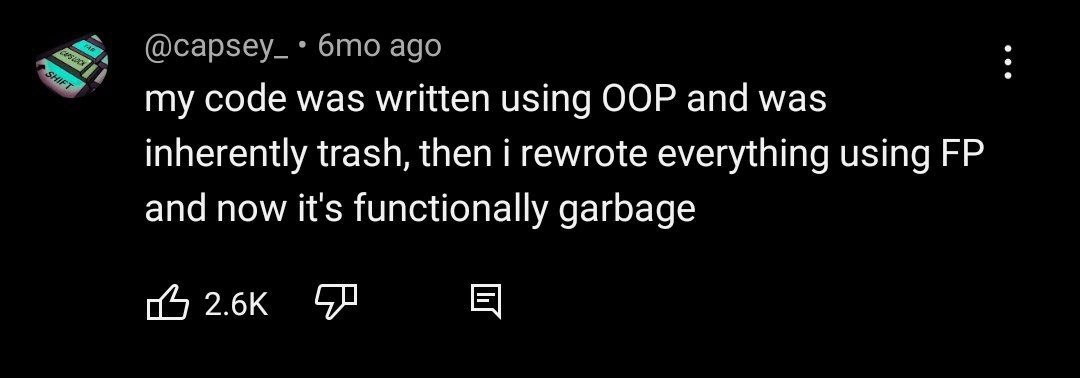
Now, given those definitions, what happened in the meme? The person had code written in OOP style that was trash (low quality, messy). They then rewrote everything using FP style. “Rewrote everything” is a huge refactoring – basically throwing out the old design and coding it again in a new way. That’s an extreme step, something developers sometimes do when they feel a system is beyond saving or when they're convinced a new approach will fix all the issues. This is the meme’s setup: paradigm switch as a grand solution. OOP and FP are often subjects of debate (oop_vs_fp is a common discussion topic among devs, sometimes almost a little LanguageWar where fans of each argue which is better). The expectation (or hope) here was that by adopting FP principles, the code would become cleaner, more manageable, maybe less buggy. After all, FP is often advertised as leading to fewer bugs because of pure functions, easier testing, etc.
But here comes the punchline: after the big rewrite, the code is “functionally garbage.” This phrase is doing double duty:
- “Functionally” implies Functional Programming style – i.e. the code is now written using FP techniques (lots of functions, probably immutable data, etc.).
- In plain English, saying something is “functionally garbage” means it basically turned out garbage, just in a fancy way of speaking (like saying "It's essentially garbage").
So the coder is joking that now the code is garbage in the functional sense and garbage in the quality sense. They switched paradigms and in the end, nothing improved – the code is just as bad as before, just in a different style. It’s a bit like saying, “I had a junky car, I replaced the engine with a new fancy one, and wow... it’s still a junky car, just with a different kind of engine.”
For a junior developer, the key lesson (wrapped in humor) is: bad code is bad code, no matter the paradigm. You can write terrible programs using OOP – for instance, maybe you put way too much logic into one object or you have objects that tightly depend on each other in convoluted ways. You can also write terrible programs using FP – perhaps you make functions so abstract or use so many indirections that no one else can understand the flow, or you still handle state but in a roundabout way that’s even harder to follow. The meme comes from a place of refactoring pain: the author likely spent a lot of time doing this huge rewrite (which is a very risky kind of refactor) hoping to fix things, and ended up with the same problems. It’s a common rookie expectation to think “maybe if I just switch to [new framework or new paradigm], all these problems will go away.” Experienced devs know that’s rarely true without addressing deeper design issues.
A bit about the context: Refactoring is usually a good practice – it means improving the internal structure of code without changing what it does. We do small refactorings all the time (rename a variable for clarity, split a long function into two, etc.) to keep code clean. But a complete rewrite (“throw away the old code, start from scratch in a new style or language”) is often dangerous. There’s even a famous warning in software lore: “Never rewrite your code from scratch,” mainly because you might introduce new bugs and you lose the lessons learned from the old system. In this meme, the person did a full rewrite. They likely encountered the classic problem: they carried over the bad practices or the messy logic from the old code into the new code. If you don't truly understand why the code was bad, you risk rebuilding the same issues. For example, if the original OOP code had a bad data model or unclear requirements, rewriting it in FP without addressing those will just recreate the same confusion in a different form.
We should also decode a bit of the playful language: "inherently trash" and "functionally garbage" are humorous phrases. By calling their own code trash/garbage, the developer is being self-deprecating – joking at their own expense. This is pretty common in DeveloperHumor: we often cope with frustration by making fun of our own failures. The contrast of OOP vs FP in those phrases (“trash” vs “garbage”) is just a stylistic way to mirror the two paradigms (trash and garbage mean the same thing; it’s like saying X was bad and now Y is equally bad in a similar way). Also, note the engagement icons shown (2.6K likes, etc.) in the image: that means thousands of other developers saw this comment and appreciated it – likely because they related to it. It struck a chord about RefactoringPain and the folly of expecting a paradigm shift to be a cure-all for code quality issues.
In summary, the meme’s message in plain terms is: “I had a really bad program using objects. I redid everything using functions, but guess what – it’s still a really bad program.” The humor comes from the irony that after doing all that work (which was supposed to make things better), nothing fundamentally changed. It’s a light-hearted warning: changing your tools or approach on a superficial level won’t automatically fix deeper problems. You still have to write clean, thoughtful code; there’s no shortcut where a different paradigm will do that job for you.
Level 3: Trash by Any Paradigm
Experienced developers will recognize the scenario immediately: a team inherits a messy codebase (technical debt up to their eyeballs) and someone suggests, "Let's rewrite everything in [hot new paradigm] – that'll solve it!" This meme delivers the punchline to that hopeful plan. The original code was “inherently trash” under OOP, and after an exhaustive rewrite in FP, it's still “functionally garbage.” The phrase itself is a double entendre: functionally meaning “in a functional-programming way” but also “basically/essentially.” In other words, the code is now written with pure functions and immutable data structures… and it’s still essentially junk. CodeQuality didn't magically improve just because we changed the programming style. This is a bitterly funny reality many senior engineers know: you can switch the paradigm, but if you don't address the underlying design problems, you’re just moving trash into a new container.
Why is this so humorous (and painful)? It pokes at the myth of the "silver bullet" in software development – the false belief that adopting a new language or paradigm will instantly slay the monsters of bad architecture and bugs. Seasoned devs have all seen enthusiastic refactoring crusades where a codebase is rewritten from scratch, say from Java (classic OOP) to Clojure or Haskell (pure FP), under the rallying cry of “FP will make it better!” Spoiler: it often doesn’t. You end up with the same spaghetti, just reimagined as functional ramen noodles. The RefactoringPain here is real: months of effort to introduce a shiny new paradigm, only to realize the system’s design problems run deeper than syntax. It's like applying a new coat of paint to a house with a shaky foundation – looks different on the surface, but the house still might crumble.
Veteran engineers might chuckle (or cringe) at this because it echoes the hard-earned truth: bad code is paradigm-agnostic. There’s an old joke in programming circles:
“You can write FORTRAN in any language.”
In essence, a programmer with bad habits can produce Fortran-style (read: ugly and outdated) code in Java, Python, Haskell – you name it. They’ll churn out a Java program devoid of proper classes (just a main() with 5000 lines), or write Haskell with nothing but one giant do block of sloppy I/O. The meme’s author self-deprecatingly admits that rewriting the codebase didn’t rid it of its problems. This is self_deprecating_code_quality humor at its finest – the developer is essentially saying, “I thought switching paradigms would magically turn my garbage code into gold, but now I just have functional-style garbage instead of object-style trash.” We recognize the oop_vs_fp culture clash here: OOP aficionados vs FP purists often debate which paradigm leads to better code. The punchline cuts through the smugness on both sides by showing that either paradigm can produce a steaming pile if used poorly. The real issue was never the paradigm – it was how the code was written. Without better structure, clearer logic, and maybe some actual unit tests and documentation, the end result is the same pile of bugs and confusion, just written in a different accent.
Let’s talk real-world examples. Imagine a sprawling OOP codebase full of God classes (objects that do far too much), cyclic dependencies, and side effects galore. Fed up with hunting bugs in that tangle, the team decides to embrace FP for its promise of pure functions and easy reasoning. They rewrite every class as a set of functions. But if they simply translated each method into a function without rethinking the architecture, they'll end up with a tangle of global state being passed around or, worse, hidden inside closures. For instance, an OOP version might have a UserManager class with confusing state; the new FP version might eliminate the class but still have a bunch of functions like loadUserData(userId, config, cache, connection) – a long parameter list that hints all the same hidden dependencies are still in play. The code might be split into many small functions (good in principle) but now you have to trace through a dozen function calls to follow one logical operation (bad in practice if done recklessly). The result? Spaghetti code can be written in any paradigm. In OOP, it's a web of interacting objects; in FP, it's an impenetrable maze of function compositions and data transformations with no comments. You can even create spaghetti in Haskell – it just might type-check and compile without errors, but it’s still indecipherable for the poor soul who maintains it.
Another pain point is the over-engineering that often accompanies a full rewrite. There's a known phenomenon called second-system syndrome: when developers design a second version of a system, they tend to over-complicate it, adding all the ideas and "improvements" they couldn't in the first iteration. So our optimistic coder not only switched to FP, but perhaps also introduced complex abstractions (maybe a monad for every little thing, or an overly abstracted pipeline). The new code might be theoretically pure, but practically impossible to understand. Sure, there are no mutable variables and every function is pure, but now you have 50 tiny functions and 20 different data types where one straightforward loop used to be. Maintenance didn't get easier – it might have gotten harder. The LanguageWars aspect of this meme also touches on pride: devotees of FP often claim their style produces more reliable, cleaner code than OOP. Meanwhile, OOP veterans might smugly watch an overzealous FP rewrite crash and burn, thinking "told you so." In reality, any paradigm switch comes with a learning curve and new failure modes. The meme humorously confirms that paradigm alone doesn’t guarantee improvement; you can write clean or crappy code in any style.
And of course, there's the human element. We can imagine the developer’s journey: nights spent converting methods into pure functions, refactoring class hierarchies into higher-order functions, proudly deleting all those .class files or class keywords. They probably hyped themselves up that this massive refactoring would solve their CodeQuality woes. Then came the harsh dawn: the new FP code ran, but it was still buggy, or slow, or impossible to extend – in short, functionally garbage. The admission in the meme rings true to anyone who’s been through a failed refactor. It’s both funny and a little tragic because we feel that pain. But hey, at least they can laugh about it now with a good pun.
In summary, the senior perspective here is: garbage code transcends paradigms. It’s a tongue-in-cheek reminder that you can’t simply rewrite your way out of trouble without improving your approach. Whether you pack your logic into objects or spread it across functions, you need sound design, clear logic, and maybe a bit of humility to actually clean up a mess. Simply changing the programming style is as effective as renaming a variable to cure a bug – that is to say, not very effective at all. Or to put it in code:
# No matter the style, bad logic is bad logic
def bad_code(style):
return "still bad"
print(bad_code("OOP"), "code") # Output: still bad code
print(bad_code("FP"), "code") # Output: still bad code
The meme gets a knowing laugh from seasoned developers because we've seen this movie before: new paradigm, same old problems. It’s a bit of schadenfreude mixed with self-recognition – after all, who among us hasn’t thought a shiny new tech would solve all our problems? And who hasn’t been proven thoroughly wrong at least once? 😅
Level 4: Lambda Calculus Can't Save Us
At the most theoretical level, switching from Object-Oriented Programming (OOP) to Functional Programming (FP) is like swapping one Turing-complete model for another. Both paradigms are equally capable in terms of what can be computed – thanks to Church-Turing equivalence, a fancy way of saying any computation you can do with objects and classes, you can also do with pure functions (and vice versa). Lambda calculus, the mathematical foundation of FP, is powerful and elegant, but it's not magical fairy dust that automatically fixes code quality. OOP was originally inspired by modeling real-world entities (thanks to people like Alan Kay, who coined the term object-oriented), while FP comes from the world of math (Alonzo Church's lambda calculus, treating computation as applying and composing functions). These are two different schools of thought in computer science theory – one focusing on state and behavior encapsulated in objects, the other on stateless transformations and immutable data.
However, no theoretical purity can rescue a fundamentally broken program. In theory, FP offers benefits like referential transparency (you can reason about code like algebra, since f(x) always gives the same output for the same input) and powerful abstraction tools from math (ever hear of monoids, functors, or monads? 🌀). But even the coolest monad in Haskell won't turn spaghetti logic into lasagna. You can layer on all the fancy category theory terminology you want – if the underlying logic is nonsensical or the code design is a big ball of mud, it remains exactly that. In an academic paper, we prove properties of pure functions; in real life, a sloppy coder can simulate an imperative, state-riddled mess inside those pure functions anyway. There’s even unsafePerformIO in Haskell to sneak in side effects – a loophole that a desperate or inexperienced FP convert might abuse, instantly trashing all those theoretical guarantees. In other words, the mathematical foundations of FP can enforce discipline, but they can't force insight. Fundamental constraints of computation (like an algorithm's complexity or a problem's inherent difficulty) remain unchanged by a paradigm shift. A poorly chosen algorithm with $O(n^2)$ complexity will still be $O(n^2)$ after a rewrite – only now it might be wrapped in a bunch of recursive lambda functions instead of loops and objects. The meme’s quip about code being “functionally garbage” wittily highlights that bad code transcends paradigm: from a theoretical standpoint, you haven’t changed the computability or complexity by going FP, you’ve just proven that you can create a dumpster fire in any formal system you choose. Essentially, the math checks out: garbage in, garbage out, regardless of paradigm.
Description
Image is a dark-theme social media comment screenshot. In the top left is a small neon keyboard avatar, followed by the handle “@capsey_” and the timestamp “6mo ago.” The white text on black background reads: “my code was written using OOP and was inherently trash, then i rewrote everything using FP and now it's functionally garbage.” Below the comment are three minimalist icons - a thumbs-up with “2.6K,” a speech-bubble outline, and a share arrow - indicating typical engagement controls. The meme humorously admits that a full rewrite from object-oriented programming (OOP) to functional programming (FP) did not improve code quality, poking fun at refactoring optimism and the belief that changing paradigms alone solves technical debt
Comments
9Comment deleted
Turns out garbage is a monoid: closed under paradigm shift, identity element “// TODO,” and still associates whether you .extends or >>=
After 20 years in the industry, I've learned that the real paradigm shift isn't from OOP to FP - it's from believing a rewrite will fix your architectural decisions to accepting that your tech debt just speaks a different dialect now
Ah yes, the classic developer journey: blame OOP for your spaghetti code, spend weeks rewriting everything in pure FP with monads and immutability, only to discover that your fundamental design decisions were the problem all along. Turns out 'functionally garbage' is still garbage, just with better composition and no side effects. The real lesson? No paradigm can save you from poorly thought-out abstractions - though at least now your garbage is referentially transparent
OOP was mutable trash; FP made it pure garbage - consistently wrong, no side effects required
Switching from OOP to FP without fixing boundaries just yields referentially transparent trash - pure garbage, no side effects, including the feature
We migrated the OO big ball of mud to FP; now the bugs are pure, total, and referentially transparent - consistently wrong, which management appreciates as “predictable.”
It's that you may have to implement custom allocator and garbage collector for this to perform less trashy. 🤓 Comment deleted
Then the garbage collector with collect itself 😭 Comment deleted
Rewrite it in Forth and it will have a stack of problems. Rewrite it in Prolog and it will just not cut it. Comment deleted