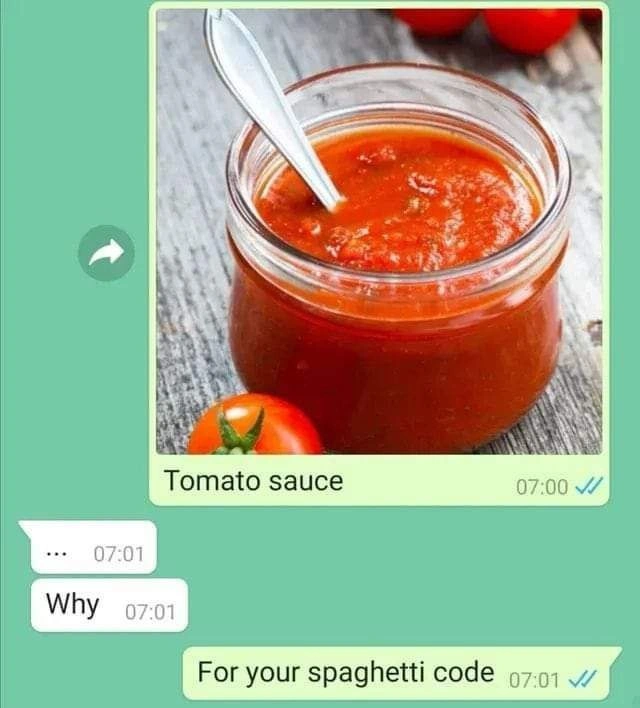
Sending tomato sauce to patch up your teammate’s spaghetti code
Why is this CodeQuality meme funny?
Level 1: Just Add Sauce
Imagine a big bowl of spaghetti noodles all jumbled up into a knot. It’s a huge mess on the plate. Now, what do people usually put on spaghetti? Tomato sauce! But will pouring tomato sauce on a tangled ball of noodles untangle them? Not at all. It might make them taste better, but they’ll still be a tangled mess. This meme is joking in the same way: one friend basically tells another, “Your programming work is as messy as a bowl of spaghetti, so I’m giving you tomato sauce to fix it.” Of course, adding sauce doesn’t really fix anything, but it’s a silly way to point out the problem. It’s like if your room is super messy and instead of helping you clean, your friend just hands you a fancy air freshener and says, “There, that should do it!” It doesn’t clean up the mess, but it sure makes you laugh.
We find it funny because it mixes up a coding problem with a cooking solution – two things that don’t really go together. It’s an absurd idea, and that silliness is the whole point. Instead of getting upset that the code (or room, or noodles) is so messy, the friends share a joke about it. The person receiving the “tomato sauce” joke probably realizes, “Okay, my code is pretty messy,” but they also get a laugh and a reminder that it’s time to tidy up. In the end, it’s a lighthearted way to say “you’ve got a mess here” – and sometimes a good laugh makes dealing with a mess a little easier.
Level 2: Untangling Spaghetti Code
So what exactly is spaghetti code? In software, this term describes code that’s all tangled up and hard to follow, just like a pile of spaghetti noodles on a plate. Instead of being organized into clear modules or functions, everything is interwoven in a confusing way. For example, imagine a single function that runs hundreds of lines long, weaving in and out of different conditions and loops with no clear structure. Reading it is frustrating – you keep losing track of which “noodle” (logic path) you’re following. This is bad code quality because it’s tough for anyone (including the original author) to maintain or update such code without breaking something. We call spaghetti code a code smell – not that it literally smells bad, but it’s a programmer’s way of saying “something’s off here.” It hints at deeper problems in the program’s design and screams that the code might need a cleanup or redesign.
Now, why would someone send a jar of tomato sauce to a programmer? This is where the joke comes in. Spaghetti code got its name from spaghetti, the food, which we often eat with tomato sauce. In the meme image, one friend sends a photo of tomato sauce in a chat because, well, tomato sauce goes on spaghetti. The next friend is perplexed and first replies with just “...” (an awkward pause, as if they’re speechless), then actually asks “Why?”. The first friend delivers the punchline: “For your spaghetti code.” Essentially, they’re teasing their teammate: “Your code is spaghetti (a messy tangle), so here’s some sauce for it!” It’s a playful way of saying “dude, your code is a mess” without directly insulting them. This kind of gentle ribbing is typical coding humor. It’s a pun (a play on words) because it takes the term “spaghetti code” and treats it like real spaghetti that just needs a topping.
Of course, in reality you can’t fix bad code by literally dumping tomato sauce on it (if only it were that easy!). What that messy code needs is refactoring – that means going into the tangled program and reorganizing or rewriting parts of it so that it becomes clean and structured. Importantly, refactoring doesn’t change what the code does (its behavior or output); it only changes how the code is written to make it easier to read and work with. It’s like taking a chaotic, cluttered room and tidying it up: you don’t toss out the stuff you need, but you put it in order so you can actually find things and move around. When code has lots of technical debt (for instance, when quick-and-dirty fixes have piled up over time), refactoring is how developers “pay off” that debt. But refactoring takes time and discipline, and teams under pressure sometimes skip it. That’s why developers joke that a particularly gnarly piece of legacy code might be beyond rescue – cue the dark humor of just pouring “sauce” on it and calling it a day.
If you’re a new developer, encountering spaghetti code for the first time can be bewildering. You might have even written some spaghetti code yourself without realizing it. Maybe you started a small project and kept adding features to the same file or function as you went along. After a while, it became this big, bouncy tangle of logic that even you struggle to understand. When a colleague or mentor sees it, they might chuckle and say, “I think this code could use some tomato sauce,” implying it’s as messy as a spaghetti dinner. It’s a lighthearted hint that you’ve got a maintainability problem. The meme exaggerates that hint by literally showing a jar of sauce being offered as the fix. It’s funny precisely because it’s absurd – every programmer knows tomato sauce won’t actually help fix code, but it acknowledges the issue in a jokey way. In a team, little jokes like this can break the tension; they remind us that yes, the code is a mess, but we’re all humans and we can share a laugh as we sort it out (preferably by refactoring, not by grocery shopping for pasta sauce).
Level 3: Marinara-Driven Development
Picture this: you’re staring at a codebase so tangled and unstructured that navigating it feels like following one noodle in a full spaghetti bowl. This meme hits home for any senior developer who’s battled spaghetti code – code that’s twisted into an incoherent mess of loops, conditions, and occasional goto statements that make the program flow resemble a plate of pasta. The image is a WhatsApp-style chat screenshot where one dev friend sends a jar of tomato sauce to another at 07:00, cheekily captioning it “Tomato sauce.” The confused teammate initially just replies with “...” (the textual equivalent of a blank stare) at 07:01, then asks “Why?” A moment later, the punchline arrives in another green bubble: “For your spaghetti code.”
In real development life, spaghetti code is a classic code smell signifying poor code quality and loads of technical debt. If you’ve ever dived into a legacy function that’s hundreds of lines long, with variables leaping in and out of scope and logic twisting back on itself, you’ve experienced this nightmare. It’s the kind of code where adding one more if feels like throwing another meatball onto an overflowing plate – you know it’s just going to roll off somewhere unpredictable. Seasoned devs often joke that the only way to improve such a mess is to “pour marinara all over it” (i.e. slap on some superficial fix), because doing a proper rewrite is daunting (or the deadline was yesterday). Instead of a real solution like refactoring the code (restructuring it to be clean and modular), someone sarcastically offers tomato sauce as a patch. It’s a tongue-in-cheek way to say, “Your code is such a tangled mess that we might as well treat it like actual spaghetti and serve it for dinner.”
There’s a dark truth hidden in the joke. In projects with rushed timelines or lax code reviews, developers sometimes do apply the equivalent of “tomato sauce” to spaghetti code. They pile on quick fixes and workarounds to mask underlying problems – essentially covering up the bad taste without addressing the rotten core. Each band-aid commit might silence a bug or placate a client for now, but it adds to the technical debt. Interest on that debt accrues in the form of future headaches: new bugs pop up unexpectedly (because the code’s flow is indecipherable), and onboarding a new team member means subjecting them to a rite of passage through cryptic, intertwined logic. Every experienced engineer has seen a junior’s face fall when they open a source file and realize it’s one giant bowl of spaghetti logic. In that moment, a bit of silly pun-based humor like this meme becomes a coping mechanism for the team’s shared pain.
Historically, the term “spaghetti code” dates back decades. In the early days of programming, before high-level structures were common, code with lots of unrestrained jumps (goto galore) would zigzag wildly through execution – much like a fork chasing noodles around a plate. Computing pioneer Edsger Dijkstra famously cautioned against such chaos in his 1968 letter “Go To Statement Considered Harmful.” The industry embraced structured programming to avoid marinara-flavored nightmares. Yet here we are in the 2020s, still encountering fresh bowls of spaghetti logic (now often garnished with global state and overly complex class hierarchies). The developer humor in this meme is both ironic and universal: whether you wrote spaghetti BASIC on an Apple II or you’re wrangling a JavaScript microservice today, you know messy code when you see it, and you know tomato sauce isn’t going to save it – but joking about it makes the bitter code review a bit easier to swallow. After all, laughing at the absurdity beats crying into your keyboard at 3 AM when that spaghetti code breaks (again).
Description
Image shows a mobile chat UI resembling WhatsApp with green message bubbles. The first bubble (time-stamp 07:00) contains a photo of a glass jar filled with bright red tomato sauce, a spoon sticking out, and a fresh tomato beside it. Beneath the photo, the sender captions, “Tomato sauce”. The next reply bubble (white background, 07:01) contains the text “…” followed by another bubble “Why”. A final green bubble (07:01) answers, “For your spaghetti code.” The joke plays on the programming term “spaghetti code” (tangled, hard-to-maintain logic), implying tomato sauce as a humorous fix, highlighting issues of code quality, technical debt, and the need for refactoring
Comments
8Comment deleted
I just refactored our spaghetti code by pouring tomato sauce on it - now the CTO’s calling it a “layered lasagna architecture” for the Gartner slide
After 20 years in the industry, I've learned that the only thing more inevitable than spaghetti code is the junior dev who confidently claims they can refactor it all in a weekend, right before creating an even more complex lasagna architecture with 17 layers of abstraction
When your codebase has more dependencies than a bowl of pasta has noodles, and the only documentation is a recipe card that says 'add sauce liberally.' At least with actual spaghetti, you can untangle it with a fork - try doing that with a 10,000-line God class that's been 'temporarily' patched for the last five years
Pro tip: apply liberally to GOTO spaghetti before the code review - hides tangles better than any linter
When the dependency graph looks like linguine, try condiment‑oriented programming - sauce injection; it won’t decouple the O(n^2) calls, but it makes the postmortem palatable
We “fixed” the spaghetti code with a service mesh - now it’s lasagna code: same dependency knots, more layers, and every forkful is a network hop
commit -m "mamma mia" Comment deleted
mama cita Comment deleted