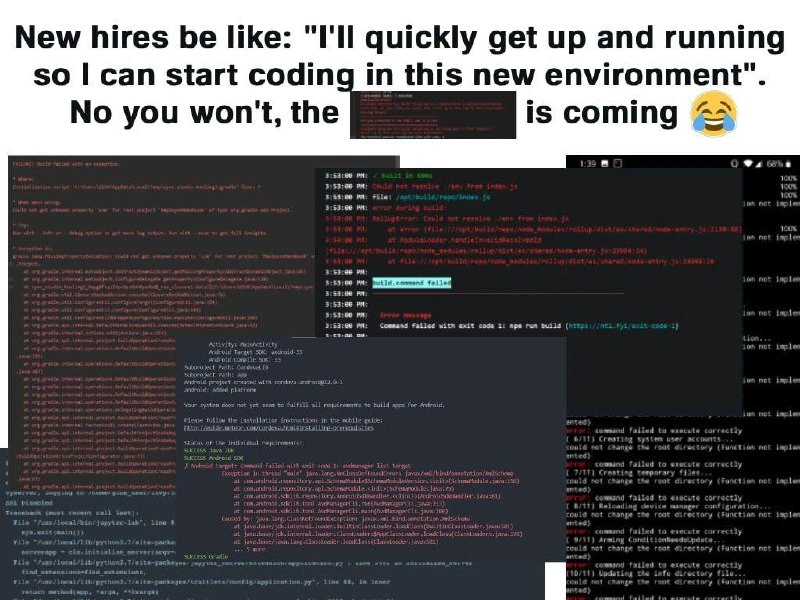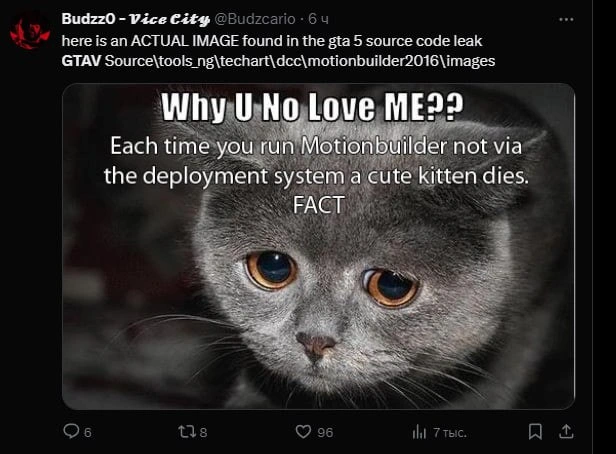
Leaked GTA-V dev meme begs: “Why U No Love ME??” about broken deploys
Why is this BuildSystems CICD meme funny?
Level 1: Think of the Kittens
Imagine you and your friends are working on a giant LEGO castle together. There’s a set of instructions everyone agreed to follow so that all the pieces fit together correctly. Now, picture one friend who decides, “I don’t need the instructions, I’ll just add my pieces however I want.” What happens? The next time someone else tries to add their part, they find the castle is built wrong and pieces are in the wrong place. The whole group gets frustrated because now they have to undo and fix that rogue section.
This meme is basically telling that story, but in a funny and exaggerated way. In the world of making a video game (or any big project), there are rules and systems to put everything together – kind of like those LEGO instructions. If someone ignores the rules, it can mess up the whole build for everyone. Instead of just saying “Don’t do that,” the team made a joke: they put a picture of a sad kitten with big eyes as if it’s about to cry, and the kitten is asking, “Why don’t you love me?” In this pretend scenario, the kitten represents the project’s build system or the rules that everyone is supposed to follow.
The text jokes that “Every time you don’t follow the process, a cute kitten dies. Fact.” Of course, that’s not literally true – it’s a playful exaggeration. The idea is similar to a teacher playfully saying, “Every time you cheat on a test, a fairy loses its wings,” to discourage cheating by making you feel a tiny bit guilty (and to laugh a little). Here, “think of the kittens” means think of how sad it is when you break the rules – you’re making the kitten (and by extension, your teammates) very sad.
So in very simple terms: The meme is a funny way of scolding team members for not following the agreed-upon process. Instead of saying “You’re causing problems when you do that,” it says “You’re hurting this adorable kitten’s feelings (and life) when you do that.” It’s using a cute animal to get people’s attention and gently shame them into behaving. Even if you’re not technical, you know that in any group activity, if someone doesn’t play by the rules, it causes trouble. Here the “trouble” is symbolized as a poor kitten meeting a tragic fate. It’s silly, meant as a joke! Everyone knows the kitten isn’t really getting hurt – it’s just a dramatic, humorous reminder.
At its heart, the meme is funny because it mixes something very serious (don’t mess up the project for everyone) with something very silly (kittens and over-the-top statements). It’s like telling a kid, “If you don’t do your homework, Santa won’t bring you presents.” You don’t literally mean Santa will skip your house; you just want them to do the right thing and you’re using a creative way to say it. In the same way, this development team is saying, “Please use the proper method to do your work; if you don’t, things break and we’re all sad (cue the kitten picture).”
So, the takeaway for anyone: follow the shared rules and processes when working together on a big project – it keeps everything running smoothly and keeps all the “kittens” (your teammates, your project’s health) happy. And if you forget, well, expect a cute kitten meme to pop up and remind you with a laugh.
Level 2: Follow the Pipeline, Save a Kitten
If you’re a newer developer or not familiar with these terms, let’s break down what’s going on in this meme. Essentially, it’s about the importance of using the team’s official build and deployment pipeline. A build pipeline (often part of what we call CI/CD, which stands for Continuous Integration/Continuous Deployment) is a series of automated steps that take code or content from raw form to a finished product (or a ready-to-run state). For example, in a typical software project, when you submit your code, the CI server automatically compiles the code (build), runs tests (integration checks), and then might deploy it to a staging or production environment (deployment) if everything passes. It’s like a factory assembly line for software: each station (step) does one job – compile, test, package, deploy – in order.
Now, in this meme’s context, MotionBuilder 2016 is a tool used by animators/technical artists on the GTA V team. It’s likely used to create or edit animations for the game (like character movements, cutscenes, etc.). They probably have a special way to use MotionBuilder in the pipeline. Perhaps there’s a script or launcher (the “deployment system” for that tool) that you’re supposed to run whenever you want to export animations into the game. This ensures that everything MotionBuilder produces gets saved in the right place and maybe triggers other steps (like converting the animation into game format, bundling it into the game’s assets, and so on).
When the meme says, “Each time you run MotionBuilder not via the deployment system…”, it means someone is opening MotionBuilder directly, instead of using the team’s prescribed method. Essentially, that person is going rogue – doing things manually when there’s an automated process intended. Why does that matter? Because skipping the official process can break the deployment. “Breaking the deploy” or “breaking the build” means that the automated pipeline can’t complete its steps successfully. Maybe the pipeline expects to find a new animation file (because you worked on an animation) in a certain folder or expects some flag that the MotionBuilder exporter usually sets – and if you didn’t run the official process, those things aren’t there. The next person who runs the pipeline or the next scheduled build will hit an error. It’s like if everyone is cooking a group meal by following a shared recipe, and one person decides to throw in an extra ingredient without telling anyone – suddenly the dish doesn’t taste right, and nobody knows why.
For a junior developer, imagine this common scenario: you commit some code and it runs fine on your machine. But when you push it to the repository, the CI server (like Jenkins, CircleCI, etc.) runs the tests and boom – something fails. You scratch your head, “But it works on my machine!” Welcome to the world of environment differences and automation. That’s why teams emphasize: always use the common build process, because it’s set up to be the same everywhere. If you bypass it, you might have something working locally in a unique way, but it blows up for everyone else. In our case, a developer running MotionBuilder by themselves might think, “Well, it worked for me, I got the animation exported.” But the deployment system wasn’t involved, so maybe no one else knows about this new animation, or it didn’t get properly registered. As a result, the BuildSystem could fail when packaging the game, or worse, the game might build but that animation won’t be there for others – leading to a bug down the line.
Now, why the kitten and the dramatic “Why U No Love ME??” text? This is a bit of developer humor. The phrase “Why you no love me?” is a playful, grammatically incorrect plea – it’s actually referencing a classic meme character (the “Y U NO” guy) who would say things like “Y U NO follow instructions?!”. Here, the deployment system or build pipeline is speaking as if it’s a person with feelings. It’s saying “Why don’t you love me?” to the developers who aren’t using it properly. The idea is that the deployment system feels left out or “unloved” when devs ignore it. By personifying the tool, it makes the message more lively than a boring “Please use the deployment script.”
And the kitten? It’s all about eliciting an emotional response (and a chuckle). The text essentially jokes: “Each time you do this wrong, a cute kitten dies. Fact.” Of course, no real kitten is harmed – it’s a hyperbole, an exaggeration. It’s like telling someone “every time you tell a lie, a fairy loses its wings” or some exaggerated cause-effect to make them think twice. The meme creators chose a cute grey kitten with big sad eyes because, let’s face it, developers are humans and humans are suckers for cute animals. It’s a lighthearted guilt-trip. They’re saying: we really, really want you to stop breaking the build, so here’s a sad kitten to make you feel bad (in a fun way). It leverages that old internet joke format “Every time you , God kills a kitten.” That exact phrase actually was a popular saying on forums many years ago aimed at various bad behaviors. The Rockstar dev team just adapted it to **“Each time you run MotionBuilder not via the deployment system, a cute kitten dies”*. By adding “FACT” at the end in big letters, they double-down on the sarcasm – as if this is a proven scientific fact (it’s not, it’s a joke, which is the humor).
From a new dev’s perspective, this meme is basically an unofficial warning poster. In a playful way, it’s teaching an important lesson: follow the team’s procedures. DevOps (the collaboration between development and operations) and SRE folks set up these automated pipelines for good reasons – consistency, reliability, and not having to manually troubleshoot every environment. When someone ignores those and does their own thing, it often causes extra work and headaches for everyone. The sad kitten is the collective “aww man” of the team when that happens. And because technical people often communicate through jokes and memes, this is an in-group way of saying “Seriously, please don’t do that.”
Also, a bit about that gta5_source_code_leak part: At some point, internal files from GTA V got leaked to the public. People combing through those files found this image in the path ...tools_ng/techart/dcc/motionbuilder2016/images. That implies it was part of the tooling (maybe an image that a tool could display). It was never meant for players to see, only the dev team. The fact that it’s a meme image in a game’s development folder is funny in itself – it shows developers have a sense of humor behind the scenes. As a junior dev, it might surprise you that even at big companies, engineers joke around like this. But they do! It’s actually pretty common to find comments in code or internal wiki pages with memes, jokes, or quirky warnings. It makes the tough job of maintaining complex systems a little more fun.
So, summarized plainly: the team had a problem with folks not using the build automation for MotionBuilder, causing deployment failures. Instead of just yelling at them in an email, someone put an image of a pleading kitten saying “Why don’t you love me?” – representing the poor neglected deployment system – and warning that each offense “kills” a kitten (i.e., makes the team sad or the build cry). It’s a humorous way to say: “Hey, this is important. Please do things the right way, for the sake of all of us (and think of the kittens!).”
Level 3: Broken Builds & Broken Hearts
This meme hits home for every senior engineer or DevOps/SRE veteran who’s ever been awake at 3 AM because someone “just quickly” did something that broke the build. It’s a snapshot of the eternal love-hate triangle between developers, the build system, and the poor folks who maintain that system. The text “Why U No Love ME??” is the pipeline’s plaintive wail – a dramatic, almost comical plea, as if the deployment system itself is feeling betrayed that developers keep bypassing it. The humor here comes from that personification: the deployment pipeline is depicted as an emo kitten begging for affection and adherence to process. Why a kitten? Because nothing says guilt-trip like a pair of sad, glowing kitty eyes staring into your soul. 🐱
Breaking the deployment pipeline is a cardinal sin in continuous integration culture. When the tweet says this image was found at GTAV Source\tools_ng\techart\dcc\motionbuilder2016\images, it reveals that even Rockstar’s GTA V development team had to deal with internal BuildPipeline drama. The exact line in the meme (as revealed by the leak) reads something along the lines of:
"Each time you run MotionBuilder not via the deployment system a cute kitten dies. FACT"
That punchline “FACT” at the end is intentionally over-the-top – it mimics those tongue-in-cheek motivational posters or memes that state an absurd consequence as an absolute truth. This is classic DevOpsHumor. The team is essentially saying: “We’ve told you a hundred times to use the proper pipeline for MotionBuilder, but since you keep forgetting, here’s an unforgettable reminder – imagine you’re basically killing kittens when you don’t follow the process.” It’s dark, it’s funny, and it’s extremely relatable to seasoned engineers who have tried everything to enforce good practices. When polite email reminders and documentation fail, ridicule and cute-animal-shaming is the next logical step, right? 😏
The specific scenario here involves MotionBuilder, which is a 3D animation tool (Autodesk MotionBuilder, 2016 edition) used likely by technical artists at Rockstar. They probably had a custom deployment system or toolchain integration for MotionBuilder – perhaps a script or launcher that they want everyone to use. That launcher might ensure any animation data or cinematic scene authored in MotionBuilder is exported with correct settings, and then automatically placed into the game’s build in a consistent way. Maybe it sets environment variables, or updates version control, or triggers a rebuild of game assets. Now, what was happening (implied by this meme) is that someone kept running MotionBuilder by itself, not through that special pipeline. Each time that happened, the automated process would be out of the loop. The result? The BuildSystems_CICD setup would detect missing steps or mismatched data and flag a DeploymentFailure – essentially a broken deploy. Possibly the game build would lack the newly created animations, or a nightly build would fail a consistency check because the pipeline didn’t run the MotionBuilder export step (since the user did it manually and perhaps forgot to inform the system). In other words, DeploymentPainPoints galore.
For a senior engineer, the humor has an extra layer of “I’ve been there.” We’ve all seen that one developer who thinks “Eh, the CI is too slow, I’ll just do it locally and copy the files over,” not realizing they just set a trap that others will trip on. The cute kitten dies meme is basically an internal memetic way to enforce peer pressure: don’t be that guy who bypasses the automation. It’s funny because it’s true – not the kitten part, but the “each time you do that, something bad happens” part. The bad thing might be an hour of lost productivity for the whole team, or a frantic hunt for what broke the nightly build. BuildFailures have real costs: when the pipeline is red (failing), no new code can go through until it’s fixed. Everyone’s stuck, managers get anxious, and engineers get cranky. So, stakes are high enough that teams develop a bit of dark humor around it to cope. It’s the same energy as the classic joke: “Works on My Machine™” – where a dev’s code runs locally but fails in CI, and they shrug it off. Here, the pipeline is essentially saying, “It doesn’t work in our shared environment if you don’t use me – so why don’t you love me and use me properly?”
This meme being part of a gta5_source_code_leak is particularly golden for industry veterans. It’s like a peek behind the curtain at Rockstar’s dev culture. We often idolize big game studios, but look – behind the scenes, their developers were sharing the same kind of jokey frustration posters as any scrappy startup or enterprise IT department. It humanizes them. Hidden_dev_images_in_repo aren’t uncommon; many codebases have Easter eggs like this (images, funny comments, inside jokes in commit messages) that never meant to go public. When they do surface (thanks to leaks or open-sourcing), the developer community gets a kick out of it. It’s a reminder that engineering is not just dry code – it’s people working together, sometimes with gallows humor to ease the stress.
The choice of a kitten and the phrasing “Why U No Love ME??” also harkens back to meme history. Senior netizens will recall the classic Y U NO meme (with a furious stick-figure guy saying things like “Y U NO [do X]” in intentionally bad grammar). That was peak internet circa 2010. By channeling that, the Rockstar dev who made this was adding a familiar comedic flair. It’s goofy and a bit nostalgic – exactly the kind of thing a tired engineer throws together at midnight after the fifth broken deploy of the week. Instead of ranting at the offender, they put a crying LOLcat up in the tool’s images folder. That image might have even been displayed by the tool itself – for instance, the next time someone launched MotionBuilder outside the official method, maybe a script popped up this image as a warning. It’s half joke, half serious: BuildAutomation meets motivational poster.
For the battle-scarred SREs reading this, there’s also an undercurrent of “we feel this pain daily.” The meme implicitly says: we have a deployment system for a reason. It’s there to prevent exactly the chaos that manual steps cause. The sad cat is basically the team’s collective mood when a deploy breaks at a bad time. And trust me, nothing triggers PTSD in a veteran operations engineer like the memory of a DeploymentFailure right before a holiday or game launch. (The meme in the tweet is dated Dec 26, 2023 – imagine finding out on your Christmas break that your source code leaked and the internet is laughing at your internal kitten meme… broken hearts, indeed.)
In summary, at a senior level this meme is hilarious and painfully relatable. It’s the combination of cuteness and truth that makes it effective. We laugh because we’ve all written or encountered “funny” error messages and warnings in our tools to cope with recurring issues. It’s a coping mechanism: when alerts at 3 AM have numbed your soul, you make the next one a bit entertaining. Here the entertainment is a sad cat saying “please stop breaking CI.” It’s absurd, it’s brilliant, and it apparently lived hidden in a AAA game’s dev toolkit – until the world got to see it and collectively say, “feel you, Rockstar devs, we’ve got those kittens in our pipelines too.”
Level 4: Hermetic Builds or Cat-astrophe
In large projects, a build pipeline isn't just a convenience – it's a carefully orchestrated system that behaves almost like a living organism. The pipeline defines a deterministic, hermetic environment where every step (compiling code, processing assets, running tests) happens under controlled conditions. Think of it as a sealed lab experiment: all variables are known, all inputs are tracked. When a developer bypasses this controlled Continuous Integration (CI) process – for example, by running MotionBuilder manually instead of through the prescribed script – they introduce unknown variables. The build stops being hermetic (sealed-off from the outside world). This undermines reproducibility. If the pipeline is a well-tuned algorithm, an out-of-band manual step is like a rogue operation that violates the algorithm’s assumptions. The next time someone else runs the pipeline, it might fail or produce different results because that manual step’s effects weren’t recorded. In formal terms, you lose determinism: the guarantee that the same inputs yield the same outputs.
From a systems theory perspective, skipping the official deploy process is akin to breaking a distributed consensus. In robust CI/CD systems (using tools like Jenkins pipelines, GitLab CI, or bespoke build orchestrators), each build stage is often represented as a node in a directed acyclic graph (DAG) of tasks. Dependencies flow one way, ensuring, say, that Step B (e.g. packaging game assets) only runs after Step A (exporting those assets via MotionBuilder) completes successfully. Now imagine a developer runs MotionBuilder on their own, outside this graph. The pipeline’s DAG doesn’t know that step happened – it's like removing a node but still expecting the edges to connect. Downstream stages might be waiting for an output or flag that was never set, leading to a catastrophic failure (or in meme-speak, a cat-astrophic failure 🐱). In database terms, the pipeline expects an atomic sequence (all-or-nothing): either the MotionBuilder step runs within the pipeline and everyone sees the results, or it doesn’t run at all. A manual run is a phantom transaction – it happened locally, but the wider system wasn’t in on it. That’s similar to violating the single source of truth principle: other engineers, and the build servers, are now out of sync with the one person’s local state.
Crucially, build pipelines also manage things like environment variables, library versions, and file paths to ensure consistency. When the meme says “Each time you run MotionBuilder not via the deployment system…”, it’s highlighting that launching this 3D tool outside the deployment system means MotionBuilder might use a different config or plugin version than the approved one. One dev’s PC might have MotionBuilder 2016 with a hotfix or different path, whereas the official pipeline ensures the exact correct version and project settings are applied. This break in uniformity can lead to non-deterministic builds – i.e., “It worked on Alice’s machine, but Bob’s build (or the CI server’s build) is broken now.” Seasoned build engineers strive for idempotence in these processes: run it once or run it five times, you get the same result. But a manual step is by nature not captured in that idempotent script, so the system can’t repeat or roll it back reliably. It’s the equivalent of introducing a Heisenbug (a bug that seems to vanish or alter when you try to observe it) because the conditions to replicate the success or failure aren’t fully in code.
In short, this hidden meme humorously exposes a deep truth: complex build/deployment systems are delicate ecosystems of assumptions and guarantees. When someone steps outside the agreed-upon CI/CD orchestration, those guarantees collapse like a house of cards – or as the meme warns, a cute kitten dies. The drama is tongue-in-cheek, but it underscores an important engineering principle: respect the pipeline’s integrity or face chaotic consequences (and sad kittens).
Description
Screenshot of a tweet by user “BudzzO - Vice City” (@Budzcario). Tweet text reads: “here is an ACTUAL IMAGE found in the gta 5 source code leak GTAV Source\tools_ng\techart\dcc\motionbuilder2016\images”. Below the tweet is a dark-toned meme image showing a close-up, grayscale cat face with glowing eyes. Large white, bold header text at the top of the meme says: “Why U No Love ME??”. Beneath, smaller white text begins: “Each time you break the deploy…”, but part of the sentence is obscured by a grey censorship block covering the meme’s center. The visual joke implies a developer-internal reminder that breaking the deployment pipeline hurts the team (and the sad cat). Technically, it highlights CI/CD-related frustrations found buried in a leaked Rockstar Games tool directory, reflecting classic build-breakage humor familiar to DevOps and build-engineering veterans
Comments
9Comment deleted
When the deploy fails, the Jenkins dashboard just flashes that grayscale cat from /tools_ng/techart/motionbuilder2016/images - because guilt-driven development still links faster than five million lines of legacy C++
After 15 years in the industry, I've seen every deployment enforcement strategy from pre-commit hooks to CI/CD gates, but nothing beats the existential dread of knowing your cowboy deployment just murdered an innocent virtual kitten - though let's be honest, the real casualty is the poor soul who has to debug whatever unholy state Motionbuilder leaves behind when you bypass the proper toolchain
Ah yes, the classic enterprise approach to enforcing best practices: emotional manipulation via kitten mortality. Because nothing says 'mature deployment pipeline' quite like guilt-tripping your technical artists with dead cats. At least Rockstar understood that JIRA tickets and Slack reminders are no match for the psychological warfare of feline casualties. One wonders if they had escalation tiers - does running it twice kill a puppy? Three times and a panda goes extinct? This is what happens when your DevRel team consists entirely of people who peaked during the rage comic era, yet somehow it's more effective than any CI/CD documentation you've ever written
GTA V leak wisdom: when your repo includes tools_ng/techart/dcc/motionbuilder2016/images/why_u_no_love_me.png, you’re not shipping software - you’re shipping a museum exhibit via CI
Some tech artist turned cat.jpg into policy-as-code - break the deploy and the pipeline serves you shame; nine years later it’s the only control that survived the breach and the reorgs
Rockstar's legacy wisdom: Skip the pipeline for Motionbuilder, and your tech debt accrues in kitten lives
wtf Comment deleted
Autodesk "deployments" are custom installers of one or several products with custom configs Comment deleted
well, here's insomniac memes, so what? Comment deleted