The Titanic Wait for 'One More Bug' Fix
Why is this Bugs meme funny?
Level 1: "Five More Minutes" That Lasted a Lifetime
A programmer told the woman in the picture he'd join her as soon as he fixed "one more" problem in his computer program. In the second picture she's a very old lady — still waiting. It's funny because everyone knows this kind of promise: a kid saying "one more level" of a video game, or a parent saying "one more minute" on the phone. With computer problems it's even worse, because fixing one problem usually uncovers another hiding underneath, like pulling one weed and finding three more under it. The "one more" never means one — and the picture stretches that little white lie across an entire lifetime.
Level 2: Why Bugs Don't Come in Units of One
Terms worth unpacking for anyone who hasn't yet lost an evening this way:
- A bug is any behavior the software shouldn't have. Crucially, finding what's wrong (debugging) and fixing it are different activities — the fix is often one line, but locating that line can take hours, because the visible error may be far away from the actual mistake.
- The debugging rabbit hole: fixing bug A exposes bug B that A was masking; B's fix requires touching code that turns out to have bug C. Bug counts behave less like a to-do list and more like a hydra.
- Time estimation for bug fixes is notoriously unreliable because you're estimating a search, not a task. "Just one more" really means "I believe the next thing I check is the cause" — a belief that has been wrong every previous time tonight.
A rite of passage you can expect: it's 6 PM, you've promised to leave, the bug looks trivial — a button label is wrong. By 9 PM you've discovered the label comes from an API, the API reads a config file, the config is overridden by an environment variable, and the environment variable was set in 2019 by someone who no longer works there. Nothing about this was foreseeable at 6 PM. The skill that eventually saves your relationships isn't faster debugging — it's timeboxing: deciding in advance that at 7 PM you write down what you know and walk away. The bug will still be there tomorrow. Fresh eyes are the most underrated debugger ever shipped.
Level 3: The Halting Problem of Date Night
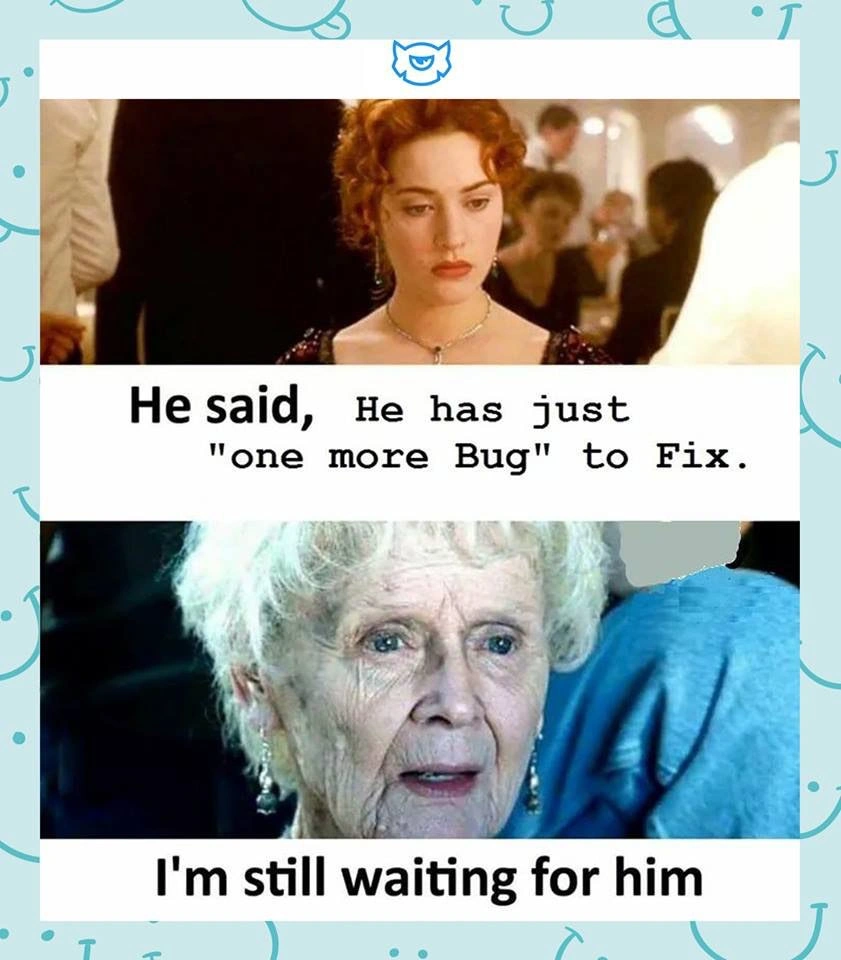
Two stills from Titanic, one lie spanning them. Young Rose at the first-class dinner table, eyes down: "He said, He has just 'one more Bug' to Fix." Then elderly Rose, eighty-four years later in the film's framing narrative: "I'm still waiting for him." The meme weaponizes the largest time-skip in mainstream cinema to measure a developer's most common sentence.
The reason "one more bug" reliably devours an evening isn't dishonesty — it's that the statement encodes a genuinely unknowable estimate. A bug's symptom is visible; its cause is not, and the distance between them is unbounded. The classic spiral: the five-minute fix reveals the function was being called with garbage input, which reveals the caller's state was corrupted three layers up, which reveals a race condition that only fires under load, which reveals the test suite never covered this path at all. Each discovery feels like progress — and locally, it is — which is exactly what makes it impossible to stop. Debugging produces intermittent rewards on an unpredictable schedule, the same reinforcement pattern that keeps people at slot machines. The developer at hour four isn't suffering; they're closer than ever, which is the most dangerous place to be.
There's also a real estimation pathology here that seniors learn to name: the ninety-ninety rule ("the first 90% of the code takes 90% of the time; the remaining 10% takes the other 90%") and the planning fallacy, where we estimate the typing and forget the understanding. "One more bug" is an estimate of effort made before the diagnosis exists — equivalent to a mechanic quoting a price from the sound of the engine over the phone. And the meme's quieter, darker layer is the cost ledger nobody expenses: the partner at the table. Crunch culture frames the all-night debugging session as heroic; the second panel reframes it from the perspective of the person who experienced it as absence. The fact that this format needed no explanation to go viral in a developer channel tells you how universally that trade-off has been made — and how rarely it was the bug's fault rather than the inability to say "I'll look tomorrow with fresh eyes," which, every veteran knows, would have found it in ten minutes anyway.
Description
This is a two-panel meme that uses stills from the movie Titanic, framed by a light blue border with smiley faces. The top panel features the character Rose as a young woman, looking melancholic, with the caption: 'He said, He has just "one more Bug" to Fix.'. The bottom panel shows Rose as an elderly woman, looking weary and ancient, with the caption: 'I'm still waiting for him'. This meme uses the 'It's Been 84 Years' format to create a classic developer joke. The humor lies in the universally relatable experience of underestimating the time and effort required to fix a software bug. What seems like a simple, final task often uncovers deeper, more complex issues, leading to a prolonged and frustrating debugging session. It perfectly captures the feeling that a 'quick fix' can stretch on indefinitely, turning minutes into hours, or in this exaggerated case, a lifetime
Comments
8Comment deleted
That 'one last bug' was a race condition in a multi-threaded process that only appeared during a leap year. By the time he wrote the unit test, the language was deprecated
“Just one more bug” is the software equivalent of Zeno’s paradox - the release gets half a sprint closer each stand-up, yet production remains an asymptote
The 'one more bug' that turned out to be a race condition in production that only manifests under specific load patterns, requires three different teams to coordinate a fix, and somehow involves a dependency that was deprecated in 2019 but nobody remembered we still use
'One more bug' is the only known counter that increments every time you decrement it
Every senior engineer knows that 'just one more bug' is the technical equivalent of 'I'll be back in five minutes' - a temporal estimation so wildly optimistic it violates the laws of physics. What starts as a simple null pointer exception inevitably cascades into discovering your entire authentication layer was built on a foundation of wishful thinking and Stack Overflow answers from 2009. By the time you've fixed the original bug, refactored three modules, updated four dependencies, and resolved the merge conflicts from the hotfix someone pushed while you were debugging, you've aged approximately one Titanic movie's worth of years
“One more bug” is the Zeno’s paradox of stabilization - each patch shrinks the blast radius, expands the regression graph, and the ETA approaches infinity
Promised 'one more bug' - classic dev code for diving into the monolith's iceberg of tech debt, never to surface
“He said ‘one more bug’ - the kind that only reproduces in prod, under GC pressure, during the canary. See you next quarter.”