The Futile Magic of robots.txt Against the NSA
Why is this Security meme funny?
Level 1: The "Please Keep Out" Sign
Websites keep a little public note that tells robot visitors — like the ones search engines send around to read pages — which rooms they're welcome in and which they should skip. It's purely a politeness system: there's no lock, just a sign. Discord added a joke line to theirs that says, essentially, "Dear spy agency: you're not allowed anywhere." The wizard picture calls it an unbreakable magic spell, and that's the laugh — it's about as unbreakable as a sticky note on your diary saying "little brothers, do not read." Anyone who follows the rules didn't need the sign, and anyone the sign is aimed at was never going to obey it.
Level 2: How robots.txt Actually Works
The file lives at a fixed location — /robots.txt at the root of a domain — and uses a tiny declarative syntax:
User-agent:names which crawler the following rules apply to (*means everyone;Twitterbotmeans just Twitter's link-preview bot). A user agent is simply the name a client sends to identify itself — and crucially, it's self-reported. Any program can claim to be anyone.Disallow:lists path prefixes the crawler is asked not to fetch.Disallow: /means "please don't crawl anything."Allow:carves exceptions back out, as Discord does for/inviteso shared invite links still generate previews on Twitter.
Things juniors discover the hard way: search engines honoring robots.txt may still list a disallowed URL if other sites link to it (they just won't show its content — use noindex or auth for that); the file does nothing against scrapers that simply ignore it; and because anyone can read it, it doubles as accidental documentation of your site's interesting paths. The Discord screenshot is a nice study in legitimate use — controlling how previews and indexes treat ephemeral pages like /reset and /verify — capped with a deliberate joke rule that works because every developer reading it knows the protocol is an honor system.
Level 3: Security by Politely Asking
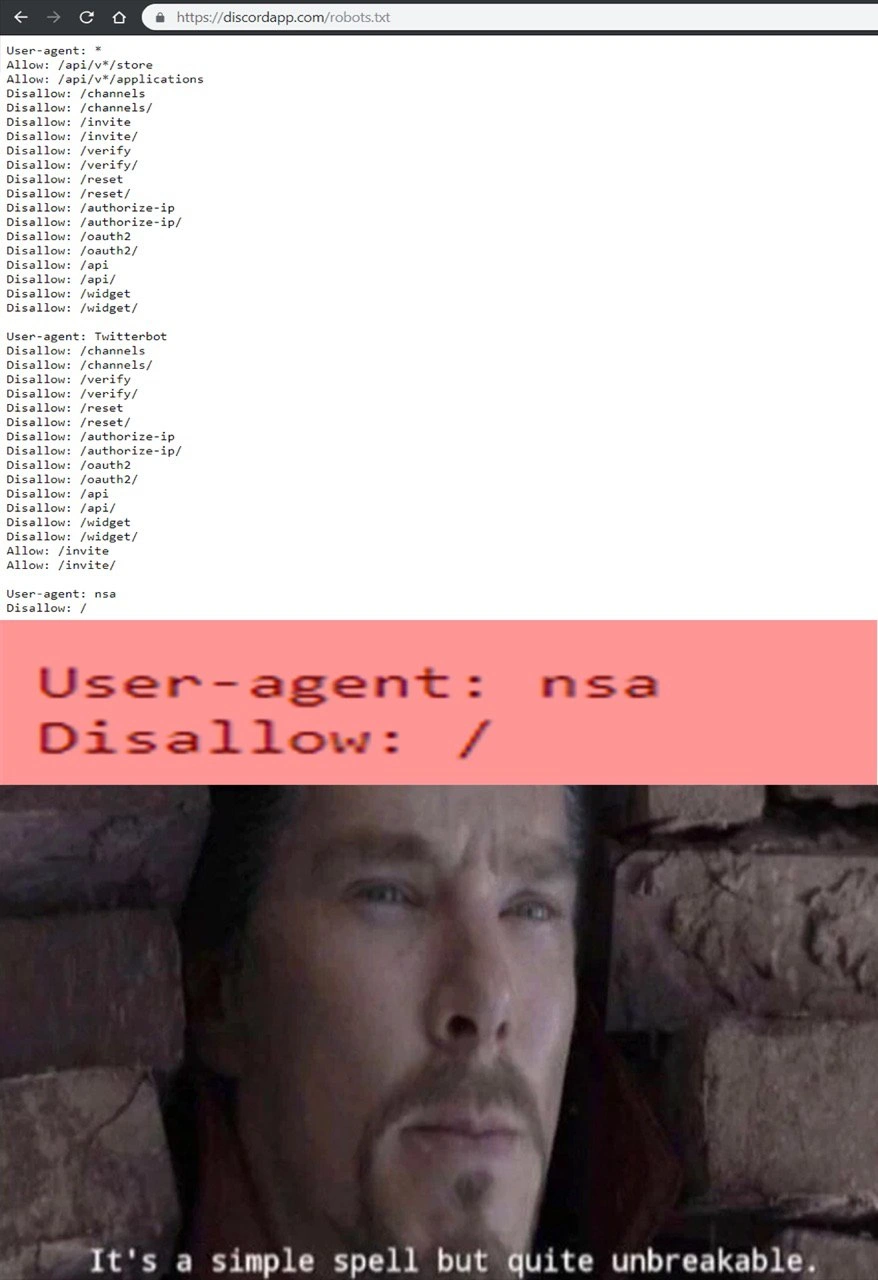
The screenshot shows https://discordapp.com/robots.txt in all its mundane glory — the usual User-agent: * block allowing /api/v*/store and /api/v*/applications while disallowing /channels, /invite, /verify, /reset, /authorize-ip, /oauth2, /api, and /widget, plus a dedicated Twitterbot section that flips /invite back to Allow (so invite links unfurl nicely in tweets — a genuinely thoughtful crawler-specific carve-out). And then, at the bottom, Discord's easter egg, zoomed into a pink callout:
User-agent: nsa
Disallow: /
Cut to Doctor Strange: "It's a simple spell but quite unbreakable."
The joke is precision-engineered for people who know what robots.txt actually is: the Robots Exclusion Protocol, a convention dating to 1994, in which a site politely requests that crawlers avoid certain paths. There is no authentication, no enforcement, no mechanism of any kind — compliance is voluntary. Googlebot honors it because Google's business depends on being a good citizen of the web. A surveillance agency's collection infrastructure would, to put it gently, not consult the file before ingesting traffic. Declaring Disallow: / to user-agent nsa is therefore the security equivalent of a "No Burglars" doormat — which is exactly why the Doctor Strange line lands. The "spell" is unbreakable in the same sense that a velvet rope is: only against entities that have voluntarily agreed to be stopped by velvet ropes.
There's a real engineering moral fossilized inside the gag, and security reviewers repeat it weekly: robots.txt is not an access-control mechanism. Worse, it's an actively counterproductive one — the file is public by design, so listing /admin-secret-panel in a Disallow line is publishing a map of everything you'd prefer attackers not find. Penetration testers read robots.txt first. Real protection means authentication, authorization, and not exposing the endpoint at all; the polite sign is only for well-behaved indexers. The meme's timing also matters culturally: post-Snowden, "the NSA reads everything" stopped being paranoia and became an engineering assumption — it's why the industry pushed HTTPS-everywhere. Discord's easter egg is gallows humor about that exact asymmetry, and the original post's caption piles on with its own mock ruleset: User-agent: hacker / Disallow: hacking / Allow: not hacking. Compliance pending.
Description
This is a two-part meme. The top part is a screenshot of the robots.txt file from discordapp.com. It displays typical web crawler directives, but at the very bottom, it includes a special rule: 'User-agent: nsa' followed by 'Disallow: /'. This specific rule is highlighted with a pink overlay. The bottom part of the meme features a still image of Doctor Strange from the Marvel Cinematic Universe, looking serious, with the caption, 'It's a simple spell but quite unbreakable.' The humor is derived from the absurd idea that a simple, voluntary directive in a robots.txt file could prevent a sophisticated government intelligence agency like the NSA from accessing a website. The 'robots.txt' protocol relies on the cooperation of web crawlers and is not a security mechanism. Juxtaposing this futile technical gesture with Doctor Strange's powerful quote creates a deeply ironic and funny meme for anyone who understands web standards and the realities of cybersecurity
Comments
8Comment deleted
My home security is based on the same principle. I have a 'No Burglars' sign on the door. It's a simple spell but quite unbreakable
Added `User-agent: nsa Disallow: /` to robots.txt - instant FedRAMP High, zero billable hours, and the CFO thinks I’m Gandalf
Meanwhile, the NSA's actual crawler identifies as Googlebot and has been indexing your DMs since 2013 while you've been adding increasingly creative user-agent blocks to robots.txt like it's some kind of security theater LARP
Securing your site with robots.txt is like a 'please don't rob us' sticky note on the vault - compliance is strictly opt-in for the well-behaved
Ah yes, the legendary 'User-agent: nsa' with 'Disallow: /' - because we all know the NSA would definitely respect robots.txt and politely identify themselves. It's the digital equivalent of putting up a 'No Trespassing' sign to stop a three-letter agency with zero-day exploits and direct fiber taps. But hey, at least when they inevitably access everything anyway, Discord's legal team can point to this line and say 'we technically asked them not to.' Security through optimistic configuration - it's not a bug, it's compliance theater
robots.txt vs NSA: voluntary compliance meets zero warrants - pure web dev optimism
Nothing says defense in depth like telling a nation state 'please don't' in robots.txt; RFC 9309 is not an ACL
Security update: added “User-agent: nsa Disallow: /” to robots.txt - our threat model now assumes nation‑states honor web standards; next sprint we’ll replace the WAF with a strongly worded README