One Line Error Localization
Why is this Debugging Troubleshooting meme funny?
Level 1: One Huge Sentence
It is like writing an entire book as one giant sentence and then saying, "The typo is in the sentence." That is true, but it does not help anyone find the typo. The meme is funny because the advice sounds clever for one second, then immediately becomes a terrible idea.
Level 2: Lines Are Clues
When code crashes, tools usually report a file name and line number. That helps the developer jump to the suspicious area quickly. If a file has normal formatting, line 73 might contain one clear statement, so the developer has a good place to start.
If all code is compressed onto one line, the tool can only say the problem is somewhere on that giant line. The location is technically correct, but it no longer narrows the search. This is why CodeFormatting, CodeQuality, and AntiPattern all fit the image: the proposed shortcut makes the code harder to read, harder to review, and harder to fix.
Small examples show the difference:
if (!user) throw new Error("missing user"); sendEmail(user.email);
That line may run, but it hides two separate actions in one place. Splitting code into readable pieces gives both humans and tools better landmarks.
Level 3: Stack Trace Absolutism
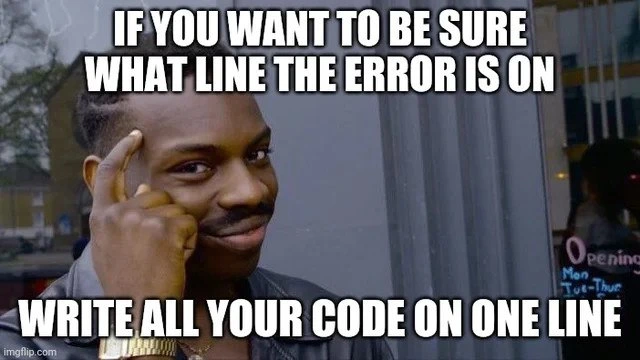
The Roll Safe pose works because the advice is technically true in the most useless possible way. The image says:
IF YOU WANT TO BE SURE WHAT LINE THE ERROR IS ON
WRITE ALL YOUR CODE ON ONE LINE
Yes, if every statement lives on line 1, every parser error, stack trace, linter warning, and runtime exception can confidently point at line 1. Congratulations: the line number is now perfectly accurate and completely unhelpful. This is Debugging_Troubleshooting as malicious compliance.
The deeper joke is about optimizing the wrong metric. Developers often want precision from ErrorMessages, but useful diagnostics depend on structure: functions split into meaningful units, statements separated by lines, names that explain intent, and stack frames that narrow the search area. One-line code erases that context. It turns a bug hunt into a horizontal scrolling contest, which is how you know the code formatter has been taken hostage.
This is also why CodeReadability and CodeMaintainability are not decorative preferences. Formatting is part of the program's human interface. A compiler may not care whether a dense expression spans one line or twenty, but the next person reading it absolutely does. The meme satirizes the kind of "pro tip" that solves a tiny irritation by creating a much larger operational problem, the same proud tradition as disabling tests to make the build green.
Description
A Roll Safe meme shows the man tapping his temple with a knowing smile, overlaid with large white all-caps text. The visible text reads: "IF YOU WANT TO BE SURE WHAT LINE THE ERROR IS ON" at the top and "WRITE ALL YOUR CODE ON ONE LINE" at the bottom; a small "imgflip.com" watermark appears in the lower-left corner. The technical joke is a deliberately terrible debugging shortcut: if every statement is on line one, stack traces and compiler diagnostics always point to the same line. It satirizes advice that optimizes one metric, line-number certainty, while destroying readability, maintainability, formatting, and actual troubleshootability.
Comments
1Comment deleted
It is O(1) error lookup with O(n) therapy for whoever reviews the file.