Skip to content
DevMeme
1865 of 7435
The Woodworker's Solace: A Bug Tracker Escape Story
Career HR Post #2073, on Sep 22, 2020 in TG

The Woodworker's Solace: A Bug Tracker Escape Story

Why is this Career HR meme funny?

Level 1: One Request Too Many

Imagine you spent all afternoon building a really cool LEGO castle. You're proud of it! Now your friend comes over and says, "Hey, can you make this LEGO castle shoot real fireworks and serve pizza?" 😕 That request sounds pretty silly, right? LEGOs are just plastic bricks – they can’t cook pizza or launch fireworks. You’d probably feel confused and a bit annoyed that your friend asked for something impossible. Maybe you even decide you don't want to play LEGO with them anymore for a while. Instead, you go outside to help your parent build a simple treehouse out of real wood. Building a treehouse is hard work – you might hammer your thumb by accident or get a splinter – but while you're doing it, no one is asking you to do something that doesn't make sense.

This meme is like that story. The developer was asked to do something crazy at their computer job (put an RSS feed in a database, which is like trying to put fireworks in a LEGO castle). It made them so frustrated that they joked about switching to a totally different job building furniture. Working with wood can be tough and even risky, but at least the requests you get in a woodshop are normal! It’s funny because it’s an exaggerated way of saying, "I got so tired of silly requests at my software job that even cutting wood for a living sounds like a relief." The joke shows how fed up the person felt, and we laugh because we know they don't really mean they'll cut furniture forever — they’re just expressing how ridiculous that last request was.

Level 2: Fingers vs Features

Now let's break this down in simpler terms for a newer developer or someone learning the ropes. The meme highlights a common source of frustration in software jobs: dealing with stakeholders (clients, bosses, or project managers) who sometimes ask for features that don't make any sense technically. In this case, the request was: “Can you add an RSS feed to a DBMS?”

Let’s define those terms first:

  • Stakeholder: This means anyone who has a stake in the project’s success and can influence what features are needed. Often it’s non-technical folks like clients or managers who have ideas (and demands) for the software.
  • Feature Request: This is when a stakeholder asks the development team to add new functionality or change something in the software. For example, "Can we add a login with Facebook?" or "We need a report generation tool in the app." Feature requests are normal in software development — handling them is a big part of a developer’s job. The trouble comes when the requests are unreasonable or based on misunderstandings.

So, what's so strange about “add an RSS feed to a DBMS”? Let’s decode it:

  • RSS Feed: RSS stands for Really Simple Syndication. An RSS feed is basically a special web page (in XML format) that lists updates or new content from a site. For instance, a news website or a blog might have an RSS feed so that subscribers or apps can get notified of the latest headlines or posts. It’s like a mini broadcast of “Here’s what’s new” that other software can read. Think of it as a news bulletin or newsletter for web content that updates automatically.
  • DBMS: This stands for Database Management System. That’s the engine that stores and organizes data for applications. Examples are Oracle, MySQL, PostgreSQL, or SQL Server. A DBMS is like a super organized filing cabinet for data. It doesn’t show data directly to users; instead, it provides data to your application (like a back-end service or website) when asked. You write queries (in SQL) to get data in or out. The DBMS is all about storing, retrieving, and managing data reliably and efficiently.

Under normal conditions, if you wanted an RSS feed for, say, your product’s latest updates, you wouldn’t “add it to the database” itself. Instead, you’d:

  1. Add code in your application (server side) that queries the database for the latest relevant data (like latest blog posts or items).
  2. Format that data into an RSS feed XML format.
  3. Provide a URL (like https://yourapp.com/updates/rss) where that feed can be accessed.

The database just holds the raw data; the application uses that data to build the RSS feed. Asking to "add an RSS feed to a DBMS" mixes these roles up. It’s a bit like asking, "Can we have our library’s catalog of books also serve as a weekly newsletter to patrons?" The library database (catalog) keeps track of books, but it doesn’t itself send out newsletters — the librarians or a separate system would create a newsletter using info from the catalog.

For a junior developer, it might not be immediately obvious why this request is silly. But as you learn about system design, you encounter the idea of separation of concerns. Each part of a system has a specific job. The database’s job is managing data. The web server or application’s job is presenting data and features to users. They work together, but you wouldn’t merge them into one magic component. If someone non-technical confuses these, you get weird requests like this RSS-DBMS idea. It basically shows the person asking doesn't quite understand what each piece does.

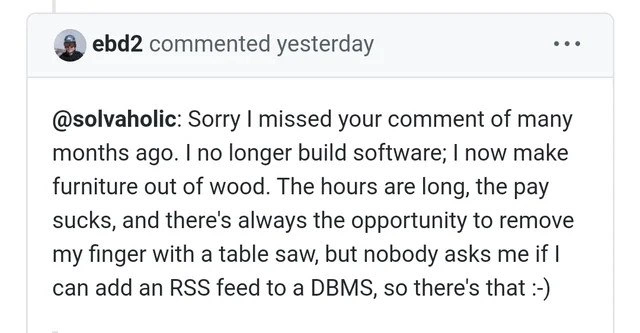
Now, the second part of the meme: the developer’s response. He says something like, "Sorry I missed your comment... I no longer build software; I now make furniture out of wood." He’s saying he left his software career to become a woodworker! Then he lists: "The hours are long, the pay sucks, and there's always the opportunity to remove my finger with a table saw." Those are obviously the downsides of woodworking. It’s hard physical work, not great money, and yes, working with power tools like a table saw can be dangerous (you have to be very careful to keep all your fingers intact). Finally he says, "...but nobody asks me if I can add an RSS feed to a DBMS, so there's that :-)"

This whole comment is meant humorously — it’s a form of developer humor about burning out and making a drastic career switch. Let’s unpack why a developer might joke about this:

  • Developer Burnout: This is when a programmer becomes extremely tired, frustrated, or disillusioned with their job to the point that they might quit. It can happen after years of tight deadlines, high stress, late-night calls, or dealing with what feel like absurd demands. Burnout is a big topic in tech because it's a high-pressure field in many ways. People joke about it as a coping mechanism.
  • Stakeholder Pressure & Misaligned Expectations: A lot of burnout comes from situations where non-technical stakeholders keep pushing developers for more features or changes, often without understanding the effort or even whether the request makes sense. When your boss or client insists on something impossible or out-of-scope (misaligned expectations), it can be very stressful. For example, being asked to "just add this one little thing" when you know that thing is actually a huge deal or not possible — that’s rough.
  • Feature Request Overload: Developers expect to get feature requests, but when they pile up endlessly or get increasingly ridiculous (like our RSS feed example), it can sap the joy out of coding. It stops feeling like creative problem-solving and more like an impossible to-do list dictated by someone who doesn’t get it.

So in the meme, the developer essentially says: “I got so fed up with these kinds of requests that I left the industry to do woodworking.” Woodworking here is a stand-in for any simpler, more tangible job. There’s a bit of romanticism among stressed tech workers about quitting and doing something manual like woodworking, farming, baking, etc. It might be tougher physically and pay less, but at the end of the day, you’ve built a chair or grown a vegetable — something real — and, importantly, wood and tools don’t make absurd feature requests. 😅

By saying "nobody asks me if I can add an RSS feed to a DBMS" the developer is highlighting how nice it is that in the woodworking world, the challenges are at least logical:

  • Wood might split or knots might make it hard to cut, but wood isn’t going to suddenly demand a new feature from you.
  • A client buying a table might have requests like a certain size or style (which are reasonable), but they won’t ask for something as nonsensical as an RSS feed on a table. They could ask for unreasonable things (clients are everywhere), but generally, physical objects have more obvious limits that everyday people understand. Software, being invisible, often leads non-tech people to think "anything is possible if you just code a bit more."

For someone early in their career, the key takeaway humorously illustrated here is: Communication with stakeholders is crucial. You’ll often need to translate tech boundaries to non-tech people. And yes, you might occasionally get a request that sounds wild or impossible. Part of growing as a developer is learning how to handle that: explaining why it’s not feasible, or finding a compromise solution, all while keeping your cool.

The meme exaggerates the outcome (totally changing careers) for comedic effect. Most developers won’t literally go buy a saw and start a woodworking shop because of one silly request. But the reason it’s funny is because every developer understands the feeling behind it. It’s that weary thought of “I’d rather do anything else than deal with this right now.”

In summary, this meme uses career humor to highlight how draining unrealistic feature requests and stakeholder expectations can be. The dev jokes that even a tougher, riskier job (where you could lose a finger!) is preferable, because at least it’s free of tech nonsense. If you’re new to the field, don’t let it scare you away — think of it as an inside joke among developers. It says: “We love coding, but man, some days the job just makes us want to run off to a cabin in the woods.” 😉

Level 3: From Schema to Sawdust

At the highest technical level, this meme is a darkly comic commentary on developer burnout and the absurdity of misaligned stakeholder requests. The scenario being referenced — “add an RSS feed to a DBMS” — is a prime example of a ridiculous feature request that no seasoned developer would take seriously. It’s the kind of ask that triggers flashbacks for battle-hardened coders: we’ve all had some manager or client propose a feature that completely misunderstands how technology works.

First, let's unpack the technical mismatch. RSS (Really Simple Syndication) is a protocol for serving syndicated web content (like blog updates) in a standardized XML format. It lives in the application/content layer — something a web server or content management system might produce for users to subscribe to. Meanwhile, a DBMS (Database Management System), like MySQL or PostgreSQL, sits deep in the data layer, responsible for storing and retrieving information efficiently, not for presenting it directly to end-users in a feed format. Asking to "add an RSS feed to a DBMS" is like asking a carpenter to install a radio antenna in a filing cabinet. It's mixing two completely distinct layers of a system without any proper interface between them. In a sane architecture, you'd have an application query the database, then format results as RSS on the front end. But a stakeholder who doesn’t grasp this separation might literally think the database itself can sprout an RSS feed if you just flip the right switch.

To a seasoned engineer, this request is absurd on multiple levels:

  • Separation of Concerns: Well-designed systems separate data storage (the DBMS) from content presentation (RSS, HTML, GUI). Bolting an RSS feed directly onto the database shatters this principle, akin to trying to embed a web browser inside your SQL engine.
  • Technical Feasibility: Mainstream databases don't come with an "RSS mode" that you can just toggle. Sure, you could MacGyver a stored procedure or a trigger to generate RSS XML when data changes, but that would be an unholy architecture. It’s theoretically possible yet practically horrendous: high complexity, poor reliability, and completely outside the DBMS’s intended use-case.
  • Misunderstanding of Roles: This request signals the stakeholder might not know (or care) what a DBMS actually does. It's a classic case of StakeholderExpectations being wildly out of line with reality. Perhaps they heard some buzzwords — "RSS feeds are cool, our data is in a database, so the database should output an RSS feed, right?" — and came to the wrong conclusion.

To humorously illustrate how a non-technical person might imagine this working, they might assume there's a simple magical command to turn on RSS in the database:

-- Imaginary SQL: what a naive stakeholder might expect exists (it doesn't)
ALTER DATABASE myDatabase ADD RSS_FEED;

Of course, no real DBMS has such a one-liner feature.

For many experienced devs, seeing the line “add an RSS feed to a DBMS” produces equal parts hilarity and horror. It's the kind of question that leaves you momentarily speechless, trying to decide if you should laugh or start a basic tech 101 lesson. We’ve all been in those meetings or email threads where a stakeholder proposes something that makes our brains blue-screen. Classic examples include:

  • "Can you make our database automatically email people every time a record updates?" (Sure, let's just teach the database to send emails by itself; who needs an application layer?)
  • "We have all our data in Excel. Can you turn that into a real-time mobile app by next week?" (Because obviously an Excel spreadsheet can magically become an app overnight, right?)
  • "This UI looks great, but can we add blockchain to it for marketing?" (Ah yes, sprinkle some blockchain on the UI salad — that will impress everyone.)

These are all real examples of stakeholder ideas going off the rails. They highlight that gap between what non-technical folks think is trivial and what’s actually technically viable. After enough of these absurd requests, you start fantasizing about careers where the only absurd request might be a customer asking for a dining table to also be a trampoline.

The comment in the meme drips with cynical wit. The author (user ebd2) basically says they’ve quit software and now "make furniture out of wood". This drastic career pivot from coding to carpentry is exaggeration for effect, but it rings true to any dev who’s daydreamed about escaping the tech grind. Instead of wrangling impossible demands from clients and Stakeholders, now the only tricky "client" is a piece of oak. And the oak isn’t going to walk into the workshop and demand, “Hey, can you quickly bolt an RSS feed onto this cabinet?”

They go on to list the downsides of woodworking: long hours, lousy pay, and a non-zero chance of literally removing a finger with a table saw. This is classic dark developer humor through contrast. A table saw is a powerful cutting tool used for slicing up lumber. Yes, it can indeed lop off a finger if you’re careless. For a desk-jockey software engineer, the worst physical injury at work might be carpal tunnel or a stiff neck – certainly not losing digits. So why joke that this high-risk, lower-pay job is preferable? Because, as the punchline delivers, “...nobody asks me if I can add an RSS feed to a DBMS.” That absurd request was apparently the last straw that broke the coder’s back.

This line is the punchline and it uses a smiling emoticon ":-)" to underscore that it’s a joke... but one that comes from a place of truth. The relief of not having to deal with nonsensical feature requests outweighs all those new downsides of the woodshop. It’s a tongue-in-cheek way to say, "I would literally rather risk physical injury than deal with more ridiculous tech requests." Developers find this hilarious because it’s an extreme exaggeration of a feeling we genuinely get sometimes. It’s a form of CareerHumor that resonates with anyone who’s been worn down by endless feature creep and client demands.

There’s also a nugget of reality in there: building tangible things can be oddly therapeutic for coders. After years of abstract software problems and StakeholderPressure, the idea of working with your hands on something concrete — where your challenges are material and straightforward — has real appeal. No vague product specs, no managers asking if you can "just make it do X by tomorrow." Wood is honest: if you measure wrong, the piece won’t fit. If you cut carelessly, the saw doesn’t care about your deadline, it just cuts where you guide it (or cuts you if you’re reckless). In a way, wood is more predictable than fickle clients or shifting project requirements.

So, this meme strikes a chord with experienced developers by capturing that "escape fantasy" in a humorous nutshell. The phrase "add an RSS feed to a DBMS" has now become a stand-in for any utterly ill-informed request that makes an engineer question their life choices. It’s a comedic exaggeration, yes, but it highlights a real issue: misaligned expectations between stakeholders and developers can drive even passionate techies to the brink. In fact, in the pantheon of DeveloperHumor, jokes about quitting tech to do something radically different (like farming, woodworking, or opening a cafĂ©) are common coping mechanisms. It’s how we collectively sigh and laugh off the stress. This meme nails that vibe by taking a specific absurd request and showing the extreme (and funny) outcome. It’s funny because it’s just relatable enough to imagine a burned-out engineer thinking, "Yep, I'd rather dodge table saws than one more meeting explaining to the boss why you can't just plug a Facebook feed directly into our database."

Description

A screenshot of a comment from a user named 'ebd2' on what appears to be a code repository or project management platform like GitHub. The comment is a reply to another user, '@solvaholic,' after a delay of many months. The text reads: '@solvaholic: Sorry I missed your comment of many months ago. I no longer build software; I now make furniture out of wood. The hours are long, the pay sucks, and there's always the opportunity to remove my finger with a table saw, but nobody asks me if I can add an RSS feed to a DBMS, so there's that :-)'. This meme is a classic piece of developer gallows humor, capturing the feeling of burnout from dealing with nonsensical or technically inappropriate requests from clients or management. The joke hinges on the absurdity of adding an RSS feed (a web content syndication format) directly to a DBMS (Database Management System), highlighting a fundamental misunderstanding of the technologies involved. The commenter humorously suggests that the physical danger of woodworking is preferable to the psychological pain of such requests
Comments

7
Anonymous ★ Top Pick I'm one more 'Can we make this blockchain-compatible?' request away from starting an artisanal goat farm. The logic is simpler, and the only bugs I'd have to deal with are actual insects
  1. Anonymous ★ Top Pick

    I'm one more 'Can we make this blockchain-compatible?' request away from starting an artisanal goat farm. The logic is simpler, and the only bugs I'd have to deal with are actual insects

  2. Anonymous

    Woodworking was the safer option - at least the table saw’s failure mode is deterministic, unlike the PM who kept demanding an eventually-consistent RSS feed embedded in the DBMS transaction log

  3. Anonymous

    At least with woodworking, when someone asks for a feature that violates the laws of physics, you can just point at actual physics instead of explaining why their "simple" request requires rewriting the entire codebase

  4. Anonymous

    Ah yes, the classic 'add an RSS feed to a DBMS' request - right up there with 'make the database more RESTful' and 'can we blockchain the SQL queries?' At least with woodworking, when someone asks you to add a feature to a table, they literally mean the furniture. The pay cut and finger-loss risk might actually be worth never having to explain again why a relational database isn't a content syndication platform

  5. Anonymous

    Switched to woodworking; it’s louder and riskier, but the architecture’s cleaner - the only feed I tune is the table saw’s feed rate, not RSS bolted onto a DBMS

  6. Anonymous

    Swapping to woodworking means the only thing with teeth is the table saw - and it still respects layering better than whoever asked for ‘RSS in the DBMS’

  7. Anonymous

    Swapped 'RSS feed in a DBMS' for 'dovetail joint on a shoestring' - same impossible spec, fewer Jira tickets

Use J and K for navigation