Memory Management Styles: The Polite vs. The Profane
Why is this Languages meme funny?
Level 1: Cleaning Up After Yourself
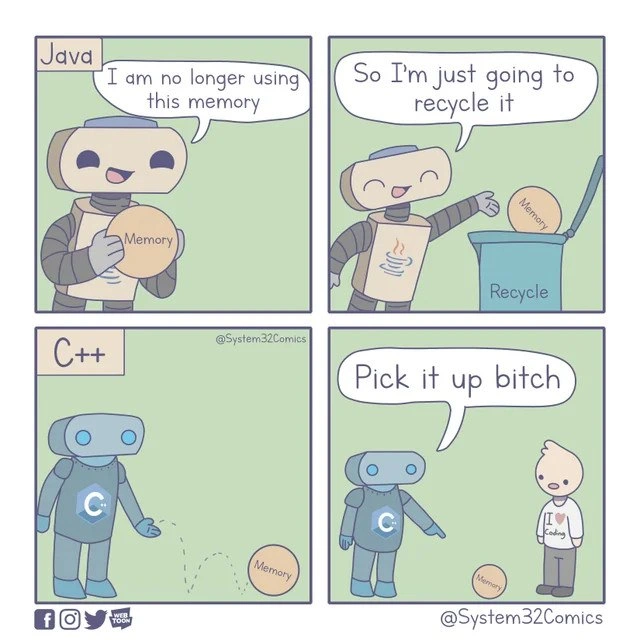
Think of it like cleaning up toys: Java is like having a friendly robot helper who automatically puts away all your toys when you’re done playing. You finish with a toy (memory) and just leave it, and the robot quickly picks it up and places it in the toy box (that’s the garbage collector doing its job). You don’t even have to ask — it’s just magically handled, so your room stays tidy. Now, C++ is like when you don’t have that helper: if you take out a toy to play (use some memory), when you’re done you can’t just drop it on the floor. You have to remember to put that toy back in its place. If you forget and leave a bunch of toys (memory) lying around, your room (computer memory) gets messy and cluttered. In the comic, the blue robot dropping the ball is like someone who left a toy on the floor, and the angry person saying “Pick it up!” is like a parent or teacher telling them to clean their mess. The joke is funny because it’s a big exaggeration of a simple idea: one kid (Java) always cleans up without being asked, while the other kid (C++) won’t clean up unless you explicitly tell them. It’s a playful way to show why having automatic help (Java’s garbage collector) feels so convenient, whereas doing everything yourself (C++ manual cleanup) can be a chore – sometimes you literally need a reminder to tidy up!
Level 2: Take Out the Garbage
Let’s break down the basics behind this comic for those newer to programming. It’s illustrating how two popular programming languages, Java and C++, handle freeing up memory differently. In programming, when you need some extra memory to store data, you often allocate it (think of it like grabbing a toy or resource you need). But when you’re done, that memory becomes garbage (not useful to you anymore) and needs to be given back so it can be reused.
Java’s Garbage Collection: In Java, you don’t directly tell the computer “free this memory now.” Instead, Java has a built-in helper called a garbage collector. When the Java robot says, “I am no longer using this memory, so I’m just going to recycle it,” it reflects what happens in Java code. For example, if you had:
// In Java: String data = new String("Hello"); // ... use data ... data = null; // We're done with the String object, no longer referenced // At some later time, Java's garbage collector will notice 'data' is null // and the "Hello" String object isn't referenced by anyone. It then frees that memory.In the above code, we created a new
Stringwhich uses some memory. When we setdatatonull, it’s like telling Java, “I don’t need this object anymore.” Java’s garbage collection will automatically detect that the"Hello"string isn’t reachable by any part of the program and will free (recycle) that memory on its own. The Recycle bin in the comic’s Java panels is a perfect metaphor for this process. You toss something in (stop using the object) and at some point the garbage collector takes out the trash for you. You, as the programmer, typically don’t have to manually clean up most objects. This makes life easier and helps avoid memory leaks in everyday Java coding. It’s one of the reasons Java (and languages like C# or Python) are considered more beginner-friendly when it comes to MemoryManagement.C++ Manual Memory Management: Now, C++ is a bit closer to the metal (we often call C++ a low-level programming language in this context, even though it has high-level features, because it gives you direct control over memory). In C++, if you allocate memory, you are in charge of later deallocating it. The comic’s C++ robot dropping the “Memory” ball on the ground illustrates a scenario where the program allocated memory but hasn’t freed it. The human yelling “Pick it up!” is like your senior developer or a debugging tool telling you “Hey, you left some memory allocated — go free it!” In code, a C++ example might look like:
// In C++: int* data = new int(42); // allocate memory for an integer and store 42 in it // ... use *data ... // Oops, we forget to free it! // delete data; <-- If we don't do this, the memory allocated for that int is never returned.In the above C++ snippet, we used
newto allocate memory for an integer. That’s like the robot picking up a "Memory" ball. If we never calldelete data;to free that memory, that chunk of memory remains used up even though we don’t need it anymore. This is called a memory leak – memory that your program took but never gave back. If this happens a lot (imagine dropping many "Memory" balls and never picking them up), your program can run out of memory over time! The meme exaggerates this by having the human character shout at the C++ robot, because in reality it’s the programmer (you) who must remember to free things. Forgetting leads to bugs and angry bug reports. C++ does provide tools to help manage this better, though. For instance, modern C++ developers use smart pointers likestd::unique_ptrorstd::shared_ptrwhich automatically calldeletefor you when objects are no longer needed (kind of adding a small automatic cleaner to help, though it’s not as sweeping as Java’s GC). There’s also a concept called RAII where you tie resources (like memory) to object lifetimes, so as soon as the object goes away, it cleans up after itself in its destructor. Still, fundamentally, C++ does not have a true garbage collecting runtime by default – it’s up to the code to clean up. That’s why the blue robot just stands there after dropping the memory ball. It’s a literal depiction of “if you don’t explicitly program the cleanup, nothing will happen!”
In summary, this comic is comparing Java vs. C++ in terms of who’s responsible for cleaning memory. Java (and similar managed languages) acts like a helpful custodian that automatically takes out the garbage (frees memory) for you when objects are no longer used. C++ is more like a do-it-yourself situation: you have the freedom to manage memory as you see fit, but with that freedom comes responsibility — you have to remember to pick up (free) the memory you dropped (allocated) once you’re done. The humor is very relatable for many coders: a lot of us learned this the hard way when first switching from a garbage-collected language to a manual one, much like a kid being told to clean their room when they weren’t used to doing it!
Level 3: Manual Memory Mayhem
From a seasoned developer’s perspective, this comic pokes fun at the day-to-day reality of memory management in different languages. In Java, and other languages with automatic memory management (like C#, Go, or Python to some extent), developers don’t usually worry about every malloc or free call – the runtime’s garbage collector is the unsung hero working in the background to prevent most memory leaks. The beige Java robot grinning and tossing away the "Memory" ball is a perfect caricature of the Java Virtual Machine saying, "Done with that object? No problem, I got it, trash has been taken out!" This feels almost magical to developers coming from lower-level contexts: you simply stop using an object (or set your reference to null), and eventually the GC cleans it up. It’s relatable humor because any programmer who’s dealt with memory in different languages knows this laissez-faire feeling of relief in Java when you can trust the system to manage garbage for you. The caption "I am no longer using this memory... So I’m just going to recycle it" playfully mirrors how a Java developer might think about releasing memory without writing any extra code – the runtime recycles unused memory automatically. This leads to fewer accidental memory leaks in day-to-day coding, sparing you those dreaded debugging sessions trying to figure out why your app is eating up more and more RAM.
Now enter the world of C++ (and C): a powerful, efficient, but unforgiving realm of ManualMemoryManagement. The blue C++ robot blankly dropping the memory ball on the ground captures the exact vibe of a program that has allocated memory but then… just never frees it. Seasoned C++ devs have war stories of missing delete calls or misplaced free() causing memory leaks that grow until the application crashes or exhausts system memory. The human character angrily pointing and shouting “Pick it up, b****!” (we’ll say "Pick it up, buddy!" for politeness) is every senior engineer or code reviewer who’s ever caught a junior developer forgetting to clean up after themselves in C or C++ code. It’s the production support engineer at 3 AM, metaphorically yelling at a leaking program "free that memory, darn it!" Because in C++, if you don't explicitly free it, that memory stays allocated until the process ends – there’s no JVM garbage collector to sweep in and save the day. This meme strikes a chord as developer humor because it dramatizes a common frustration: C++ gives you total control and responsibility. That “Memory” ball on the floor might seem harmless, but seasoned devs know it’s like a ticking time bomb – each forgotten allocation is one more chunk of memory gone missing, potentially never returned, possibly leading to performance issues or crashes down the line.
This comic also touches on the cultural differences between language ecosystems. In high-level, garbage_collected languages like Java, memory issues are less frequent (though not completely gone – you can still have leaks if you mistakenly keep references, and GC pauses can cause performance hiccups). In systems programming with C++ (or embedded C), manual memory handling is a fundamental part of the job; it’s powerful (you can manage memory very efficiently and even do tricky things), but it’s easy to shoot yourself in the foot. Everyone who’s grappled with a wild pointer or a double-free bug in C++ can relate to that exasperated human in the last panel. The joke encapsulates a classic compare-and-contrast: Java vs C++ memory management. It’s an inside joke among programmers that when something goes wrong in a C++ program, an experienced colleague might dryly suggest, “Did you remember to free your memory?” — essentially the polite workplace translation of “Pick it up, you fool!” 😆. The comic, originally by System32Comics, distills this into a simple visual: Java is the well-behaved student tidying up automatically, and C++ is the kid who left a mess until the teacher yelled. It’s funny because it’s true: despite all advances, even today if you write C++ code, memory ownership bugs and the need to manually manage resources are still very much a thing. The absurdity of someone having to yell at the code to clean up is a tongue-in-cheek reflection of how it sometimes feels to hunt down memory leaks in a large C++ codebase. In short, the meme delivers a bit of CodingHumor by reminding us of that eternal software engineering lesson — if your language doesn’t clean up for you, you better do it yourself!.
Level 4: Mark and Sweep vs Delete
At the deepest technical level, this meme highlights a contrast in memory management algorithms between two programming paradigms. Java's garbage collection uses a tracing approach (often mark-and-sweep) which periodically pauses to mark all objects still in use (traversing object references from root pointers like stacks and registers) and then sweep up the unreferenced objects, reclaiming their memory. Modern JVMs even use generational garbage collectors: new objects go into a young generation area (the "Eden"), and most garbage is collected there quickly, while long-lived objects get tenured into an old generation for less frequent collection. This design is rooted in academic work from as early as the 1960s (Lisp’s invention of automatic heap management by John McCarthy) and trades runtime overhead for developer convenience and safety. The coffee-logo robot cheerfully tossing the "Memory" ball in a recycle bin personifies this automatic memory reclamation process – a behind-the-scenes janitor thread cleaning up so the Java programmer rarely worries about unused objects cluttering the heap.
In contrast, C++ follows the manual model: when you allocate memory (e.g. via new or malloc on the heap), the program doesn’t have a background process to clean it up – the programmer must explicitly free it. C++ relies on deterministic destruction: objects allocated on the stack are cleaned up as soon as they go out of scope, and for heap allocations, it's on you to call delete or free at the right time. The blue C++ robot dropping the "Memory" ball and doing nothing (until yelled at) is an apt metaphor for how the language runtime itself will not automatically collect discarded memory. Instead, C++ employs paradigms like RAII (Resource Acquisition Is Initialization) and smart pointers (e.g. std::unique_ptr, std::shared_ptr) to help manage ownership and cleanup. These are not garbage collectors but patterns and tools that encourage timely cleanup by tying resource lifetimes to object lifetimes – kind of like training the robot to pick things up when it’s instructed properly. The fundamental computer science aspect here involves memory ownership and the lack of a perfect universal solution: automatic GC needs runtime checks and can’t predict future usage with absolute certainty (thanks to problems akin to the halting problem, we can’t always know if an object will be used again), whereas manual management gives full control (and responsibility) to the programmer but is error-prone. This dichotomy between managed and unmanaged memory systems is a classic CS_Fundamental trade-off, one that influences language design, runtime performance, and developer experience. The meme humorously distills this complex topic: one system has a built-in algorithmic garbage disposal, and the other is essentially saying, “I’ll only clean up if you explicitly tell me to (or else I’ll leave junk laying around in memory).” It’s a lighthearted take on a serious low-level concept that has deep implications for how programming languages operate under the hood.
Description
A four-panel comic by System32Comics that humorously contrasts memory management in Java and C++. The first two panels are labeled 'Java.' In panel one, a friendly, smiling robot holds an orange ball labeled 'Memory' and says, 'I am no longer using this memory.' In panel two, the same robot cheerfully places the ball into a blue bin labeled 'Recycle,' saying, 'So I'm just going to recycle it.' This represents Java's automatic garbage collection. The bottom two panels are labeled 'C++.' In panel three, a more stern-looking robot with a 'C' logo on its chest drops the 'Memory' ball onto the floor. In the final panel, the C++ robot aggressively tells a human programmer (wearing an 'I ❤️ Coding' shirt), 'Pick it up bitch.' This illustrates the manual and demanding nature of memory management in C++, where the developer is explicitly responsible for deallocating memory to prevent leaks

Comments
7Comment deleted
The C++ robot is what you get after years of telling junior devs to delete their pointers. Eventually, you automate the belligerence
Java GC: a janitor who barges in during your 99.9th-percentile SLA; C++: no janitor - just a sign that says “Clean up after yourself or the segfault is considered self-inflicted.”
The real plot twist is when the C++ developer discovers smart pointers exist and realizes they've been living in 1998 for the past decade - but still refuses to use them because 'raw pointers build character' and 'RAII is for people who can't handle real programming.'
The eternal dichotomy: Java developers sleep soundly while the GC does the dishes at 3 AM, occasionally triggering a stop-the-world event that wakes everyone up. Meanwhile, C++ developers are still awake, meticulously tracking every allocation like a forensic accountant, knowing that one missed `delete` means explaining to production why the server now identifies as a memory hoarder. At least with C++ you get deterministic cleanup - and the existential dread of wondering if you actually freed everything
Java has a GC; C++ has RAII - until a shared_ptr cycle turns your “temp” into a long‑term lease on the heap
Latency SLO translation: Java trusts the GC eventually; C++ demands RAII/unique_ptr now - one pauses the world, the other pauses your weekend
Java GC parties while auto-cleaning; C++ devs chase leaks like lost socks in a valgrind dryer