Newbie's Path to 'Senior' AI Engineer
Why is this Juniors meme funny?
Level 1: Running Before Crawling
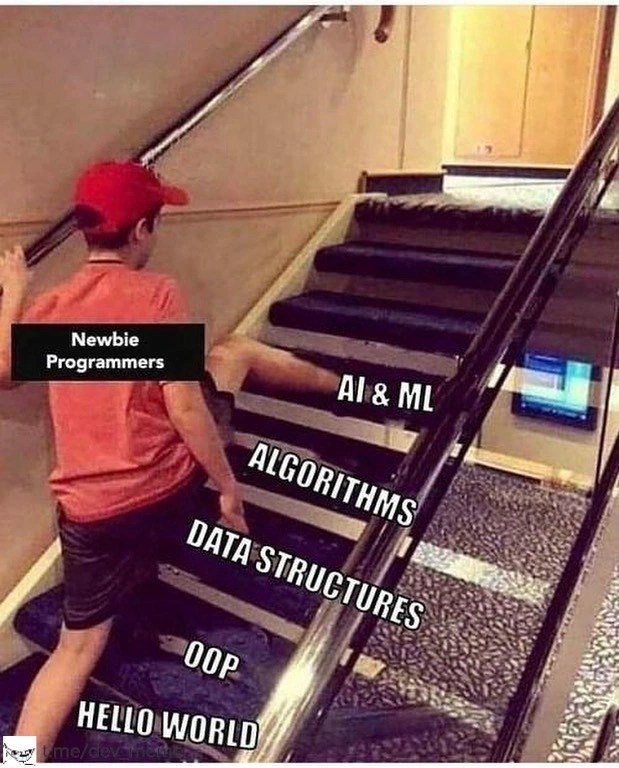
Imagine a kid who just learned how to stand up deciding that next, they want to ride a rocketship. đ Sounds funny, right? In real life, we know you have to learn to crawl, then walk, then run before you can do something super advanced. Thatâs exactly why this picture is silly and amusing. The boy in the image tries to jump up a bunch of stairs at once. Those stairs have labels like elementary school subjects in programming: first saying hello, then basic tools, then more tricky puzzles, and finally the rocket science stuff. Skipping all the easy steps and jumping straight to the hardest one is like trying to read a big chapter book without even learning the alphabet. You might really want to get to the exciting story, but if you donât know your ABCs, youâll just end up confused. The humor here is that we can all see heâs too eager â heâs so focused on the shiny, popular thing at the top (making a smart computer program) that he ignores the simple lessons that come first. Itâs a bit like trying to build the top floor of a house without building the lower floors: the whole thing might collapse. We laugh because we recognize that mix of big dreams and impatience. Everybody needs to start with small steps, no matter how excited they are about reaching the top. The meme is a goofy way to say, âDonât skip the basics, or you might stumble!â
Level 2: Climbing the Learning Curve
This meme shows a young programmer-to-be literally climbing the learning curve of computer science â or rather, trying to jump past most of it! Each stair has a label that represents a key step in learning programming, from the very first simple program to pretty advanced topics. Letâs break down those steps in plain terms, and why each one matters:
âHello Worldâ â This is often the first program anyone writes when learning to code. Itâs as simple as it sounds: you write a few lines of code to display the text âHello, World!â on the screen. It might seem trivial, but itâs an important confidence booster. Writing a Hello World program teaches you how to run a program on your computer and is a sanity check that your programming environment is set up correctly. Itâs kind of like learning how to turn the key in the ignition before driving a car. Skipping this step means you might not even know how to start or see output, which is the foundation of all coding.
OOP (Object-Oriented Programming) â Once youâre comfortable with basic coding, you usually learn how to organize more complex programs. OOP is a style of programming that uses âobjectsâ to design software. Think of objects as containers that bundle data and functions together, like a
Studentobject that has data (name, grades) and functions (calculate GPA). OOP helps keep code modular and manageable as projects grow. For example, in a simple game, you might have aPlayerobject and anEnemyobject each with their own behaviors. If you skip learning OOP, you might end up writing one giant blob of code thatâs hard to debug or reuse. Understanding OOP is a fundamental step in writing clean, organized code for anything beyond tiny scripts.Data Structures â These are different ways to store and organize information in a program. You can think of data structures as containers or shapes for data: like lists, queues, stacks, trees, or dictionaries. Each has its own strengths. For instance, a list (or array) is like a simple shelf where you line up data in order; a dictionary (or map) is like an index or phonebook where you can look up a value by a key; a tree structure is like a family tree that branches out. Learning data structures is crucial because it helps you choose the right tool for storing data efficiently. If you have a lot of data (say, millions of records for a machine learning program), knowing the right data structure can mean the difference between a program that runs in seconds vs. one that runs in hours. Skipping this step might leave a newbie programmer unaware of why their program is so slow or why it runs out of memory. Itâs like trying to organize a library of books in random piles because you never learned what a bookshelf is.
Algorithms â An algorithm is a step-by-step solution to a problem â basically, itâs a recipe that a computer can follow. Common algorithms you learn in CS 101 include sorting (how to put a list of items in order), searching (how to find an item in a collection), and more complex ones like pathfinding or data compression. Along with algorithms, you learn about efficiency using something called Big O notation, which is a way to talk about how fast or slow an algorithm is as the input grows. For example, if you have a list of 1000 numbers, a good sorting algorithm can sort them much faster than a bad one â algorithms matter. Learning this helps you write code that doesnât bog down as your data or user count grows. If a programmer skips studying algorithms, they might write code that works on small tests but completely fails or freezes with real-world sizes. Itâs similar to not knowing any cooking techniques â you might get by making a sandwich, but if you suddenly have to cook a meal for 50 people, youâd be in big trouble without efficient recipes and planning.
AI & ML (Artificial Intelligence & Machine Learning) â This is the high step the kid in the meme jumps to. AI & ML are advanced topics where you make programs that can learn or make decisions from data. For example, teaching a program to recognize handwriting, or to recommend movies based on your past watches, falls under AI/ML. These topics usually require understanding a lot of the above fundamentals plus some heavier math (like calculus and linear algebra) and domain knowledge. Modern machine learning often uses libraries and frameworks (
scikit-learn,TensorFlow,PyTorch, etc.) that do a lot of heavy lifting. Thatâs great because it lets even newcomers experiment with AI. But if you only learn the high-level tools without the basics, you end up treating AI like a magic black box. For instance, a newbie might use a neural network to solve a problem, but if they havenât learned about algorithms or data structures, they wonât understand the results or how to improve them. They might not realize their image classifier is overfitting (memorizing the training data instead of learning general patterns) because they skipped the lessons on how to evaluate and tune algorithms.
In a traditional learning journey (like a CS 101 class or structured self-study), youâd start at Hello World and climb each step in order: small programs, then structured programming and OOP, then data structures, then algorithms, and finally specialize in something like AI/ML. Each step builds on the previous ones, ensuring you have the tools to handle the next challenge. What the meme jokes about is newbie_overreach â when beginners try to leap straight to the flashiest, most âexcitingâ topic (AI, because itâs all over the news and job postings) while ignoring the underlying building blocks. Itâs poking fun at the learningCurve many attempt to cheat. We often say in programming, âthereâs no shortcut for experience,â and each of those skipped steps represents experience and knowledge that would make working in AI/ML much smoother.
For a junior or someone just starting out, the message is: donât be in such a rush to skip the basics. The fundamentals might seem dull compared to training a computer to beat a video game or predict the stock market, but those fundamentals are what will save you when something goes wrong. The meme is a lighthearted reminder that even the coolest tech is built on simple concepts. You have to learn to walk before you can run in tech, just like in anything else. Skipping straight to the âcool stuffâ might work for a short demo or a school project, but youâll hit a wall (or trip on a stair!) when you face a real-world coding challenge.
Level 3: Overfitting the Resume
The meme captures a classic industry trend in tech learning: enthusiastic newcomers leaping onto the AI & ML bandwagon while skipping_fundamentals. In the image, "Newbie Programmers" bypass steps labeled Hello World, OOP, Data Structures, Algorithms and plant a foot directly on AI & ML. This exaggerated leap is funny because itâs a too-real satire of how some aspiring developers try to fast-track their way to hot buzzwords. They want to build the next smart chatbot or a self-driving car AI without first printing "Hello, World!" or understanding what an object or array is.
From a senior engineerâs perspective, this is both humorous and cringe-inducing. It highlights a bootcamp_mentality seen in many coding bootcamps and hurried CS programs: focus on trendy skills to pad a rĂ©sumĂ©, often at the expense of solid CS_Fundamentals. Weâve all seen junior rĂ©sumĂ©s overfitting with keywords like TensorFlow, Neural Networks, and MachineLearningHumor, yet the candidates might struggle to explain a basic sorting algorithm or the difference between a stack and a queue. The term overconfidence bias comes to mind: a little knowledge (like using a high-level ML library) gives newbies a false sense that theyâre expert enough to skip the âboring basics.â Itâs the developer equivalent of trying to build a skyscraper without laying the foundation. Spoiler: that skyscraper (or codebase) gets very shaky, very fast.
Why is this leap problematic? Because AI doesnât live in a vacuum. Machine learning is built on algorithms and data structures under the hood. A newbie might import a fancy neural network library and get a model working on a toy dataset, but without understanding algorithms, they wonât grasp why their training slows to a crawl on larger data (hint: maybe that O(nÂČ) loop they wrote is the culprit). Skipping Data Structures knowledge could mean they choose the wrong way to store data (like using a list where a set is needed), turning a simple task into a memory-hogging mess. Overlooking OOP (Object-Oriented Programming) often leads to tangled, spaghetti code because they havenât learned to organize code into classes or modules. This makes even âHello Worldâ-level debugging a nightmare when the project scales. The meme nails the LearningCurve joke: bypassing the lower steps means the curve later on isnât just steep â itâs a cliff.
Thereâs also a rich irony here that senior devs smirk at. Hello World is traditionally a beginnerâs very first program â the canonical step to ensure your tools are set up and to learn basic syntax. Itâs a rite of passage going back to Brian Kernighanâs 1970s examples, a tiny two-word program that opens the door to everything else. Skipping that is like skipping âthe doorâ and trying to jump in through a second-story window. Each skipped step in the meme represents core CSFundamentals knowledge:
- Hello World: setting up the environment, basic syntax, and gaining the small thrill of seeing a program run.
- OOP (Object-Oriented Programming): learning to structure code with classes/objects, so larger programs donât become unmanageable. (Think of OOP as learning to organize tools in a toolbox instead of a messy heap.)
- Data Structures: understanding how to store and organize data efficiently (lists, dictionaries, trees, etc.), which is crucial when dealing with lots of input or big data in ML.
- Algorithms: learning problem-solving recipes and complexity (sorting, searching, Big-O notation) so your solutions are correct and scale well.
New developers who jump straight to AI & ML often treat these lower-level skills as unnecessary old steps â until reality kicks in. In real projects, an ML model is only as good as the code and data underpinning it. Without algorithmic thinking, a newbie could unknowingly create a model training loop that takes 10 hours instead of 10 minutes. Without understanding data structures, they might load data in a way that uses 10Ă more memory than needed, then wonder why the app crashes. And without OOP or clean coding practices, even a âsuccessfulâ AI prototype can become impossible to maintain or extend â a true newbie_overreach predicament where progress stalls because foundational knowledge is missing.
The humor has an edge of truth: every seasoned developer has either been that eager learner or has mentored one. We chuckle because we remember feeling invincible after building a toy neural network that recognized cats vs dogs, thinking âIâm basically an AI expert now!â â only to be humbled later by a basic bug or a whiteboard interview on DataStructures we couldnât solve. The memeâs staircase format is a step_skipping_gag that visually lampoons this over-eagerness. The AI hype in the industry is real â technologies like AI/ML are the shiny IndustryTrends_Hype of our time, attracting newcomers in droves. The experienced folks know that under the shiny hood of AI lies a powerful engine built from good old-fashioned code architecture and math. In other words, thereâs no free lunch theorem in learning either: you canât get the powerful results of AI without putting in the time to learn the fundamentals that power it. The boy in the meme might land his foot on the AI & ML step today, but without the support of the lower steps, thereâs a good chance heâll slip. And when he does, itâs the solid ground of Hello World and friends that will catch him (after some bruises to the ego). So, the meme is a playful reminder: even in a cutting-edge field like AI, you canât escape the basics â skip them at your own peril (and for the rest of us, amusement).
Description
This meme uses the 'skipping steps' format, where a young boy in a red t-shirt and baseball cap is seen taking a giant leap up a flight of stairs, skipping several steps in the process. A black label identifies the boy as 'Newbie Programmers'. The stairs he is stepping over are individually labeled from bottom to top: 'HELLO WORLD', 'OOP', 'DATA STRUCTURES', and 'ALGORITHMS'. The single step he is aiming for at the top is labeled 'AI & ML'. The meme humorously criticizes the common tendency for aspiring or junior developers to bypass fundamental computer science principles in their eagerness to work with trendy, high-level technologies like Artificial Intelligence and Machine Learning. To experienced engineers, this illustrates a familiar anti-pattern where a lack of foundational knowledge leads to poorly architected and inefficient solutions, even if the developer manages to get something superficially working in a high-level framework
Comments
7Comment deleted
It's the classic 'npm install tensorflow' approach to a computer science degree. What could possibly go wrong with the dependency tree?
Sure, you can âYOLOâ past data structures into deep learning - but when the gradient explodes, whoâs going to debug it, ChatGPT or the CS course you never took?
The real joke is that after 15 years, you realize the stairs are circular - you're still debugging Hello World, just in a distributed Kubernetes cluster with ML-powered observability that somehow makes printf debugging look sophisticated
The real plot twist? After climbing all those stairs to reach AI & ML, you discover the laptop at the top is just running a linear regression model that could've been implemented on step two. But hey, at least you can now call yourself a 'Machine Learning Engineer' and explain to stakeholders why their recommendation system needs a Kubernetes cluster with 47 microservices instead of a simple collaborative filtering algorithm
Newbies descend to Hello World like it's the final boss - after 'conquering' AI without a single balanced BST
Everyone wants a GPU budget before learning arrays, then wonders why their real-time inference is O(n^2) because the queue is a list
Skipping to AI means fine-tuning a 7B-parameter Hello World while an O(n^2) ORM query feeds it - gradient descent can't optimize away missing CS101