Skip to content
DevMeme
818 of 7435
Dating Profile Binary Filter
DevCommunities Post #925, on Dec 20, 2019 in TG

Dating Profile Binary Filter

Why is this DevCommunities meme funny?

Level 1: Secret Code Prank

Imagine your friend writes you a note using a secret code that only people like you know how to read. You're really curious and spend time translating all those strange symbols, thinking you’ll uncover a cool secret or a nice message. But when you finally decode it, the note just says, "You are a nerd!" 😲 It’s like a little prank — they tricked you into doing all that work just to playfully tease you.

In this meme, something similar is happening with a dating profile. The girl wrote her bio in a computer's secret language (a bunch of 0s and 1s). A curious person who knows a lot about computers got excited and decoded that gibberish into normal words, hoping for something fun or sweet. But the only message they found was a cheeky insult calling them a nerd. It's funny for the same reason a prank is funny: only someone with the know-how (in this case, the "nerd") would crack the code, and the moment they do, the message pokes fun at them. They end up laughing as well, because they realize they walked right into the joke. In simple terms, she hid a silly "gotcha!" note in code, and the techie who took the bait got roasted and amused at the same time.

Level 2: Hidden in Plain ASCII

Now let's break down what's happening in this meme in simpler terms. On the left side, there's a profile from a dating app (Tinder). Usually, a Tinder bio is a short blurb where someone describes themselves. But here, instead of a normal sentence, the bio is written entirely as a long string of 0s and 1s. At first glance it looks like nonsense, but to a programmer, those are immediately recognizable as binary numbers. In computing, binary (base-2) is the language of 0s and 1s that computers use to represent all data. So seeing a bunch of eight-digit binary numbers like 01101011 01101001... is a big clue that this could actually be text or some coded message in disguise.

The key to unlocking it is a code called ASCII, which stands for American Standard Code for Information Interchange. ASCII is a standard way to represent characters (letters, numbers, punctuation) as numeric codes that computers can handle. In ASCII, each character is assigned a number: for example, the capital letter A is 65, the lowercase a is 97, and so on. Those numbers are often shown in binary so the computer can store and process them. For instance, A (65) in binary is 01000001, and a (97) in binary is 01100001. Every printable character you can type on a keyboard—letters A-Z, a-z, digits 0-9, spaces, common symbols—has an ASCII code. So if you have a sequence of binary that aligns with those codes, you can decode it back into regular text.

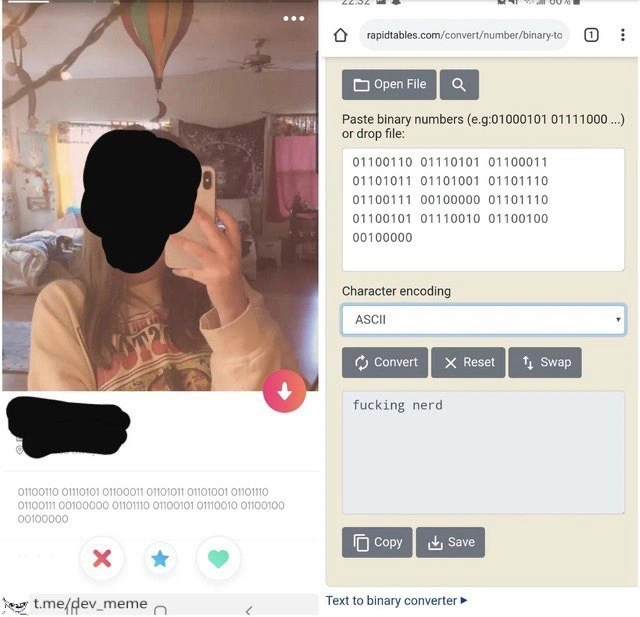
In the meme, the woman’s bio was exactly such a sequence. All those eight-bit numbers are ASCII codes for letters and spaces. The person viewing the profile (likely a developer) got curious and decided to translate that binary bio into plain text. The right side of the image shows how they did it: they used an online binary-to-text converter (you can see "Character encoding: ASCII" selected in the screenshot). They pasted the string of binary numbers and hit "Convert". What popped out in the output box was the phrase "fucking nerd". In other words, when the binary data is interpreted as ASCII text, it literally spells out an insulting message!

Let's illustrate how this conversion works with a short example. Take the binary chunk 01100110 from the bio. If we interpret that as a binary number and convert it to decimal, we get 102. Now, 102 in ASCII corresponds to the letter 'f'. We can do this in code to verify:

bits = "01100110"            # a chunk from the binary string
decimal_value = int(bits, 2)  # convert binary string to a decimal integer
print(decimal_value)          # outputs: 102
print(chr(decimal_value))     # outputs: 'f'

We'd repeat that for each 8-bit segment and then join all the characters together. Doing that for the entire bio yields "fucking nerd". The online converter essentially automated these steps for the whole string in one go.

So what does that mean in a normal sense? It means the Tinder bio was a secret message written in a form only a certain group of people (like programmers or tech enthusiasts) would recognize. The woman wrote her bio in binary code. If someone doesn't know about ASCII or binary, they'd just see a bunch of strange zeros and ones and probably ignore it. But a developer or a "nerd" sees a puzzle to solve. Here, the puzzle solution turned out to be a playful insult: the bio literally calls the decoder a nerd in plain English!

This is a kind of inside joke or prank. It's like she’s saying, "If you can read this, then haha, you're exactly the nerd I expected you to be." In developer communities, we actually do things like this for fun—hiding messages in code or obscure formats for others to find. It’s usually done in good humor. In this case, the humor comes from the unexpected result. The poor developer might have thought they'd unveil a cute hidden compliment or a reference (maybe something like "You found me! 😄"), but instead they got a cheeky burn.

To sum it up: the meme shows a scenario where a programmer’s special skill (reading binary ASCII code) leads them straight into a joke at their own expense. The phrase "hidden in plain ASCII" is a play on "hidden in plain sight"—the message was always there, written in a standard format, but only those nerdy enough to decode it would ever see it. And when they do, the message literally calls them out. It’s a funny example of how technical knowledge can sometimes backfire, serving up a punchline meant just for the ones who understand the setup.

Level 3: Binary Burn

In the left panel of this meme, we see a dating profile on Tinder with what looks like a meaningless string of 0's and 1's instead of a typical bio. Any seasoned developer’s eyes will immediately light up: that's binary code, practically begging to be decoded. We can't help it — after years of poring over bit patterns in crash dumps and weird encoding issues, spotting a binary sequence in the wild triggers our problem-solving instinct. So naturally, our hapless developer copies the bio's cryptic binary text and plops it into an ASCII converter (the right panel shows a site like RapidTables’ binary-to-text tool, a go-to for quick character encoding translations).

What comes out of the conversion is not a hidden love poem or a geeky movie quote as one might hope, but the blunt phrase "fucking nerd". Ouch. It's a perfect bait-and-switch that tickles the dev funny bone while lightly roasting them. Essentially, she set up a nerd trap. The only people who will bother to translate that wall of 0s and 1s are exactly those who live and breathe tech enough to recognize it — in other words, nerds. And the payload is a not-so-subtle burn delivered precisely to that audience. If you decoded it, you pretty much proved her point.

The humor here comes from how precisely it targets developers' habits and knowledge. We pride ourselves on understanding data formats, so encountering a Tinder bio in raw binary feels like discovering an Easter egg. The bio is written in ASCII binary, meaning each group of eight bits corresponds to a text character. A savvy coder can actually spot clues that this is intentional ASCII text, not random gibberish:

  • 8-bit chunks: The bio's binary string is neatly segmented into groups of 8 bits (like 01100110). That's exactly one byte per group, which is the standard size for a single ASCII character. Random binary data wouldn’t line up so perfectly into readable byte-sized pieces.
  • Spaces in binary: You can see the sequence 00100000 appearing at intervals in the string. In ASCII, 00100000 (binary for decimal 32) represents the space character " ". Those regular spaces suggest the binary forms separate words in a sentence rather than one long jumble.
  • Letter patterns: Many of the bytes start with 0110, for example 01100110, 01110101, 01100011... In ASCII, all lowercase letters a through z have binary codes from 01100001 (97, 'a') to 01111010 (122, 'z'). That recurring 0110 prefix is a telltale sign you're looking at readable lowercase letters.
  • No weird outliers: All the byte values fall into the range of normal printable ASCII characters (letters and basic punctuation like spaces). There are no odd control codes or lone high bits. The data is too perfectly structured to be anything but a deliberate text message.

Armed with these hints, a developer knows there's a real message hiding here and instinctively decodes it. This plays into a common programmer behavior: we love hunting for hidden meanings in what others see as noise. In tech circles, hiding messages in plain sight is a time-honored tradition. We've all heard of source code comments or website Easter eggs left by cheeky developers. (For instance, inspecting a website's HTML/CSS might reveal a secret ASCII art or a note like, "Psst, we see you looking at the console. Wanna work with us?" left as a wink to fellow techies.)

This Tinder bio gag exploits that exact curiosity. The developer expects some insider reward for decoding the binary — maybe a clever joke or a flirty reference only programming geeks would get. Instead, they get the rug pulled out from under them: the inside joke is on them. It's a classic reversal of expectations. Normally, uncovering a hidden message gives a sense of pride or belonging ("I solved it! I'm in on the joke."). Here, the punchline is basically "Ha, you took the time to translate this... you nerd."

For experienced devs, there's an extra layer of irony and relatability. We've spent years mastering things like binary math, memorizing parts of the ASCII table, and wrestling with text encodings. It's a niche skill set outside of coding — almost a party trick — except here the "party" is a dating app. Using our highly specialized knowledge in a flirty social context is already funny (who decodes binary on a dating profile? A proud nerd, that's who). And then to have that effort rewarded with a playful jab rather than admiration is the cherry on top. Within nerd culture, being called a nerd isn’t even a true insult most days (many of us wear it proudly), but in a dating scenario it underscores feeling just a tad out-of-place. The meme cleverly merges these worlds: it's computational humor colliding with social commentary about dating expectations.

Ultimately, this meme is a laugh both at ourselves and at how easily our developer instincts can be used against us. The joke is so surgically targeted — using real binary-to-text conversion with the ASCII setting highlighted — that any programmer immediately gets that simultaneous feeling of being impressed and being owned. It's the kind of gag you'd excitedly share with your coder friends, saying "Look at this savage Tinder burn in binary!" You know that whoever decodes it is exactly the kind of person who would appreciate the joke, even if they're also the butt of it. In the end, we're left with a memorable nerd-inception: a secret message that playfully dunks on the very geeks who are clever enough to uncover it.

Description

A two-panel meme juxtaposing a dating app profile with a binary-to-text converter. On the left, a screenshot from a Tinder-like application shows a woman's mirror selfie, with her face obscured. Her profile biography consists solely of a string of binary code: '01100110 01110101 01100011 01101011 01101001 01101110 01100111 00100000 01101110 01100101 01110010 01100100 00100000'. On the right, a screenshot of the website rapidtables.com shows this binary code pasted into a converter, which translates it from ASCII to the English text 'fucking nerd'. The humor arises from the tech-specific filter used in a social context; only someone with the curiosity and knowledge to decode the binary would understand the playful insult, making it a classic in-joke for the tech community
Comments

7
Anonymous ★ Top Pick This is the geek equivalent of a CAPTCHA to prove you're not a bot... or a project manager
  1. Anonymous ★ Top Pick

    This is the geek equivalent of a CAPTCHA to prove you're not a bot... or a project manager

  2. Anonymous

    Nothing like letting UTF-8 crush your UTF-feelings - turns out even romance is little-endian

  3. Anonymous

    After 20 years in tech, I've learned that encoding your feelings in binary is like deploying on Friday - technically possible, but the human response will always be unpredictable and potentially hostile

  4. Anonymous

    When your dating profile doubles as a unit test for potential matches: if they can decode binary without Googling, they've passed the technical screening round. Bonus points if they recognize this is essentially a human CAPTCHA designed to filter out non-technical candidates. The real question is whether 'fucking nerd' is a bug report or a feature specification

  5. Anonymous

    20 YoE and still bookmarking text-to-binary tools instead of `''.join(format(ord(c), '08b') for c in 'fucking nerd')` - true senior efficiency

  6. Anonymous

    Love this auth pattern: pass the ASCII handshake and you instantly get a 403 - decoder detected, violating the non‑functional requirement of “no nerds.”

  7. Anonymous

    That bio is a Bloom filter implemented in 8‑bit ASCII - if you decode it, you’ve already matched the set, and the payload says so

Use J and K for navigation