Skip to content
DevMeme
816 of 7435
Free Antivirus to the 'Rescue'
Security Post #923, on Dec 19, 2019 in TG

Free Antivirus to the 'Rescue'

Why is this Security meme funny?

Level 1: Security Guard Thief

Imagine you have a cookie jar and a sneaky thief grabs it and starts running away. You shout for help, and a friendly security guard shows up just in time. The guard catches the thief and stops them – phew, your cookies are safe from the bad guy! But then, instead of handing the jar back to you, the guard tucks your cookie jar under his arm and walks off, waving goodbye. You stand there confused, thinking, “Wait, those were my cookies!” In the end, you lost your cookies either way. First the thief tried to take them, then the very person who was supposed to help took them "for safekeeping." It’s funny in a silly way, but also not fair, right? That’s exactly what this cartoon is showing: sometimes the helper who promises to protect your treasures might end up keeping them. It’s a simple reminder to be careful who you trust with your stuff – whether it’s cookies, toys, or even personal data on your computer. The hero might turn out to be another thief if you’re not paying attention.

Level 2: Hidden Price Tag

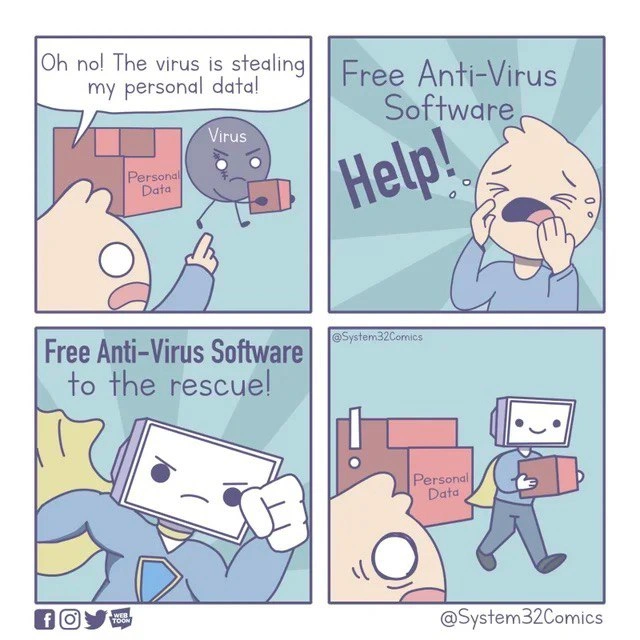
Let’s simplify what’s happening in this meme, especially for those newer to security. We have a virus (a type of malicious software, or malware) that is stealing someone’s personal data. “Personal Data” could mean anything from your documents, photos, passwords, or browsing history – basically stuff you don’t want strangers to have. The character is understandably panicking: “Oh no! The virus is stealing my personal data!” This is a scary scenario that we hear about often in tech: a data breach or personal info theft. To stop it, the character calls out for help and in comes Free Anti-Virus Software – essentially a program meant to detect and remove viruses for free.

Antivirus (AV) software works by scanning your computer for those malicious programs and stopping them. Many companies offer a free version of their AV in addition to paid suites. Free sounds great, right? It’s like getting a security guard for your computer without paying. In the comic, the AV is drawn as a superhero with a cape – that’s how it markets itself: the rescuer of your data and defender against hackers. And indeed, in panel 3, “Free Anti-Virus to the rescue!” – it appears to save the day by punching out the “Virus” bad guy. So far, so good: the Security threat is handled.

But here’s the twist and where PrivacyConcerns creep in. In the last panel, that superhero antivirus is walking away with the box of “Personal Data” in its hands. The user is left stunned, basically thinking, “Wait, what?! That’s mine!” This scenario is highlighting that free software often has a hidden price tag. If you’re not paying money, you might be paying with your information. This is a common reality in the tech world: free apps and services make money by collecting user data (with or without your full awareness) and using it for advertising or selling it to third parties. It’s a form of telemetry collection — which means the software is gathering data about your system and usage and sending it back to the company. They might do this for legitimate reasons like improving the program or catching new viruses (for example, uploading a suspicious file to a cloud server to analyze it). However, there’s a fine line between necessary data collection and spyware. Spyware is a type of malware that spies on you — it gathers info like your browsing habits or files and sends it to someone else.

Now, a reputable free antivirus isn’t going to steal your banking info and send it to criminals (that would be outright malicious and illegal). But it might, for instance, log what programs you use, or what websites you visit that it considered risky, and send those logs to its company’s server. They often mention this in the EULA (End User License Agreement) or during installation as “collecting anonymized data to improve our service.” The joke in the meme is that, effectively, your data still got taken away to someone’s vault – maybe not a thief’s hideout, but the antivirus company’s database.

This raises a Security vs. DataPrivacy issue: you solved one problem (got rid of the virus, improving security) but introduced another (your data isn’t entirely private anymore). The meme simplifies it by showing the AV literally walking off with the data. In real life it might not be so blatant; you might just notice targeted ads later and wonder how, or read an article outing a “free” service for selling data. The tags like free_antivirus and spyware_disguised_as_av point to exactly this concern – some free security tools act almost like the thing they promise to protect you from. It’s a bit of a bait-and-switch: you think you installed a guard, but that guard is taking detailed notes on everything you do.

For someone early in their tech career (or any user), the key takeaway is: nothing is really free. With software, if you aren’t paying with cash, you might be paying with information. In the context of antivirus:

  • A paid antivirus makes money from your subscription, so it hopefully has less need to gather or monetize your data (aside from necessary info for it to function). You’re the customer.
  • A free antivirus has to keep the lights on somehow. Some do it by showing you ads or constantly trying to upsell you to the paid version. Others might partner with other companies or, worst-case, sell some user data (hopefully anonymized, but who knows) to advertisers. In that case, you’re not the customer, you’re part of the product being sold (your data is the product).

The meme uses a humorous storyline to make a point for SecurityAwareness: be cautious of what you install, especially if it promises to do something serious like protect your entire computer but doesn’t charge you anything. Always ask, “How are they making money?” Sometimes the answer is “by harvesting user data.” Even legitimate companies might do things that make you uncomfortable if you knew. This comic is basically an awareness poster: sometimes the cure can feel a lot like the disease. It encourages a healthy bit of skepticism. After all, an antivirus needs a lot of access on your machine to find viruses – and with great power comes great responsibility (or great risk, if misused).

In summary, panel by panel in plain terms:

  • Panel 1: A virus (bad program) is stealing personal data. User is panicking. (Security problem!)
  • Panel 2: User calls for the Free Anti-Virus for help. (This is the typical reaction: download a free tool to fix it.)
  • Panel 3: The Free AV (drawn as a hero) knocks out the virus. (Threat removed! Hooray, data saved… maybe.)
  • Panel 4: The Free AV walks away holding the user’s data. (Uh oh… the data is “saved” from the virus, but now the AV took possession of it. Privacy problem!)

That’s the hidden price: your data ended up with someone else anyway. The meme is a lighthearted way to remind us to think about privacy even when we’re solving a security issue. It’s not saying all free AV is evil; it’s just a caricature of a real risk. As developers or power-users, it’s a nudge to be more transparent and cautious about such trade-offs, and as everyday users, it’s a reminder to read the fine print (or at least choose well-known, trustworthy tools). After seeing this, you might double-check the settings on your security tools or consider whether that free app is really worth it.

Level 3: Freemium Faustian Bargain

Why do devs smirk (or groan) at this comic? Because it’s riffing on the old saying: “If you’re not paying for it, you’re the product.” The meme shows a delighted “Free Anti-Virus Software” superhero swooping in, only to exfiltrate your data itself. This hits close to home for anyone who's seen how some "free" security tools operate. The humor comes from exaggeration, but only slightly. In real life, many free antiviruses do walk off with something of yours — maybe not your entire “Personal Data” box in one go, but certainly loads of telemetry about your system and habits. They’ll justify it as improving your security or “for research,” but experienced folks know a PrivacyConcern when they see one. The comic literally illustrates a scenario insiders call the security vs privacy tradeoff: you got rid of the obvious Malware threat, but now you’ve got a trusted program quietly acting a bit like spyware, siphoning info to its own vault (database). The final panel’s punchline is basically: “Saved your data... to my collection!” It’s a cynical twist that lands because it contains truth — just ask anyone following the news around late 2019 about a certain antivirus vendor.

Indeed, around the time this meme was posted, a real-world drama was unfolding. Avast, a popular free AV (hello there! 👋 “Hello from Avast!” as the post ironically says), was found to be collecting users’ browsing history and app usage and selling it through a subsidiary. The very company positioning itself as a guardian against Data Breach and malware was quietly packaging detailed user clickstreams for marketers. To the rescue!… or perhaps straight into a marketing database. This comic by System32Comics cleverly captures that facepalm-worthy moment. The character’s stunned expression in Panel 4? That’s basically the tech community when they read the investigative reports. It’s funny in a dark way: we all sorta knew there’s a catch with free services, but seeing it play out so blatantly was still shocking. The meme resonates because it visualizes an open secret in security circles: Free antivirus software often comes with strings attached — your privacy being the string.

Let’s break down the roles here. The round gray Virus in panel 1 is the obvious villain, labeled and caught in the act of stealing the “Personal Data” box. That’s classic malware: creeping into your system, trying to send your documents, passwords, or photos off to some remote hacker. The panicked user yells “Help!” and in comes the caped hero, the Free AV. We’ve seen this narrative a thousand times in marketing: “Download our free security tool and save the day!” The comic even uses the dramatic “to the rescue!” tagline, which is exactly how these products see themselves. And to give credit, many do remove the offending virus. But… as the final scene shows, the story doesn’t necessarily have a happy ending for the user’s DataPrivacy. The “hero” walks away with the same box of personal files. That’s a sharp commentary on how some security products simply replace one data thief with another, more subtle one.

Why is this so relatable for seasoned developers and IT folks? Because many of us have cleaned up machines where the cure was as bad as the disease. Think of those countless toolbars, “PC optimizers,” and freemium antiviruses non-techie friends install. You eliminate the ransomware, only to find the AV itself nagging for an upgrade or sending suspicious outbound traffic. It’s practically an industry pattern: the free tier of security software often comes bundled with PUPs (Potentially Unwanted Programs) or aggressive data collection modules. In corporate environments, we worry about shadow IT – users installing unapproved “security” plugins that actually exfiltrate company data. In personal life, we tell our relatives, “Just use Windows Defender and don’t click shady links” because we’ve seen free AVs bog down systems with pop-ups or worse, sell data. The comic exaggerates the scenario for humor, but not by much!

The “vault” imagery in the meme is spot-on. Many antivirus programs refer to their quarantine as a vault or chest. It’s supposed to be a safe storage for infected files, isolated from the system. But it’s also a witty metaphor: your data went into the vault, and now it’s the AV’s property. Whether it’s local quarantine or uploaded to a cloud, you are effectively no longer in control of that “Personal Data.” Just like the user in the comic who watches speechlessly as the AV walks off, you might not even realize if/when your files have been sent to quarantine in the cloud. Unless you dig into logs or Wireshark your network, you might miss that your free_antivirus just zipped up a document and phoned home. And let’s be honest, hardly anyone reads those lengthy EULAs where the software declares it might collect data. So the meme lands an SecurityAwareness lesson with humor: be careful what you install in the name of security! A freebie superhero might demand a secret fee.

To seasoned tech observers, this scenario is also a commentary on business models. Free antivirus companies have to make money somehow – if not from users, then from user data. This leads to a quiet but uncomfortable transformation: security software acting a bit like an adtech company. It’s a faux_security model: the software keeps you safe from outside threats, but meanwhile treats your data as fair game for monetization. The humor isn’t just that the user lost their data anyway, it’s also a wink at how gullible situations can be. It’s the “fool me twice” scenario. The virus fooled the user first, then the “savior” fooled them again. That double betrayal is something a lot of us have experienced indirectly. And if you haven’t, well, just know that clicking “I agree” on a free security tool might be signing a deal with the (data-hungry) devil – a true Freemium Faustian Bargain.

To put it in perspective, here’s a tongue-in-cheek comparison that illustrates why this meme hits home:

Virus 🦠 (Malware) "Free" Antivirus 🛡️ (Hero?)
How it arrives Sneaks in via a shady download or email attachment. You didn’t want this. Often invited in by the user seeking protection (marketed as helpful).
What it does Steals or encrypts your data, then tries to send it to a hacker’s server. Exfiltrates info without consent. Scans and quarantines threats... then quietly uploads a bunch of “telemetry” (browsing history, app usage, etc.) to the vendor. Often also without truly informed consent.
Visibility Tries to hide. Runs in background, hoping you don’t notice until damage is done. Runs openly (as a trusted app), but its data collection is usually hidden in settings or fine print. You might not notice what's being sent out.
Claims/Excuse No claim at all – it’s outright malicious. Claims to “keep you safe”. Data collection is “for your own good” or to improve service. (Trust us™)
Outcome for your data Data breach: Your info ends up in a bad actor’s hands. Privacy violated. Data trade: Your info might end up in the company’s servers (and possibly sold). Privacy... still violated.
Bottom Line You got hacked and your privacy is compromised. You got “protected”... but your privacy may be compromised anyway. 🤦

As you can see, the end result in both columns isn’t great for the user’s DataPrivacy. The meme distills this into a visual punch: whether it was the obvious malware or the trusted software, your precious “Personal Data” got yoinked. That mix of technical accuracy and comic exaggeration is why seasoned developers share a rueful laugh at this. It’s absurd, it’s true, and it shines light on an uncomfortable aspect of our industry: sometimes our “solutions” betray us in the very way we’re trying to avoid. In security engineering meetings, this is a well-known conundrum – how to ensure the tools don’t become another threat. The average user might not realize it, but every free app, especially one with system access, comes with an implied question: “Do I trust this thing with my data?” For free antivirus software in particular, many of us would answer that with a raised eyebrow and a healthy dose of skepticism. This comic just expresses that skepticism with a perfect dash of dark humor.

Level 4: The Trustware Paradox

At the deepest technical level, this meme underscores a fundamental paradox of security: to remove a threat, you often grant a security tool sweeping trust, almost as much trust as you give your operating system itself. Free or not, antivirus software typically runs with kernel-level privileges (the highest level of access on your machine). It hooks into file operations, intercepts system calls, and even inspects network traffic at a low level. In fact, many AV programs install their own network proxies or certificates to inspect HTTPS traffic, performing a controlled man-in-the-middle (MITM) on your encrypted connections. This is done under the premise of catching malicious downloads, but think about it: you're effectively handing the keys of your personal data vault to this software "hero." The meme’s final panel (the AV walking off with the “Personal Data” box) nails this irony – the guardian now has unrestricted access to the treasure it’s supposed to protect.

From a theoretical standpoint, it’s a classic “Who watches the watchers?” scenario (or Quis custodiet ipsos custodes?, as philosophers might say). Any endpoint security tool that is powerful enough to stop a sophisticated malware attack is, by definition, powerful enough to do serious damage itself. If a virus is a thief sneaking in through the backdoor, an AV is like a guard with keys to every door – great when the guard is honest, but devastating if they go rogue. Security researchers often point out that antivirus software increases the system’s attack surface. There have been real cases where vulnerabilities in AV engines allowed attackers to exploit those very high privileges: essentially turning the trusted defender into an open gate. For example, an AV might automatically unpack and analyze a shady file with deep system access – if that analysis code has a flaw, boom, an attacker can run code as SYSTEM (the most privileged user in Windows). In other words, installing an AV can introduce vulnerabilities as much as it removes them. It’s a double-edged sword that veteran engineers and security architects approach with caution.

There’s also the matter of data exfiltration under the guise of protection. Modern antivirus suites frequently use cloud-based scanners: suspicious files or even telemetry about your computer’s behavior get uploaded to the vendor’s servers for analysis. Ostensibly this helps improve detection via machine learning on big data. But fundamentally, it means your files (potentially even that secret project or embarrassing photo) might be quietly leaving your hard drive. The meme humorously calls this out by showing the AV literally carrying off the “Personal Data” box. Technically, the AV might label this process as “quarantine” or “cloud analysis” – a vault where infected files go. Yet, from the user’s perspective it’s not much different from what the spyware was doing: your data is leaving your control. The trustware_paradox tag is apt – the very software you trust to secure you operates with the same powers (and sometimes the same invasive behaviors) as the bad guys.

Security theory folks might liken this to Ken Thompson’s famous paper “Reflections on Trusting Trust” (1984). In that granddaddy of security gotchas, Thompson showed that you can’t fully trust a system if any part of its toolchain is compromised – even a compiler could hide a backdoor while looking benign. Similarly, if your “trusted” anti-malware guardian is itself doing something fishy (be it intentional like data harvesting or unintentional like having an exploitable bug), you might never know. After all, who’s going to detect the detector? The OS trusts it, you trust it, and it can essentially mark its own homework. This meme’s dark punchline draws on that unsettling truth: a free antivirus can effectively behave like a sanctioned rootkit (a program with deep, hidden control), moving with freedom on the system. In pure technical irony, the “virus” and the “anti-virus” become indistinguishable in behavior — except one wears a cape and a friendly face. That’s the faux_security reality the comic highlights at a theoretical level: if the cure has unchecked power, it can easily become a second disease.

Description

A four-panel comic from 'System32Comics' that satirizes the business model of free antivirus software. In the first panel, a user exclaims, 'Oh no! The virus is stealing my personal data!' as a grey, menacing 'Virus' character runs off with a box labeled 'Personal Data'. In the second panel, the user cries for 'Help!', with the text 'Free Anti-Virus Software' displayed prominently. The third panel shows a heroic superhero with a computer monitor for a head, labeled 'Free Anti-Virus Software to the rescue!', striking a powerful pose. The final panel delivers the punchline: the now-smiling antivirus superhero is calmly walking away with the 'Personal Data' box, leaving the user looking on in shocked silence. The comic humorously illustrates the cynical view that many free security products, while protecting from traditional malware, often engage in their own form of data collection, effectively making the user the product
Comments

7
Anonymous ★ Top Pick The main difference between malware and some free antivirus is that the antivirus gets your consent to exfiltrate data via a 40-page EULA you agree to at 3 AM
  1. Anonymous ★ Top Pick

    The main difference between malware and some free antivirus is that the antivirus gets your consent to exfiltrate data via a 40-page EULA you agree to at 3 AM

  2. Anonymous

    Free AV vendors perfected zero-day collection long ago - they call it their analytics pipeline

  3. Anonymous

    The real vulnerability was assuming anything with 'free' and 'enterprise-grade protection' in the same sentence wasn't harvesting telemetry to sell to the highest bidder

  4. Anonymous

    The real virus was the friends we made along the way - specifically, the 'free' antivirus that's now selling your browsing history to data brokers while proudly displaying a green checkmark on your system tray. At least the original malware had the decency to be honest about its intentions

  5. Anonymous

    In threat modeling, “free antivirus” turns the adversary into an approved vendor with admin rights - the attack surface doesn’t shrink, it just gets a EULA

  6. Anonymous

    Free anti-virus: the supply-chain attack where the 'dependency' owns your data pipeline

  7. Anonymous

    Endpoint agent taxonomy: malware exfiltrates data; “free AV” ships the same feature behind an EULA, a tray icon, and a scheduled telemetry job

Use J and K for navigation