Percussive Maintenance: If It's Good Enough for NASA...
Why is this Debugging Troubleshooting meme funny?
Level 1: If It’s Stuck, Whack It
Imagine you have a toy or gadget that suddenly stops working. You’re not sure why it’s not working right. A “normal” person might be very careful with it or just be confused. But someone like an experienced tinkerer (imagine your handy friend or a frustrated older sibling) might just give it a little smack to see if that helps. Sounds funny, right? But sometimes, believe it or not, that actually fixes the problem! For example, think of a flashlight that’s not turning on – you might shake or tap it to reposition the batteries, and suddenly the light comes back. Or maybe a jar with a tight lid – a quick bang on the counter can loosen it.
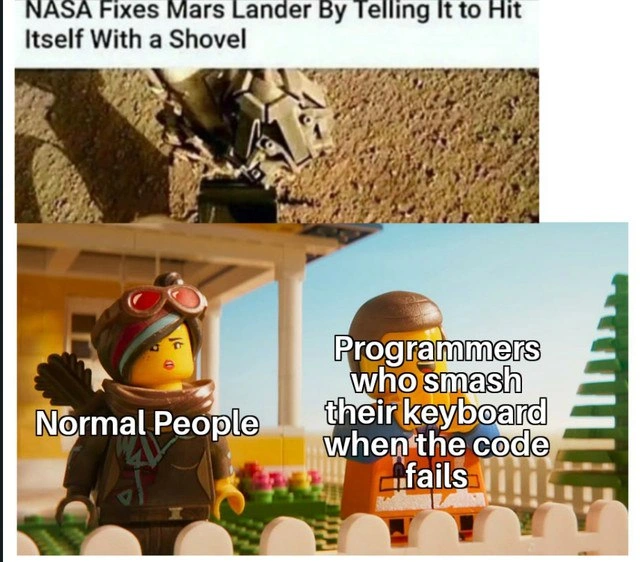
This meme is joking about that idea. In the top picture, even super-smart NASA scientists ended up fixing a Mars robot by basically telling it to hit itself with a shovel. That’s like the most high-tech version of “give it a tap” ever! In the bottom picture, we see LEGO characters: one is labeled “Normal People” and looks surprised, and the other is labeled “Programmers who smash their keyboard when the code fails,” looking totally okay with what’s happening. The joke is that regular folks are shocked that hitting the expensive Mars machine was the solution, but programmers – the people who write computer code – aren’t shocked at all. Why? Because when programmers get really frustrated by a computer bug or error that they can’t fix, they feel like hitting the computer or keyboard too (some actually do, at least a little smack or a big sigh and a fist on the desk). It’s a way to vent when nothing else seems to work.
So in simple terms: the meme is saying “Hey, even NASA had to fix something by banging on it. See? Sometimes just whacking the darn thing is the way to go!” The “normal person” is like “No way, that’s crazy!” but the programmer is like “Been there, done that.” It’s funny because it’s a mix of childish problem-solving (hitting it until it works) with the most advanced space technology. It makes us laugh and feel a bit better because even the smartest people sometimes use a super simple fix. It’s like finding out your teacher also sometimes guesses the answer when they’re stuck – a surprising and silly truth that we can all smile about.
Level 2: Brute-Force Debugging
In this meme’s two panels, we get a funny comparison between a high-tech fix and a low-tech instinct. The top panel references a real event: NASA’s Mars InSight lander had a probe (a digging instrument often nicknamed the “mole”) that got stuck in the Martian soil. After many careful attempts to free it failed, the NASA team tried a very direct method – they used the lander’s robotic arm, which has a shovel-like scoop, to hit or push the stuck probe. The headline paraphrased is “NASA fixes Mars lander by telling it to hit itself with a shovel.” It sounds crazy, but that was essentially true! The lander literally applied force to itself as a fix. This is a classic example of percussive maintenance – a term for fixing a device by whacking it in the right spot. Think of hitting an old TV on the side to stop the picture from flickering, or slapping a remote control to get the batteries to connect properly. It’s a real-world trial-and-error trick when we suspect something is just jammed or in a weird state physically. In NASA’s case, the shovel tap provided enough jolt to help the probe start digging again. Pretty cool, right? Even though it was a high-tech robot on Mars, the solution was almost like fixing a kitchen appliance by banging on it.
Now, the bottom panel uses a scene with LEGO characters (from The Lego Movie style) to illustrate two kinds of people. The character on the left is labeled “Normal People” and looks puzzled or concerned. The character on the right is labeled “Programmers who smash their keyboard when the code fails,” and that one looks calm or determined. This setup is showing a contrast in reactions: A normal person would be confused or think it’s absurd to hit an expensive Mars lander with a shovel to fix it. Meanwhile, a programmer – who has probably experienced a lot of debugging frustration – isn’t surprised at all; in fact, they’re portrayed as the type who might literally smash their keyboard when their code doesn’t work, out of pure frustration or as a last-ditch attempt at a solution.
Let’s break down a few terms and ideas here:
Debugging: This is the process of finding and fixing bugs (errors or problems) in software code. It’s like being a detective for why your program isn’t doing what it’s supposed to do. Troubleshooting is a similar idea, but can apply to hardware or any system: it means figuring out what’s wrong and how to fix it.
Bugs in Software: A “bug” is a mistake or problem in a program that causes it to behave unexpectedly. The term famously came from an actual moth that got stuck in an early computer, but nowadays it just means any coding error or glitch. Bug fixing (or bug squashing) is what programmers do to correct those mistakes and make the code work properly.
Brute Force Solution: In general, a brute-force solution means solving a problem by trying everything, or by using pure force/effort, rather than an elegant or clever strategy. In programming, a brute-force algorithm might test all possible inputs until it finds the answer because it can’t or doesn’t use a smarter shortcut. In the context of debugging, a brute-force approach could mean trying lots of random changes or overly simplistic actions to see if the problem goes away. It’s like throwing spaghetti at the wall and seeing what sticks.
Trial and Error: This is the “keep trying different things until something works” method. It’s not very systematic, but it’s sometimes what you resort to when you’re truly stuck. For example, if you can’t figure out why your program is crashing, you might start changing or commenting out sections of code one by one (trial and error) to narrow down the issue. It’s not the most efficient, but it can eventually get the job done when you’re out of other ideas.
Percussive Maintenance: As mentioned, this is the practice of hitting or physically jolting a device to try to fix an issue. It’s a somewhat jokey term because it sounds like a legitimate maintenance technique, but really it’s what people do when they’re frustrated or when they suspect, say, a loose connection or mechanical jam. Believe it or not, it has worked in many cases: from old tube TVs, to stuck jar lids (smacking the lid can loosen it), to even some car engines (a tap on the starter motor can sometimes get a stuck part moving). In hardware, sometimes a part isn’t broken, it’s just momentarily stuck or not in contact, and a quick hit reseats connections or overcomes static friction. Of course, whacking your device too hard can also break things, so it’s a risky “technique”! In our meme, NASA’s shovel-whack is a form of percussive maintenance on a $800 million piece of equipment – that contrast is hilarious when you think about it.
Keyboard Smash: When the meme says “programmers who smash their keyboard when the code fails,” it’s describing a (comical) image of a programmer literally pounding on their keyboard in anger or frustration. This isn’t a real problem-solving method for software (smashing keys won’t magically produce correct code), but it’s a relatable emotional expression. Many people who work with computers have felt the urge to smack the computer or keyboard when nothing is working. It’s basically an anger outlet. In internet culture, a “keyboard smash” can also refer to just mashing random keys (like “asdjkl;ghhh”) to express frustration or excitement in a chat. Here it’s taken more literally – the programmer is physically hitting the keyboard, akin to how NASA hit the lander.
Hardware Self-Repair: This phrase isn’t something you’d see in a textbook, but in context, it jokingly means the hardware (the Mars lander) fixed its own problem by using its built-in tools (its robotic arm) on itself. Usually, machines can’t repair themselves – humans have to repair them. But NASA sent a command, and then the robot essentially gave itself a thump. It’s like if your computer had an arm and, when a part got stuck, you could tell it “give yourself a good knock to shake things loose.” It sounds silly, but that’s what happened on Mars! So the tag mars_lander_fix and hardware_self_repair point to this unusual event where the solution was a physical action by the machine upon itself.
Now, why is this funny to developers? It’s because it validates a very human debugging experience. Normally, we think of NASA engineers carefully coding and analyzing data, not resorting to something that feels like a trial-and-error hack. But in this case, they did! So for programmers, it’s like, “Ha! Even rocket scientists have to roll up their sleeves and try the old smack-it method.” The meme labels show that a “normal person” might be bewildered by this approach – they might say, “Isn’t hitting it just going to break it more? That’s not a real fix!” But a programmer (especially one who has wrestled with stubborn bugs at 2 AM) will react more like, “I totally get it. Sometimes you gotta do what you gotta do.” The programmer Lego figure is ready for action because to them, whacking a device in frustration is an understandable move when you’re at wit’s end. In fact, there’s a common tongue-in-cheek saying among IT folks: “Did you try turning it off and on again?” That’s basically a gentler form of percussive maintenance – restarting a machine to jolt it out of a problematic state. It’s simple, sometimes crude, but often effective. Another joking saying is, “Just give it a good smack!” which we usually don’t mean literally for computers, but here the meme takes it to a funny literal place.
In summary, this meme uses a relatable humor scenario for techies. It connects an extreme real-life example (NASA’s brute-force shovel fix on Mars) with the everyday frustrations of debugging code. It teaches us that whether you’re coding a simple app or operating a Mars lander, problem-solving isn’t always elegant. Occasionally, trial-and-error and even a bit of (controlled) brute force saves the day. And that makes those of us who’ve felt dumb resorting to “silly” fixes feel a little vindicated and a lot amused!
Level 3: Shovel of Last Resort
This meme strikes a chord with seasoned engineers because it highlights the absurd yet familiar tactic of percussive maintenance – literally fixing something by hitting it – being used in the most high-tech context imaginable. NASA, the epitome of precision and engineering rigor, had a Mars lander instrument that wouldn’t dig. After all the fancy algorithms and careful remote troubleshooting failed, they basically told the lander to hit itself with a shovel. It’s a true story (from the InSight lander mission), and it worked. For experienced developers, this resonates as the ultimate “if all else fails, try brute force” anecdote. We’ve all been there during late-night debugging sessions, when a bug defies all logic and every elegant fix fails. In desperation, you resort to a seemingly caveman solution – maybe you literally smack the side of the misbehaving server, or more often you do the digital equivalent: kill the process, reboot the machine, or start randomly changing things (a practice jokingly known as shotgun debugging). The meme’s top panel shows NASA’s shovel-on-lander hack, and the bottom panel labels a bemused Lego figure as “Normal People” and a confident-looking Lego figure as “Programmers who smash their keyboard when the code fails.” This juxtaposition is comedic gold for developers.
Why? Because “normal people” expect complex problems to have complex, thoughtful solutions – they’d be shocked to see a billion-dollar Mars gadget whacking itself. Meanwhile, programmers (and IT folks in general) just nod knowingly, utterly unfazed. They’ve internalized a grim truth of debugging: when you’re staring down a stubborn bug or a frozen system at 3 AM, brute force solutions start to look extremely reasonable. The meme humorously validates that unorthodox instinct. It’s basically saying, “See? Even NASA sometimes fixes stuff by essentially giving it a good smack. You’re not crazy for pounding on your unresponsive PC!”
This speaks to shared developer experience (DX): the frustration of debugging can reduce even the most logical coder to trying primal tactics. There’s a sort of dark camaraderie in it – like a rite of passage. We all know the textbook way to handle bugs: systematically isolate the issue, use debuggers, logs, unit tests, etc. But the developer humor here is that in reality, when those refined methods fail, the situation can devolve into trial-and-error. You might furiously mash the keyboard or yank a cable, not because it’s in any manual, but because desperation and fatigue set in. It’s a cathartic release – and who knows, it might just jar something into place.
The NASA shovel hack is the perfect real-world example of “if it’s stupid and it works, it ain’t stupid.” It flips the script: the highest tech team on Earth (and Mars) validated a very low-tech approach. Historically, engineers have plenty of lore around this. Old mainframe acting up? Reseat the cards (basically, unplug and plug them back, maybe with a smack for good measure). Frozen laptop? Ctrl-Alt-Del or hard-reboot (the polite version of a slap). Got a rusted car starter? A few taps with a wrench might get it going. Even the term “percussive maintenance” is tongue-in-cheek official jargon acknowledging that whacking the device is sometimes effective. Seasoned devs have likely encountered hardware fixes like tapping a stuck hard drive to overcome stiction or slapping an old CRT monitor to stop it flickering. It’s not proper engineering, but it’s undeniably satisfying when it works.
In the software realm, physically smashing your keyboard won’t directly fix a code bug, of course, but it symbolizes those wild last-ditch efforts. (Who among us hasn’t hit “Run” over and over with increasing force as if the computer gods respond to enthusiasm?) The Lego scene’s contrast is brilliant: The “Normal People” character is like, “You’re telling me NASA solved a problem by hitting it?!” while the programmer character is basically rolling their eyes: “Oh, a stuck problem that got fixed by a good whack? Been there, done that, no big deal.” The relatable humor comes from that shared understanding that high-tech problems sometimes have low-tech fixes, and how outsiders find that shocking. It’s a wink and a nod to the notion that debugging frustration can turn the most rational engineer into someone willing to try almost anything – even something as seemingly crude as a shovel smack – to get things working again. And hey, when an approach is Mars-tested by NASA, it earns some geek credibility. So the next time you jokingly smack your misbehaving router or pound the keyboard when an app freezes, you can half-seriously claim you’re just following NASA’s best practices!
Level 4: Simulated Annealing IRL
Even in the ultra-technical realm of space engineering, sometimes solutions look surprisingly analog. At a deep level, NASA’s shovel hack on the Mars lander illustrates a concept akin to escaping a local minima in algorithms. The lander’s drill (the “mole”) was physically stuck due to soil properties – basically trapped in a metastable state where gentle logic (normal commands) couldn’t free it. By applying a sudden percussive force (whacking it with the shovel), engineers essentially injected a burst of energy to overcome static friction (a phenomenon engineers call stiction). It’s reminiscent of how a simulated annealing algorithm will occasionally take a big random jump to escape a rut in the solution space. In other words, NASA introduced randomness and force to jolt the system out of a stuck state – a real-world parallel to adding noise or a reset impulse in a digital system to shake out of a deadlock. This outrageous-sounding fix is grounded in solid physics and optimization theory: when finely-tuned control fails due to hidden variables (like unexpectedly cohesive Martian soil or an elusive software bug), a brute-force nudge can sometimes push the system into a workable path. It’s a last-resort nod to the laws of thermodynamics and search algorithms – sometimes you add energy (or randomness) to break free from an energy well (or bad state). The humor here comes from recognizing this lofty principle hiding in what looks like a caveman move. Even the most advanced systems occasionally need a good kick, validating that underneath all our refined algorithms and aerospace-grade code, the universe still permits – and sometimes rewards – a well-placed smack as a problem-solving technique.
Description
A two-panel meme that validates the classic programmer's urge to hit things when they don't work. The top panel shows a news headline, 'NASA Fixes Mars Lander By Telling It to Hit Itself With a Shovel', accompanied by an image of the InSight lander's robotic arm on the Martian surface. The bottom panel features a scene from The Lego Movie. The character Wyldstyle, labeled 'Normal People', looks with concern at Emmet, who is labeled 'Programmers who smash their keyboard when the code fails'. The joke provides a humorous justification for the frustrated, brute-force 'solution' of keyboard smashing. By showing that even a highly sophisticated organization like NASA resorts to a form of 'percussive maintenance' on multi-million dollar equipment millions of miles away, it normalizes the seemingly irrational behavior of a developer at their desk. For senior engineers, it's a funny and relatable take on the surprising effectiveness of unorthodox, low-tech solutions, even in high-tech fields
Comments
10Comment deleted
The official term is 'kinetic recalibration.' It's the first step in any senior engineer's debugging flowchart, right after 'blaming the compiler' and before 'sacrificing a rubber duck to the legacy code gods'
NASA just shipped the first remote percussive-maintenance API - kubectl shovel --namespace=mars - because at 20-minute RTT, brute force counts as a distributed-systems pattern
NASA spent millions on remote debugging tools just to reinvent percussive maintenance, while we've been practicing it on production servers since someone first suggested "just restart the pod."
When NASA's solution to a multi-million dollar Mars lander malfunction is literally 'have you tried hitting it?', you realize that percussive maintenance transcends all levels of engineering sophistication. The difference is NASA documents it as 'applying mechanical force to dislodge regolith obstruction' while we just rage-quit and blame the compiler. At least when their hardware doesn't respond, they can't accidentally commit the broken state to production
Percussive maintenance is just a physical-layer retry with exponential backoff - aka apply_impulse_until_telemetry_green()
NASA fixed a Mars lander by telling it to hit itself with a shovel - the only runbook where an idempotent bash command is literal. Keyboard‑smashing? Just local retries with terrible observability
Percussive maintenance: the only fix that works on both Mars rovers and Heisenbugs hiding in prod
Works with humans as well Comment deleted
Sometimes it the only way Comment deleted
But my main computer is a laptop... Comment deleted