The Standard Google Internship Trade Offer
Why is this Interviews meme funny?
Level 1: Puzzle for Prize
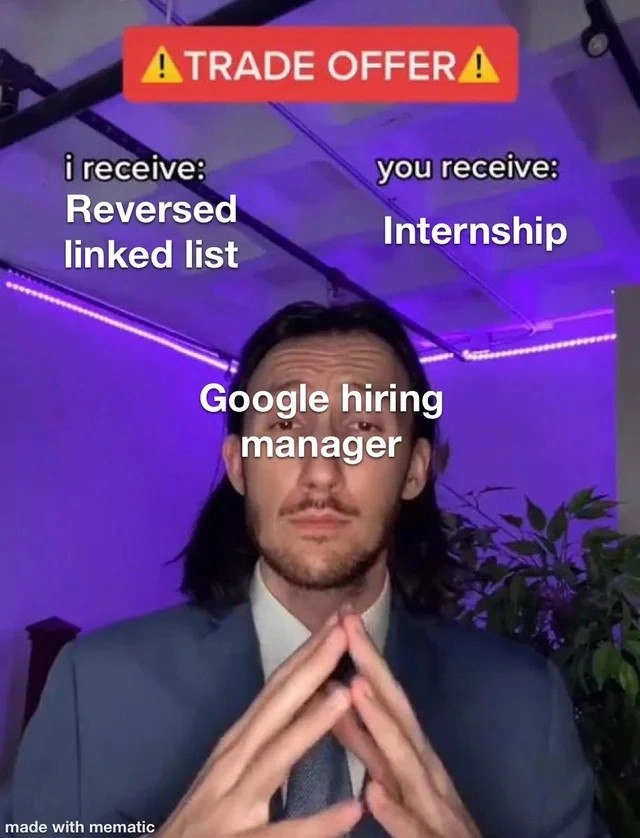
Imagine you really want a special treat, like a cookie, and a grown-up says, “Okay, but first you have to solve this little puzzle.” You solve the puzzle, and then you get the cookie as a reward. This meme is joking about the same kind of deal, but in the world of computer jobs. The “puzzle” here is a simple coding task (flipping a list of things backwards, which is a common little brain-teaser in coding), and the “prize” is an internship – kind of like a short-term job that could lead to a bigger job. The picture shows a serious-looking man offering this trade: “You give me the solved puzzle, I give you the internship.” It’s funny because it makes a big, dramatic deal out of something small and basic. It’s like saying getting a job is as easy as trading one little solved riddle for a ticket in. Of course, real life is a bit more complicated, but the joke makes us laugh because sometimes it really feels like that when you’re in an interview. It’s a simple exchange: do the trick, get the treat, and the meme makes that idea super clear and silly to bring out the humor.
Level 2: Reverse for Reward
So what exactly is going on here? Let’s break down the pieces for those newer to this:
Linked list – This is a fundamental concept in computer science. Imagine a chain of nodes (pieces of data). Each node holds some information and a pointer (or reference) to the next node in the chain. It’s like a treasure hunt where each clue points you to the next clue. In a singly linked list, each node only knows about the one after it. (There’s also a “doubly” linked list where nodes know about both their next and previous neighbors, but the classic interview question uses the simpler singly linked version.) If you have a list A -> B -> C -> D, A points to B, B points to C, C points to D, and D points to null (the end). This is a basic data structure taught in CS classes and is a favorite topic in CS_Fundamentals exams.
Reversing a linked list – This means changing all those pointers so that the chain goes in the opposite direction. If the original list was A -> B -> C -> D -> null, then after reversing it we want D -> C -> B -> A -> null. The first element becomes the last, the last becomes the first. In practical terms, you have to rewire each node’s next pointer to point to the previous node instead. If you’ve never done it before, it can be a bit tricky to visualize: you’re literally reversing the arrows. Imagine you have a line of people each pointing to the person on their right; to reverse the line, each person must turn around and point to the person who was on their left. You have to be careful so that nobody gets lost in the process! In coding, this often involves keeping track of three things as you move through the list: the current node you’re on, the one behind it (previous), and the one ahead (next) that you’re about to visit. By iteratively making the current node point to its previous instead of its next, you’ll eventually flip the entire chain. Here’s a short example in Python-like pseudocode to illustrate how one might implement it:
def reverse_linked_list(head):
prev = None # Start with no "previous" node
curr = head # Begin at the head of the list
while curr is not None:
nxt = curr.next # Save the next node
curr.next = prev # Reverse the pointer of the current node
prev = curr # Move prev to this node
curr = nxt # Move to the next node in the original list
return prev # New head of the reversed list (prev will be at the original tail)
In this snippet, we traverse the list, and as we go, we flip each next pointer to point backwards. By the end, prev is pointing at what used to be the last node, which is now the first node of the reversed list. If this is new to you, don’t worry – it’s a classic exercise in pointer manipulation and is taught in most programming courses. The key idea is not losing track of the list as you reverse it (that’s why we store nxt before changing curr.next). Once you've done it a couple of times, it starts to feel like a routine pattern.
Now, why is this important for the meme? Because “reverse a linked list” is one of those CodingChallenges that shows up everywhere in coding interviews, especially for internships or junior roles. If you’re a student or new grad preparing for interviews, there’s a very high chance you’ve practiced this problem on sites like LeetCode or HackerRank, or read about it in interview prep books. It’s basically the “Hello World” of TechnicalInterviews – a simple, well-known task that interviewers use to assess whether you understand pointers/references and basic algorithmic thinking. It’s so common that it’s almost a running joke in the developer community; everyone preparing for an interview ensures they can reverse a linked list in their sleep, because it might be the ticket to pass the first round.
Internship – In the tech world, an internship is typically a short-term job or training position, often for students or recent graduates (the Juniors). Interns get a chance to work at a company for a few months (like over the summer) to learn and contribute, and in return the company evaluates them for potential future hiring. Internships at big companies (like Google, Facebook, etc.) are highly sought after – they can be stepping stones to full-time jobs and great learning experiences. But to get an internship, candidates usually have to go through multiple interview rounds, including the dreaded technical interview where they solve coding problems. Think of it as an entrance exam to prove you have the basic skills. The meme highlights one of these entrance exam questions in a tongue-in-cheek way.
The Trade Offer meme template – This is an internet meme format that was trending around 2021. It usually features a person in a suit (with dramatic colored lighting and hands clasped) stating: “I receive: ___, You receive: ___.” It became a viral way to joke about all sorts of exchanges, both serious and absurd. In the original viral videos, the suited man lists what he’s offering and what he expects in return, often in a humorously mismatched way. Here, that format is applied to the interview setting. The left side of the meme says “I receive: Reversed linked list” and the right side says “You receive: Internship,” with the implication that the person making the offer is the interviewer or hiring manager. In fact, the meme even labels the person as a “Google hiring manager,” implying this scenario humorously represents a Google interview trade. So the format is being used to say: “The hiring manager is proposing a deal – if the candidate gives them a correct reversed linked list solution, the candidate gets an internship in return.” It’s a jokey way to summarize the feeling of a coding interview: transactional and somewhat absurd if you think about it literally.
Why is this funny or relatable? For many new developers or students, the internship interview process can feel intimidating and sometimes a bit absurd. You spend weeks practicing problems like sorting algorithms, tree traversals, and linked list tricks, all for a shot at a role where you might never use those exact algorithms again on the job. It can feel like you’re learning party tricks to impress an interviewer rather than skills you’ll use day-to-day. This meme resonates because it exaggerates that feeling: it reduces the whole interview to one well-known trick. The idea of “I’ll reverse this list for you, and you give me a job” is a comedic oversimplification — of course, real interviews involve more than that, but sometimes it does feel like a specific puzzle is the price of admission. It’s InterviewHumor that many folks who have gone through the process can chuckle at, especially if they’ve ever been asked exactly this question.
For a junior developer, it’s helpful to know the context:
- Big tech companies often use these DataStructures and algorithm questions as a filtering mechanism. It might seem scary or silly, but it’s the norm. That’s why you hear advice to practice on LeetCode or other CodingChallenges platforms.
- The “trade offer” phrasing in the meme is just for laughs — in real life no interviewer will phrase it so blatantly! But it captures the vibe perfectly. You might as well hear: “Implement a linked list reversal, and we’ll consider giving you a shot at this internship.”
- There’s also an implied gentle jab at companies: as if to say, “Is that all it takes? I hand you a basic algorithm, you hand me a job?” In reality, internships involve many more factors (resume, behavioral interviews, etc.), but the meme isolates this one aspect to comedic effect.
So, the meme is essentially InterviewHumor meets a trending meme format. It’s a lighthearted way to commiserate about the grind of tech interviews. If you’re preparing for interviews yourself, take it as both a joke and a hint: yes, you really should know how to reverse a linked list (along with other common problems)! But also, remember that everyone goes through this, and that somewhat silly as it is, it’s a shared experience that even seasoned devs look back on and laugh about. The next time you practice an algorithm like this, you might chuckle thinking of it as handing over a reversed list in exchange for your “prize.” 😉
Level 3: Pointers for a Position
At first glance, this meme repurposes the popular Trade Offer format to parody the ritual of tech interviews. The image shows a suited figure (labeled “Google hiring manager”) solemnly bartering: on the left, “I receive: Reversed linked list”; on the right, “You receive: Internship.” The humor hits experienced developers immediately: it caricatures a technical interview as a straightforward exchange — solve a classic coding puzzle and earn an entry-level job. It’s poking fun at how transactional the interview process can feel, especially for juniors in big tech.
In a real interview scenario (particularly at places like Google or other FAANG giants), candidates are often expected to demonstrate mastery of CS fundamentals and data structures under pressure. One of the most infamous examples is “reverse a singly linked list.” This problem is a staple of algorithm_interview_question culture — it's probably listed in every LeetCodeProblems top 10, right alongside FizzBuzz and binary search. Reversing a linked list involves carefully manipulating pointers (references) so that a list of nodes points in the opposite direction. It’s not rocket science for a seasoned dev (the solution is usually just a few lines of code), but it’s become almost a ritual in entry-level interviews. The meme exaggerates this by implying that reversing a linked list is the sole currency to purchase an internship.
Why is that funny (and a bit painful) to experienced engineers? Because it rings true. Many of us have sat on both sides of the table and seen how technical interviews turn into a form of coding challenge theater. Interviewers (like the meme’s Google hiring manager) often act as gatekeepers of a coveted opportunity (the internship), and the price of entry is performing well on a well-worn algorithm puzzle. It’s a barter: demonstrate you know this fundamental concept and maybe you’ll be deemed worthy of the role. The meme’s format dramatizes this, as if the hiring manager is calmly steepling their fingers and saying, “Show me you can invert a linked list’s pointers, and in return I grant you an internship.” It’s funny because it’s a dramatization of something very real and absurd: that a procedure as mundane as flipping a linked list is treated like the ultimate intern_trade_offer.
From a senior perspective, there’s an inside joke here about how InterviewHumor often centers on the disconnect between what interviews test and what the job actually requires. Reversing a list is a textbook problem taught in school; it's a neat way to check understanding of memory references or pointer manipulation. But in an actual developer job (even at Google), an intern is unlikely to ever manually reverse a linked list — they’d use a library method or a higher-level approach. Everyone knows this, yet the interview process still insists on these puzzles. That tension is comedic gold. We laugh because we’ve all either furiously practiced such CodingChallenges or administered them, knowing full well it’s more of a hazing ritual than a reflection of real-world coding. The meme distills this reality perfectly: “I receive your ability to invert node pointers (proving you studied your DataStructures), you receive a 3-month internship.” It’s a cynical formula, yet so widespread that it’s instantly recognizable to anyone in tech.
Historically, this practice comes from the belief that strong fundamentals in algorithms translate to solid problem-solving skills on the job. Companies like Google championed this approach in their hiring, which is why the meme specifically calls out a Google hiring manager making the trade offer. There’s a bit of tongue-in-cheek flattery in targeting Google — the implication is that at the pinnacle of tech, even getting your foot in the door demands this algorithmic tribute. Over the years, the industry has developed a shared consciousness (and a bit of PTSD) around these interviews. We’ve seen candidates invert binary trees, sum nodes in linked lists, implement quicksort from scratch – all to prove they’re competent. Memorizing solutions from sites like LeetCode has become a nearly mandatory part of the recruitment dance. This meme is acknowledging that reality with a smirk: “We know the game. Solve the puzzle, get the prize. Deal?”
From an engineering standpoint, reversing a linked list is a clean, classic problem: you traverse the list once (O(n) time complexity), adjusting pointers in place (O(1) space if done iteratively). It tests careful pointer handling – lose track of a node’s next pointer and you’ve suddenly wrecked the list (and your chances of impressing the interviewer). For seasoned devs, the task is almost muscle memory. In fact, many can write this blindfolded on a whiteboard under the stress of an interview timer. That’s why the meme elicits a chuckle and perhaps an eye-roll: the algorithm_interview_question process has become so routine that it genuinely feels like this trivial quid pro quo. The absurdly formal “⚠️ Trade Offer ⚠️” template only heightens that absurdity, framing the whole scenario as if it’s some high-stakes deal, when in reality it’s a somewhat mundane exchange of regurgitated knowledge for an entry-level opportunity.
Crucially, the shared experience underpinning the joke is what makes it relatable. Virtually every developer remembers preparing for these questions or being asked one in an interview. The InterviewHumor hits home because we collectively recognize how silly yet serious this dance is. In an ideal world, internships might be earned through demonstrated passion, project work, or relevant skills – but in the real world, often it boils down to performing well on a narrow set of algorithmic questions. The meme’s message: “This is the deal, take it or leave it.” It’s simultaneously a critique and a comedy. We laugh, perhaps a bit ruefully, because we’ve all essentially “paid” our reversed-linked-list dues to get where we are.
Description
A popular 'Trade Offer' meme format, originating from TikTok, applied to the tech industry's hiring practices. The image features a man in a suit (TikTokker @bradeazy) with his hands steepled, looking earnestly at the camera under purple lighting. A red banner at the top reads 'TRADE OFFER'. The offer is split into two columns: 'i receive: Reversed linked list' and 'you receive: Internship'. Centered below is the label 'Google hiring manager'. This meme satirizes the perception that technical interviews at major tech companies like Google disproportionately focus on classic, often abstract, computer science problems (like reversing a linked list) that may not be directly relevant to the day-to-day work of an intern. It humorously boils down the entire complex, stressful interview process into a simplistic, almost transactional exchange, highlighting a common critique of 'FAANG' hiring culture. For experienced engineers, it's a nod to the rite of passage that is the algorithm-heavy technical screen
Comments
14Comment deleted
The real trade offer is: you receive a six-figure salary, and I receive the satisfaction of knowing you can reverse a linked list on a whiteboard, a skill you will never, ever use again
Trade offer: you reverse a linked list in 5 lines; I give you an internship maintaining a microservice mesh that’s basically a distributed cyclic graph - let me know when you find the head
After 20 years in the industry, I've realized the only thing more efficiently reversed than a linked list in a Google interview is the candidate's confidence level when they're asked to do it on a whiteboard while explaining the space-time complexity to someone who's been writing YAML configs for the past five years
The real O(n) complexity here isn't reversing the linked list - it's the mental gymnastics required to justify why an intern position demands the same algorithmic prowess as a Staff Engineer role. At least they're not asking you to implement a B-tree on a whiteboard while the hiring manager silently judges your variable naming conventions
Nothing says internship ready like O(n) pointer rewiring on a data structure we replaced with arrays a decade ago
Internship trade: reverse a linked list on a whiteboard; then welcome to prod where the list is circular, doubly linked, and eventually consistent across three microservices
Reversing a linked list gets the Google internship; reversing their sprawling monorepo architecture? That's senior dev purgatory
It's a lie. Everyone knows you get hired to Google after solving a puzzle about infinite amount of water and two buckets. Comment deleted
Inverting binary tree goes brrrr Comment deleted
It's not a binary tree Comment deleted
Yeah I know. I heard that binary tree tasks are common on interviews for big tech companies, so I thought this would fit here Comment deleted
01010101 Comment deleted
Lmao Comment deleted
01011001 Comment deleted