The CSS Christmas Tree: display: none
Why is this Frontend meme funny?
Level 1: The Invisible Tree
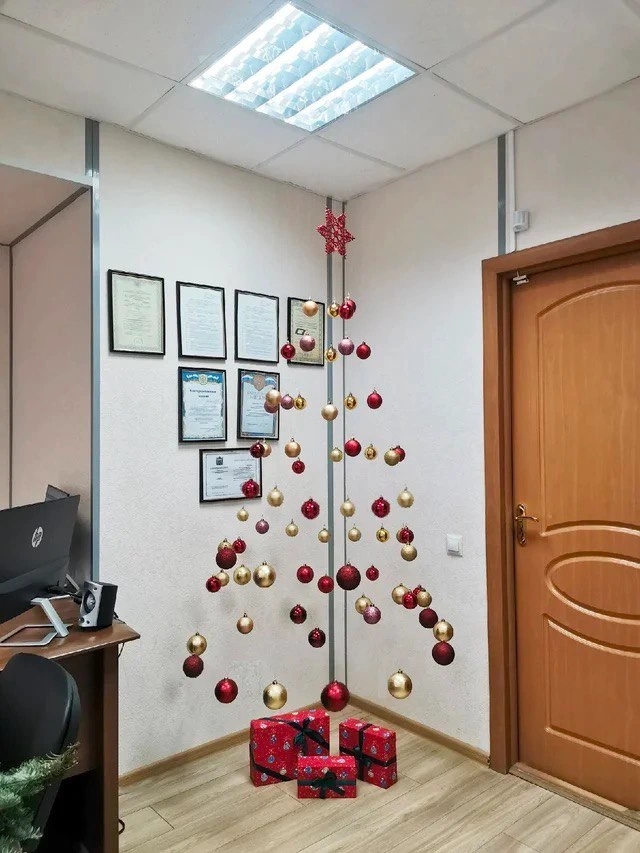
Imagine a Christmas tree that you can see but isn’t really there. In the office photo, all the shiny red and gold balls are hanging in the air in the shape of a tree, and there’s a sparkly star on top—yet there’s no actual tree holding them up! It looks like a tree from a distance, but if you walk closer, you realize the green part (the branches and trunk) is completely missing. They basically made an invisible Christmas tree by using thin strings to dangle the ornaments so that they outline a tree shape on the wall. There are even a few wrapped presents sitting at the base, just like a normal tree, which makes the illusion even better.
This is funny and clever because usually the tree is the main part of a Christmas tree, right? Here, someone left out the tree itself and only kept the fun parts (the decorations). It’s as if you drew a picture of a Christmas tree in the air with nothing but the baubles. Why would anyone do this? Probably to save space or avoid any mess (no falling pine needles to clean up, yay!). Maybe the office had a rule like “no big decorations” or they didn’t want to spend money on a tree, so a creative person said, “Let’s just hang the ornaments and pretend there’s a tree behind them.” It’s like a little prank or a magic trick: your eyes see the familiar triangle shape of a Christmas tree, but then you realize it’s all an illusion.
For a kid or anyone, it’s a bit like when you play pretend. Imagine setting up a bunch of toy ornaments in the air and saying, “Look, here’s my tree,” without actually having the tree part. It would make your friends both puzzled and amused. The emotional punchline here is that the office still got to feel festive and show holiday spirit, but in a super slim, almost ghost-like way. It’s both a Christmas tree and not a Christmas tree at the same time. That surprise—of seeing something so familiar done in such an odd way—is what makes it so amusing. Even if you don’t know anything about computers or fancy design terms, you can laugh at the idea that someone literally made a tree disappear and left only the sparkles hanging there. It’s a mix of creative problem-solving and goofy fun, and it leaves everyone who sees it with a big grin, thinking, “Wow, I’ve never seen a tree like that before!”
Level 2: All Ornaments, No Tree
At first glance, you notice something odd: there are shiny red and gold Christmas ornaments hanging in mid-air in the shape of a tree, and there’s even a red star on top – but there's no actual tree. The decorations outline where a Christmas tree would be, yet the tree itself is completely invisible! This is what they mean by a stateless, zero-footprint Christmas tree: it gives you the idea of a tree without using a real tree at all.
Let’s break down those buzzwords in simpler terms. In computing, stateless means not holding on to information between uses or steps. For example, a stateless web server doesn’t remember anything about you from one request to the next – it’s as if every time you visit, it has no memory of before. How does that apply here? A normal Christmas tree (like a real pine or even a plastic tree) “remembers” its shape – it’s there, physically supporting the ornaments all the time. But this stateless tree has no persistent structure. Once you take the ornaments down, there’s nothing left – no branches or trunk that stay behind. Each bauble hangs on its own, without a shared “tree memory.” In other words, the tree doesn’t keep state; the shape is temporary and only exists when all the ornaments are in place. If you remove them, you’re back to an empty corner with no sign there was ever a tree – just like a stateless service that leaves no trace when it’s done.
Now, zero-footprint usually means using almost no space or leaving nothing behind. In software, a “zero-footprint” application might run entirely in a web browser without installing anything on your computer – when you close it, it’s like it was never there. In our office decoration, zero-footprint means the Christmas tree isn’t taking up any floor space or permanent real estate. There’s no bulky tree stand or big pot of water. They used a slim metal pole in the corner (actually a conduit or column that was already part of the building) and nearly invisible threads to suspend the ornaments. If they take everything down, the office corner will look as if nothing was ever there – no pine needles on the floor, no holes in the wall, truly no footprint left behind. It’s the ultimate zero_budget_decor solution: they probably spent little to no money (maybe just on ornaments and string) and didn’t have to buy or store a tree at all.
So why would the office architect want a setup like this? In tech teams, an “architect” is a senior engineer responsible for designing the big-picture structure of systems (not unlike a building architect, but for software and IT systems). These folks often love efficiency and clever designs. One principle they champion is minimizing state and unused resources because that makes systems easier to scale and less error-prone. It’s become a bit of an inside joke in OfficeCulture that such architects try to optimize everything – sometimes to a humorous extent. Here, that mindset led to an extremely minimalist design for a holiday decoration. It’s as if someone said, “Do we really need an actual tree for this? What’s the simplest way to get the idea of a Christmas tree with the least overhead?” And they delivered exactly that: all ornaments, no tree. This kind of solution is creative and efficient, but also a little quirky – a fun example of engineering humor in real life.
Think of it this way: normally, you’d have a big green tree and you’d hang ornaments on it. That’s like a traditional all-in-one solution – everything in one place (in software, we’d call it a monolithic design). Here, instead, each ornament is kind of doing its own thing, hanging independently. Together they form the shape of a tree, but there isn’t a central tree tying them together (which is more like a distributed or modular design). In software, that’s akin to microservices: lots of little independent services that work together for a larger purpose, but there’s no single core program that everything relies on. If one microservice fails, the whole app can often still run, minus one feature. Similarly, if one string fell and an ornament dropped, you’d still recognize the shape as a tree (just with one “service” missing until it’s put back up). This shows the idea of loose coupling in a very visual way – each component (bauble) is separate, and only the overall arrangement creates the product (tree).
The caption with the code .tree { display: none; } is a wink to those familiar with web development. In Cascading Style Sheets (CSS), that rule means “hide the element with class ‘tree’.” So, if you had an HTML element representing the tree, that code would make it invisible on the page. The joke here is that they literally did that in the physical world: they hid the tree! All the decorations (which would be like the child elements in HTML) are still visible, but the tree container itself has been told not to display. You don’t need to know CSS to get the humor though – it’s basically saying in programmer language, “we turned the tree off.” The fact that the meme presents the solution as a bit of code is part of the fun, blending an office decoration with a coding gag. A junior developer might not catch the CSS reference immediately, but once it’s explained, it usually gets a chuckle: they treated the Christmas tree like a piece of HTML to be styled, and the style applied was display: none (no display). It’s a clever crossover between coding and decorating.
This whole scenario is a friendly example of overengineering turned out well. Overengineering means you’ve made something more complicated than it needs to be, often because you’re being extra clever or following strict requirements. Instead of just buying a normal tree (simple solution), someone spent time to design this floating ornament tree from scratch. It probably involved sketching the outline, cutting varying lengths of fishing line, and carefully hanging each bauble at the right height to form that perfect triangular tree shape. That’s a lot of work! In a way, it’s like writing a custom program to do something manually possible – more effort, but you do it for the challenge or to meet some precise goal. The end result here is pretty cool: it’s unique, conversation-starting, and fulfills the office rules (no mess, low cost, fits the design ethos). It shows how an engineering mindset can approach even a festive task differently.
For someone new to these concepts, the takeaway is that a stateless design removes the core object (no tree), a zero-footprint design minimizes impact (no space, no cleanup), and an architect’s job is to think about these kinds of optimizations. And sometimes, thinking that way leads to funny but smart solutions like this. The meme is essentially showing a suspended_bauble_architecture —hanging each ornament separately to simulate a whole— which is both practical in its context and amusing. It teaches that in engineering (and in office life), there’s often more than one way to solve a problem, and the most straightforward solution (a real tree) might be skipped in favor of an innovative workaround (zero_budget_decor for the win!). It’s this mix of creativity, technical inside-jokes, and holiday cheer that makes the scenario enjoyable for both seasoned devs and newer folks who are just learning why “less can be more” in design.
Level 3: Ornaments in the Cloud
This meme merges corporate design principles with holiday fun, producing a scene that makes experienced engineers smirk knowingly. We have what’s essentially a stateless (even serverless) Christmas tree. Instead of a traditional tree structure (the monolithic trunk holding everything up), there are just dozens of ornaments floating in formation—like microservices deployed in the cloud, each independent yet collectively forming a recognizable whole. The office architect clearly insisted on a design with no persistent state: no heavy trunk, no messy pine needles, nothing that holds memory or requires maintenance. The result is a zero-footprint decoration: it occupies virtually no floor space and leaves no trace when removed, a truly resource-optimized holiday hack that any minimalist would applaud. It’s as if they built a festive feature using only the interface (the shiny exterior) with the implementation (the tree itself) abstracted away. The team gets to brag about having a stateless_christmas_tree in production—holiday spirit delivered with almost no underlying infrastructure!
Only in a strict CorporateCulture environment (notice those framed compliance certificates on the wall) would someone go to these lengths to adhere to architectural ideals and office policies. This is a playful jab at how serious design patterns can infiltrate everyday life. If a real tree is deemed too stateful (needing water, shedding needles, violating some facility rule) or too wasteful for the budget, the solution is to abstract it away. In true MinimalismInDesign fashion, they've kept only the essential “user interface” of a Christmas tree—the sparkle and outline—while eliminating the bulky underlying data structure (the actual tree). It’s like implementing an interface with no concrete class behind it, or using a data structure where all the nodes are just references. The humor hits home for senior devs because it parodys that one colleague (we all know them!) who insists on purity in architecture: “Why use 100% of resources on a tree object when we can achieve the same output with 10% of the material?” This over-optimized holiday decoration is basically an overengineering in décor form, and it’s hilarious because it actually works. The corner of the room still screams “Christmas tree!” without any actual tree present.
Developers will also appreciate the cheeky front-end reference in the caption: .tree { display: none; }. In CSS (web styling), that one-liner hides an element from the page. Here it’s as if the tree element was told not to display, leaving all its child elements (the baubles) visible and perfectly positioned. We effectively have an HTML structure where the <div class="tree"></div> is invisible, but its contents are still in the DOM, hanging around exactly like the photo. This literal interpretation of a style rule in real life is pure TechHumor. It’s the kind of thing that makes a seasoned web developer snort: they basically debugged the office décor by toggling a CSS flag! The tree is there conceptually, but not rendered—just like a hidden UI component that still affects layout. You look at this corner and think, “Did someone just set the Christmas tree to display:none?” Yes, yes they did, and the proof is right before our eyes.
From a system design perspective, this pointer_based_tree_design is oddly fascinating. Each ornament is individually suspended by nearly invisible fishing line attached to the ceiling or that vertical metal conduit. Think of the conduit as a fixed pointer or spine in memory, and each bauble as an object placed at a specific offset (coordinate). There’s no bulky object holding them together—just references (the strings) linking them to a central support. The “tree” shape emerges from the careful placement of parts, not from a physically present tree object. In computing, we often do something similar: for example, using a sparse data structure that stores only the important pieces and omits all the empty space. Here, rather than storing an entire tree (with branches, etc.), they stored only the meaningful data points—the ornaments—and let the viewer’s eye (or the wall’s corner) fill in the gaps. It’s also reminiscent of a flyweight pattern in design, where you share as much structure as possible. The wall and gravity are the shared context here, and each ornament only adds its small part (color, sparkle) without needing a full tree of its own. And if one ornament falls off, you essentially get a dangling pointer (a bauble on the floor with no tree to hang on) – in software that’s an error, but in the office it just means someone needs to grab a ladder and reattach the rogue ornament. No big crash, no all-system downtime; the tree shape survives minor faults, much like a fault-tolerant microservice system where one node going down doesn’t bring the whole cluster down.
The EngineeringHumor shines through this whole scenario. It’s taking a serious concept (stateless, zero-footprint architecture) and applying it in the most literal, whimsical way. Seasoned developers find it so relatable because we’ve all sat in meetings about “eliminating unnecessary components” or “keeping things lightweight,” and here that philosophy has been applied to holiday decorating. It’s the ultimate corporate_xmas_hack: comply with every rule (spend nothing, add no clutter, break no fire codes) and still have a Christmas tree… kind of. We laugh because it reminds us of those times we followed best practices to the letter and ended up with a solution that was technically elegant but also a bit absurd. Yet, just like in those projects, you can’t argue with the result: it does the job. The corner looks festive and on-brand with the company’s love of efficiency. For any veteran developer, it’s hard not to smile and think, “Yep, that’s exactly what happens when an architect gets cheeky with holiday décor – Christmas Tree as a Service, deployed with zero downtime and zero leftover mess.”
Description
A photograph taken in an office corner shows a minimalist and nerdy Christmas decoration. Red and gold ornaments, along with a red star at the top, are suspended by fine threads from the ceiling, arranged to form the three-dimensional outline of a Christmas tree. There is no actual tree; the ornaments float in mid-air, creating a 'ghost' or 'invisible' tree. Below this structure, several wrapped Christmas presents sit on the floor. The caption provided for this image is '.tree {display:none}'. The joke is a clever visual pun on a fundamental CSS rule. In web development, `display: none;` is a CSS property that completely removes an element from the document layout, making it invisible. Here, the physical 'tree' element is absent, but its decorations remain, perfectly and humorously illustrating the concept

Comments
7Comment deleted
That's not `display: none`, that's `visibility: hidden`. The space is still reserved in the layout. You can tell by the presents underneath
Finally, a holiday deployment that’s truly server-less: a distributed mesh of dangling pointers that scales horizontally - just add more ornaments, no Terraform plan required
This is what happens when you ask a developer to implement a Christmas tree with O(1) space complexity - technically correct, vertically scalable, and guaranteed to pass all unit tests for 'is_christmas_tree = true'
When your office's cable management infrastructure doubles as a Christmas tree, you know you've achieved peak engineering efficiency. It's literally a dependency tree with proper vertical scaling, ornament load balancing, and zero horizontal footprint. The architect who designed this clearly understood the CAP theorem: you can have Celebration, Aesthetics, or Physical space - pick two. They chose celebration and space optimization, accepting that aesthetic compromises are just technical debt you pay off after the holidays. Bonus points for reusing existing infrastructure rather than provisioning new resources - truly cloud-native thinking applied to holiday decorations
Branchless architecture: no git merges needed, just deploy straight to main
Procurement freeze forced us to ship a headless, serverless Christmas tree - gravity as the scheduler, zero downtime, and strong consistency only from the approved viewing angle
We decomposed the monolithic spruce into microservices - 80 dangling endpoints, zero trunk, plenty of strings attached; one janitor is our chaos monkey and the ceiling hook is the single point of failure