Skip to content
DevMeme
5972 of 7435
Microsoft Unveils the Majorana 1 Quantum Processing Unit
QuantumComputing Post #6541, on Feb 19, 2025 in TG

Microsoft Unveils the Majorana 1 Quantum Processing Unit

Why is this QuantumComputing meme funny?

Level 1: New Magic Matter

Imagine you have a bunch of LEGO bricks, but these aren’t ordinary LEGO bricks – they’re magical ones. With normal LEGOs, if you build a tall tower and bump into it, it might wobble or fall apart. But Microsoft has found a new kind of LEGO brick that locks together in a super special way, so your towers stay standing no matter what little bumps come along. Using these new bricks, you could build something incredibly complicated and huge – say, a castle with a million tiny pieces – and it would still fit in the palm of your hand and not crumble. That’s essentially what they’re doing with this new quantum chip.

In simple terms, today’s computers are like skilled accountants using beads on an abacus – moving one bead at a time (those beads are like regular bits 0 or 1). A quantum computer is more like a wizard with a magical abacus where each bead can be both here and there at the same time until you look at it. This makes the wizard able to try many paths of a puzzle all at once. The trouble was, even a small sneeze could mess up the magic beads’ positions. What Microsoft did is invent a new kind of magic bead that’s much harder to mess up – almost like the beads are connected by an invisible thread that keeps them from flying off the abacus. They achieved this by creating a new material (think of it like discovering a new kind of metal or ice) that has very special properties. Satya Nadella (the big boss at Microsoft) excitedly said it’s like finding a “new state of matter” – kind of how water can be liquid, solid, or gas, they found a new way a material can exist that helps these magic beads (qubits) do their tricks without falling apart.

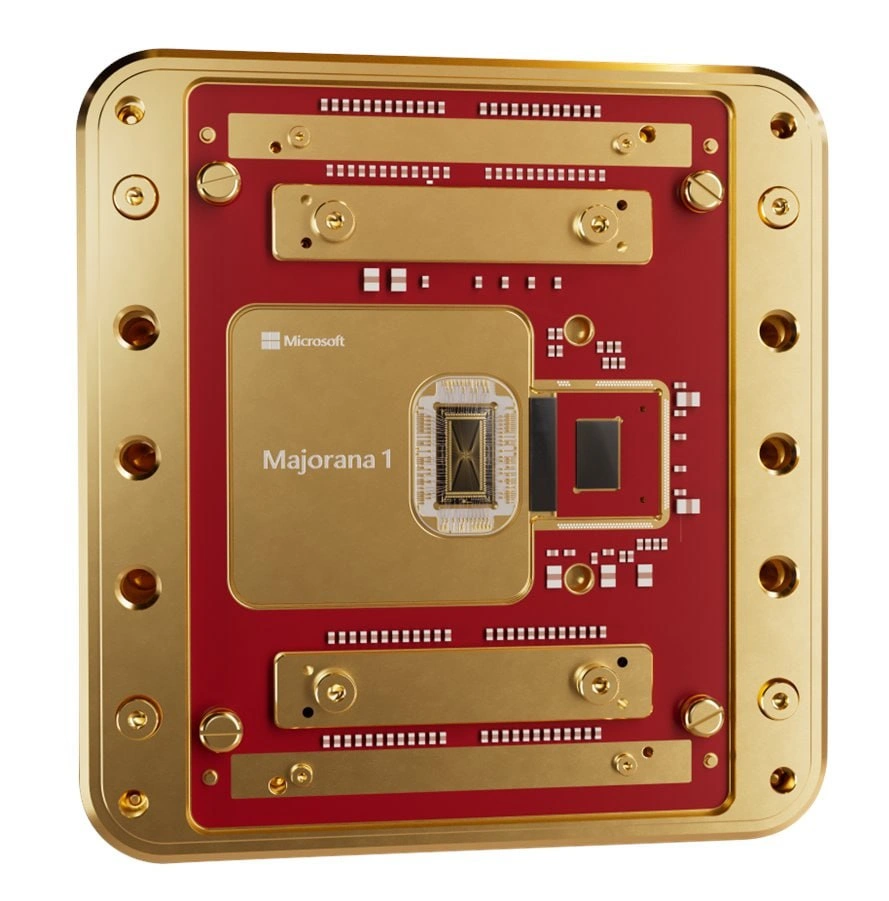
The picture shows a tiny chip that’s red with gold parts. It’s small but super powerful in potential – sort of like a shiny golden treasure chest that might hold a genie. The gold bits make it look like a little piece of jewelry or a pirate’s treasure, but they’re actually part of how the chip works and stays cool (gold is good for making sure the chip can talk to the outside world without interference, and it looks cool too!). If this chip works as hoped, it could solve really big riddles and problems that even the fastest normal computers can’t solve. It’s like having a team of a million geniuses inside a tiny box, all working together on a problem. People are excited (and maybe a tiny bit skeptical) because for a long time, this idea was like a fairy tale – something everyone talked about but hadn’t actually seen. Microsoft is now saying, “Look, we have it for real!” It’s a bit like if someone claimed they found a real-life phoenix or unicorn – you’d be amazed but you’d also want to see proof.

In the end, what’s important is that this isn’t just tech for tech’s sake – Microsoft is saying they want this quantum magic to help everyone, by solving tough problems and making computers much more powerful tools for humanity. So this little red-and-gold quantum chip is like a new hope in the tech world: a tiny shiny magic matter device that could make the impossible possible, turning what used to be wild sci-fi ideas into real-life capabilities. It’s both dazzling to look at and dazzling in what it promises – and that mix of wonder and awe is why people are talking about it with big grins on their faces.

Level 2: Beyond 0 and 1

Alright, let’s break down what all this means in simpler terms. Traditional computers use bits – little electrical switches that can be either 0 or 1 (off or on). Everything your computer or phone does, from emails to video games, boils down to those 0s and 1s being processed at billions of operations per second. Now, a quantum computer uses what we call qubits (quantum bits). A qubit isn’t just 0 or 1; thanks to a quantum property called superposition, it can be in a kind of combination of 0 and 1 at the same time (imagine a coin spinning in the air – not heads or tails yet, kind of both). This allows quantum computers to process a huge range of possibilities simultaneously. They can, in theory, solve certain kinds of problems much faster than normal computers. However, qubits are really hard to make and handle because the moment you observe or disturb them, they “collapse” to either 0 or 1 (like that spinning coin landing as heads or tails when you catch it). They’re also super sensitive – tiny vibrations, a slight temperature change, or electromagnetic noise can cause a qubit to lose its quantum state (we call that decoherence, basically the qubit saying “whoops, I lost my quantum magic, back to plain 0/1”). This error-prone nature has been a big roadblock: current quantum computers have to use lots of extra qubits to correct errors in other qubits, which is like having an army of proofreaders for a very jittery typist.

Microsoft’s Majorana 1 chip is attempting to solve that fragility by using a very special type of qubit known as a topological qubit. The word topological comes from topology, a field in math that deals with shapes and how they can be twisted or connected without breaking. Here’s a simple way to imagine it: think of a topological qubit like a message tied into a knot on a rope, whereas a regular qubit is like a message written in chalk on a blackboard. If you jostle things a bit, the chalk message can smudge or erase (normal qubit gets errors), but the knot (topological qubit) won’t easily untie just from small disturbances – the message stays intact. To make that kind of stable qubit, you need special materials and particles. Enter the Majorana particle: it’s an exotic quantum object (named after the Italian physicist Ettore Majorana) that is kind of its own antiparticle. Without diving into particle physics, the key point is that if you manage to create pairs of Majoranas in a material, they can form a qubit that’s encoded in the pair as a whole, not in one particle alone. If something local messes with one part, the overall info (the “knot”) can survive. The Majorana 1 chip uses a new material called a topoconductor, which is basically a specially engineered superconductor that can host these Majorana particles. A superconductor is a material that conducts electricity with zero resistance (usually at very low temperatures) – they often look like and include metals such as aluminum or, indeed, gold plating on the contacts, because you want super clean, conductive surfaces in these experiments. Microsoft is saying they’ve created a new phase of matter in such a material where these Majorana particles appear. That’s what Nadella means by “new state of matter” – it’s like how water can be liquid or turn to ice; here an electrical system can be in a normal state or in a new superconducting state that has this special topological property.

The image gives us clues: The red square is a circuit board (likely something that connects and cools the quantum chip). The gold frame and plates not only make it look cool, but also serve a purpose: gold is used in quantum chip packaging because it’s a great conductor and doesn’t corrode. The large gold plate labeled “Microsoft Majorana 1” is probably a protective lid or part of the cold housing for the actual qubit device. To the right of that label, there’s a small window showing a tiny silicon or III-V semiconductor die (the black rectangle) and an X-shaped structure inside. That X shape might be an arrangement of nanowires or contacts where the magic happens – possibly four nanowires meeting, which could allow the Majorana particles at their ends to be swapped around (that exchanging is how you’d perform operations on a topological qubit). It’s a bit like seeing the engine through a car’s hood, but in this case the “engine” is a tiny nanostructure only a few microns wide! The rest of the board has vias (little copper/gold holes) and traces (the white lines/silkscreen) to carry signals in and out, plus mounting holes at the corners (where screws likely attach it to a larger apparatus). This chip would be operated at extremely low temperatures (near absolute zero, maybe around 20 millikelvin) in a dilution refrigerator.

For a developer new to quantum concepts, what’s exciting here is the promise of qubits that are faster, more reliable, and smaller. Microsoft claims these qubits are about 0.01 millimeter (10 micrometers) in size. That is tiny – roughly the size of a red blood cell, or to put it another way, you could fit about 100 of them lined up in a millimeter. That small size and improved stability means we could finally scale quantum computers up. Right now, other quantum computers (like those using superconducting qubits from IBM) take up an entire lab with their cooling systems and control electronics, and the chips themselves might only have tens or hundreds of qubits arranged over several millimeters or centimeters. The notion of a million-qubit processor fitting in your hand is game-changing. It means packing enormous computing potential into a small form factor – something that currently is unimaginable with today’s qubit tech. If you’ve heard of Moore’s Law for classical chips (the trend that chips get denser and more powerful), there’s a kind of analogous dream in quantum computing: to go from just a handful of qubits to thousands or millions, because more qubits = more complex problems we can solve.

Let’s also clarify what problems a quantum computer could solve that normal computers can’t. It’s not that a quantum computer would replace your PC or run Minecraft faster. Instead, they’re suited for specific tasks: for example, running certain quantum algorithms like Shor’s algorithm to factor large numbers (which could break some encryption – this is why people talk about quantum computing in the context of cybersecurity) or simulating quantum physics and chemistry (like accurately modeling molecules for drug discovery or new materials – tasks that classical supercomputers struggle with). They’re also considered for complex optimization problems and machine learning tasks. However, to do any of that in a “meaningful” way, it’s widely believed we need thousands if not millions of high-quality qubits, because we also need to do error correction. So Microsoft saying they have a clearer path to a million qubits is like saying, “We think we found a way to actually build a quantum computer that can tackle real-world problems, not just toy demonstrations.” That’s a big claim.

From a Microsoft perspective, this Majorana 1 chip is part of their Microsoft Quantum program (sometimes branded under Azure Quantum). Microsoft even has a programming language for quantum called Q# and a whole software stack anticipating these quantum machines. The joke among some devs has been that Microsoft was late to show any physical progress because they put all their eggs in the Majorana basket – a basket that hadn’t materialized. Now it looks like that egg is finally hatching. In a sense, this image and announcement are as much about reassuring the developer community (“Yes, we’ve got real hardware coming, not just theoretical research”) as about the science itself. It’s a call-out to both hardware enthusiasts (Hardware geeks drool over the gold PCB and unique chip) and software folks (QuantumComputingConcepts tags hint at the new algorithms we can run) that quantum computing is advancing.

To sum it up in plainer terms: Microsoft built a new kind of computer chip – a quantum chip – that uses strange physics to be more reliable than previous quantum chips. They did this by inventing a new material (or using exotic physics in materials) that lets them make a qubit that doesn’t mess up so easily. The picture shows a fancy version of that chip. If this works, in a few years we could have quantum computers much more powerful than what we have now, possibly small enough to fit in a closet (though still not exactly a laptop – remember, it needs super cold refrigeration!). It’s a significant milestone for both Microsoft and the field of quantum tech at large. For newer developers or students, it’s a sign that stuff you learn in physics and advanced CS classes – like particle physics, quantum mechanics, and topology – can directly lead to leaps in computing technology. And hey, it also kind of looks cool and shiny, which doesn’t hurt in getting people interested.

Level 3: Superposition of Hype and Hope

At a high level, this meme-worthy announcement hits developers and tech enthusiasts with a mix of wow-factor and cautious optimism. On one hand, Microsoft is showcasing a gorgeous red-and-gold quantum chip render – it looks like something straight out of a sci-fi lab or a Marvel movie (the red-and-gold motif even gives off Iron Man vibes, with tech that Tony Stark would drool over). The image screams “premium hardware”: gold-plated components, precision-engineered nanostructures, and that enticing peek at a tiny X-shaped device at the center which likely houses the exotic qubit magic. For anyone who’s seen a real quantum computing lab, this polished presentation is almost amusing – in reality, most quantum hardware experiments involve a mess of cables, control electronics bigger than fridges, and qubits sitting in dilution refrigerators that look like steampunk chandeliers. Yet here we have a clean, palm-sized quantum chip being flaunted like a jewel. It’s quantum bling in the best way, and it signals, “Hey devs, quantum computing is becoming real hardware, not just theory or giant lab contraptions.”

The text from Satya Nadella in the post adds a heavy dose of hype (or hope?) that industry veterans will read with a critical but intrigued eye. He literally says they've created “an entirely new state of matter” – which is not a phrase you hear every day in a CEO’s status update! To be fair, this refers to the topological superconductors (topoconductors) enabling Majorana qubits. It’s a bold claim, bordering on sounding like sci-fi technobabble, yet it reflects a real breakthrough in materials science. Experienced folks know states of matter aren’t limited to just solid, liquid, gas – there’s plasma, Bose-Einstein condensates, and indeed various quantum phases like topological insulators/superconductors. So, Microsoft is basically saying, “We finally got the special quantum material we need for our qubits.” That’s huge news if true, because Microsoft’s approach to QuantumComputing has long been the outlier: while IBM, Google, and others built working (but error-prone) quantum processors with more conventional qubits, Microsoft bet on topological qubits – a harder path with a bigger payoff (fewer errors, scalable design). This announcement implies their patience paid off after ~20 years of research. A seasoned developer or engineer might chuckle at the line, “not in decades… but in years,” because it has a familiar ring from tech history: how many times have we heard “meaningful {technology} is just a few years away”? It evokes both skepticism and excitement. The quantum computing field has seen hype cycles before (remember the buzz around quantum supremacy when Google’s 53-qubit Sycamore did a special computation faster than a supercomputer?). So the meme here could be that Microsoft is confidently hyping what others cautiously say is still far off. Superposition is a quantum concept meaning something can be in multiple states at once – and indeed, this news has us in a superposition of hype and hope. We’re excited because if Microsoft can build a stable, million-qubit quantum machine “in years,” it could revolutionize computing across every sector as Nadella claims – solving problems like molecular simulation for new drugs, optimization problems for logistics, or running quantum algorithms (like Shor’s algorithm to factor huge numbers and crack cryptography, or Grover’s algorithm to speed up search problems) that classical computers can’t touch in any feasible time. Those are the QuantumAlgorithm dreams developers have been salivating over. On the other hand, industry veterans have a bit of PTSD from grand promises – from AI to VR, and yes, quantum – sometimes the timeline stretches much longer than the optimistic soundbites. So a senior dev might grin at “truly meaningful quantum computer in years, not decades” and think, “Alright, I’ll believe it when I see it – but I’d love to see it!”

From a hardware perspective, there’s a lot to appreciate. The gold plating on the chip isn’t just for show: gold is an excellent conductor and is often used in high-end electronics and quantum devices for its stability (and because it doesn’t oxidize or corrode easily, which is useful when you’re cooling things to near absolute zero in a fridge the size of a closet). The red PCB (printed circuit board) with gold accents and those recessed screw holes suggest this is a module that might bolt into a larger cryogenic unit. The image likely is a render (a very realistic illustration) rather than a photograph, used to illustrate the Majorana 1 design without exposing all of Microsoft’s proprietary details. It’s common in hardware announcements to show a glamor shot like this, and the community often has a little fun with it: “If it’s in CAD renderings with shiny gold, it must be serious!”. This visual flaunting is part of tech showmanship – kind of like how NVIDIA might show a sleek graphic of a new GPU chip with neon lighting in marketing materials. Here it’s a quantum chip being marketed almost like a product launch, which is itself a bit humorous because actual quantum processors are usually deep in research labs, not something you’d show off physically.

Another subtle angle: Microsoft naming it “Majorana 1” is telling. It implies this could be the first in a line of quantum processing units (QPUs) based on Majorana qubits. Compare that to how classical CPUs or GPUs have product names (Intel has “Core i9” or NVIDIA “RTX 4090”). This naming hints at a future where quantum chips might be commercialized with versions/numbers, which is both exciting and amusing – the notion of a “Majorana 2” or “Majorana X” in a few years, like we’re versioning quantum hardware as if they were Xbox consoles. (Hey, Microsoft does love the letter X – perhaps one day we’ll have an “X-Qubit Series X” 😄).

For those in the QuantumComputing field, the mention of Majorana is a big deal. The community knows Microsoft has been relatively quiet (and sometimes seen as lagging) in the quantum race because they were chasing this Majorana unicorn while others built noisy intermediate-scale quantum (NISQ) devices. Now this announcement is Microsoft basically saying, “Checkmate, we got the thing we’ve been talking about in theory.” It’s a bit like a long-awaited commit finally getting merged after countless revisions – exciting but you also want to run all the tests to be sure it works as advertised. And Nadella’s post even touches on that human side: “Sometimes researchers have to work on things for decades to make progress possible. It takes patience and persistence…” That resonates with any developer who’s slogged through a multi-year project or anyone in tech who’s seen big payoffs from long-term R&D. It’s a humblebrag and a genuine point: innovation often requires marathon effort, not just a sprint.

In summary, the senior perspective sees this meme and message as groundbreaking news packaged with a pinch of spectacle. It’s Microsoft staking a claim in the future of computing with a flashy piece of quantum hardware. The humor or meme factor comes from the boldness: “New state of matter! Million qubits! Palm of your hand! Solves unsolvable problems! (And look, it’s trimmed in gold like a royal medal.)” It’s hard not to both smirk and grin at the audacity. For seasoned techies, it’s a mix of “This could change everything” and “Let’s hope it’s not just PowerPoint engineering.” We’ve got one foot in enthusiasm and one foot grounded in reality – fittingly quantum, don’t you think?

Level 4: Topologically Protected Qubits

At the bleeding edge of quantum computing, Microsoft’s Majorana 1 chip is tapping into some seriously advanced physics. It’s not just another qubit-on-a-chip; it’s based on topological qubits using Majorana fermions. In theory, a Majorana qubit stores information in a way that’s extremely hard to disturb – the quantum state is “knotted up” in the material's topology. This goes back to ideas from Alexei Kitaev’s work on topological quantum computing: you create qubits using pairs of Majorana zero modes (exotic quasi-particles that are their own antiparticles) in a special material called a topological superconductor (what Microsoft dramatically calls a topoconductor). The Majorana particles emerge at the ends of tiny nanowires in these materials. When you physically braid such Majorana paths around each other, you enact quantum logic operations that are inherently protected from local noise. In math terms, these follow non-Abelian statistics – meaning swapping two of these quasi-particles changes the quantum state in a way that depends on the order of swapping (like a matrix that doesn’t commute: $AB \neq BA$). This bizarre property is what gives topological qubits their robustness: small perturbations (like a stray electromagnetic nudge) won’t easily knock the qubit out of its quantum state because the information is stored in the overall topology of the system, not any one particle. It’s as if the computation is a global property of the material’s quantum state. Traditional qubits (like superconducting circuits or ion traps) are delicate – they decohere if a butterfly sneezes two labs over. But Majorana-based qubits aim to be intrinsically fault-tolerant. By creating a new state of matter (a topological superconducting phase) inside this chip, Microsoft’s research is essentially engineering a physical medium where qubits can live a longer, more stable life. This is why Satya Nadella can boldly claim they’ve discovered “an entirely new state of matter” – it’s not science fiction; it’s condensed matter physics and quantum field theory coming together to enable computing. If proven, Majorana qubits could dramatically reduce error rates because the quantum information is literally protected by the laws of topology (you’d have to do something as drastic as cutting or untying a quantum knot to lose the data). Quantum hardware at this level blurs the line between engineering and fundamental physics research. It involves cryogenic nanotechnology: semiconducting nanowires, superconducting contacts, and ultra-cold refrigerators (near absolute zero) to coax out these Majorana modes. Microsoft’s quantum hardware team (part of its Azure Quantum program) has spent nearly 20 years with academic partners trying to reliably create Majorana zero modes – a pursuit marked by both breakthroughs and setbacks (even retracted papers when experiments proved tricky). Now, the Majorana 1 chip in this image hints that they’ve succeeded in making a prototype topological qubit chip. Each qubit is tiny (on the order of tens of micrometers, around 1/100th of a millimeter as they claim), meaning you could pack a million qubits on a chip if you can wire them up and control them. For perspective, current superconducting qubit chips (like those from IBM or Google) hold maybe a few hundred qubits max on a large thumbnail-sized die, and those qubits need heavy error correction. A topological qubit, being far more stable, could serve as a logical qubit with much less overhead. This is why the Majorana 1 development is so important: it targets the twin holy grails of quantum computing – scalability (lots of qubits on one hardware platform) and stability (low error rates). If successful, it could bypass a lot of the qubit error-correction gymnastics currently needed. Under the hood, it’s like they’ve found a shortcut in the physics: rather than fighting decoherence with complex error-correcting codes made of many noisy qubits, design qubits that naturally resist decoherence. It’s a bit analogous to using error-correcting memory at a hardware level instead of fixing errors in software. Of course, all of this still has to be proven out fully – Majorana 1 is likely a testbed chip. But it embodies some deep theory: by marrying quantum computing with topological phases of matter, Microsoft is aiming for a fundamental leap in capability. The humor, for those in the know, is that this “overnight breakthrough” is built on decades of exceedingly intricate research. It’s as if someone just casually said, “Oh, we solved one of the Millennium Prize Problems on our lunch break,” when in reality it involved a global effort and new physics. The quantum computing community recognizes that if Majorana qubits truly work as intended, it’s a monumental achievement – almost like discovering a new elementary particle that also happens to compute. The meme-worthy aspect is that this chip is being flaunted with gold accents and grand claims, evoking both awe and a raised eyebrow. It’s hardware bling backed by hardcore topology. To a veteran engineer or physicist, it’s equal parts “Finally, the math is becoming reality!” and “I really hope this isn’t another false start, but man, it looks promising.”

Description

A high-resolution, professional photograph of Microsoft's 'Majorana 1' quantum processing unit. The device is square, featuring a striking design with a gold-plated outer frame and a vibrant red circuit board interior. In the center sits a large, gold-colored chip prominently displaying the Microsoft logo and the text 'Majorana 1'. The overall image showcases intricate circuitry, precise screw placements, and various electronic components, conveying a sense of cutting-edge, expensive technology. This image was part of a major announcement by Microsoft CEO Satya Nadella, who described it as a fundamental breakthrough in quantum computing. The technology is based on topological qubits and the creation of a new state of matter, which Microsoft claims will lead to faster, more reliable, and smaller quantum computers, significantly accelerating the path to a million-qubit processor


Comments

122
Anonymous ★ Top Pick I see they went with gold plating. That's to distract you from the fact that the error correction budget will be larger than the GDP of a small country
  1. Anonymous ★ Top Pick

    I see they went with gold plating. That's to distract you from the fact that the error correction budget will be larger than the GDP of a small country

  2. Anonymous

    Majorana 1 keeps qubits coherent with topological braids - now if only we could braid our Git branches that cleanly, prod wouldn’t be a superposition of hotfixes

  3. Anonymous

    After 20 years of chasing Majorana fermions like they're the last bug before production, Microsoft finally ships hardware that makes Schrödinger's cat look deterministic. Meanwhile, the rest of us are still debugging race conditions in classical computing while they're literally racing quantum states

  4. Anonymous

    When Microsoft said they were working on 'topologically protected qubits,' I didn't realize they meant literally encasing them in gold-plated Fort Knox-level shielding. At this point, the hardware budget for quantum computing makes AWS bills look like pocket change - and unlike your Kubernetes cluster, you can't just 'turn it off and on again' when it's operating at 15 millikelvin. The real quantum superposition here is Microsoft simultaneously claiming they've solved quantum computing while the rest of us are still debugging race conditions in our distributed systems

  5. Anonymous

    Majorana 1 qubits: topologically protected from decoherence, unlike our microservices from cascading failures

  6. Anonymous

    Microsoft Majorana 1: the only Microsoft product where the RCA can honestly read, “we looked at it and it stopped working.”

  7. Anonymous

    Majorana 1: the only chip where “enable production mode” means cool to 10 mK and braid anyons until the error budget stops paging SRE

  8. dev_meme 1y

    Chat, should we keep that bot? Like some kind of domesticated animal

    1. @HeTema 1y

      Sure, sounds fun.

    2. @SheepGod 1y

      ooh so we got a robot pet now?

  9. @mrYakov 1y

    Btw, quantum computing is useless in almost all common applications. Its highly specialised things and most of us dont get any benefit from that technology

    1. @Eshark22 1y

      That was the same with binary computers though

      1. @mrYakov 1y

        Its really naive to just extrapolate past to future

    2. @Bitals 1y

      It's very useful for breaking all of exabytes of our encrypted data collected by three letter agencies and waiting in their datacenters.

      1. @mrYakov 1y

        True, but post quantum cryptography exists

        1. @Bitals 1y

          It was adopted on a large scale way after the glowies started storing everything they could reach, and it still isn't used everywhere.

          1. @mrYakov 1y

            True, but we still have time to fix that.

            1. @Bitals 1y

              We can't fix vulnerable data already in their hands.

              1. @mrYakov 1y

                *old vulnerable data

                1. @Bitals 1y

                  Not a lot of sensitive data stops being sensitive in 5 years.

                  1. @Bitals 1y

                    Even 10.

          2. dev_meme 1y

            Was added? It's almost nowhere from being added

        2. @RiedleroD 1y

          you would not believe the amount of companies that still don't encrypt their internal data at all

          1. @lilfluffyears 1y

            And companies who store their data on google drive

            1. @azizhakberdiev 1y

              post quantum encryption means nothing when a random guy with manhack barges into your server room

      2. dev_meme 1y

        It's much mature now, compared to 5 and esp 10y ago We still have no battle-proven alghs They all are much less efficient Encrypted data itself not at risk. Key-exchange and signature schemes is what at risk first of all. Data being encrypted with reverse-calculated keys is only first-order effect

        1. _ 1y

          What isn't decrypting data with reverse-calculated keys a threat the same way signature is ?

          1. dev_meme 1y

            Getting/Leaking keys ain’t a threat by itself, it depends The threat is what attacker who obtained them can do

    3. @lina_inverse 1y

      people in the 60s: Btw, quantum computing is useless in almost all common applications. Its highly specialised things and most of us dont get any benefit from that technology

      1. @mrYakov 1y

        Its really naive to just extrapolate past to future(x2)

        1. dev_meme 1y

          It's not like we have any other (better) way to think about it And, as humans, we always will try to predict future to best of our abilities

        2. @lina_inverse 1y

          history tends to repeat itself. not always, but it tends to happen

          1. @mrYakov 1y

            Maan. This is absolutely meaningless thing. You cant rely on that. History can repeat, or can not repeat. When there was no computers, people dont believe that we can automatically process information, so they dont see any potential in computers. But now we already have really cool instrument in almost every area of our life. Excluding breaking cryptography or some other highly niche things

          2. @azizhakberdiev 1y

            do you know how many failed prototypes of computing machines existed back then?

            1. @azizhakberdiev 1y

              I don't think we use Babbage's differentiation machine nowadays

              1. @azizhakberdiev 1y

                but holy shi, it was a groundbreaking technology

            2. @lina_inverse 1y

              yes and most of that stuff can be made with regular computers today, but still I've seen analog computers resurging. some algorithms tend to be slow and an electronic/mechanical implementation can be faster and consume less power

              1. @azizhakberdiev 1y

                I hope you understand limitations of analog technology and the reason why everything is digital

                1. @lina_inverse 1y

                  yes but there are usecases. an analog computer would need a circuit designed for solving an especific problem, but sometimes you might want to do that

                  1. @azizhakberdiev 1y

                    that's simply impractical, that's why

                    1. @lina_inverse 1y

                      well, yes, but sometimes it's worth doing it

                      1. @azizhakberdiev 1y

                        short answer, D/A circuit

    4. @Mitsune 1y

      My brother in Christ quantum computing was never meant to replace your personal computer or even become your secondary processor. And just because it solves 0.001% of the problems of our times it can't really affect our lives? Are you forgetting the power in the hands of 0.001% of us? Our lives are literally at the mercy of the top few...

      1. @mrYakov 1y

        And they already have power to know everything they want

        1. @Algoinde 1y

          Not when it's unknown in-flight traffic

        2. @Mitsune 1y

          Never said it was gonna be a weapon for the rich and the powerful. Just that the problems being solved may be few in number but their impact can and will be drastic.

  10. @Eshark22 1y

    Wasn't it? (Idk)

    1. @RiedleroD 1y

      not really, they were used to do hard math from the beginning, even mechanical punchcard-based ones were used e.g. in accounting and shit. modern computers do much more complex tasks by transforming them into accounting problems. No reason why we couldn't do similar things with quantum computers, though it's yet to be determined how useful they would actually be, since they're not inherently faster than binary computers, they can just do some stuff natively that binary computers have to emulate with extremely expensive math. So like most other advancements in technology, this is likely to be useful for some things, but not an outright revolution for an entire field.

    2. @chupasaurus 1y

      The very first automatic digital computer (and also ALU) was binary only.

    3. @ZgGPuo8dZef58K6hxxGVj3Z2 1y

      It was indeed. Then we made games run on them lmfao and social media

  11. @Vetalkost 1y

    Majorana fermions, topological insulators, topologically protected electron states in a channel at the edge of an inverted band quantum wells - time has finally come ... maybe ...

    1. @a_646_man 1y

      Sounds to me like former academic physicians went for hype money and are trying to hide hoax behind scientific terms

  12. @saniel42 1y

    No

    1. @SomeWhereIBelong 1y

      Useless

  13. @Strangerx 1y

    A couple of reflections on the quantum computing breakthrough we just announced... Most of us grew up learning there are three main types of matter that matter: solid, liquid, and gas. Well, today, that changed — and not because someone left the freezer open. After nearly 20 years of relentless pursuit (and probably way too much coffee), we’ve created an entirely new state of matter, unlocked by a revolutionary new class of materials: memeconductors. Yes, you heard that right. These materials harness the raw, unpredictable power of internet memes, enabling a fundamental leap in computing. Introducing Marijuana 1, the first quantum processing unit built on a, uh, “highly” topological core. 🍃 We believe this breakthrough will allow us to create a truly mind-blowing quantum computer not in decades, as some buzzkills have predicted, but in years. And unlike your friend who said they'd pay you back in Bitcoin, this is real. The qubits created with memeconductors are faster, more reliable, and way smaller. They’re just 1/100th of a millimeter, meaning we now have a clear path to a million-qubit processor. That's right—quantum computing just got pocket-sized. Take that, iPhone! Imagine a chip that can fit in the palm of your hand yet is capable of solving problems that even all the computers on Earth today combined could not! Like, maybe it could finally figure out what the heck is going on in "Tenet." Of course, breakthroughs like this don’t just happen overnight. It takes patience, persistence, and the kind of optimism you only get from reading motivational quotes on Instagram. But at Microsoft, we’re here for the long game. This isn't about hyping tech; it’s about building technology that truly serves the world—one dank meme at a time. Stay tuned. The future just got a lot more interesting. And, possibly, a bit gigglier.

  14. @gmayv 1y

    All I read was: pls buy our stock

  15. @HatKid 1y

    why would i need a portable quantum chip that solves kind of problems that computers can't solve bruh

    1. @Mitsune 1y

      Are you claiming your portable computing system is capable of creating near absolute 0 temperatures? Yeah they keep saying it can fit in your palm to hype it up but no one ever said that your laptop is or ever would be capable of sustaining quantum states.

      1. @HatKid 1y

        so it't not really a computer but...a fridge? :)

        1. @Mitsune 1y

          It's a computer that requires the most expensive and sophisticated fridge we'll ever hear about

  16. @Le_o_R 1y

    Everything does.

  17. @mrYakov 1y

    Btw, if quantum computer will run doom, it should look like: We simulate every possible gamer move at same time, player cant see anything, when player want to see game state, it will randomly choose from every game state possible.

    1. dev_meme 1y

      But we already have it! Did you tried games running on video-generation models that are feeded with user's input?

      1. @mrYakov 1y

        No, neural networks produce smooth but cursed gameplay. This is exact opposite, every time you want to see a game state, it gives absolutely correct state, but just random one.

      2. @azizhakberdiev 1y

        I saw AI minecraft. If you stare into something yellow or red AI will think it is nether and generate nether lmao

        1. @azizhakberdiev 1y

          but anyway, extremely costly on resources, yet fails to precisely reproduce original game properly. AI field has a lot of time and money to spend on that useless stuff

  18. @mrYakov 1y

    truly unique gaming experience

  19. アレックス 1y

    >not about hyping tech >hypes tech

  20. @mrYakov 1y

    And what ? Point is, almost all existing areas already have tools. Quantum computers dont replace that tools. Regular computer close 99.99999% of our information processing requests.

    1. @lina_inverse 1y

      yes but sometimes those tools are slow, for things like numerical analysis, optimization problems or simulating quantic systems, regular computers are slow

      1. @mrYakov 1y

        And this does not change my words. Niche tools make a minor contribution to our lives. No radical changes will happen from the advent of a quantum computer.

        1. @lina_inverse 1y

          not inmediatly, but in the long run we don't know

      2. @mrYakov 1y

        O, yea, yea, this is exactly the routine tasks every people solve every day.

    2. @Eshark22 1y

      But it could be, its nice to think we are near another revolution like the one the original computers brought

  21. @mrYakov 1y

    Its like comparing car and rocket. We dont fly on space rocket in shop. We can do that, but car do it better

    1. @Mitsune 1y

      Can you drive a satellite to space in the back seat of your car? And just because most of us don't have personal satellites does that make it utterly useless?

      1. @mrYakov 1y

        Damn, this is so annoying. To attribute a false thesis to me and heroically refute it. I never said that quantum computers are utterly useless, I said that they have a very narrow specialization that will not have any effect on us.

        1. @Mitsune 1y

          > it will never affect any of us > When did I say it's useless?

          1. @mrYakov 1y

            Bro, how much your life changed after, for example, falcon 9 launch ? I suspect, falcon 9 launch absolutely nothing changed in your life. Same thing with quantum computing.

            1. @Mitsune 1y

              I grew my foreskin back

  22. @RiedleroD 1y

    blud doesn't even know what plasma is, nor what defines a state of matter

  23. @RiedleroD 1y

    probably in the future, sure. I don't think that's currently possible though

  24. @Eshark22 1y

    Ofcouse we can't predict the future, and whether or not it will be the next big thing

    1. @qtsmolcat 1y

      You can't?

      1. @Eshark22 1y

        Not accurately 😭

    2. @sylfn 1y

      we can, just the quality of predictions might be bad

      1. @Hollow_Arigo 1y

        with 90% failure rate

      2. @qtsmolcat 1y

        Nobody said anything about being correct 😒

  25. @Eshark22 1y

    Maybe quantum computing will help us

    1. @mira_the_cat 1y

      make training LLMs more efficient 👍

  26. @fleebz 1y

    topological qubits are also called topological photonics and do Not scale well and do not have all-to-all connectivity. it's cool though. but a shame microsoft had to be involved

  27. @fleebz 1y

    also "fit in the palm of your hand" is a stretch unless you wanna freeze your hand off in a vacuum chamber

  28. @Mitsune 1y

    Y'all just hatin

    1. @HatKid 1y

      no, i just don't really understand the point of portable quantum pc

      1. @Mitsune 1y

        It never said it was gonna be

  29. @HatKid 1y

    i mean, i don't think i will have any tasks in my life that requires a quantum computer, but maybe something changes, idk.

    1. @Mitsune 1y

      Are you pinging your nearest satellite on a daily basis?

      1. @HatKid 1y

        yeah, sometimes, but maybe i should get it out from my garage and throw away

        1. @Mitsune 1y

          Exactly! Just because you don't have it in your garage doesn't mean it's utterly useless

  30. @bekzat_karayev 1y

    It is like with fusion, "always 10 years away from being 10 years away". They will just show some "prototype" or "breakthrough" from time to time, just to get another billion dollars from investors

  31. @mira_the_cat 1y

    why not deepseek/minimax/qwen developers? 😄

  32. @yontouryuu 1y

    > Microsoft > it's about building technology that truly serves the world Go back to w11 bruh

    1. @ZgGPuo8dZef58K6hxxGVj3Z2 1y

      Fr😭🗿

  33. @spacenuke 1y

    The only useful quantum computers are quantum annealers

    1. @qtsmolcat 1y

      Don't you hate when development of entirely new systems takes a long time and happens in incremental steps, instead of magically appearing one day?

      1. @ZgGPuo8dZef58K6hxxGVj3Z2 1y

        Fr

      2. @spacenuke 1y

        Ten years ago IBM had a system about this size. They’ve maybe doubled it since. It still does nothing useful. Meanwhile the D-Wave machines can solve useful optimization problems like bin packing, scheduling, etc. now. Yet somehow, huge advances like their Advantage 2 machine get totally ignored while 8 useless topological qubits gets everyone frothing at the mouth.

  34. @spacenuke 1y

    Gate model machines have no interesting near term applications until they actually get to a million qubits and Microsoft’s pathetic 8 is a far cry from that

  35. @spacenuke 1y

    Only D-Wave is making a device worth actually using

  36. @spacenuke 1y

    Gate model is not even that interesting. Yes, Shor’s algorithm may be able to factor numbers for us and defeat some cryptography; is that a good thing? Does that advance the species somehow? Especially in light of post quantum encryption existing, it doesn’t seem like it’s that amazing of a thing to accomplish even if they did get there.

  37. @spacenuke 1y

    Gate model is not even that interesting. Yes, Shor’s algorithm may be able to factor numbers for us and defeat some cryptography; is that a good thing? Does that advance the species somehow? Especially in light of post quantum encryption existing, it doesn’t seem like it’s that amazing of a thing to accomplish even if they did get there.

    1. @Mitsune 1y

      Man why does everyone think quantum computing could only ever be useful for breaking encryption.

      1. @mira_the_cat 1y

        probably because it's the most obvious and scary combinatorial problem for most. I'd say it would be cool to train LLMs on them as i heard they are good at optimization problems

  38. @iovi_iovi 1y

    💩

  39. @bad94e81 1y

    Fake + Gay Microsoft had been pushing those articles for ages, they've been called out on unscientific untestable unproven results several times

    1. @RiedleroD 1y

      "gay" is a little mean but ok

      1. @bad94e81 1y

        Only a little

  40. @Kingjojoun 1y

    Will it be as good as the tread ripper (I have little knowledge about computers)

    1. @RiedleroD 1y

      no

  41. @colllapse 1y

    so far experts consider it hoax - related papers were retracted, and there are inconsistecies within their measurements as well as no proof of existence of majorana modes.

    1. @RiedleroD 1y

      bruh

      1. @colllapse 1y

        what

Use J and K for navigation