Skip to content
DevMeme
5971 of 7435
Crypto's Grand Vision vs. Its Absurd 2025 Reality
Blockchain Post #6540, on Feb 19, 2025 in TG

Crypto's Grand Vision vs. Its Absurd 2025 Reality

Why is this Blockchain meme funny?

Level 1: New Money to Funny Money

Imagine you had a big plan to change the world. Let’s say, back in 2014, a kid in your class says: “When I grow up, I’m going to invent a new kind of money so everyone can trade fairly and be happy!” That sounds awesome and really important, right? Fast forward to 2025, and you ask, “Hey, what happened to that big money idea?” It turns out instead of everyone using it for good, kids on the playground are obsessing over trading the silliest, grossest toy coins and bragging whenever the richest kid buys a new one. The names of these toy coins? They’re like ridiculous joke names that would make you giggle – think of something like “Booger Bucks” or “Doggy Doo Dollars.” And the big news of the day is that one kid (who always has a lot of lunch money) spent $5 to buy a pile of DoggyDoo Dollars, and all the other kids are going “Wow! Did you see that?!”

In other words, the grand, serious promise turned into a goofy game. It’s as if someone promised to build a super high-tech bank for kids where no adults were needed (so you could trade your candy and toys freely). But instead, a few years later, everyone’s just using that system to swap joke items and make funny memes about it. The original idea – helping everyone interact with money in a better way – got lost. Now it’s mostly about who can collect the craziest-named play money and hope it becomes the next big fad.

Why is this funny? Because the difference is so huge! It’s like expecting a rocket ship and getting a slingshot with a whoopee cushion attached. The big kid (2014) said “I’ll change the world with this new thing!” and the little kid (2025) is just excitedly shouting “Haha, look, I got poop-coin and its price went up because some big kid bought a bit!” We laugh because it’s a classic case of expectations vs. reality. The serious thing turned very silly. Even if you don’t know anything about real crypto money, you can understand the feeling: it’s like someone promised a revolution but delivered a carnival.

So in simple terms: We thought we’d get a brand-new money system that makes life better. Instead, we mostly got a funny money circus where people chase crazy coin names for giggles and greed. And that big mismatch is exactly what makes the meme joke land – it’s pointing at the “oops!” in a very imaginative way.

Level 2: Whale Watching 101

At a simpler level, this meme jokes about how the conversation around cryptocurrency has changed from 2014 to 2025. In 2014, a “crypto guy” (imagine an excited Bitcoin enthusiast or blockchain developer) confidently says: “Crypto will revolutionize finance and change how we interact with money.” That was a pretty common belief back then! Blockchain technology was new and buzzworthy – it’s the tech behind Bitcoin that lets everyone keep a shared ledger (like a distributed database of transactions) without a bank in the middle. People truly thought this would make sending money as easy as sending an email, reduce fees, and give folks control over their finances. There was talk of using cryptocurrency for everything: buying coffee, transferring money overseas, you name it. Essentially, in 2014 the expectation was that by 2025 we’d all possibly be using crypto in daily life and big banks might be less important. Developers were imagining building a whole new financial infrastructure on blockchain – smart contracts for automated agreements, and DeFi (Decentralized Finance) platforms so anyone could access loans or earn interest without needing a traditional bank. It was an exciting, hopeful time in the crypto world.

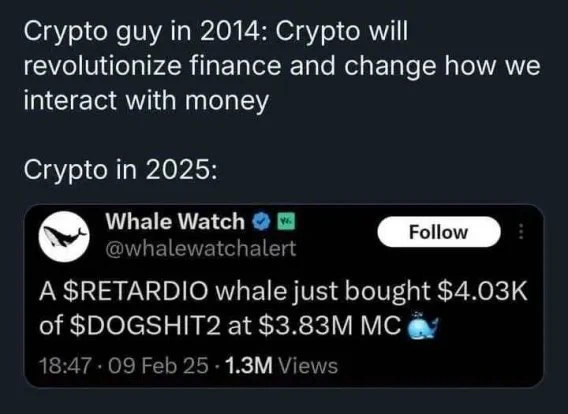
Now the meme shows “Crypto in 2025” as a starkly different reality – and it’s played for laughs. Instead of serious financial revolution news, we see a fake Twitter-style post from an account called “Whale Watch.” It announces: “A $RETARDIO whale just bought $4.03K of $DOGSHIT2 at $3.83M MC 🐋” – accompanied by a whale emoji and showing it got 1.3 million views. Let’s break that down, because it’s full of crypto slang and humor:

  • Whale: In crypto lingo, a “whale” is an investor who holds a huge amount of a cryptocurrency. Just like a whale in the ocean causes big waves, a crypto whale can make big splashes in the market – for example, by buying or selling large quantities that can push prices up or down. People watch whales because following their moves can sometimes be profitable (or at least exciting!). There are Twitter bots and accounts that literally track large transactions and label them as “whale alerts.” Here, Whale Watch is parodying those accounts.

  • $4.03K: This means $4,030 USD worth of something. It’s the amount the whale supposedly bought. Now, $4k is actually not that huge – certainly not what we’d expect a “whale” to be dealing with. (Often, whales move millions.) That’s part of the joke: calling someone who spent $4k a whale is kind of absurd, implying either the market is so small that $4k is big, or it’s exaggerating for hype.

  • $RETARDIO and $DOGSHIT2: These are the ticker symbols (like stock symbols) for two cryptocurrencies – and yes, they’re intentionally ridiculous and crude names. In crypto, projects often have short tickers with a $ sign (e.g., Bitcoin is $BTC, Ethereum is $ETH). Here, $RETARDIO and $DOGSHIT2 are fictional, offensive joke names. They’re styled to poke fun at real memecoins. For instance, there really have been token names referencing silly or profane things – often to get attention. “Dogshit2” clearly is a play on the fact that we even have a second version of “dog sh**” as a coin. It’s humorously implying that after things like Dogecoin (a real meme coin themed after a dog), even more brazen copycats came along. The use of an offensive slur in “RETARDIO” is to underline how low-effort or trollish some coin names can be (for context, the word it’s playing on is a derogatory term – here it’s used to illustrate that even such a name might exist in the wild west of crypto). In short, these names scream: “this is not a serious project.”

  • bought ... at $3.83M MC: The “MC” here stands for Market Cap, which means market capitalization. Market cap is the total value of all the coins in circulation. If a coin has a price of $1 and there are 1 million coins, the market cap is $1 million. So for $DOGSHIT2, a $3.83M MC means all the Dogshit2 coins combined are worth $3.83 million at that moment. That is tiny in the world of finance (by comparison, Bitcoin’s market cap is in the hundreds of billions). Mentioning the market cap is something crypto watchers do to gauge the size or potential of a coin — a low market cap can mean it’s new or small (and potentially could grow big or vanish to zero). In the tweet, saying someone bought into Dogshit2 when it’s at $3.83M MC is highlighting how small and speculative this coin is. It’s like saying, “Hey, this whale got in on this micro-scale coin early, maybe hoping it moons (surges in value).”

  • 🐋 Emoji: That whale emoji is just reinforcing that it’s about a whale. Crypto tweets often use emojis for flair, e.g., rocket 🚀 for “to the moon” or diamond 💎 for “strong hands.” The whale emoji signifies a big player. It adds to the tongue-in-cheek tone here.

  • 1.3M views: On platforms like Twitter (now X), you can see how many people viewed a tweet. This line shows the tweet is very widely seen (1.3 million is a lot of views!). The implication is that a huge number of people are paying attention to this trivial piece of news. That’s part of the satire: so many eyes on something as silly as Dogshit2 whale movements. It hints that by 2025, the crypto world is obsessed with this kind of content.

So, putting it together: Instead of headlines about banks adopting blockchain or citizens using crypto to save on remittances, the “crypto news” in 2025 (as imagined by the meme) is a viral post about a big holder (whale) buying a small amount ($4k) of a joke coin (Dogshit2) that’s worth $3.8M in total – which is basically like a penny stock. It’s a bit like if the future of finance turned out to be watching and gossiping about a rich guy making a bet on a lottery ticket. The humor comes from the huge disconnect between what was promised and what actually interests people.

For someone newer to tech or crypto, a few terms and concepts here might need a bit more explanation. Let’s clarify them:

  • Blockchain: This is the foundational technology behind cryptocurrencies. Think of a blockchain as a distributed ledger or database that is shared across many computers (nodes). Every time a transaction (like “Alice sends 1 Bitcoin to Bob”) happens, it’s recorded in a “block” along with other transactions. These blocks are linked (chained) in chronological order, and each block has a cryptographic link to the previous one. This makes the ledger very tamper-resistant – you can’t alter an old record without breaking the chain on everyone’s copy. In simple terms, a blockchain lets a network of strangers agree on the state of transactions without needing to trust a central authority. This was revolutionary for enabling cryptocurrency.

  • Cryptocurrency: A form of digital money that uses cryptography for security and typically runs on a blockchain. Bitcoin was the first successful cryptocurrency, and now there are thousands. Each crypto is essentially a token or coin in its own network. Crypto can be used to transfer value online, kind of like sending an email, but securely and (ideally) without intermediaries. People often also treat crypto as an investment asset. In the meme, Bitcoin isn’t mentioned by name, but it’s implied since Bitcoin and early cryptos were the ones expected to change finance. By 2025, aside from major ones like Bitcoin or Ethereum, there’s a whole zoo of other cryptos – some serious, many not.

  • Whale (in crypto): As mentioned, a whale is a big holder. For example, someone who owns 5% of all a coin’s supply or can buy huge amounts without flinching might be called a whale. When you see “whale alert” posts, they usually indicate significant transactions, like coins moving to an exchange (could mean the whale might sell) or a big buy that might pump the price. Traders like to follow whales somewhat like how small fish follow a big shark, hoping to grab leftovers or ride the wave.

  • Memecoin: This refers to a cryptocurrency that’s inspired by an internet meme or some joke, rather than a serious business case or technology innovation. The most famous example is Dogecoin, which started in 2013 as a joke referencing the “Doge” Shiba Inu dog meme. Unexpectedly, Dogecoin gained a huge following and real value (partly because memes spread easily and create communities). A memecoin typically doesn’t have much intrinsic utility – its value comes from people on the internet buying into the joke or hype. Often memecoins have silly or cartoonish branding, huge token supplies (like trillions of coins), and they thrive on social media buzz. By 2025, there have been countless memecoins (some examples: Shiba Inu coin, Pepe coin, etc.), many of which had wild short-term price surges and crashes. Dogshit2 in the meme is a parody name but is totally in line with this trend of absurd meme-based coins.

  • “Shitcoin”: Pardon the language, but this is an actual slang term in crypto circles! It’s a derogatory label for a coin that is considered worthless or scammy – basically, lacking any legitimate project or value behind it. Often, any memecoin or failed project coin gets called a shitcoin. People joke that during hype times, their portfolios turn into “a pile of shitcoins.” In the meme, using a name like Dogshit2 is a direct nod to that term – it’s self-branded as a shitcoin. So we have a shitcoin about dog poop… it’s very meta-humor. Shitcoin humor is common on tech forums where devs poke fun at the ridiculous tokens out there.

  • Market Cap (MC): As explained, short for market capitalization. This metric = (price of one coin) × (total number of coins in circulation). It gives a sense of the size or value of the network. Bitcoin’s market cap is huge (hundreds of billions USD), meaning it’s widely held and traded, and presumably has significant value. A small cap (like a few million) suggests a highly speculative, niche coin that could be easily manipulated. People often use market cap to compare crypto projects or to say “this one still has room to grow (or crash).” In context, mentioning the market cap in that tweet makes it sound like news – e.g., “at $3.83M MC” is a detail you’d include if you were, say, an analyst talking about the coin’s status. But here it’s included almost to mock how small this big news really is.

Now, why is this funny and what’s the message for a newcomer? It’s basically pointing out how far off the mark the crypto future ended up, compared to early hopes. If you’re a junior developer or just a tech follower: imagine you read all the exciting stuff about blockchain in 2014, maybe even learned some crypto programming hoping to change the world. Come 2025, you open Twitter and the trending crypto news is stuff like “Whale buys Dogshit coin.” You’d probably have a laugh and maybe a sigh: so this is what it’s come to! The meme is that laugh-sigh in picture form.

It’s also a bit of a cautionary tale about hype cycles in tech. Early on, there’s idealism; later, reality might take a strange turn. In the crypto industry, after years of roller-coaster speculation, a lot of developers have grown skeptical of grand claims. They’ve seen projects promise moons and deliver basically nothing or devolve into scams. So this meme’s exaggeration resonates — it captures that feeling of “the big revolution became kind of a joke.” It’s said with humor, but also a hint of disappointment that many techies can relate to.

In short, Level 2 takeaways:

  • 2014 expectation: Crypto (with blockchain tech) was supposed to seriously transform finance, making it more open, fair, and technologically advanced.
  • 2025 reality (as joked here): Crypto news looks like random big players buying goofy-named coins, and everyone getting excited over essentially nonsense. The focus seems to be on speculative meme tokens rather than world-changing applications.

For someone learning about this now: yes, crypto is still full of innovation and serious stuff, but you should know it also has this wildly speculative, often absurd side. This meme is shining a light on that gap in a humorous way. It’s almost like an inside joke among developers: “We were promised a high-tech financial utopia, but what we got were whale alerts for shitcoins.”

Level 3: Satoshi to Shitcoins

Crypto guy in 2014: “Crypto will revolutionize finance and change how we interact with money.”
Crypto in 2025: A $RETARDIO whale just bought $4.03K of $DOGSHIT2 at $3.83M MC 🐋

This meme lands its punchline by setting up a decade-long expectation vs reality scenario. In 2014, the typical crypto enthusiast (let’s imagine a passionate Bitcoin early adopter or blockchain developer) was brimming with utopian optimism. This was the era when folks at meetups and conferences earnestly proclaimed that blockchain tech and cryptocurrency would upend traditional banking, empower the unbanked, and create a new, fair financial system. Remember, 2014 was not long after Bitcoin’s first big peak and the rise of altcoins; it’s around when Ethereum was being invented to extend crypto beyond currency. The sentiment “Crypto will revolutionize finance” was widespread among tech visionaries and investors riding the BlockchainHype wave. They envisioned everyday people using crypto for payments, smart contracts replacing legal paperwork, and perhaps even the end of centralized banks – basically a financial revolution on par with the internet’s impact on information. This was the IndustryTrends_Hype phase: lofty promises, whitepapers everywhere, and TED talks about how cryptocurrency and distributed ledgers would solve almost every problem (from remittances to supply chain trust).

Fast-forward to the “Crypto in 2025” reality that the meme humorously presents: instead of a well-oiled decentralized financial utopia, we have Whale Watch tweets about someone buying a few thousand dollars of a coin literally named $DOGSHIT2. 😅 The IndustrySatire here is razor-sharp. It’s highlighting how a technology that was supposed to professionalize and revolutionize finance has, in practice, spawned a circus of memecoins and hype-driven silliness. The text of the fake tweet reads like pure shitcoin humor: $RETARDIO and $DOGSHIT2 are intentionally outrageous names. They sound like parody, but the joke is that they’re totally plausible in the current crypto ecosystem where we’ve seen tokens called things like $DOGE, $SHIB, $PEPE, and even more profane variants. By 2025, it seems the CryptocurrencyTrends have shifted from serious fintech innovation to a game of who can create the most absurdly named token and still attract speculators.

The term “whale” in that tweet is critical to the humor. In crypto jargon a whale is a big investor with enough capital to make waves in the market (just as a whale in the ocean makes a splash). Whale accounts and whale alerts have become a staple of crypto trading culture: entire Twitter accounts and bots (like the parody “Whale Watch” here) are dedicated to tracking large trades. Originally, these alerts were for serious assets – say, someone moving 5,000 BTC ($\sim$ a small fortune) could hint at market-moving news. But now we’re apparently monitoring whales buying $4.03K (just four thousand dollars!) of some fringe token. That’s like an insignificant trade in any respectable market – yet it’s presented as breaking news to 1.3 million viewers. This is a brilliant jab at the meme culture that has infiltrated crypto finance: even trivial transactions on joke assets get hyped if they feed into the speculation frenzy. It suggests that by 2025, the signal-to-noise ratio in crypto is so low that people obsess over any “🐋 whale” movements, even if the whale is more of a guppy by traditional standards. The IndustryIrony is palpable: once we dreamed of institutional adoption and meaningful volume, now we’re cheering that some degen (“degenerate” speculative trader) aped in with a few grand on “Dogshit 2.”

Why is this so funny (and a bit tragic) to developers and tech leaders? Because it rings too true. Many of us have lived through multiple crypto hype cycles. We remember the serious talks about decentralizing finance – and we also watched as speculative mania took over. The meme distills a feeling of disillusionment: “Is this what all that innovative effort amounted to?” It’s engineers and idealists shaking their heads (with a smirk) at how the noble goals got drowned in shitcoin churn. It’s a form of communal catharsis and IndustrySatire – laughing so we don’t cry about the state of things. By exaggerating with coins like “RETARDIO” (a deliberately offensive name that underscores the immaturity in the space) and “DOGSHIT2” (implying even the second version of dog sh*t is a coin now), the meme calls out how low the bar has sunk. There’s an unwritten shared experience being referenced: those of us who were in the trenches coding blockchain solutions or advocating for crypto in 2014 have all had that facepalm moment around 2025 where we see headlines about some memecoin market pump or an Elon Musk tweet about Dogecoin and think, “What happened to the revolution?”

Real-world scenarios underpinning this meme are abundant. Take the DeFi speculation boom of 2020-2021: decentralized finance did enable amazing things (like anyone providing liquidity or getting a loan with crypto collateral), but it also enabled insane casino-like behavior. People created tokens with names of absurdity (often dog-related or outright vulgar) and thanks to platforms like Uniswap, these tokens could go from launch to millions in market cap overnight purely on hype. There were indeed Twitter bots announcing whenever someone made a big purchase of these tokens – exactly like the Whale Watch tweet in the meme. For example, during the height of the memecoin market frenzy, you’d see messages like “🐋 A whale just bought 100 billion SHIB” or “Somebody spent $50,000 on [ridiculous token name] – new ATH (All Time High)!” The meme’s fictional alert of $4.03K on a $3.83M market cap is poking fun at how tiny these markets often are. A $3.83M market cap means the entire value of all DOGSHIT2 in circulation is under $4 million – pocket change in global finance. Yet crypto communities will obsess over it as if it’s Apple or Google stock. The humor isn’t just that the names are crude; it’s also in the scale mismatch: after all the talk of crypto transforming trillions in finance, we’re excited about a few thousand bucks moving around in some micro-cap token with a whale emoji slapped on it.

The meme also alludes to a loss of direction: “Crypto in 2025” has arguably devolved into a hunt for the next joke that might moon (slang for skyrocketing in price). Serious developers often gripe that meaningful projects (like improving payment infrastructure or building decentralized identity systems) get overshadowed by whatever coin has the funniest meme or the loudest army of shillers on Reddit and Twitter. It’s a classic IndustrySatire scenario: the clownish outcome overshadowing the original mission, much like if a research lab invented the laser for surgery and the world ended up mostly using it for laser tag. The tweet’s tone (“🐋 just bought ... at $3.83M MC”) mimics real whale alert tweets, down to the whale emoji and exact formatting, which gives it authenticity. That makes it funnier because on first glance a crypto-savvy person might think it’s a real screenshot – and then do a double-take at the token names. It’s a layered joke for those in the know: we chuckle at the names, then maybe sigh because it’s plausible this could be real given the absurd listings we’ve seen on sites like CoinGecko or Binance Smart Chain’s trending tokens.

From an industry perspective, this contrast highlights how cryptocurrency trends often diverge from the original intent due to human nature and incentives. The meme essentially says: we promised a high-minded FinTech revolution, but what we got was a memecoin casino. Why does this keep happening, and why is it hard to fix? Part of it is the permissionless design of crypto. Anyone with some coding knowledge can deploy a new token contract – there’s no review board or regulator to say “no, you can’t create $DOGSHIT2, that name is ridiculous and you have no business model.” In a way, that’s the point of crypto: no gatekeepers. But it also means the floodgates are open for scams, jokes, and everything in between. The crypto community itself, especially new entrants, often chase quick profits. If something like Dogecoin went 100x because it was funny and got meme traction, the incentive is there for others to launch even sillier coins to replicate that success. It’s a classic greater fool scenario combined with FOMO (Fear Of Missing Out): rationality takes a backseat. Even smart people can end up speculating on nonsense because they don’t want to miss the next big pump – “maybe this ridiculously named token will be the next 1000x, who cares if it has no real use.” The result? A cycle where BlockchainHype and serious development continue in one stream, but the loudest noise in the room is about “whale alerts” and meme coins pumping, because that’s what draws eyeballs and adrenaline.

On top of that, consider the role of social media and meme culture. The crypto revolution was supposed to be about tech, but it’s been hijacked by Twitter and Reddit culture to a large extent. Memes are powerful — Dogecoin’s success was largely a meme success. By 2025, we have entire subcultures (think r/WallStreetBets-style but crypto-focused, sometimes called “SatoshiStreetBets”) where the humor and meme-worthiness of a coin can matter more than its tech. This creates an environment where a coin named $DOGSHIT2 can actually gain traction precisely because it’s outrageous (people share it as a joke, which ironically increases its notoriety and possibly its price). MemeCulture has become intertwined with investment for a subset of crypto users, turning markets into part amusement, part gambling. The meme we’re analyzing is an example of TechHumor shining a light on that reality: it’s an insider joke by developers who feel like they’re watching the inmates run the asylum at times. It’s funny because it’s true enough to sting.

We can practically feel the eye-roll of a cynical veteran developer reading that Whale Watch tweet. Perhaps they were there in 2014, explaining Bitcoin’s merits to dismissive bankers, and now in 2025 they get notifications about “$RETARDIO whale buys.” The shared understanding is, yeah, this industry often ends up like this. It’s reminiscent of other tech hype cycles: remember how the internet was going to bring about world peace and understanding? By the mid-2000s, that idealism looked quaint in the face of pop-up ads and doge memes. Similarly, the grand talk of financial revolution has met the messy reality of human behavior. The meme’s humor has that bite of “we’ve seen this before”. In fact, historically, finance has always had periods of irrational exuberance – be it the Tulip Mania in the 1600s or the Dot-com bubble in 1999. Crypto is no different; it’s just finance with a jetpack of technology and a global always-online community.

To sum up why this meme resonates: it’s an industry parody compressing a decade of crypto evolution (or devolution) into one image. It captures the disillusionment and dark comedy felt by technologists: the revolutionary train didn’t quite derail, but it arrived at a very goofy station. By showing the literally profane names of tokens and a relatively paltry trade being trumpeted as big news, it satirizes the excessive hype and lack of substance in the current crypto scene. This is both a laugh at the absurdity and a knowing nod – an acknowledgment that technology alone can’t dictate purpose. The Blockchain did its job; humans just chose to Flood the memepool (pun intended). The meme is effectively winking at us: remember when we thought this tech would change the world? Turns out, it mostly changed how fast people can pump and dump joke assets. It’s funny, it’s sad, and it’s a scenario so real that many devs could reply with the meme-ish phrase: “welp, this is fine 🔥🐕.”

In case the point wasn’t clear, here’s a tongue-in-cheek comparison of the crypto ideal vs the crypto reality depicted:

2014 Crypto Vision 2025 Crypto Reality
Decentralized global currency for all 🌍 Thousands of memecoins traded like joke collectibles 😂
Trustless systems to eliminate banks 🏦 Trusting Whale Watch tweets and FOMO alerts 🐋📢
Financial inclusion for the unbanked 🙌 Get-rich-quick schemes for the already online 💸
Serious fintech innovation (smart contracts, DeFi) 🚀 Outlandish tokens named $DOGSHIT2 dominate meme culture 🐶💩

This table encapsulates the comedic disparity the meme is pointing out. In 2014, keywords were decentralization, trustless, inclusion, and genuine innovation. In 2025, the buzz is around memes, whales, and quick profit. It’s an IndustrySatire scorecard that tech folks will read and chuckle at – perhaps a bit uncomfortably – because we recognize our beloved revolution in the left column and the circus it became in the right column. The meme holds up this mirror with a sly grin, and the reflection is both hilarious and sobering.

Level 4: Proof-of-Work vs Proof-of-Joke

At the core of this darkly funny meme lies a contrast between blockchain’s elegant theory and its messy reality. Back in the early 2010s, cryptographers and distributed systems experts were celebrating breakthroughs like Bitcoin’s Proof-of-Work consensus. This algorithm solved a classic academic problem – the Byzantine Generals Problem – by allowing a decentralized network to agree on a single ledger without trusting any central authority. In theory, this was revolutionary: a trustless system where mathematics and cryptography (think SHA-256 hashes and digital signatures) guaranteed the integrity of transactions. Bitcoin’s blockchain design uses a chain of cryptographic hashes (Merkle trees linking blocks of transactions) to make an append-only, tamper-evident ledger across thousands of nodes. It was a beautiful union of game theory and computer science – miners compete to solve cryptographic puzzles, securing the network in exchange for rewards, aligning everyone’s incentives by design. This was the revolutionize finance part: no more central banks or gatekeepers; code and math would let anyone be their own bank.

As the field advanced, new consensus mechanisms like Proof-of-Stake and refined Byzantine Fault Tolerant algorithms (PBFT, Raft, etc.) emerged, addressing efficiency and scalability. Platforms like Ethereum introduced smart contracts, essentially programs stored on the blockchain that execute exactly as written, enabling complex financial instruments and DeFi (Decentralized Finance) protocols. Academically, everything seemed poised to change how we interact with money at a fundamental level. Researchers debated formal verification of smart contracts, zero-knowledge proofs for privacy, and novel tokenomics models to create stable, self-governing digital economies. The 2014 crypto idealists weren’t just fantasizing – they were extrapolating from very real technical innovations that promised a more democratized and transparent financial system. Underlying it all were serious cryptographic primitives (like elliptic curve signatures, cryptographic hash functions) and distributed consensus guarantees: double-spend protection, censorship resistance, and mathematically provable scarcity (e.g. Bitcoin’s 21 million supply cap enforced by code). The expectation was that by 2025, these fundamentals would underpin a new era of global finance – perhaps borderless payments, automated escrow, algorithmic governance – fulfilling the lofty goals written in all those whitepapers.

However, here’s where the IndustryIrony kicks in: the trustless technology solved the problem of “who verifies transactions?” but not “what will people do with this freedom?” The permissionless nature of blockchain means anyone can participate and innovate – or, as it turns out, unleash a flood of memecoins and dubious schemes. The protocols don’t discriminate between a transfer that feeds a child or one that funds a pointless token named DOGSHIT2. A distributed ledger will faithfully record both with the same rigor. In a theoretical sense, the system is working perfectly: it treats all actors equally and enforces the rules consistently. But that very neutrality is why silly and irrational uses can thrive alongside noble ones. It’s a bit like a perfectly balanced multiplayer game: the physics are sound, but players might just use it to do donuts in the parking lot. Blockchain technology doesn’t imbue transactions with meaning or value – it only guarantees they execute correctly and securely. This meme cleverly exposes that gap between technological capability and human behavior. On paper, by 2025 we’ve achieved things like eventual consistency at global scale and robust cryptographic security for digital assets. Yet those advances are being applied to track and trade joke tokens about dog poop. It’s as if we used a space-grade laser to carve memes into toast: an absurd mismatch of tool and task.

The reference to a whale buying a memecoin is more than just internet humor – it’s highlighting a kind of emergent phenomenon that no amount of theoretical foresight fully captured. The pioneers solved how to remove banks from the equation, but removing gatekeepers also removed filters on human speculative frenzy. In game theory terms, the Nash equilibrium of an open crypto market doesn’t reliably lead to rational investment in utility; it often leads to greater fool games (everyone speculating that someone else will pay more for a valueless token). This is reminiscent of past economic bubbles – something even classical economics or complexity theory grapples with – but now supercharged by frictionless digital markets. The Byzantine fault-tolerant networks ensure the ledger’s correctness but cannot ensure the sanity of what’s being recorded. Essentially, the crypto ledger will reach consensus on nonsense too, if that’s what people throw at it. The meme’s fictional token names like $RETARDIO and $DOGSHIT2 (intentionally crude and offensive) underscore this point: no amount of encryption or consensus algorithms can prevent people from collectively assigning value to nonsense. The lofty cryptographic revolution has, in practice, given equal footing to shitposting-as-a-currency.

From a theoretical lens, it’s a fascinating outcome. Some might even call it a failure mode of the technology’s social layer. We’ve built censorship-resistant platforms that treat a $4 million charity endowment and a $4K joke token pump with the same indifference. The smart contracts that enable complex derivatives and decentralized exchanges will just as happily facilitate the creation of DOGSHIT2 tokens overnight – the code to create a new ERC-20 token is trivial, a few dozen lines at most, no gatekeepers required. All the formal verification and auditing in the world doesn’t apply when the entire purpose of the contract is essentially “exist, be tradeable, and maybe burn 2% on each transfer for hype.” In other words, the system’s neutrality is both its strength and its comedy. The meme nails this by juxtaposing the high-minded 2014 proclamation with a 2025 Whale Watch tweet that’s effectively noise dressed as news. It’s a reminder that technical revolutions don’t always pan out in the intended direction: sometimes the distributed, trustless future arrives right on time, but with doge memes dog memes and crypto whale alerts as its headline act. It’s a proof-of-concept of a different sort – call it Proof-of-Joke – where the consensus is that people will always find a way to turn even the most groundbreaking infrastructure into a playground for absurdity.

Description

A two-part meme contrasting the past and present of cryptocurrency. The top text reads, 'Crypto guy in 2014: Crypto will revolutionize finance and change how we interact with money.' Below this optimistic statement, a second line reads, 'Crypto in 2025:'. This is followed by a screenshot of a tweet from the account 'Whale Watch' (@whalewatchalert). The tweet, dated Feb 09, 2025, reports, 'A $RETARDIO whale just bought $4.03K of $DOGSHIT2 at $3.83M MC'. The meme uses the expectation vs. reality format to satirize the evolution of the cryptocurrency space. The humor comes from the stark juxtaposition of the original, world-changing ambitions of crypto with the current landscape, which is often characterized by highly speculative and absurdly named 'meme coins' or 'shitcoins'. For experienced tech professionals, this reflects a common cynicism about how a promising technology has been largely dominated by speculative gambling and hype rather than substantive innovation
Comments

16
Anonymous ★ Top Pick Early crypto visionaries wanted to decentralize finance, but it turns out the main thing they decentralized was the ability to create tokens named after insults and bodily fluids
  1. Anonymous ★ Top Pick

    Early crypto visionaries wanted to decentralize finance, but it turns out the main thing they decentralized was the ability to create tokens named after insults and bodily fluids

  2. Anonymous

    We engineered a globally replicated, byzantine-fault-tolerant ledger so a bot can ping us at 3 a.m. with “whale bought $4K of DOGSHIT2” - proof-of-why, indeed

  3. Anonymous

    After a decade of building 'trustless Byzantine fault-tolerant consensus mechanisms,' we've successfully achieved the pinnacle of distributed computing: tracking which anonymous wallet just YOLO'd their kids' college fund into a token literally called DOGSHIT2. Satoshi's whitepaper didn't prepare us for this particular edge case in the protocol

  4. Anonymous

    From 'decentralized trustless financial infrastructure that will disrupt legacy banking systems' to tracking $4K whale movements in $DOGSHIT2 - a perfect demonstration of how every revolutionary technology eventually finds its true product-market fit: enabling people to gamble on increasingly absurd things with extra steps and higher gas fees

  5. Anonymous

    We spent a decade perfecting BFT and zk-rollups so a whale-alert bot can tweet about someone aping into DOGSHIT2 - turns out we decentralized trust, not taste

  6. Anonymous

    From Merkle trees revolutionizing finance to rooting for $DOGSHIT2 whales - blockchain's only consistent proof is of eternal hype cycles

  7. Anonymous

    Web3 in practice: an event-driven system where WhaleTweet() triggers retailLiquidity.transferFrom(bagholders); liveness proven, utility unimplemented

  8. @azizhakberdiev 1y

    Damm, that's revolutionary

    1. @hy60koshk 1y

      Cannot argue with that

  9. アレックス 1y

    >lock smart young people out of fintech with regulatory barriers >they build their own fintech >they're all like 12 so they name it shit like RETARDIO and DOGSHIT

  10. アレックス 1y

    😮

  11. @Le_o_R 1y

    I read there are like 1M new shitcoins per week. Most of them are rugpulls. People are still looking for "the next Bitcoin".

    1. @azizhakberdiev 1y

      those people don't understand even 0.1% of bitcoin

      1. @mira_the_cat 1y

        if they understood they wouldn't use BTC 😁

        1. @mira_the_cat 1y

          🎉, 🤡 without arguments

  12. Mario 1y

    MC stands for $MEGACUM

Use J and K for navigation