Skip to content
DevMeme
5973 of 7435
The Senior Developer's Art of Subtraction
Career HR Post #6542, on Feb 20, 2025 in TG

The Senior Developer's Art of Subtraction

Why is this Career HR meme funny?

Level 1: Less is More

Imagine a young kid packing their backpack for a trip. The kid is excited and tries to pack everything – every toy, every gadget, "just in case" they might need it. Now imagine a wise older traveler packing their bag. The traveler only packs the essentials and leaves out anything unnecessary. The kid ends up with a huge, heavy bag full of things they never actually use, while the experienced traveler’s bag is light and easy to carry, with nothing extra weighing them down.

This is just like the idea in our meme: the junior developer is like the kid who wants to add every piece of code they can think of, but the senior developer is like the wise traveler who knows that adding too much will just create hassle. It's funny in a friendly way because you'd expect the "expert" (the senior) to be doing more, not less. But the expert knows a secret: doing less can sometimes be smarter. In the end, the message is simple: if you avoid adding unnecessary stuff, everything goes smoother. Often, less clutter (and less code) means a much easier journey for everyone.

Level 2: Think Twice, Code Once

The meme text basically means: junior developers focus on figuring out how to write a solution, whereas senior developers focus on deciding if something needs to be written at all. In other words, an inexperienced coder might ask, "What code can I add to solve this problem?" but an experienced coder first asks, "Do I even need to add new code to solve this, or is there a simpler way?" It's highlighting a shift in mindset that comes with experience.

Let's break down some key terms and ideas from this joke:

  • YAGNI (You Ain't Gonna Need It): This is a principle that tells developers not to write code for features or scenarios that aren't necessary right now. For example, a junior might think far ahead and start coding a bunch of extra options "just in case we need them in the future." A senior will likely advise: don't add that code now because you probably ain't gonna need it. Write it later if it actually becomes needed. This keeps the project simpler.

  • Over-engineering: This means making a system more complicated than it needs to be. A junior developer might over-engineer by writing a whole new module or system for something that could have been done with a simple loop or a built-in function. Over-engineering often happens when someone is trying to anticipate future needs or just show off their coding skills, but it can backfire by creating unnecessary complexity.

  • Technical debt: This is a metaphor for the extra work we have to do later because we chose a quick or easy solution now, or because we added stuff we didn't actually need. Unnecessary code contributes to technical debt. It's like clutter in a house – eventually, you'll have to clean it up or maintain it, which is extra effort that could have been avoided by not cluttering in the first place.

  • Code quality: This refers to how clean, understandable, and maintainable the code is. Generally, less unnecessary code means better code quality because the codebase is easier to read and there's less that can go wrong. Every piece of code you add is another piece that must be tested and kept working. By writing only what's necessary, a senior developer keeps the code quality high.

In the tweet, the difference is also about developer productivity and being effective:

  • A junior might measure productivity by "How much code did I write today?"
  • A senior might measure productivity by "How much code did I not have to write to achieve the same result?" (Because if you solved a problem with 10 lines instead of 100, that's actually more efficient!)

This is a common theme in Senior vs Junior Developers humor. A new developer is often eager to prove themselves by coding a lot. They might design an elaborate solution for a problem, writing many lines or even additional features that weren't asked for. The senior developer has been through the upkeep of these kinds of over-built solutions and learned to value simplicity. They often say things like "let's start small" or "we can always add that feature later if we need it."

For example, imagine we have to process some data in "basic" mode for now. A junior developer might think: "Well, I'll code it to also handle an 'advanced' mode and a 'futureMode' in case we need those." They end up writing extra code paths for those modes, even though the project only needs the basic mode at the moment. A senior developer would likely only implement the basic mode for now. If down the line "advanced" mode is truly needed, then they will write that code when it's required. This avoids having a bunch of unused code laying around.

Here's a little pseudo-code to illustrate:

// Junior approach: handle every theoretical case up front
function processData(data, mode) {
    if (mode === 'basic') {
        return basicProcess(data);
    } else if (mode === 'advanced') {
        // 'advanced' branch isn't needed yet, but the junior adds it anyway
        return advancedProcess(data);
    } else if (mode === 'futureMode') {
        // 'futureMode' is a hypothetical feature that might never be used
        return futureProcess(data);
    }
}
// Senior approach: implement only what's needed right now
function processData(data) {
    return basicProcess(data); // support the current requirements only
}

In the junior's version above, they wrote code for "advanced" and "futureMode" that aren't actually needed at the moment. This makes the function longer and more complex for no gain (and if those features never get used, that code just sits there, potentially harboring bugs or confusion). In the senior's version, they keep it lean and straightforward: only basic processing, because that's all that's needed. This makes the code easier to read and test. If later the team really needs an advanced mode, the senior will add it when it's necessary (and by that time, they'll have a better idea of what's truly needed for "advanced" anyway).

We can summarize the mindset difference like this:

Junior Developer (novice mindset) Senior Developer (experienced mindset)
"How can I solve this by writing code?" "Can I solve this with less code or no new code?"
Adds extra features just in case. Avoids adding features until necessary (YAGNI).
Often proud of creating complex solutions. Proud of simple, elegant solutions (fewer moving parts).
Writes a lot of code to show progress. Tries to minimize code for easier maintenance.

The meme is relatable humor because many of us have gone through this transition. As a junior, you might have felt every problem needs a lot of code and clever solutions. As you gain experience, you start to realize that every extra bit of code is extra responsibility. There's an old joke: "No one has to fix bugs in code that doesn't exist." That's essentially what the senior developer in the tweet lives by. They carefully consider if some code is truly needed before writing it. This leads to cleaner, more maintainable projects.

So the tweet is pointing out a kind of wisdom in a funny way: coding isn't just about writing code, it's equally about knowing what not to write. The result is often better code quality and less headache down the road. It's a lesson in being a more effective developer: sometimes, doing less really is doing more!

Level 3: Less Code, Fewer Bugs

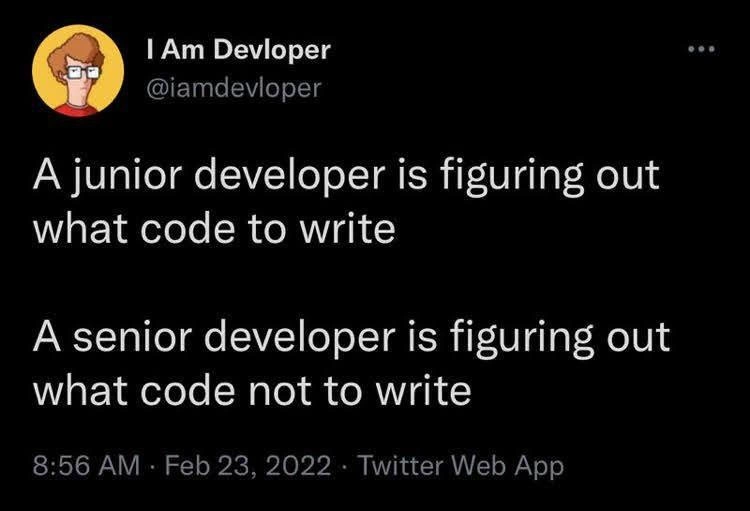
"A junior developer is figuring out what code to write..."
"A senior developer is figuring out what code not to write."

This meme makes experienced devs smile because it nails a fundamental truth of software development: experience often teaches restraint. It's humorous because it flips the script on what productivity means. A newbie coder might equate progress with churning out features and lines of code, eagerly asking "What can I add?". Meanwhile, a seasoned engineer is cautiously asking "What can I avoid adding?". The joke resonates in engineering circles because senior developers have learned that each new line of code is also a new liability.

There's a well-known adage in programming: "the best code is no code at all." That might sound counterintuitive, but experienced devs chuckle at it because they've felt the sting of maintaining unnecessary code. More code means a larger surface area for bugs, more things to maintain, and more potential for something to go wrong at 3 AM. It's a case of "less is more" applied to coding. By writing less code (only what’s truly needed), you inherently get fewer bugs, lower complexity, and easier maintenance.

This tweet highlights the YAGNI principle (short for You Ain't Gonna Need It). YAGNI comes from Extreme Programming and advises developers not to implement a feature until it's actually needed. A junior dev, full of enthusiasm, might over-engineer a solution by adding all sorts of hooks, extensions, and layers for hypothetical future requirements. They might think, "I'll just implement this extra config system or a plugin architecture now because we might need it later." The senior dev inside all of us has learned to challenge that impulse: Are we sure we'll ever need that? Probably not. YAGNI saves teams from sinking time into features that never get used. Seasoned engineers know that code written "just in case" often becomes tech debt – extra stuff you have to support or rip out later when it inevitably rots.

Another concept at play is the KISS principle ("Keep It Simple, Stupid"). Seniors prize simplicity. They've seen seemingly clever, complex codebases become unmanageable. For example, imagine a junior deciding to write a custom data caching layer or a mini framework for a small project, thinking it's a brilliant exercise of skill. A senior would likely cringe, knowing that adopting a lightweight existing solution (or sometimes no new code at all) would be safer and faster. It's funny because many of us have been that junior who wrote a fancy system from scratch, only to realize later that it was overkill. Over time, you learn that every line of code you write, you have to debug, document, and maintain. So the "senior ninja move" is often finding a way to solve a problem with as little new code as possible – maybe by reusing an existing function or simply not doing the low-priority feature at all.

This difference in mindset is a common source of developer humor because it's so relatable across the industry. We've all seen the ambitious new dev who wants to build everything from scratch, and the battle-worn senior who breaks in with a gentle "Let's hold off on that." The humor carries a bit of hard-won wisdom: it's poking fun at how real coding mastery isn't about typing more, it's about thinking more (and typing less). The senior developer isn't being lazy; they're being strategic. By not writing code today, they save themselves and their team from debugging and refactoring that code tomorrow. It's a form of developer productivity that comes from foresight: understanding that every new feature or line of code has a cost.

This "senior vs junior developers" contrast is more than just a joke — it's practically become part of developer lore. In the early days of computing, memory and processing were scarce, so developers had to be very minimalist – every instruction counted. Today we have abundant resources, so it's easy for juniors to write heaps of code without immediate consequences. But even in modern large systems, experienced devs know that bloat is dangerous. Many infamous software failures and massive maintenance headaches came from well-intentioned engineers adding too much too soon. The phrase "Don't over-engineer" is practically senior developer gospel. In fact, one of the joys for a senior is deleting code that isn't needed - it's like cleaning out clutter from a room. There's a tongue-in-cheek metric where some say a "10x developer" is someone who removes ten times more code than they write, simplifying the codebase dramatically. 😄

So, @iamdevloper's tweet is funny because it's true: part of becoming a senior developer is learning the wisdom of omission. It's recognizing that you improve code quality not just by writing well, but by not writing at all when it's not necessary. The junior vs senior contrast exaggerates it for effect, but anyone who's maintained a large codebase will nod and laugh, remembering the countless times they've said, "Let's not write that yet, we might thank ourselves later." It's a concise reminder that sometimes, the real skill in coding is knowing what not to write.

Description

A screenshot of a tweet from the popular satirical tech account 'I Am Devloper' (@iamdevloper). The tweet, set in white text on a black background, presents a concise aphorism about software development experience. It reads: 'A junior developer is figuring out what code to write', followed by a separate line, 'A senior developer is figuring out what code not to write'. This statement captures a fundamental shift in perspective that comes with experience. While junior developers focus on the immediate task of producing code to meet requirements, senior developers leverage their experience to foresee long-term consequences, such as maintenance overhead, complexity, and technical debt. Their primary focus becomes avoiding unnecessary work, simplifying solutions, and understanding that often the most valuable contribution is preventing the introduction of problematic or superfluous code
Comments

13
Anonymous ★ Top Pick A junior's first instinct is to write a microservice. A senior's first instinct is to see if the problem can be solved by deleting the legacy cron job that's causing it
  1. Anonymous ★ Top Pick

    A junior's first instinct is to write a microservice. A senior's first instinct is to see if the problem can be solved by deleting the legacy cron job that's causing it

  2. Anonymous

    Junior KPI: lines committed; Senior KPI: lines avoided - because the only bug with zero MTTR is the feature you killed in backlog grooming

  3. Anonymous

    The real 10x developer isn't the one who writes 10x more code - it's the one who prevents 10x the technical debt by knowing when that clever abstraction will become tomorrow's 'what were they thinking?' refactoring epic

  4. Anonymous

    The real senior developer move? Spending three days convincing the team that the feature request can be solved by removing code from five different microservices, updating a config flag, and writing zero new lines - then watching the junior dev's mind explode when it actually works

  5. Anonymous

    Funny thing about scalability: the only module that never wakes you at 3 a.m. is the one you convinced product not to build

  6. Anonymous

    Career path: junior writes code; senior deletes code; principal deletes the requirement - because the cheapest SLA is no service

  7. Anonymous

    Senior devs don't write code - they delete it before it haunts the next decade's poor soul oncall

  8. @einbetungzahl 1y

    A staff engineer is figuring out how much he can go without writing any code

    1. @ALaborate 1y

      middle developer is figuring out what code to delete

  9. @qtsmolcat 1y

    What if I'm figuring out what not to write by looking at what I wrote

  10. @mpolovnev 1y

    A junior HR is looking for devs to hire. A staff HR is looking for devs to fire :)

    1. @SamsonovAnton 1y

      "Perpetuum mobile cannot exist" — they said...

  11. @einbetungzahl 1y

    Engineering Manager figuring out who to blame

Use J and K for navigation