Martin Shkreli Calls the Quantum Computing Bubble
Why is this QuantumComputing meme funny?
Level 1: Shiny New Toys
Imagine a bunch of kids in a playground who get excited about a brand-new toy everyone’s talking about. Let’s say it’s the latest high-tech robot puppy. At first, everyone is convinced this robot dog is the greatest thing ever. All the kids beg their parents to buy it, and for a while, the playground is full of robot puppies. It’s like the toy has become super popular overnight. This is like a “boom” of excitement – kind of like blowing a big soap bubble where it gets bigger and bigger as more kids join in the craze.
But then something familiar happens. After a little time, the kids start realizing the robot puppy isn’t as magical as they thought. Maybe it runs out of batteries fast, or it doesn’t actually do homework like some rumors said. The excitement fades. One by one, kids lose interest and the robot puppies get left at home, maybe even tossed aside in the toy box. In the end, that super popular toy everyone had to have is just… yesterday’s news. The big bubble of excitement pops – just like a soap bubble that gets too big and suddenly bursts into soapy droplets.
Now imagine an older kid or a teacher watching this whole thing. They’ve seen many toy fads come and go over the years – from fidget spinners to trading cards – so they’re not surprised at all. In fact, they smile and maybe gently joke, “Here we go again!” They kind of knew from the start that the robot puppy craze would calm down, because it always does. Every few years there’s a new “greatest toy ever” that causes a frenzy, and every time it eventually loses its shine.
This meme is poking fun at that same pattern, but with technology companies instead of toys. Quantum computing is like the shiny new toy of the tech world right now – it’s exciting and everyone’s hyped about it, sort of how all the kids were crazy about the robot puppy. The meme jokes that, just like those other toy crazes (or past tech crazes), the excitement might end with a lot of people feeling a bit let down when things go back to normal. Seasoned folks in tech are basically the older kids nodding and saying, “Yep, we’ve seen this before.” It’s funny in a knowing way – we can laugh because we recognize the pattern of getting super excited and then calming down, whether it’s in a playground or on the stock market.
Level 2: Bubbles and Busts
So what exactly is this meme getting at? Let’s break it down in plain terms. The post is basically calling out quantum computing as the latest example of a tech hype bubble. A “bubble” is when everyone gets so excited about something – say a new technology or industry – that they invest tons of money into it, pumping its value way up (hype). But usually, the excitement overshoots reality: the real-world payoff or profit doesn’t come as fast as expected. When people finally realize that, the bubble “bursts” – values crash hard (bust). The meme humorously lists a bunch of past IndustryTrends_Hype cycles to say “Hey, we’ve seen this pattern before, and now it’s happening with quantum computing.”
Here are the examples referenced, in case you haven’t lived through them:
Dot-com Bubble (late 1990s) – Back when the internet was new, any company that had a website or a “.com” in its name was instantly worth crazy amounts of money. People thought the internet would instantly remake the world (and it did change a lot, but not everyone made money from it overnight). By 2000, many of these dotcom_flashback companies had no profits and collapsed. Stocks that were once high-flyers fell 90% or more, and many startups vanished. It was a lesson that a cool idea (like selling pet food online in 1999) wasn’t enough to justify sky-high prices.
Subprime Mortgage Crisis (mid-2000s) – This was a housing market bubble. Banks were giving out too many risky home loans (called subprime mortgages). For a while, it seemed like home prices would just keep going up forever – another form of irrational hype. But in 2007-2008, reality hit: people couldn’t pay those loans, the housing “bubble” burst, and home values plummeted. This caused a huge financial crisis. The meme mentions it to show even outside tech, speculative frenzies end badly. It’s also famous because some investors made a fortune by shorting (betting against) those housing investments – that’s depicted in the movie “The Big Short.”
3D Printing Hype (early 2010s) – There was a period when 3D printing was the buzzword. People imagined a 3D printer in every home creating anything you needed, and investors drove up the stocks of 3D printer makers. This is the 3d_printing_hype reference. But making high-quality items at home turned out less practical than hoped (at least in that timeframe). The excitement cooled off. Companies that were worth billions lost most of their value – again drops on the order of 90%. Today 3D printing is indeed useful in niches (like prototyping and custom parts), but it didn’t revolutionize everyday life as fast as the hype claimed, so the bubble investors had built burst.
Weed Stocks (late 2010s) – When cannabis started getting legalized in more places, especially Canada and some U.S. states, there was a frenzy to invest in cannabis companies (the meme’s “weed stocks” line). This wasn’t directly a tech trend, but it had a similar hype pattern. Everyone thought these companies would become insanely profitable because weed was becoming mainstream. For a while, their stock prices skyrocketed. But then competition, regulation, and plain business challenges kicked in. Many weed companies didn’t deliver big profits quickly, so their stock prices came crashing down – often losing well over 90% from the peak. Early excitement turned to disappointment, exemplifying yet another bubble that popped. The meme uses it as a cheeky comparison to say “quantum computing might go the same way – a lot of buzz, then a big crash.”
Autonomous Driving (mid-2010s) – This refers to the hype around self-driving cars. Companies like Google’s Waymo, Tesla, Uber, and a bunch of startups were racing to create fully autonomous driving systems. Investors and tech pundits were convinced that by the early 2020s we’d be routinely hailing driverless taxis or buying cars that chauffeur themselves. Money poured in and expectations were sky-high. But self-driving turned out to be a harder problem than optimistic timelines suggested. There are technical and safety challenges in handling the endless unpredictable scenarios of real roads. By the late 2010s into the early 2020s, progress slowed and several high-profile projects were dialed back or failed. For example, Uber gave up on its self-driving division, and a startup called Argo AI (backed by Ford and VW) shut down in 2022 after huge investments. In other words, the autonomous_driving_speculation bubble deflated; we still don’t have the widespread robo-taxis that were promised. The meme lists this to poke at how even “sure thing” tech bets can stall out and hammer those lofty valuations.
Now, the meme’s main target: Quantum Computing. This is the new star on the tech hype stage. QuantumComputing is a completely different approach to computing that uses quantum physics. Instead of the regular bits in your computer (which are either 0 or 1), quantum computers use qubits that can be 0 and 1 at the same time (thanks to quantum superposition). In theory, this could let them solve certain kinds of problems way faster than normal computers. For example, there’s a famous idea that a powerful quantum computer could break the encryption that secures the internet (by factoring large numbers quickly, which is normally very hard). Understandably, claims like that create a lot of buzz! Companies and governments are pouring money into quantum research, startups are popping up, and any news about a breakthrough sends stocks surging. It feels a bit like the early dot-com days, which is why some folks suspect a quantum_bubble is forming – excitement might be outpacing the actual tech.
The meme specifically says these quantum computing stocks will “drop 90-95%.” That means if a stock is $100, they think it might fall to $5 or $10 eventually – essentially a huge crash. Why such a dramatic fall? This is what usually happens when a bubble bursts. Many past bubble examples indeed saw roughly that magnitude of drop (dot-com stocks, for instance, often lost over 90% of their value after 2000). By listing those past cases, the meme-maker is implying “quantum is just like those, so watch out!” It’s a warning wrapped in a joke.
The kicker line “how and when to put the trade on – that’s up to you” is basically financial lingo. It’s like the person is saying: I’m not going to tell you exactly when to bet against these quantum companies (because timing a market crash is tricky), but I’m convinced it’s a bubble that you could profit from if you short it at the right time. In simpler terms: these stocks are gonna tank, but you have to figure out how to take advantage of that yourself. It’s a bit tongue-in-cheek, as if they’re giving out free investing advice with a wink.
For a junior developer or someone new to tech, the underlying lesson (and humor) here is about industry trends and skepticism. The tech world often has these cycles of hype. A new technology emerges, everyone says it will change the world, money flows in, stocks rocket upward – that’s the boom. But then reality sets in: maybe the tech wasn’t ready, maybe making money from it is harder than anticipated, maybe it was just a feature and not a whole industry. Then comes the bust – companies fail or downsize, stocks plummet. Eventually, the tech may slowly progress in the background (the internet did change the world after the dot-com bust, and self-driving tech is still advancing gradually), but the initial investors who paid peak prices get hurt.
This meme is TechSatire because it pokes fun at that predictable TechHypeCycle. It’s basically saying to those of us excited about quantum computing: “Cool your jets. We’ve been here before with other ‘game-changing’ ideas. Don’t be the one left holding the bag when the bubble pops.” Seasoned engineers chuckle at this because it’s a bit of an inside joke – a mix of “I’ve seen this happen multiple times” and “some people never learn.” The tags like IndustryIrony and TechHumor fit perfectly: it’s ironic how every time we collectively hype something as the next big thing, a lot of folks act as if risk and history don’t apply – until they do.
In summary, the meme uses a fake(?) tweet format to compare quantum computing’s stock surge to a greatest-hits list of recent investment fads and fiascos. By doing so, it delivers both a warning and a laugh. If you know the context, you get the joke that “quantum is Schrödinger’s cat of investments: it’s either the future or a flop, and right now it’s kinda both.” And if you didn’t know the context, well, now you see how each item on that list was once the hot thing that later fell back to earth. It’s a crash course (pun intended) in tech bubble history aimed to put today’s quantum excitement in perspective.
Level 3: Shor’s Algorithm vs Short Selling
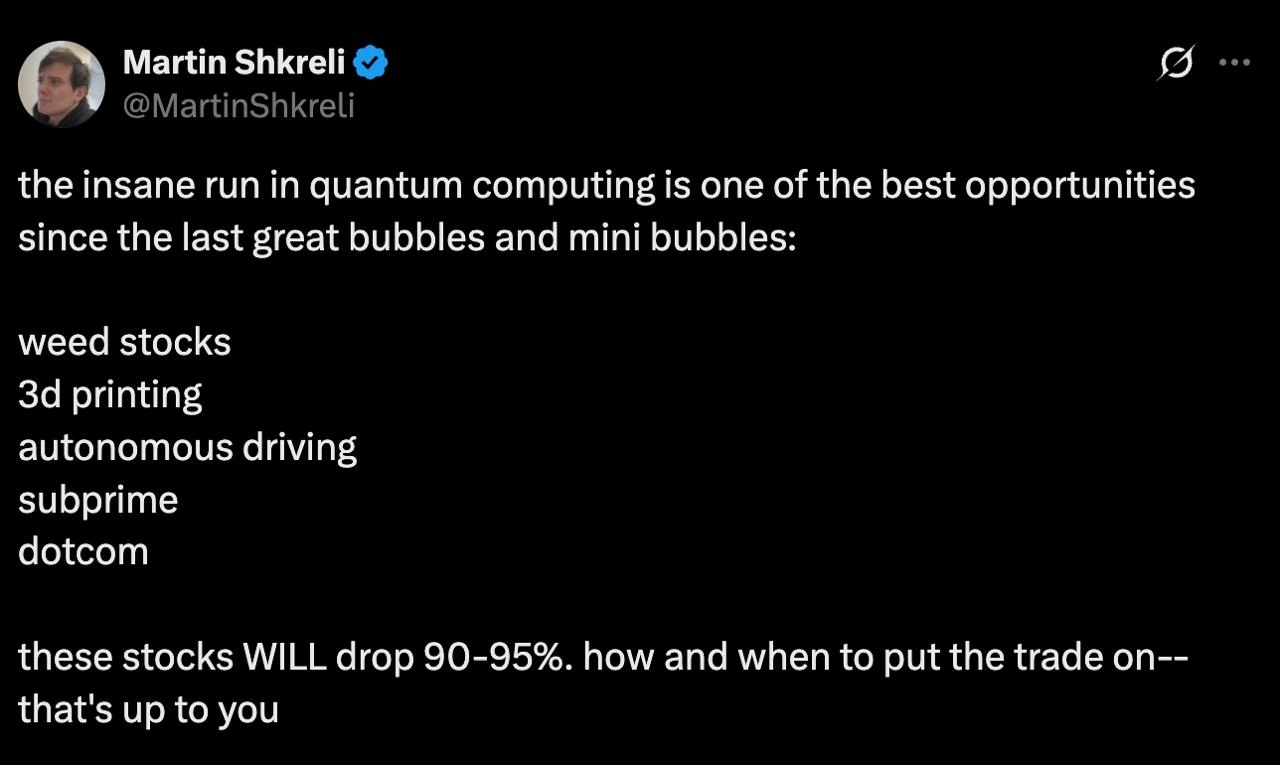
Seasoned techies can practically smell the déjà vu in this meme. It humorously suggests that the quantum computing craze is the latest chapter in a never-ending story of IndustryTrends overshooting reality. The tweet-style image explicitly name-drops past bubbles: dot-com startups, subprime mortgages, 3D printing, weed stocks, autonomous driving. If you’ve been around the block (chain) a few times, you’ll recognize those as iconic booms that went bust. The meme’s author – a verified finance-world provocateur no less – proclaims the “insane run” in quantum tech is “one of the best opportunities since the last great bubbles”. Translation: we’ve seen this movie before, and we know how it ends. It’s a cynical, knowing wink to veteran engineers and investors: get ready to short this hype.
That’s where the dark humor lies. Short selling is an investment move where you profit from a price collapse – essentially betting that today’s high-flyers will come crashing down. By likening quantum computing fever to previous manias (which all collapsed ~90% or more), the meme screams “Bubble alert!” For someone who remembers the dotcom crash of 2000, this hits like a flashback. Back then, anything with a .com in its name got crazy funding (sound familiar with today’s “quantum” rebrands?), until folks realized eyeballs don’t equal revenue. Stocks imploded spectacularly – a dotcom_flashback indeed. Fast-forward, we saw smaller mini bubbles: in the mid-2010s, 3D printing hype promised a Star Trek replicator in every home, lifting companies like 3D Systems to stratospheric valuations. When home 3D printers didn’t revolutionize everything overnight, those stocks cratered ~95%, burning investors. Around the same time, autonomous_driving_speculation had us believing we’d hail self-driving robo-taxis by 2020. Billions poured into self-driving startups and divisions. Yet as anyone stuck in traffic today can tell you, full autonomy didn’t arrive on schedule – and some self-driving ventures (Argo AI, anyone?) folded or got absorbed at fire-sale prices.
Don’t forget weed stocks circa 2018 – as legalization spread, cannabis startups were suddenly the hot investment. Many thought they’d be rolling in green (both kinds) for years. But a few disappointing earnings reports and regulatory hiccups later, that bubble went up in smoke, with big names losing over 90% of their value. Even outside tech, the meme drags in subprime – shorthand for the mid-2000s housing bubble fueled by risky mortgages. When that popped, it triggered the 2008 financial crisis. Not exactly a tech fad, but it underscores the universality of speculative folly. Importantly, subprime was immortalized in “The Big Short”, and here the meme effectively invites you to consider a “Big Short: Quantum Edition.”
All these references set the stage for an industry irony: every “next big thing” tends to follow the same tragicomic arc. Smart people, swept up by TechHypeCycle FOMO, pour money and breathless headlines into a paradigm-shifting idea – be it the internet, mortgage-backed securities, or quantum qubits – only to learn (again) that revolutions take longer than quarterly reports tolerate. As a result, many early high-flyers nosedive. Insiders with long memories can’t help but chuckle. The meme’s tone basically says: Go ahead, marvel at the quantum breakthroughs – just don’t be shocked when today’s high valuations collapse under their own weight. It’s tech satire pointing out that as radical as quantum computers are, they might not magically escape the economic gravity that humbled all those prior hypes.
We even get a sly clue in the phrase “how and when to put the trade on – that’s up to you.” This is the poster essentially nudging the reader: I’m not your financial advisor, but wink-wink, you might want to bet against these quantum stocks at the right moment. The humor is sardonic. It assumes the audience’s shared scar tissue: many veteran developers saw colleagues jump to “hot” startups that later went belly-up, or maybe even had stock options from a hype-cycle darling that expired worthless. They’ve witnessed TechSatire become tech reality too many times. So a meme like this resonates as both a cautionary tale and a schadenfreude-laced joke. It’s saying: those who cannot remember the past are doomed to repeat it – and boy, are we repeating it.
In essence, this meme is gallows humor for the tech world. It acknowledges the wild enthusiasm around QuantumComputing – research breakthroughs, jaw-dropping predictions of new supercomputers – but then gives a knowing nod to history. The IndustryIrony is rich: we have Wall Street and Silicon Valley entangled in a classic dance where quantum_bubble valuations far exceed present reality, much like Pets.com’s stock price once far exceeded any actual pet food sales. The very term “Schrödinger’s portfolio” in the title riffs on the idea that these quantum investments are simultaneously genius and foolish. Maybe one day quantum computing really will change everything (some Plateau of Productivity eventually), but many of today’s overhyped ventures could be effectively dead money long before then. The meme’s senior-level insight: technologies can be revolutionary and overhyped at the same time. Knowing that saves you a lot of heartbreak – or, for the shrewd, it’s an opportunity to profit from the inevitable pop. As the saying goes, “history doesn’t repeat, but it often rhymes,” and in the tech industry, the rhyme scheme is looking very familiar.
Level 4: Entangled Expectations
At the cutting edge of Quantum Computing, hype and reality exist in a kind of superposition. On one hand, the theoretical foundations are mind-blowing: qubits leveraging superposition can explore many states at once, and entanglement links particles with spooky coordination Einstein himself called “spukhafte Fernwirkung”. These principles enable algorithms like Shor’s algorithm (which can factor huge numbers exponentially faster than classical methods) and Grover’s algorithm (speeding up search). In theory, such quantum breakthroughs could upend cryptography and computing as we know it. It’s no wonder investors are seeing quantum startups as Schrödinger’s golden goose.
However, the practical challenges are enormous. Real qubits are finicky; they decohere (lose their quantum state) in microseconds unless kept in ultra-stable, near-absolute-zero environments. Scaling from a lab demo to a useful quantum computer means fighting physics at every step: error rates, noise, the No-Cloning Theorem (which forbids copying arbitrary quantum states) – all impose harsh limits. To factor a 2048-bit RSA key using Shor’s algorithm, you’d likely need thousands of stable, error-corrected qubits. Today, even the best quantum hardware has only tens of high-quality qubits with error-correction overhead pushing logical qubit counts into the thousands. In short, there’s a cosmic gulf between quantum’s promise and quantum’s present.
This gulf is fertile ground for a TechHypeCycle. In Gartner’s terms, quantum tech is cresting the Peak of Inflated Expectations – magical results are anticipated any day now, fueling frenetic speculation. Yet the Trough of Disillusionment may loom when those results prove slower to materialize (because physics doesn’t bend to quarterly earnings). The meme’s core joke taps into this dynamic: it posits that today’s quantum bubble is like previous tech bubbles, where valuations soared on shimmering promises before gravity – and thermodynamics – brought them back to earth. In a sense, we have a Schrödinger’s portfolio: right now quantum computing companies are both the next trillion-dollar giants and massively overvalued duds, and only time (the observer, in quantum parlance) will collapse that wavefunction. It’s an uncertainty principle of markets – until real profits or breakthroughs are observed, their fate is indeterminate.
Description
A screenshot of a tweet from the controversial financial figure Martin Shkreli (@MartinShkreli). The tweet, presented as white text on a black background, offers a cynical financial prediction. Shkreli states, 'the insane run in quantum computing is one of the best opportunities since the last great bubbles and mini bubbles:'. He then lists several past investment bubbles: 'weed stocks', '3d printing', 'autonomous driving', 'subprime', and 'dotcom'. The tweet concludes with a bold prediction: 'these stocks WILL drop 90-95%. how and when to put the trade on-- that's up to you'. This post resonates with experienced tech professionals who have witnessed numerous technology hype cycles. Shkreli's financial analysis mirrors the technical skepticism of senior engineers who understand the vast chasm between a technology's theoretical promise and its practical, profitable implementation, affirming the view that quantum computing, despite its potential, is currently in a phase of speculative overvaluation

Comments
14Comment deleted
A quantum stock is in a superposition of being both worthless and massively overvalued until you observe its first quarterly earnings report, at which point it collapses into the 'worthless' state
Quantum stocks are in superposition: they’re both funding your Series C and bankrupting your 401(k) until the market observes a recession
Ah yes, quantum computing stocks - simultaneously worth billions and worthless until you observe your portfolio, at which point the wavefunction collapses along with your 401k. At least with the dotcom bubble we got some decent infrastructure out of it
Ah yes, quantum computing stocks - where the value exists in a superposition of 'revolutionary breakthrough' and 'vaporware' until an auditor observes the balance sheet, at which point the wave function collapses to zero. At least with the dotcom bubble, you could actually ping the servers before they went bankrupt
Quantum stocks: entangled in superposition of hype until the market measures them, collapsing 90% like a qubit in Shkreli's crosshairs
Every time the CFO asks if we’re “doing quantum,” I note our SLOs are higher than a NISQ device’s gate fidelity - and suggest buying puts until the surface code ships
Valuing NISQ startups is simple: one logical qubit needs around a million physical qubits - apply that error‑correction multiplier to revenue and the chart collapses 95%
Is there any applications of quantum computing other than breaking encryption? If not, we already have CloudFlare and Databrokers for that. Comment deleted
Dont listen to that fucking retard. He's one of dudes talking about insane opportunities since time immemorial His finance videos back in the day were good tho Comment deleted
I'm not, but also quantum researches I know ghosted me, so 🤷♂ Comment deleted
well it doesn't just lower the complexity of cryptographic algorithms, it can be applied to all sorts of problems, most of which we're not even aware of yet. Problem is that the physical side of things seems just as hard as the computational benefit it would provide. Stuff like the big conditional Z gate in oracle functions for Grover's algorithm are way too ideal, even for as few bits as 10-20. Generally the theory doesn't match up to practice but I don't know, I'm just some CS student and internet yapper Comment deleted
:) Comment deleted
I don't know much about quantum computing but it seems we're just solving one very difficult problem to be able to solve / lower the complexity of other very difficult problems Comment deleted
In 2017, Shkreli was convicted in federal court on two counts of securities fraud and one count of conspiracy. He was sentenced to seven years in prison and up to $7.4 million in fines. In the civil antitrust case, Shkreli was fined a further $64.6 million to be repaid to victims. In May 2022, he was released early from the low-security federal prison in Allenwood, Pennsylvania. He is permanently banned from serving as an officer of any publicly traded company. https://en.wikipedia.org/wiki/Martin_Shkreli Comment deleted