Skip to content
DevMeme
6209 of 7435
The Ultimate Escape from 'I Hope This Email Finds You Well'
MentalHealth Post #6807, on May 23, 2025 in TG

The Ultimate Escape from 'I Hope This Email Finds You Well'

Why is this MentalHealth meme funny?

Level 1: Email Hide-and-Seek

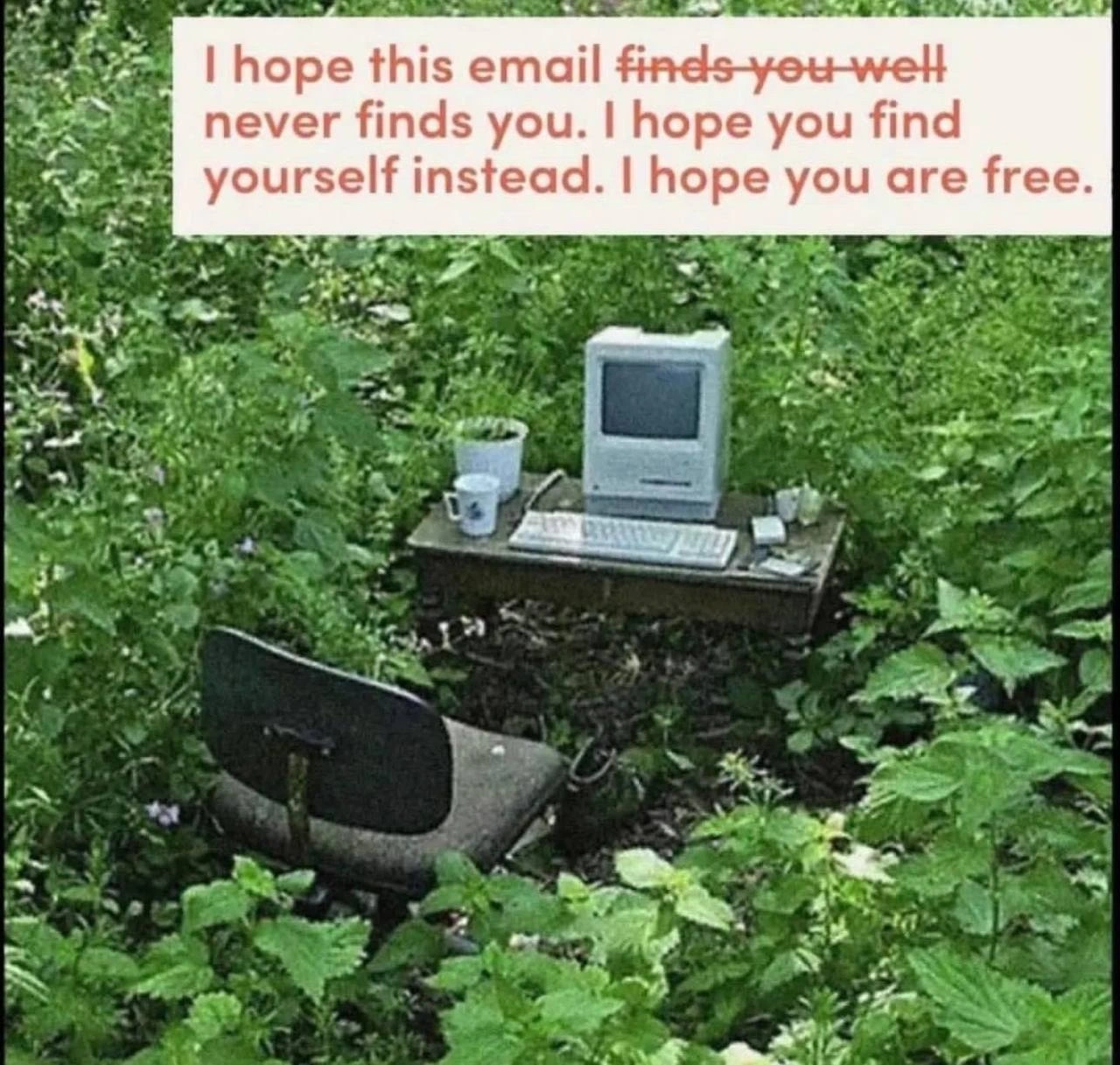
Imagine you’re getting so many messages from school or chores from your parents that you feel completely fed up. This picture is like a funny daydream of running away so that no more messages can reach you. It’s as if someone took their whole office desk – computer, chair, coffee cup and all – and plopped it down in the middle of a forest to hide from the world. There’s a big phrase at the top that says, “I hope this email never finds you. I hope you find yourself instead. I hope you are free.” That’s basically like saying, “I hope these work messages never catch up with you. I hope you’re out there discovering who you are and feeling free.” It’s a warm wish for someone to be happy far away from work stress. The reason this is funny is the silly picture that goes with it: nobody actually drags a computer into the woods to escape emails! But imagining it can make us smile. It’s like playing hide-and-seek with your responsibilities. Think of the email as a friend who’s “It” in hide-and-seek, and the person has found the best hiding spot ever – so good that the email will never find them. We all know how peaceful it feels to hide in a quiet spot during hide-and-seek, hoping not to be found. This meme gives that same feeling with work emails. It’s saying the person would rather listen to birds and wind in the trees than the ding of a new email. In simple terms, it’s a joke about wanting a break. Just like sometimes you might hide to avoid doing homework for a little while, here a grown-up is jokingly “hiding” in nature to avoid work messages. The overall emotion is happy and freeing – it makes you think of running outside to play and leaving your phone or computer behind. Even if we can’t really abandon our responsibilities forever, the idea of a peaceful escape where no one can bug you for a bit is a fun, relatable fantasy.

Level 2: Forest Mode On (No Wi-Fi)

Let’s break down the meme in simpler terms. The top text is playing with a very common email greeting: “I hope this email finds you well.” That’s the polite phrase people often start work emails with. Here, the meme maker changes it to say “I hope this email never finds you. I hope you find yourself instead. I hope you are free.” In plain English, that means the sender actually doesn’t want the email to reach the other person at all! They’re saying they’d rather the person be out enjoying life and discovering themselves instead of being bothered by an email. It’s a good-natured twist – basically wishing someone freedom from work messages. This strikes a chord in tech circles because it’s the opposite of our everyday reality: usually we’re drowning in messages and emails. Seeing someone openly wish “I hope you never even see this email” is funny and liberating. It’s like a friend telling you, “Forget that inbox, go have a life!” Instead of the usual formal communication, the tone here is almost poetic and rebellious. That alone sets the stage for the meme’s theme of escape from constant Email and office chatter.

Now, look at the image below that text: it shows a small workstation set up in the wilderness. There’s a tiny wooden table placed among dense green plants and bushes. On the table is a very old beige Macintosh computer (one of those boxy Apple desktop machines from the late 1980s or early 90s), along with a keyboard, a mouse, a coffee mug, and even a little potted plant. In front of the desk is an empty office chair, the kind you’d normally see in a cubicle, but here it’s sitting on forest ground! The whole scene is like someone took their entire office desk and just dropped it in the middle of the woods. There are no cables connected to that Mac (and honestly, that model of Mac is so old it probably couldn’t connect to modern Wi-Fi anyway). Clearly, this setup isn’t actually functional for real work – and that’s the joke. It visually says: “I’m doing my job out here in nature, totally disconnected from the world.” Of course, if you’re in the thick of a forest with a 1980s computer, you won’t get any internet, so you won’t get any emails. That’s why they call it the “ultimate spam filter.”

Let’s clarify that term spam filter: usually, a spam filter is a program or tool that automatically catches unwanted emails (spam, like those annoying ads or phishing scams) and prevents them from clogging your inbox. But no spam filter is 100% perfect, and important emails can still flood in. This meme jokingly says the best spam filter is to not be reachable at all. In other words, no internet, no email – problem solved! It’s an extreme solution to email_overwhelm, which is the feeling of drowning in too many emails. The computer in the woods represents being completely offline, so that absolutely no new messages (spam or otherwise) can arrive.

This ties into the reality of RemoteWork life. Many of us work from home or anywhere now, using tools like email, Slack, or Microsoft Teams to stay in touch. These are examples of asynchronous communication – meaning you send a message and the other person can respond later, not instantly like a phone call. Async communication is great for working across different time zones or avoiding constant meetings. But it has a dark side: you can end up with an inbox full of unread messages each morning, because everyone was sending things while you were offline. Companies encourage this style to increase flexibility, but without limits it can become overwhelming. There’s even a popular concept called “inbox zero” – an aimed-for state where you have zero emails left unanswered in your inbox. It’s a productivity goal: you process or reply to every email so nothing lingers. In theory it helps you stay on top of communication. In practice, reaching inbox zero is really hard when dozens of new emails come every day (or every hour!). Many junior devs experience this shock when they first join a big team: one day away sick and you come back to hundreds of messages to catch up on. The meme exaggerates a solution: physically removing oneself so that the inbox stays at zero because no new mails get in. It’s like achieving inbox zero by default – if your laptop is sitting in a jungle with no network, there’s literally nothing in the inbox to deal with!

Another term from the tags is Out_of_office (OOO) auto-reply. This is a feature of email where you set a message to be sent automatically to anyone who emails you, usually when you’re on vacation or out sick. It typically says something like, “I’m out of the office and will get back to you when I return.” It’s a polite way to let people know not to expect a quick response. In this meme, going into the woods is like enabling a permanent OOO responder. The joke is that the auto-reply might as well say, “I’m unreachable – I’ve literally gone to the forest to be free, don’t bother waiting for a reply.” It’s taking the concept of being “out of office” to a comedic extreme: not just out of the office, but out of the grid entirely! One of the context tags is out_of_office_auto_reply, and indeed the meme’s text (“I hope you are free”) feels like an out-of-office message written by someone who has had enough of work. Senior engineers who’ve written many courteous OOO emails might secretly wish they could write something like this instead, telling people they’re truly gone fishing (or gone forest-bathing, in this case).

Let’s talk about that old computer – the legacy Macintosh. To younger folks, it might look like a weird box with a tiny screen. Back in the 1980s and early 90s, that was what a personal computer looked like! They were all-in-one machines with a CRT screen built in, and you saved data on floppy disks. Crucially, these old Macs did not have wireless internet. If you wanted to get online (which wasn’t common until later), you had to plug in a telephone line and use a dial-up modem that made screechy sounds. So putting a Macintosh in the woods emphasizes that this setup cannot connect to modern communication networks. It’s a symbol of a bygone era of computing, one without constant connectivity. It also adds a nostalgic touch – many senior developers grew up with machines like that, so it evokes a time when a computer was more like a typewriter or a game console: it wasn’t constantly pinging you with notifications. The presence of the ceramic mug and desk plant on the table is a cute detail too. Those are things every office worker recognizes on their own desks. Seeing them out in nature is funny because it’s so out-of-context – nobody takes their potted succulent and coffee mug camping! But here they are, as if to say, “This is my new office now, leaves and all.” This visual gag falls under CorporateHumor and RemoteWorkCulture satire. It pokes fun at the romantic idea of the “remote workspace”: sure, you can work remotely from anywhere… but if “anywhere” is literally the woods with no internet, you’re not getting any actual work done! It’s highlighting the tension between the promise of remote work (work from a cabin! work from a beach!) and the reality (you still need a good internet connection and you’re usually just at home, bombarded by messages).

Finally, the deeper message is about MentalHealth and DeveloperBurnout in the tech industry. Burnout means a state of emotional, mental, and often physical exhaustion caused by prolonged stress – and it’s unfortunately common in tech jobs where the pace is fast and the communication never stops. The meme acknowledges this by basically advocating a digital_detox. A digital detox is when you deliberately take time away from screens, email, and the internet to recharge your mind. Here, the detox isn’t just closing your laptop for an evening; it’s humorously depicted as literally putting your entire work life out in the middle of nowhere. That line “I hope you find yourself instead” is very telling. It implies that constantly being reactive to emails might make you lose sense of yourself, and stepping away can help you “find yourself.” The meme resonates with developers who have felt the stress of constant connectivity. It’s saying, “Hey, don’t let work emails control your life. You have the power to step away.” Of course, we can’t all just run off into the wild whenever we get an annoying email from our boss, but the exaggeration makes us smile and think. It’s like a friend jokingly suggesting the most hardcore solution when you complain about something – “Ugh, I have 300 unread emails.” – “Have you tried chucking your computer into a forest?” It’s funny because it’s so over-the-top, yet it highlights a real need for balance.

In summary, this meme uses a silly nature_workstation scene and a flipped email greeting to comment on RemoteWork and communication overload. It defines the ultimate “inbox_zero” as simply not being reachable at all. For a junior developer, it’s a reminder that yes, even experienced devs get overwhelmed by communication and dream of escape sometimes. It also underlines the importance of taking breaks and not feeling guilty about unplugging. The tags like MentalHealthInTech and WorkLifeBalanceTips attached to this meme show that it’s part of a larger conversation: tech workers encouraging one another to seek a healthier relationship with work, even if it’s by joking about forest hideouts. And who knows – that old Mac in the woods might not check email, but maybe it’s good for writing a personal journal or some code, distraction-free. 😄 In any case, the meme humorously assures us that wanting to disappear from your inbox now and then is a pretty normal feeling in today’s work culture.

Level 3: Green-Field Deployment

On the highest plane of developer humor, this meme delivers a pointed critique of corporate communication overload and the fantasy of ultimate escape. The top banner’s red text riffs on that tired email opener we all know: “I hope this email finds you well.” Every seasoned engineer has rolled their eyes at this phrase while skimming yet another long email thread. Here, it’s struck through and subverted into a liberating message: “I hope this email never finds you. I hope you find yourself instead. I hope you are free.” This isn’t just flowery language – it’s a battle-cry against the always-on email culture. The meme author basically says, “I don’t want this email to reach you at all; I want you off the grid, taking care of yourself.” It’s a cheeky rejection of obligatory polite formalities and an embrace of WorkLifeBalanceTips that go beyond the token advice. For a Cynical Veteran who’s seen one too many 3 A.M. production bug reports prefaced with “Hope you’re doing well,” this line drips with humorous truth. We all know the email never “finds us well” – more often it finds us tired, burned out, or neck-deep in other tasks. By wishing the email never finds you, the meme taps into that shared fantasy of being unreachable by work crises for a change. It’s an office-world twist on “Get lost, email” – literally telling the message to go astray in the wilderness.

Now, the image below the quote is a brilliant visual punchline that senior engineers especially can appreciate. We see a full 1980s-era legacy Macintosh computer setup – the béige desktop, floppy drive slot and all – perched on a tiny table in the middle of a lush forest. There’s even an office chair facing the screen, but notably no one is sitting there. It’s like a techie’s take on Walden – the dev has “gone to the woods” not to live deliberately with nature, but to deliberately dodge their email inbox. The absurdity of an outdoor office underscores the humor: this is the ultimate “remote work” scenario, where remote means truly remote, as in miles away from any Wi-Fi signal. In dev-speak, this setup is essentially an air-gapped workstation. No Ethernet, no Wi-Fi – heck, that vintage Mac likely doesn’t even know what the Internet is without a dial-up modem. Mother Nature herself becomes the sysadmin, effectively unplugging the network cable by surrounding this desk with thick bushes and trees. (One imagines a smug little squirrel chewing through the last phone line for good measure – the forest’s own spam filter as a service! 🐿️) The result? Inbox Zero, guaranteed. Not the aspirational, fleeting inbox zero you get after a Sunday evening Outlook purge – but the real deal: zero new emails because no email can physically reach you out here. It’s a digital_detox taken to comical extremes. The meme’s title nails it: “the ultimate spam filter is disappearing into the woods.” Why bother with AI-based spam detection or fiddling with Gmail rules, when you can implement the most robust filter of all – total disconnection? The entire corporate mail server could be frantically pinging your address and never get a reply. This old Mac in the wild is basically running rm -rf inbox on life.

For those of us entrenched in RemoteWorkCulture, the image also satirizes the “work from anywhere” ideal that’s been sold to modern tech workers. We’ve seen those glossy photos of a developer supposedly coding from a beach or a mountaintop, right? Well, here it’s an overgrown forest, and the machine in question is hilariously impractical – a legacy_macintosh the size of a sewing machine, tethered to nothing. It pokes fun at the idea: sure, you can work from paradise… if you bring a generator and don’t actually need internet! The empty chair is a great touch: it’s pointed away, as if the weary engineer got up and wandered off among the trees, leaving their mug and potted plant as an offering to the work gods. Senior devs recognize this daydream – who hasn’t fantasized about ghosting a chaotic project by “accidentally” losing connectivity? We joke about it in Slack: “Oops, VPN dropped, guess I’m done for the day!” Here that joke is made literal. The nature_workstation has everything except the human and the network: exactly the ingredients you need for peace and quiet. It’s as if the forest itself issued an Out_of_Office Auto-Reply on behalf of the developer: “This person has fled civilization. Your email will not be delivered. Please contact someone who still has cell reception.”

Beneath the humor, there’s a vein of painful truth: developer burnout and the yearning for relief. In modern CorporateCulture, especially in globally distributed teams, asynchronous communication via email and chat means you’re never truly “off.” You might leave your desk at 6 PM, but the emails keep coming – colleagues in another timezone, managers tossing tasks into your queue at midnight, automated Jira notifications dancing at 3 AM. The promised flexibility of async work can easily turn into a 24/7 drip of responsibilities. Any senior engineer who’s been through a product launch or a crunch period knows the dread of waking up to a email_overwhelm situation: a triple-digit unread count and a slew of “just following up” nudges. Achieving inbox_zero in that environment feels like Sisyphus pushing a boulder – clear 10 emails, 20 more roll in. Over time, this constant pressure erodes your morale. You start daydreaming about more extreme solutions – like, say, vanishing into the woods where Outlook, Slack, and even carrier pigeons can’t find you. The meme brilliantly captures that extreme daydream. It’s funny because it’s outrageous, but it’s also cathartic: it validates the feeling so many devs have but can’t act on. Instead of yet another company-sanctioned “mindfulness hour” (which usually just means an hour of more emails to catch up on later), this meme’s remedy is a full-on escape. It’s the hard reset of collaboration tools – power down the laptop, walk outside, keep walking… and keep going until the only “signal” you have is birds chirping. As a grizzled veteran might say with a smirk, “No outage on call, no P1 incident – just literally out-age in nature.”

Communication is at the heart of this satirical scene. Our industry runs on communication: design docs, stand-up notes, PR reviews, incident reports – it’s endless. When that communication becomes noise, the fantasy flips: what if we just stopped listening? Senior devs have a dark little corner of their mind that cheers at that rebellious thought. Of course, in reality you can’t just ignore all emails (unless you’re ready to get fired achieve true enlightenment). But seeing this image is a vicarious thrill. It’s a humorous reminder that we do need breaks, and sometimes we need to seriously reevaluate our relationship with work communication. The juxtaposition of a dusty old Mac and vibrant green wilderness says maybe it’s time to go outside and reclaim some sanity. It’s corporate humor with a MentalHealthInTech message: if you ever feel totally overwhelmed by the pings and dings, you’re not alone – even this old computer looks like it gave up and went on permanent OOO mode. In the end, the meme resonates on multiple levels: it lampoons the emptiness of corporate email etiquette, it applauds the primal urge to escape work stress, and it gives a knowing wink to all the coders who have fantasized about chucking their laptop out the window. RemoteWork gave us freedom to work from anywhere – this joke pushes it to say, “Great, I choose to work from nowhere at all!” The ultimate spam filter indeed: if you can’t unsubscribe from the deluge, just unsubscribe from the internet.

Description

The image displays a surreal scene of an abandoned office setup in the middle of a lush, overgrown green field. A vintage all-in-one desktop computer, reminiscent of an early Apple Macintosh, sits on a small wooden desk next to a mug and a potted plant. An old, worn-out office chair is tipped over on the ground nearby, partially consumed by the surrounding foliage. Overlaid at the top is a text box with a poignant message that reads: 'I hope this email finds you well never finds you. I hope you find yourself instead. I hope you are free.' This meme powerfully visualizes the desire to escape the relentless connectivity and pressures of modern corporate and tech culture. It subverts the empty pleasantry of a common email greeting, turning it into a sincere wish for freedom and self-discovery, a sentiment that resonates deeply with professionals, especially senior developers, who often experience burnout from the 'always-on' expectation
Comments

7
Anonymous ★ Top Pick The ultimate offboarding process: migrating your entire dev environment to /dev/null, which, it turns out, is just a peaceful field with zero connectivity
  1. Anonymous ★ Top Pick

    The ultimate offboarding process: migrating your entire dev environment to /dev/null, which, it turns out, is just a peaceful field with zero connectivity

  2. Anonymous

    Sure, the latency on this wilderness LAN is terrible - but at least the only thing pinging you here is a woodpecker

  3. Anonymous

    After 20 years of 'hoping this email finds you well,' I finally achieved inbox zero by letting the forest reclaim my desk. Turns out the best way to handle legacy systems is to let them become actual archaeological artifacts

  4. Anonymous

    When your legacy system finally achieves what every developer dreams of: complete disconnection from production, zero uptime requirements, and absolute freedom from on-call rotations. The Macintosh found enlightenment by literally touching grass - perhaps the ultimate refactoring is just letting nature handle the deprecation cycle

  5. Anonymous

    The ultimate legacy migration: from colo to compost, with perfect uptime via natural selection

  6. Anonymous

    We finally shipped a true greenfield architecture: an air‑gapped workstation with zero integrations - turns out the most reliable way to drain the email queue is to remove the transport layer

  7. Anonymous

    Finally fixed notification fatigue with an air-gapped migration plan: ship the email client to a non-routable biome and let entropy process the unsubscribe queue

Use J and K for navigation