Skip to content
DevMeme
6207 of 7435
The Inescapable Spam of Corporate Acquisitions
CorporateCulture Post #6805, on May 23, 2025 in TG

The Inescapable Spam of Corporate Acquisitions

Why is this CorporateCulture meme funny?

Level 1: Junk Mail for Everyone

Imagine the junk mail that shows up in your home mailbox – those random flyers and ads you never asked for. It doesn’t matter if you live in a tiny apartment or a huge mansion, the mailman will still deliver those unwanted flyers to you, right? In the same way, even if someone is the boss of one of the biggest companies in the world, they still get annoying spam emails. It’s funny (and a bit surprising) because you’d think being super important would stop the pesky messages – but nope! It turns out nobody is too important to avoid junk mail.

Level 2: External Means Caution

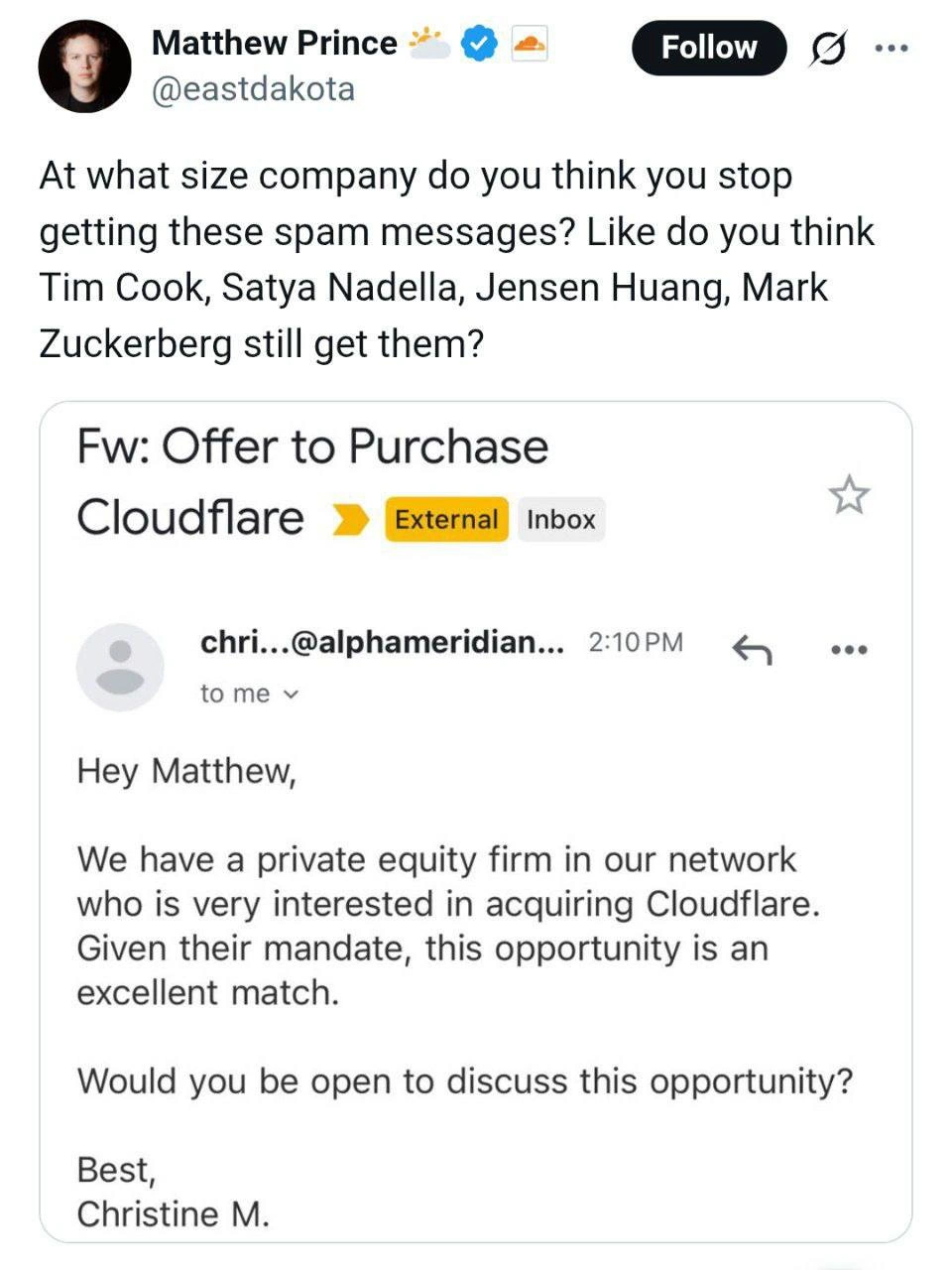
This meme highlights a real-world example of email spam reaching the very top of a company. Let’s break down what’s happening. The image is a tweet from Matthew Prince, who is the CEO of Cloudflare. (Cloudflare is a large tech company that provides internet security and performance services – think of them like bodyguards for websites, keeping bad traffic out and speeding up loading times.) In his tweet, Matthew jokes by asking: “At what size company do you stop getting these spam messages? Do folks like Tim Cook (Apple’s CEO), Satya Nadella (Microsoft’s CEO), Jensen Huang (NVIDIA’s CEO), Mark Zuckerberg (Facebook/Meta’s CEO) still get them?” He’s wondering if even the most famous tech leaders keep receiving unsolicited emails like this. The punchline is that he’s implying yes, they probably do, because here he is, running a multi-billion-dollar company, and he still gets junk messages in his inbox.

Now, what kind of email is he talking about? The screenshot below the tweet shows an email with the subject line “Fw: Offer to Purchase Cloudflare.” “Fw:” at the start of a subject stands for “Forward.” It likely means someone forwarded this email to Matthew (maybe an assistant or another team member passed it on). The email is from someone named Christine M. at some company (the address is partially hidden but looks like it starts with chri...@alphameridian...). Her message basically says: “Hey Matthew, we have a private equity firm in our network that is very interested in acquiring Cloudflare. Given their mandate, this opportunity is an excellent match. Would you be open to discussing this opportunity?” In plain terms, she’s claiming that some investment firm wants to buy Cloudflare, and she’s asking if the CEO is willing to talk about it.

This kind of message is unsolicited – Matthew didn’t ask for it, it just showed up. In email lingo, unsolicited offers like this often count as spam (unwanted junk email). Companies, especially big ones, get tons of these: random people offering deals, partnerships, investments, or services out of the blue. There’s even a tongue-in-cheek term “acquisition_spam” for those out-of-the-blue offers to buy your company that usually aren’t serious. Now, a private equity firm is basically an investment company that buys other businesses (often to try to improve them and sell them later for profit). If a private equity firm were truly interested in Cloudflare (which is a public company worth billions), they would normally go through very formal channels – they might contact Cloudflare’s board of directors or use investment bankers. It definitely wouldn’t start with a casual email to the CEO from someone he’s never heard of. That’s why this email comes off as either a clueless cold-call or possibly something sneaky (like a scam). It’s a bit like getting a message from a stranger saying, “Hey, I want to buy your entire house, want to chat?” – most people would find that sketchy if it came out of nowhere.

One thing that stands out in the email screenshot is the bright yellow label that says “External” next to the subject. Many organizations add an external email banner or tag to any message that comes in from outside their company’s domain. For example, if the email isn’t from an @cloudflare.com address (Cloudflare’s own domain), the system will mark it as external. This is a security measure. It instantly tells the reader, “Hey, this email came from outside our company. Be cautious.” It’s especially useful to prevent phishing – that’s when someone sends a fake email to trick you into giving up sensitive information or doing something you shouldn’t. In big companies, employees are trained to be extra careful with emails marked "External," especially if those emails ask for something important or unusual. So when Matthew sees that yellow External tag, it’s a big reminder: this message is from an outsider, and he should have his guard up.

Now, you might wonder, “Don’t CEOs have filters or assistants so they never see this stuff?” Large companies do use spam filters and other email tools to manage the huge volume of incoming messages. A spam filter automatically tries to detect junk or malicious emails and will divert those to a spam/junk folder. These filters look for known bad senders, suspicious phrases, or weird formatting. However, they’re not perfect. Their job is to block bad emails without accidentally blocking the legitimate ones. If a message looks professional and comes from an address that isn’t on any blacklist, it might sneak through. In this case, Christine’s email is written in a very normal business tone – she addresses him by first name, speaks about a business opportunity, and doesn’t include obvious spam keywords or links. There’s nothing immediately “spammy” like ALL-CAPS or weird $$$ signs. So the email filtering system likely treated it as potentially legitimate business mail, and it wound up in Matthew’s regular inbox rather than the spam folder.

From a new developer’s perspective (or anyone new to office life), it’s eye-opening that nobody is immune to spam, not even top executives. In fact, the more high-profile you are, the more likely your contact info finds its way into various databases or lists, and the more random people will try to reach out. CEOs and other big leaders often have to deal with lots of incoming communication. Part of their job (or their assistant’s job) is sorting out what’s important and what’s trash. We usually talk about them managing stakeholders – meaning clients, partners, investors, etc. – but a side effect is they also have to weed out the non-stakeholders who are just wasting time. It’s a bit ironic: you’d think being very important comes with a bubble to protect you from everyday nuisances, but here we see that even a CEO has to glance at a ridiculous “can we buy your company?” email and decide to ignore it.

So the core of the joke is: the CEO of a huge tech company is chuckling (and slightly groaning) that he still gets those cheesy “Can we buy you?” emails in his inbox. It’s funny because you’d assume at his level this annoyance would disappear – but it hasn’t. It’s a reminder that spam is the great equalizer in the digital world. Whether you’re a beginner just getting your first email account or you’re literally running a major corporation, you’ll have to deal with some junk messages. Everyone finds them annoying, and seeing that even a billionaire CEO deals with the same problem is both relatable and absurd at the same time.

Level 3: Spam at Scale

Picture this: you’re the CEO of a multi-billion dollar tech firm (say, Cloudflare, with a global network and a hefty market cap) and yet you open your inbox to find essentially a cold-call email reading, “We’d like to buy your company.” It’s absurd and hilarious — akin to someone cold-emailing Tim Cook offering to purchase Apple, or pinging Satya Nadella on a random Tuesday about “an excellent match” to acquire Microsoft. The meme hits on the CorporateCulture reality that no matter how high you climb, you never graduate beyond the reach of spam and unsolicited pitches. In fact, success can paint an even bigger target on your back. Every tech professional with a public-facing role knows the drill: announce a promotion or a big product launch, and suddenly your inbox gets flooded with random partnership offers, recruiter queries, and sometimes outright scams. It’s communication chaos at scale — a constant background noise of opportunists and automated email blasts that become part of your daily routine and even your stakeholder management.

What’s being satirized here is the naive idea that at some company_size_threshold, spam just stops. Matthew Prince (the co-founder and CEO of Cloudflare) is poking fun at this notion by wondering if industry titans like Cook, Nadella, Jensen Huang, or Mark Zuckerberg have somehow ascended to a spam-free existence. These guys run companies so large, you’d think they have force fields around their email. But clearly, even they might still be getting these cringe-worthy “offer to purchase” messages. The humor is in the disconnect: multi-billion dollar public companies aren’t sold via a random External email from a Christine M. at “alphameridian…”. Serious acquisition talks involve investment banks, board meetings, and lawyers — not a one-liner email with a suspiciously generic pitch. Yet here it is, sitting in the CEO’s inbox, complete with Gmail slapping an "External" warning label on it like a bright yellow sticky note screaming, "Stranger Danger!"

For veteran IT folks, there’s a knowing smirk here: we’ve configured those external email banners and SpamFiltering rules, and we preach SecurityAwareness to employees ad nauseam. (Because the last thing you want is Bob in Accounting wiring money to someone who just pretended to be the CEO in an email.) By policy, any message that originates outside the company – especially one broaching sensitive topics like an acquisition – gets flagged. Cloudflare’s mail system, as shown in the screenshot, dutifully adds that "[External]" tag (often even a little shield icon) to drive the point home. It’s a necessary paranoia in large organizations: assume any unexpected message is potentially a con until proven legit.

And oh, the sheer audacity of these acquisition spam emails! This isn’t your usual "Hello friend, I have a business proposal" scam with obvious red flags. It’s dressed up in business-casual language: “private equity firm… very interested… excellent match.” If you work in tech long enough, you recognize this tone. It’s the email equivalent of those unsolicited LinkedIn messages where a stranger, overly cordial, tries to get a foot in the door. Maybe it’s a legit-but-clueless brokerage fishing for a bite; maybe it’s outright phishing – a ploy to get the CEO on the hook and then reel them into something shady. Either way, it triggers an eye-roll from the experienced crowd: Here we go again, another bit of junk we have to mentally triage.

There’s an implied nod to the spam filter whack-a-mole game, too. We like to think our filters and firewalls are smart enough to catch anything truly ridiculous. And yet, if an email is just plausible enough – say, a politely worded M&A inquiry – it might slip past the automated nets because, technically, it could be real. (After all, big companies do acquire smaller ones through brokers on occasion, so you can’t just auto-block every note mentioning “acquiring”.) This is the perpetual annoyance for senior engineers and IT admins: balancing false positives vs. false negatives. Clamp down too hard and you might toss a genuine opportunity into the trash; keep things too open and, well, even your CEO ends up reading spam about selling the company he built. It’s a classic lose-lose scenario, played for laughs here because Matthew Prince is basically saying, “Seriously, even I can’t filter this junk out?”

The shared experience that makes this meme resonate is that everyone in tech, from junior devs to CEOs, deals with a form of this nonsense. Sure, the subject lines change – a junior developer might get emails about “exciting new career opportunities” or offers for outsourced development services, whereas the CEO gets “We have a private equity buyer for you” – but the vibe is identical. It’s unsolicited, often tone-deaf, and usually dealt with by a quick tap of the Delete key. The meme perfectly captures that weary, comedic question we’ve all had: “Does this ever stop?” And the punchline answer from the universe is, “Apparently not, even if you run one of the biggest internet infrastructure companies on the planet.”

Level 4: The Eternal Spam Conjecture

We all want to imagine there's a threshold – that at some billion-dollar market cap, unsolicited pitches magically vanish from your inbox. Spoiler alert: no such luck. At a fundamental level, email is built on open trust. The core protocol (SMTP) has no built-in notion of "company size" or "VIP immunity." If an address exists, it can be sent to – whether you're running a tiny startup or Cloudflare itself. As communication networks grow, the probability of receiving spam from somewhere approaches inevitability. In quasi-mathematical terms:

$$ P(\text{no spam from N senders}) = (1 - p)^{N} ,, $$

where p is the chance any one sender might spam you. As the pool of possible senders N grows large (which it does as your fame/size increases), $P(\text{no spam})$ approaches zero. In plain English: the bigger you are, the more inbox bait gets tossed your way, making whaling attempts a statistical certainty.

To combat this deluge, organizations deploy a gauntlet of spam filtering techniques. Classical Bayesian filters compute the probability an email is spam based on word frequency (think: "lottery" or "Nigerian prince" triggers). Modern filters layer in machine learning models, blacklists of known bad IPs, and authentication checks like SPF/DKIM/DMARC to verify the sender really is who they claim. Yet here we see the limits of that technology. The forwarded email titled “Offer to Purchase Cloudflare” is crafted to appear as legitimate business correspondence. It’s written in calm, professional language – no obvious phishing links, no misspellings, nothing that screams "bulk spam." This is by design: sophisticated spammers and opportunistic brokers have learned to evade detection by blending in with normal corporate jargon.

There’s a whole subgenre of email threats called spear phishing (targeted at specific individuals) and its top-tier cousin whaling (harpooning big CEOs and executives). These messages are the stealth bombers of spam: individually hand-crafted or at least carefully worded to slip past the automated sentries. A generic filter might catch blatant scams or virus-laden attachments, but a polite-sounding “private equity firm is interested in acquiring your company” doesn’t tick the usual alarm boxes. It might even get a pass from content filters because hey, M&A inquiries are a thing. The security system does what it can – see that bright yellow “External” banner? That’s a context clue injected by Cloudflare’s email gateway to scream “Heads up: this came from outside our castle walls!” It's an extra SecurityAwareness step, trying to compensate for the human factor: even a world-class CEO can accidentally trust a well-disguised email if they’re not reminded to stay wary.

Ultimately, there's a kind of inbox inevitability at play. The economics of spam are ruthlessly in favor of the sender: blasting out one more email costs virtually nothing, and the potential payoff (imagine actually roping in a Fortune 500 CEO) is enormous. So from an algorithmic arms-race perspective, no company is ever "too big" to target. Spam scales indefinitely, probing every possible weakness in filters and humans alike. In fact, the higher you climb, the more tempting a target you become – a paradox of success where your reward is an Inbox overflowing with the same old unsolicited nonsense, just written in a fancier tone.

Description

A screenshot of a tweet from Matthew Prince, the CEO of Cloudflare (@eastdakota). In the tweet, he humorously asks at what company size one stops receiving spam messages, wondering if prominent CEOs like Tim Cook or Satya Nadella still get them. Below his text, he includes a screenshot of an email he received. The email has the subject line 'Fw: Offer to Purchase Cloudflare' and is marked as 'External Inbox'. The body of the email is from a 'Christine M.' and pitches a serious acquisition inquiry from a private equity firm. The humor lies in the juxtaposition of a massive, multi-billion dollar business decision (acquiring Cloudflare) being initiated through a generic, unsolicited cold email, a method typically associated with low-level spam. It's a highly relatable scenario for tech professionals who are constantly inundated with low-quality recruiter and sales spam, scaled up to the CEO level

Comments

10
Anonymous ★ Top Pick Guess even when you're running a significant portion of the internet's infrastructure, your inbox is still just one rule away from treating multi-billion dollar acquisition offers as spam. Some problems don't scale
  1. Anonymous ★ Top Pick

    Guess even when you're running a significant portion of the internet's infrastructure, your inbox is still just one rule away from treating multi-billion dollar acquisition offers as spam. Some problems don't scale

  2. Anonymous

    Proof that no matter how many billions you’re worth - or how many SPF/DKIM records you publish - someone’s still going to hit your inbox with a ‘quick chat about strategic acquisition synergies.’

  3. Anonymous

    The best part about being CEO of a $20B public company? Still getting cold emails from 'private equity firms in our network' who somehow missed that Cloudflare isn't exactly a Series A startup looking for an exit. Next they'll be offering to help with our 'growth challenges' and 'scaling issues.'

  4. Anonymous

    Turns out even when you're running a company that literally protects half the internet from attacks, your inbox still can't escape Christine from 'alphameridian' and her 'excellent match' acquisition pitch. It's the one distributed system problem that scales infinitely regardless of your engineering prowess - spam finds a way, whether you're debugging kernel panics or sitting in the C-suite. At least Matthew's email has an 'External' tag; most of us just have regex-based hope and a prayer

  5. Anonymous

    We’ve hardened the mail gateway with SPF/DKIM/DMARC and zero trust - yet the most persistent attacker is a PE associate with mail merge; mitigation: subject contains ‘Offer to Purchase’ → /dev/null

  6. Anonymous

    Cloudflare's WAF blocks L7 threats at 300Tbps, but can't classify 'excellent match' PE spam as a false positive

  7. Anonymous

    You can throttle a terabit DDoS, but “Fw: Offer to Purchase” is a distributed cold‑email system with perfect DKIM and infinite retries - turns out PE outreach is O(ARR)

  8. @decide_later 1y

    Hey Matthew, I believe I am fully capable to carry the responsibilities of being the sole administrator and CEO of your huynya. Best, Nicholas B.

  9. @decide_later 1y

    (not sure if Russian memes are permitted, so the pic is smth along the lines of, "i'm ready to admin your shit")

  10. @patsany_horosh_mne_v_dm_pisat 1y

    Why don't I get spam emails, but this guys does?

Use J and K for navigation