Manual Coders Added to the Wanted List
Why is this AI ML meme funny?
Level 1: The Homemade Sandwich Gang
It is like seeing a wanted poster for people who still make sandwiches with bread, cheese, and a knife because everyone else now uses a machine that assembles lunch from a spoken request. The machine may be faster, and handmade lunch is not automatically better, but treating the old method as suspicious is absurd. What matters is whether the sandwich is safe, tastes right, and belongs to the person who ordered it—not who moved every slice into place.
Level 2: From Completion to Agent
Code generation means creating source code automatically from another input. It predates modern AI. A website framework might generate a project skeleton; a database tool might generate classes from a schema; an IDE might expand a short template into a full loop. These systems save repetitive typing through known rules.
AI coding tools add a spectrum of assistance:
| Tool behavior | Typical input | Typical output |
|---|---|---|
| Autocomplete | The code immediately before the cursor | A token, line, or short block |
| Chat assistant | A question plus selected context | Explanation, example, or proposed patch |
| Coding agent | A goal plus repository and tool access | Multi-file edits, commands, tests, and a reviewable result |
The farther a tool moves down that table, the more context and permission it may need. Context can include source code, documentation, logs, and issue descriptions. Permissions can include reading files, executing tests, or changing branches. Those capabilities make an agent useful, but they also mean teams must control secrets, untrusted instructions, destructive commands, licensing constraints, and which environments the tool may reach.
A safe beginner workflow treats generated code as a candidate, not an oracle:
- State the required behavior and constraints clearly.
- Ask for a small, inspectable change.
- Read the diff and look up anything unfamiliar.
- Run relevant tests and add cases that challenge the happy path.
- Explain the change in your own words before merging it.
Manual coding remains valuable when learning, exploring unfamiliar low-level behavior, making a tiny exact edit, working under data restrictions, or simply enjoying the craft. Assistance is valuable for repetitive transformations, navigation, scaffolding, test ideas, and rapid experiments. The meme is funny because it turns that practical choice into a moral category. The photographed group is not accused of shipping defects—only of personally pressing the keys.
Level 3: Suspects Used Keyboards
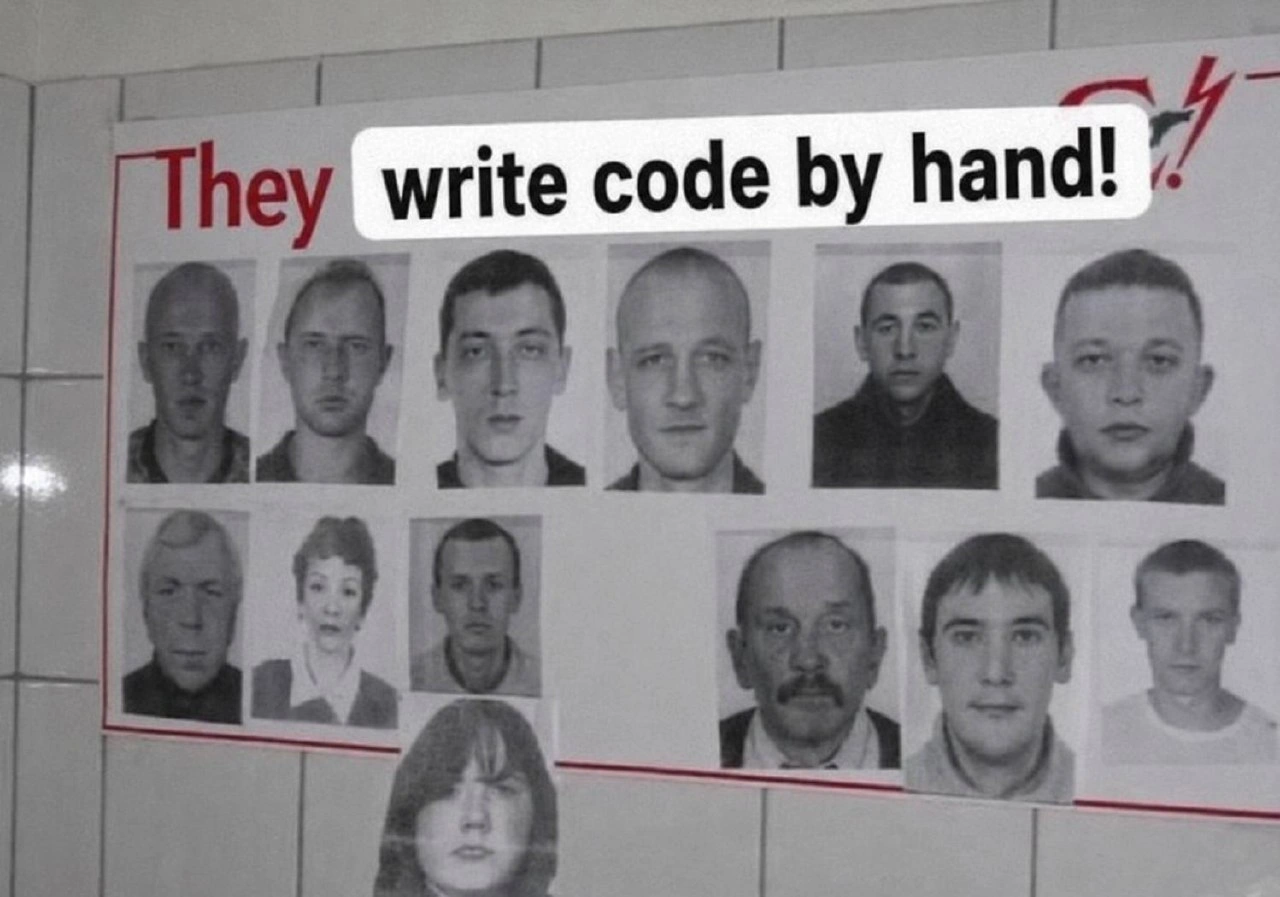
“They write code by hand!”
The red “They,” the grid of unsmiling identification photographs, and the rounded white accusation turn an ordinary development practice into a public warning. Nothing in the faces identifies a programming language, editor, or crime; the overlay alone converts these people into a suspicious class. That is the satire: AI-assisted development has been normalized so aggressively that direct authorship can be presented as deviant behavior requiring photographic evidence.
“By hand” is already a wonderfully unstable category. Most developers do not toggle machine instructions into a processor. They use compilers, standard libraries, frameworks, package managers, database mappers, IDE refactors, templates, snippets, and autocomplete. Each layer generates or supplies work that an earlier programmer might have written manually. Software history is largely the story of moving intent upward through abstractions, then complaining that the next abstraction means nobody programs anymore.
Generative coding tools do introduce a meaningful change, however. Traditional tools are usually deterministic: given the same source and configuration, a compiler or formatter should perform a specified transformation. A language-model assistant produces a probabilistic proposal from learned patterns and supplied context. An agent may go further by searching a repository, editing multiple files, running commands, observing failures, and revising its patch. The developer’s work shifts from typing every token toward specifying intent, curating context, constraining access, evaluating a diff, and deciding whether the result belongs in the system.
That makes authorship less useful than accountability. Handwritten code can be insecure nonsense; generated code can be clear and correct. In either case, someone must understand the behavior well enough to approve it, test it, operate it, and repair it under conditions the original prompt never mentioned. “The agent wrote it” is not a root-cause analysis. Production has historically declined to accept alibis.
The economic pressure behind the joke is more interesting than tool preference. Organizations can see generated patches and lines of code immediately, while maintainability, architectural coherence, incident risk, and developer understanding reveal themselves slowly. If an assistant multiplies implementation output without improving review capacity, the bottleneck moves downstream:
- More pull requests compete for experienced reviewers.
- Plausible but subtly wrong code takes longer to verify than obviously broken code.
- Repeated generated patterns can spread the same misconception across a codebase.
- Large diffs increase the chance that reviewers skim rather than reason.
- Cheap creation leaves the team with expensive maintenance inventory.
This is automation bias: people may over-trust a result because a capable system produced it, especially when the output looks polished. The opposite bias is just as lazy—rejecting sound code solely because a model helped write it. A mature workflow uses tests, static analysis, security controls, small diffs, explicit requirements, and human review to judge the artifact. The source of the keystrokes changes the risk profile, but it does not remove the need for evidence.
There is also a training problem. Writing small programs manually builds syntax fluency and, more importantly, the mental models needed to debug control flow, state, data structures, concurrency, and failure modes. Refusing all assistance forever can waste time on boilerplate; delegating everything before those models form can create a developer who can request a system but cannot interrogate it. The useful skill is not ceremonial keyboard labor. It is maintaining enough comprehension to detect when a confident patch solves the adjacent problem beautifully.
The poster format exaggerates a real cultural enforcement mechanism. Tool adoption is not driven only by capability; it is also driven by status. “I use agents” can signal modernity and velocity, while “I write code by hand” can be framed as nostalgia or resistance. The meme takes that social pressure to its logical endpoint: the remaining manual coders have been placed on a wall. Their incriminating evidence is presumably handwritten logic and an empty prompt history.
Description
A grainy photograph shows a large wanted-style poster mounted on a gray tiled wall, filled with a grid of black-and-white identification photos of men and women staring toward the camera. Red printed text at the upper left says "They," while a rounded white overlay completes the accusation in bold black letters: "write code by hand!" The police-lineup presentation treats manually authored software as suspicious behavior, satirizing a development culture in which AI assistants, autocomplete, and generated patches are becoming normal enough that unaided coding can be framed as an eccentric old practice.
Comments
1Comment deleted
The evidence was handwritten logic and an empty prompt history.